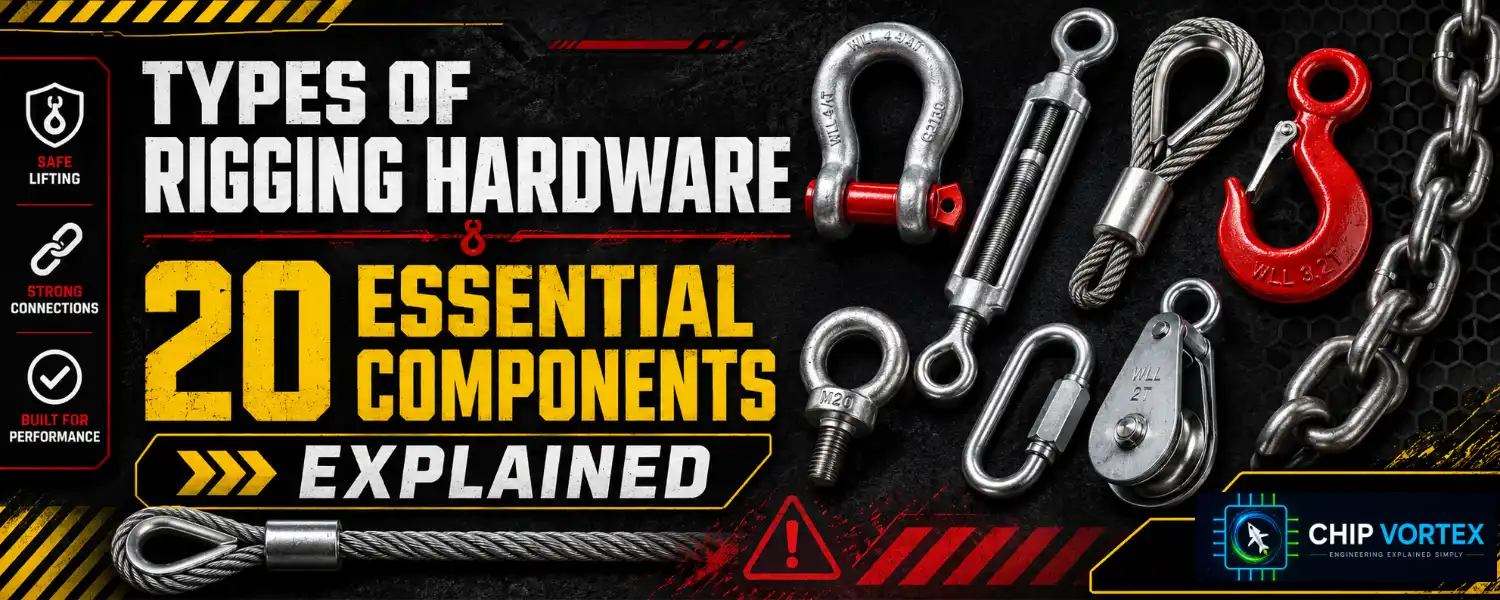
Rigging hardware is the connective tissue of every lift, tow, and tie-down — the shackles, hooks, and links that join a load to whatever is pulling or holding it. Each piece looks simple, but every one of them has a specific job, a rated limit, and a right and wrong way to use it. This guide covers the 8 categories of rigging hardware — about 20 essential components — with what each one does and the safety rules that keep loads in the air where they belong.
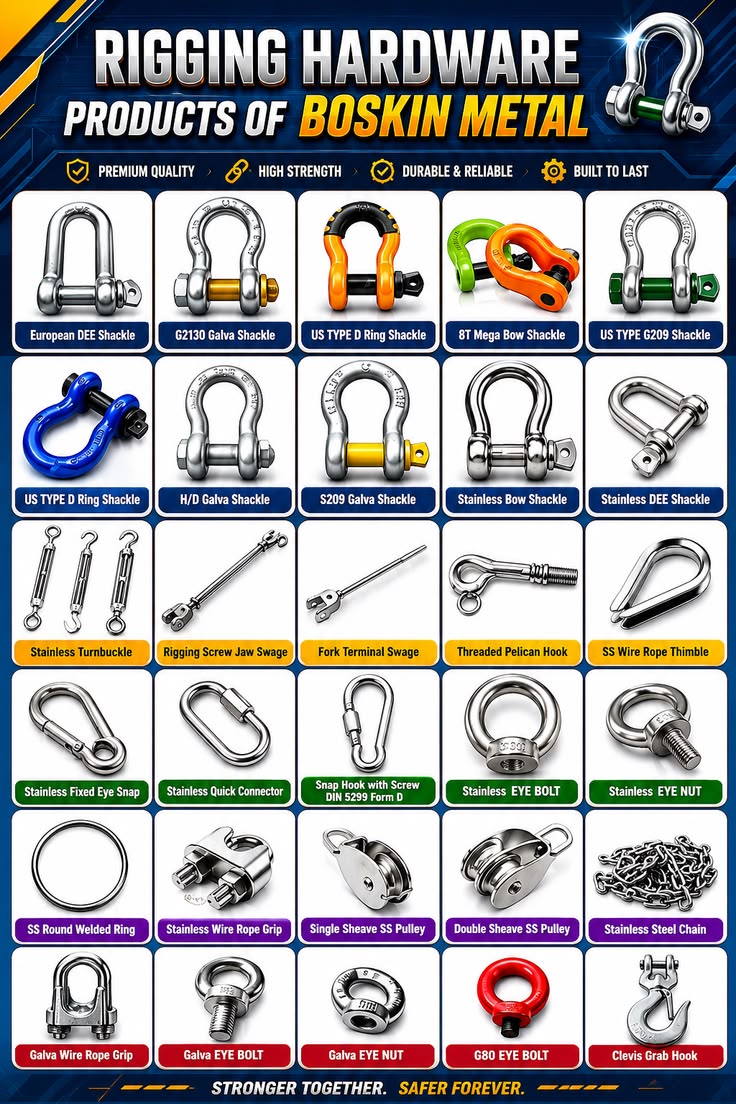
Save the chart for the workshop wall, then let’s work through each category.
Quick Reference: Rigging Hardware at a Glance
| # | Category | Key Items | Main Job |
|---|---|---|---|
| 1 | Shackles | D shackle, bow shackle, screw pin, bolt-type | Connecting loads, slings, and anchor points |
| 2 | Turnbuckles | Jaw, eye, and hook end types | Adjusting tension in cables and rods |
| 3 | Wire Rope Fittings | Thimble, rope clips, swage terminals | Forming and protecting wire rope ends |
| 4 | Hooks | Snap, pelican, clevis grab hooks | Quick connection and release |
| 5 | Eye Bolts & Eye Nuts | Plain, shouldered, eye nuts, welded rings | Creating lifting points on equipment |
| 6 | Quick Links & Connectors | Quick links, spring snap hooks | Light-duty joining and closure |
| 7 | Pulleys (Blocks) | Single and double sheave | Redirecting pull and multiplying force |
| 8 | Lifting Chain | Grade 80 / Grade 100 alloy chain | Overhead lifting and heavy pulls |
1. Shackles
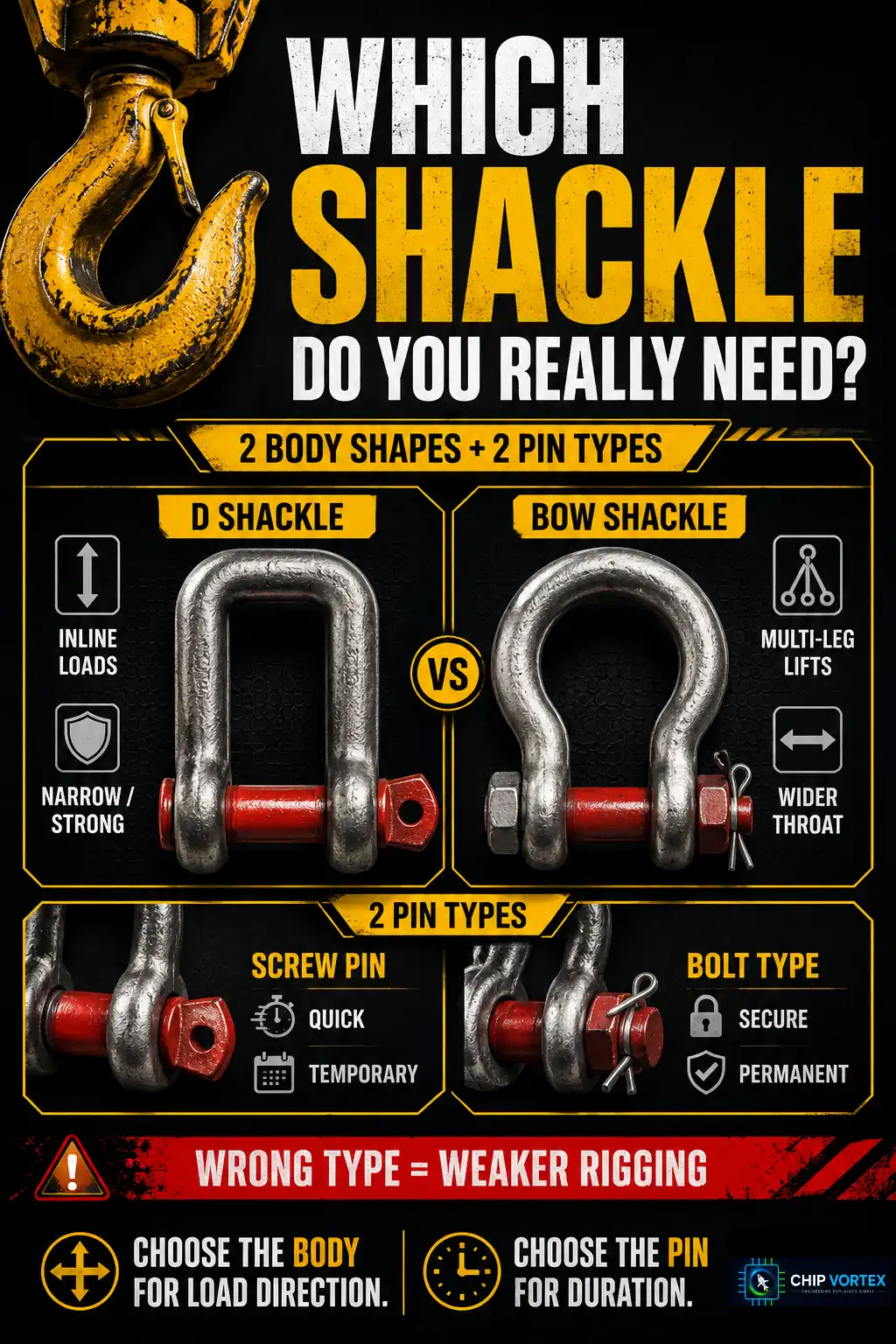
The shackle is the workhorse connector of all rigging — a U-shaped body closed by a removable pin. Two body shapes and two pin styles cover almost every situation.
D (Dee) shackle. A narrow, straight-sided loop. Its shape is strong for loads pulled in line with the body, but the narrow throat means side loads bend it — one direction of pull, done properly.
Bow (anchor) shackle. A rounded, O-shaped body with a wider throat. That extra room accepts multiple sling legs and tolerates loads from changing angles, which is why bow shackles dominate multi-leg lifts — at a slightly lower rating than a D shackle of the same pin size.
Screw pin vs bolt-type. A screw pin threads straight into the body — fast to connect and disconnect, ideal for temporary rigging. A bolt-type shackle uses a bolt, nut, and cotter pin: slower to fit, but it cannot unscrew, making it the rule for permanent installations and any connection exposed to vibration or load rotation.
Best for: Nearly every connection in rigging — choose the body for the load direction, the pin for the duration.
2. Turnbuckles (Rigging Screws)
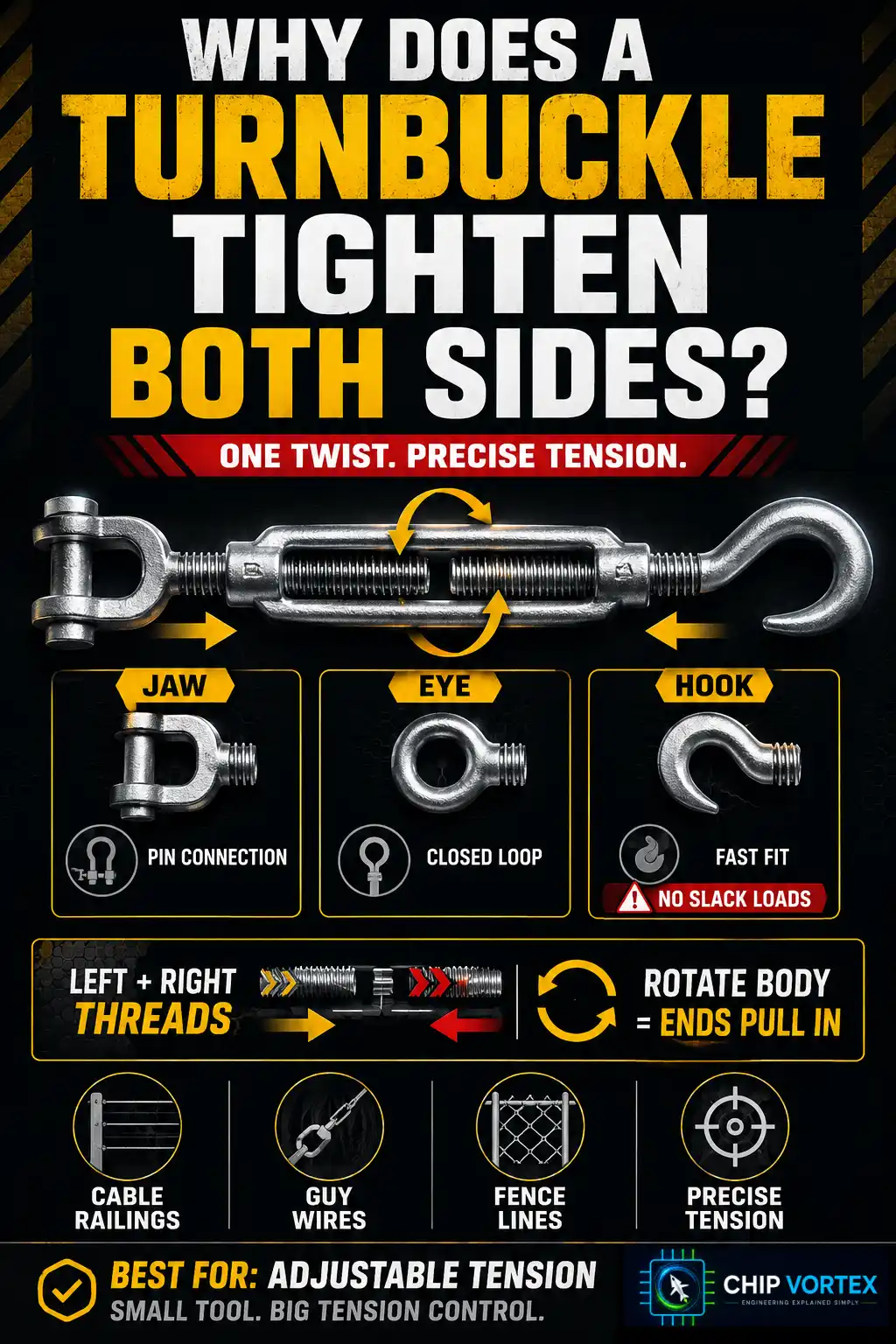
A turnbuckle is a metal frame with a threaded fitting at each end — one left-hand thread, one right-hand — so rotating the body draws both ends inward and tensions whatever they’re attached to. End fittings come in three styles you can mix: jaw (a clevis with a pin, for shackle-style connections), eye (a closed loop), and hook (fast but only for loads that can never go slack). Turnbuckles tension cable railings, guy wires, fence lines, and rigging on everything from antennas to sailboats.
Best for: Putting precise, adjustable tension into a cable or rod assembly.
3. Wire Rope Fittings
Wire rope only works as hard as its end connections. Three fittings make those ends.
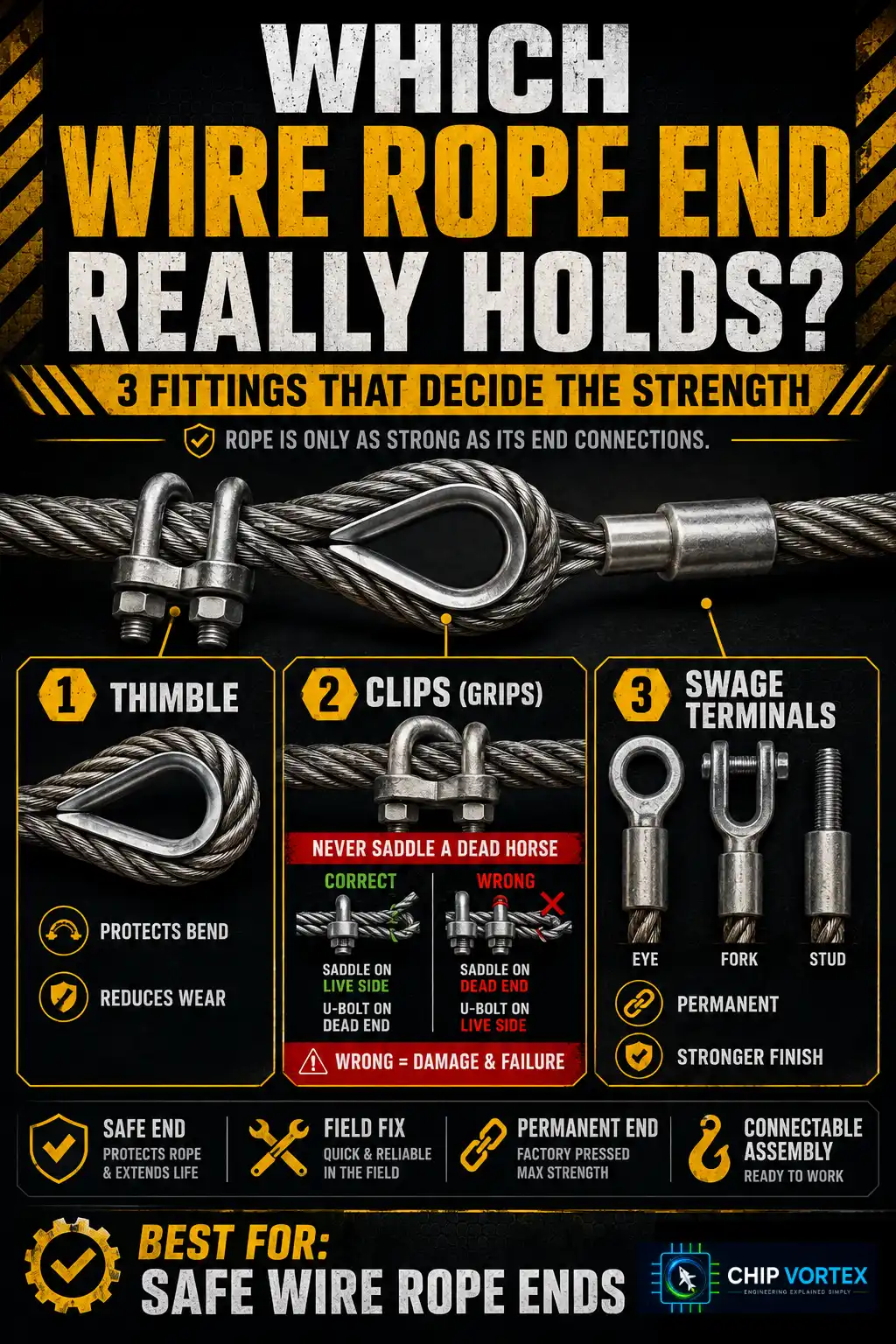
Thimble. A grooved teardrop insert that sits inside a wire rope eye, keeping the rope’s bend radius wide and protecting it from pinching and abrasion at the connection point. Cheap insurance for the life of the rope.
Wire rope clips (grips). U-bolt clamps for forming an eye in the field. They come with rigging’s most famous rule: never saddle a dead horse. The saddle (the cast base) always sits on the live, load-carrying side of the rope; the U-bolt clamps the short dead end. Reverse it and the U-bolt crushes the load-bearing strands.
Swage terminals. Permanent fittings — fork, eye, or stud ended — pressed onto the rope with a hydraulic swaging machine. Cleaner, stronger, and more reliable than clips, which is why factory-made slings and cable assemblies use swaged ends.
Best for: Turning raw wire rope into safe, connectable assemblies.
4. Hooks
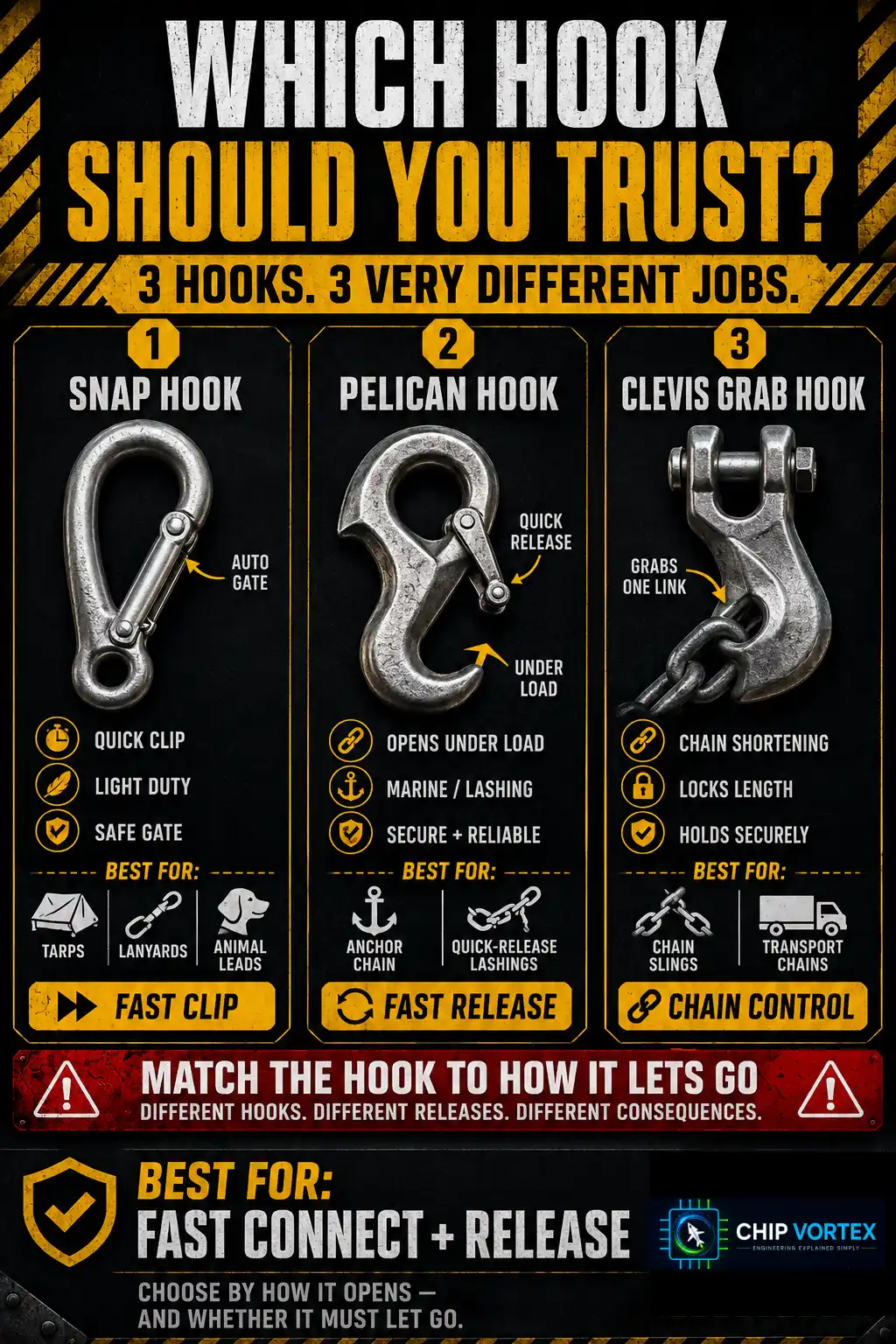
Snap hook. A hook with a spring-loaded gate that closes automatically — quick one-handed connections for light-duty jobs like tarps, lanyards, and animal leads.
Pelican hook. A hinged hook with a quick-release mechanism that can be opened under load — the reason it secures ship anchor chains and quick-release lashings where instant let-go matters.
Clevis grab hook. A narrow-throated hook sized to grip a chain link edge-on. Drop a link in and the chain is locked at that length — the standard tool for shortening chain slings and securing transport chains.
Best for: Fast connect-and-release — with each hook style matched to how (and whether) it must let go.
5. Eye Bolts & Eye Nuts
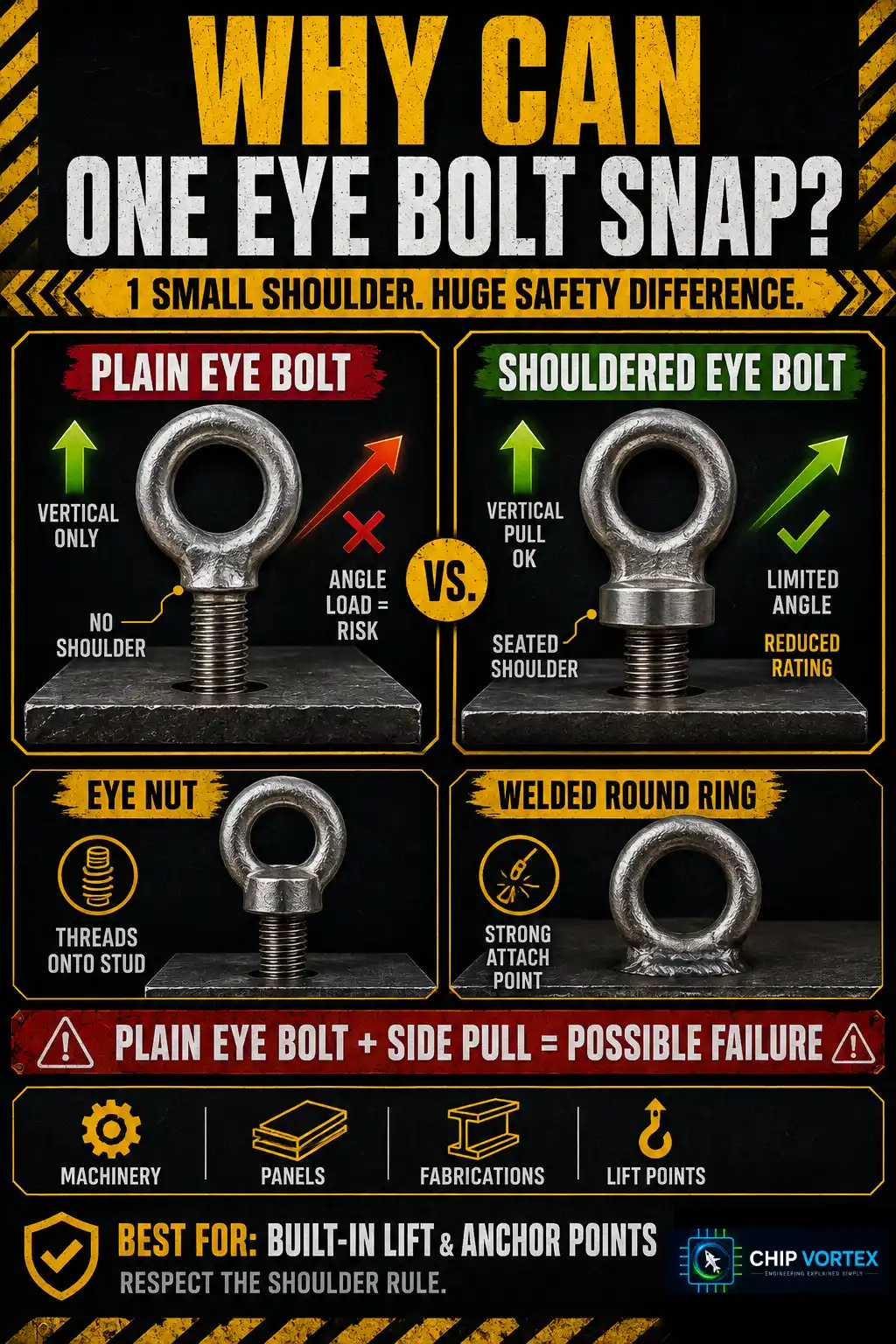
Eye bolts thread into equipment to create a lifting point, and one distinction here is genuinely critical. A plain (non-shouldered) eye bolt is rated for vertical, straight-up pulls only — load it at an angle and its capacity collapses, and it can bend or snap. A shouldered eye bolt seats a machined collar against the surface, allowing limited angular loading at reduced ratings. Eye nuts do the same job in reverse — threading onto an existing stud — and welded round rings serve as simple, strong attachment points in fabricated assemblies.
Best for: Built-in lifting and anchor points on machinery, panels, and fabrications — with the shoulder rule respected every time.
6. Quick Links & Connectors
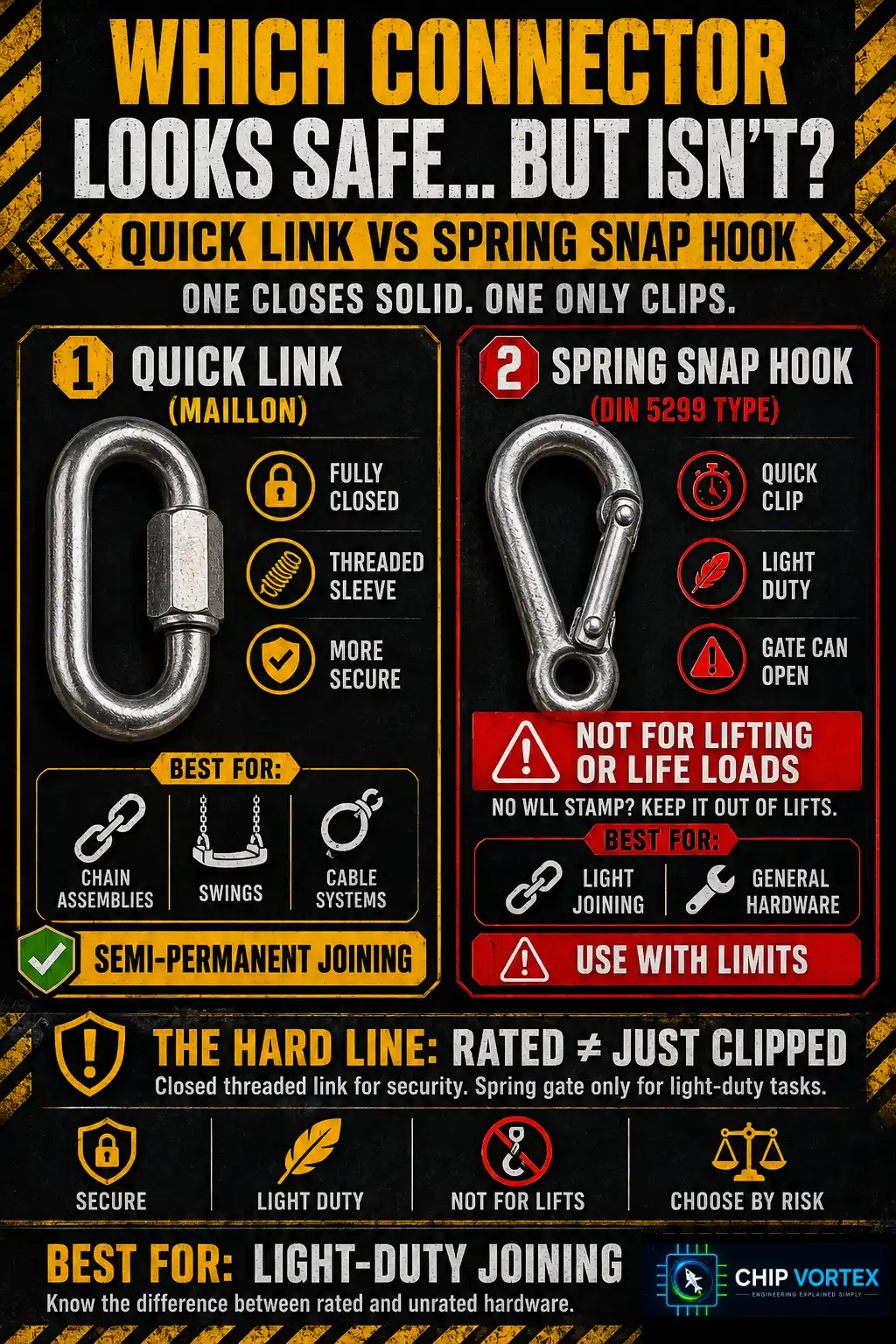
Quick link (maillon). A chain-link shape closed by a threaded sleeve. Screwed shut, it’s fully closed on all sides — stronger and more secure than any spring gate, and the right choice for semi-permanent connections in chain assemblies, swings, and cable systems.
Spring snap hook (DIN 5299 type). The familiar carabiner-style clip from the hardware store. Genuinely useful for light duty — and genuinely dangerous when misused, because most are not rated for lifting or life loads. If it doesn’t carry a stamped working load limit, it never goes in a lifting system. Full stop.
Best for: Light-duty joining — with a hard line between rated and unrated hardware.
7. Pulleys (Blocks)
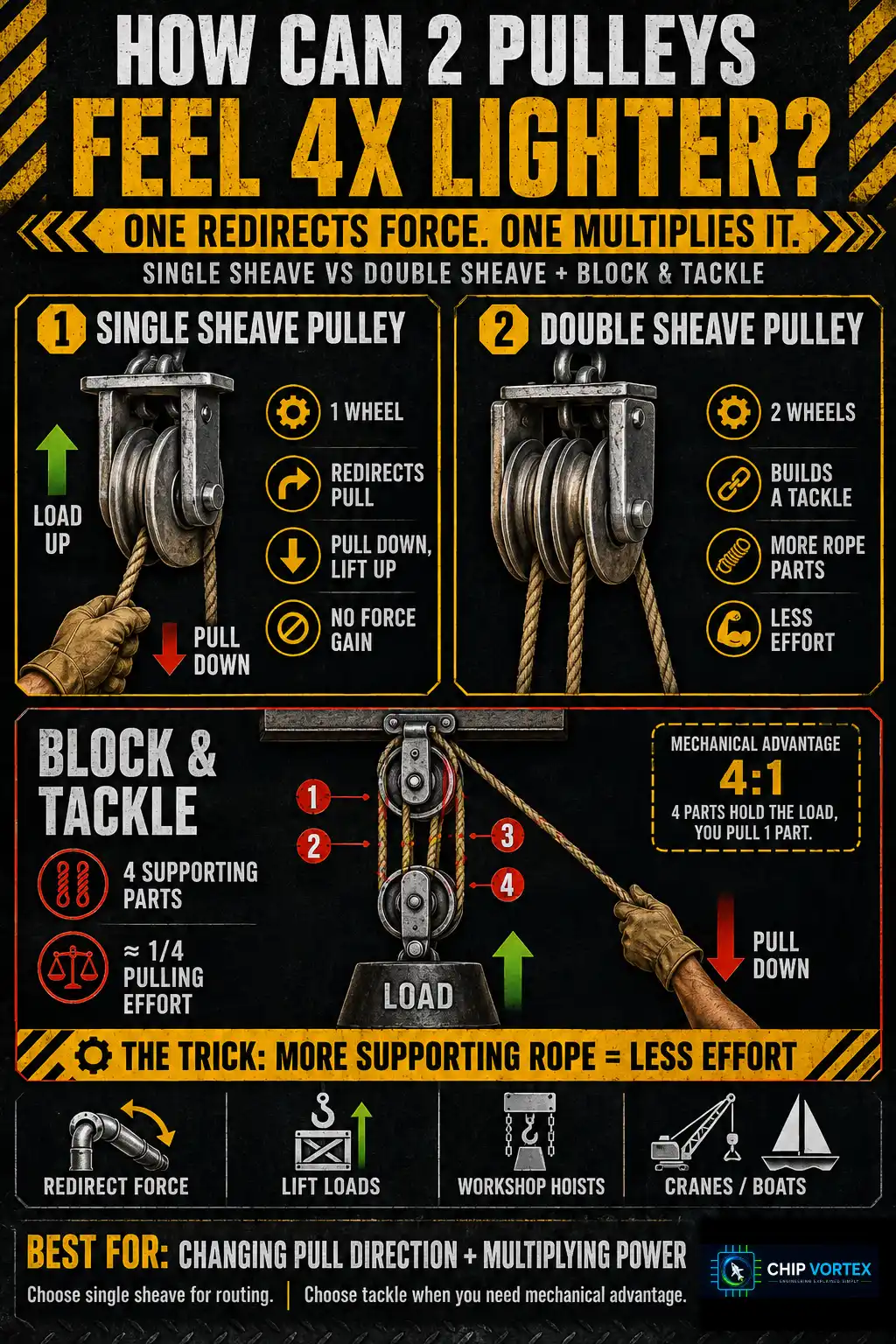
Single sheave pulley. One grooved wheel in a frame. It doesn’t reduce the effort — it redirects it, letting you pull down to lift up, or route a line around an obstacle.
Double sheave pulley. Two wheels in one frame. Combine a double block with a second block and you’ve built a block and tackle: the load hangs from multiple rope parts, and each part carries only a fraction of the weight. Four supporting parts means roughly one-quarter the pulling effort — the oldest force multiplier in engineering, still working on cranes, sailboats, and workshop hoists.
Best for: Changing the direction of a pull — or multiplying your pulling power.
8. Lifting Chain
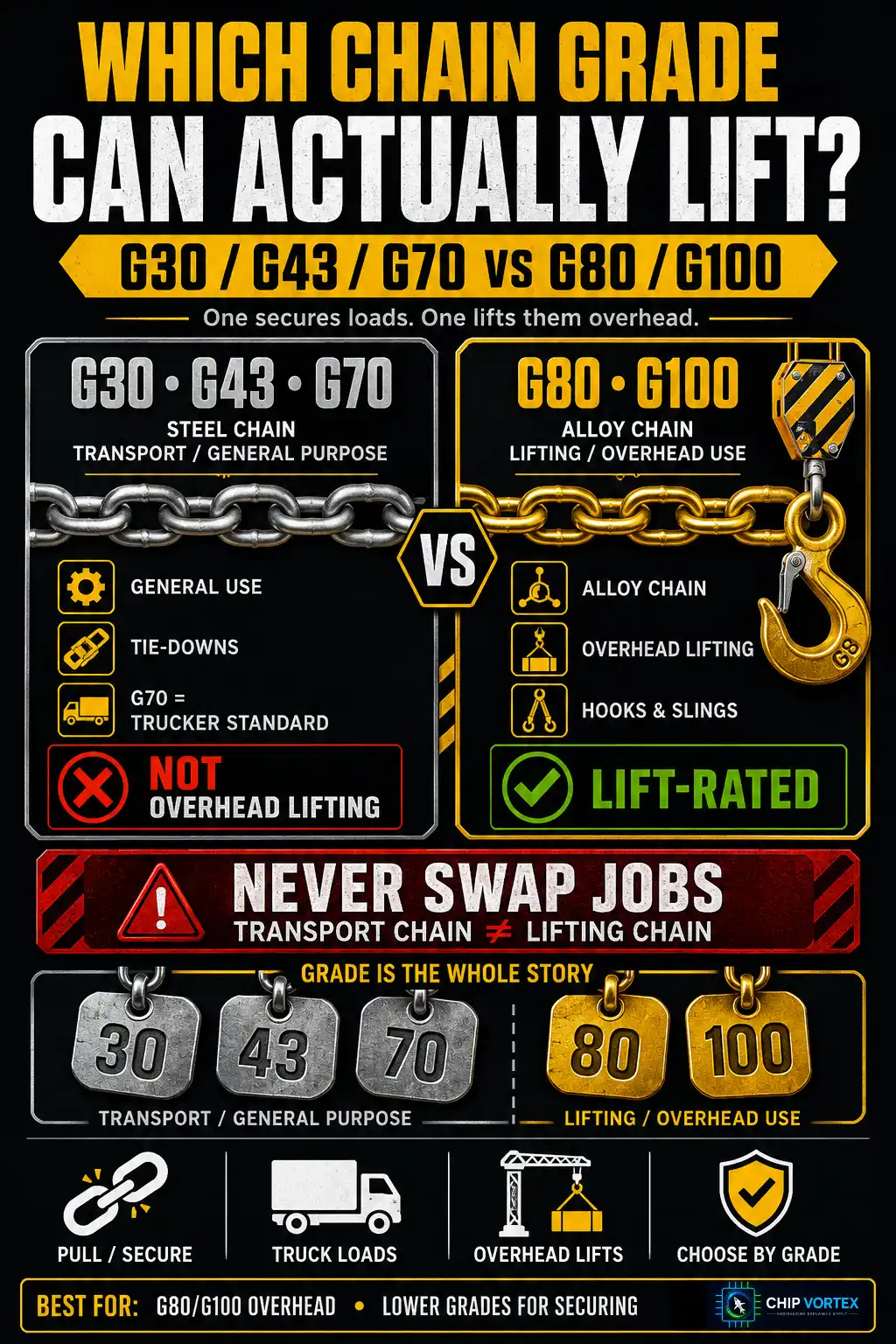
Chain is graded, and the grade is the whole story. Grade 30, 43, and 70 are carbon-steel chains for general purpose work and transport tie-downs (G70, usually gold-colored, is the trucker’s standard). Grade 80 and Grade 100 are heat-treated alloy chains — the only grades rated for overhead lifting. That’s why lifting slings, hooks, and fittings carry the G80/G100 marking: it signals alloy steel with the strength and toughness to hold a load above people. Transport chain lashes loads down; alloy chain lifts them up — and the two never swap jobs.
Best for: G80/G100 for anything overhead; lower grades for pulling and securing.
Decoding the Labels: Galvanized, Stainless & Grade Numbers
Catalogs throw these words at every product, so here’s the translation. Galvanized means zinc-coated carbon steel — economical rust protection for general outdoor use. Stainless steel resists corrosion from within — the choice for marine, food, and architectural settings, accepting that stainless is often rated below alloy steel of the same size. Grade numbers (G80, G100) mark heat-treated alloy steel built for overhead lifting. The material question is always the same trade: is the enemy corrosion or load? Buy for the enemy you actually face.
Rigging Safety: The Rules That Never Bend
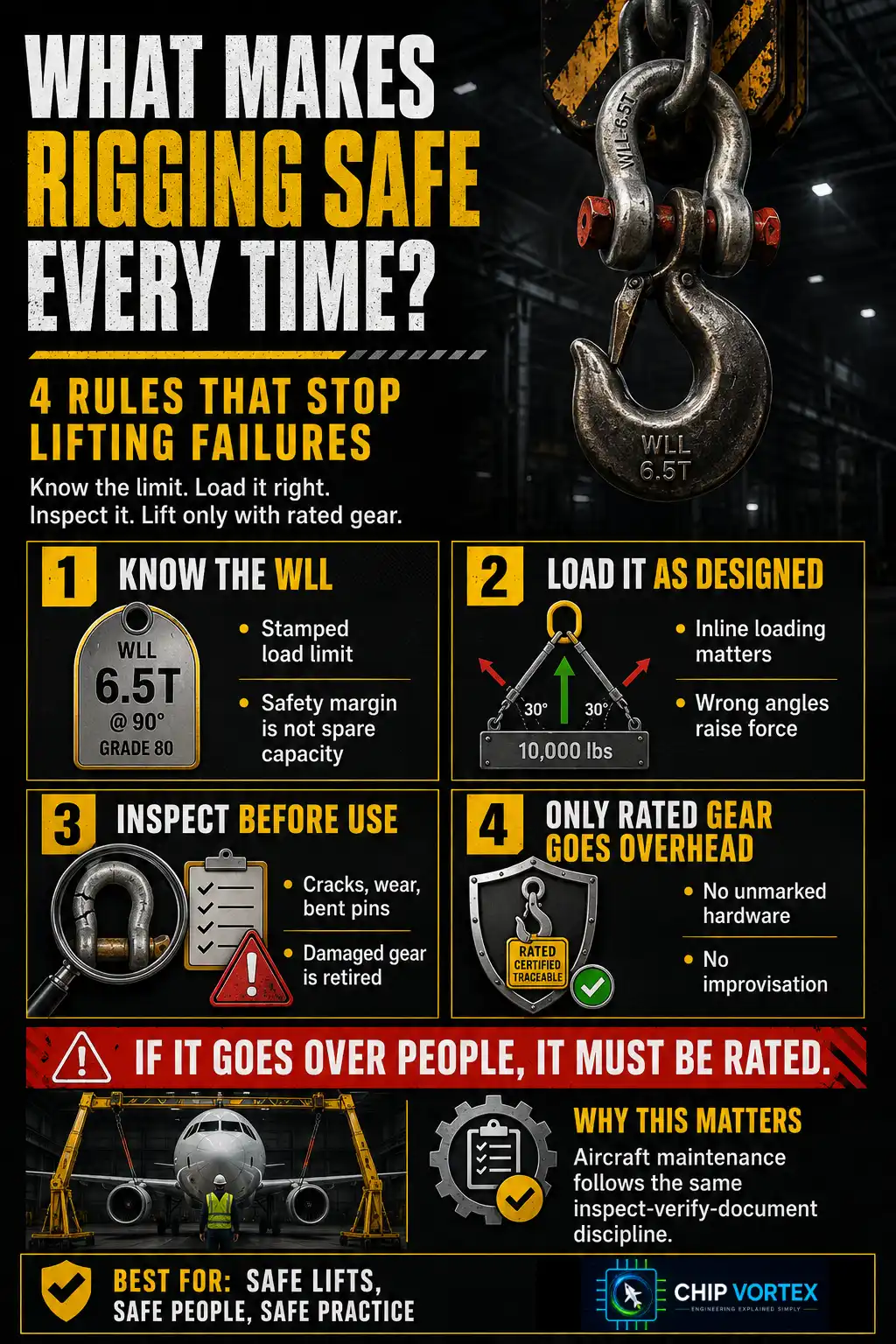
Know the WLL. Every rated component carries a stamped Working Load Limit — the maximum load it may carry in service. It’s derived from the breaking strength divided by a design factor (commonly 4:1 to 6:1). The margin exists to absorb shock, wear, and imperfect real-world conditions — it is not spare capacity to borrow.
Load hardware the way it was designed. Shackles pulled in line, plain eye bolts straight up, hooks loaded in the bowl and never on the tip. Sling angles matter too: as sling legs flatten toward horizontal, the tension in each leg climbs steeply above the weight it supports.
Inspect before every use. Wear, cracks, bent pins, stretched links, damaged threads, missing WLL markings — any one of them retires the component on the spot. Damaged rigging hardware is never repaired for lifting; it’s destroyed and replaced.
Only rated hardware goes overhead. No hardware-store snap hooks, no unmarked links, no improvisation. If it will hold a load above a person, it carries a rating and a paper trail.
Aircraft maintenance runs on exactly this discipline: an engine change happens under certified slings, rated shackles, and inspected lifting points, with the same inspect-verify-document culture applied to the rigging as to the aircraft itself. Good rigging practice is maintenance practice.
FAQ: Rigging Hardware
What’s the difference between a D shackle and a bow shackle?▾
A D shackle’s narrow body is strongest for a single in-line pull. A bow shackle’s rounded body accepts multiple slings and loads from different angles, at a slightly lower rating for the same size.
When should I use a bolt-type shackle instead of a screw pin?▾
Any permanent or long-term connection, and anywhere vibration or load rotation could work a screw pin loose. Screw pins are for temporary rigging that’s connected and removed by hand.
What does G80 mean on chain and fittings?▾
Grade 80 — heat-treated alloy steel rated for overhead lifting. Grades below 80 (G30, G43, G70) are for general use and transport tie-downs, never for lifting loads overhead.
What is a Working Load Limit (WLL)?▾
The maximum load a component may carry in normal service — its breaking strength divided by a design factor, typically 4:1 to 6:1. Exceeding the WLL eats the safety margin that protects against shock and wear.
Can regular carabiners or snap hooks be used for lifting?▾
No. Unless a connector carries a stamped WLL from the manufacturer, it is not lifting hardware — spring snap hooks and hardware-store carabiners are for light duty only.
Save the chart to your workshop board — it earns its place the first time someone asks “which shackle do I need?” And since rigging is only one half of holding things together, pair it with our guides to types of nuts and types of springs.