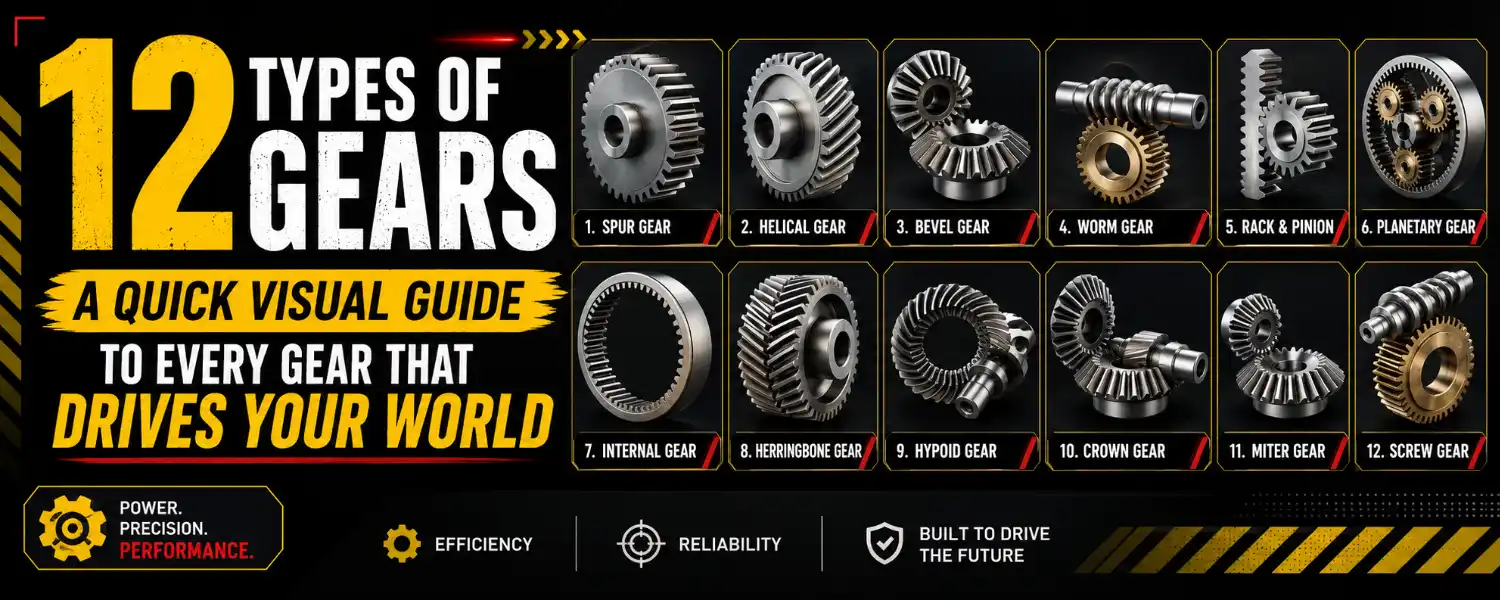
A gear has one job — pass rotation from one shaft to another — and yet engineers have invented a dozen different tooth shapes to do it. Why? Because every gear type is an answer to a different question: How much noise can you tolerate? Which way do the shafts point? How big a reduction do you need in how little space? Here are all 12 types of gears, family by family, and the reason each shape exists.
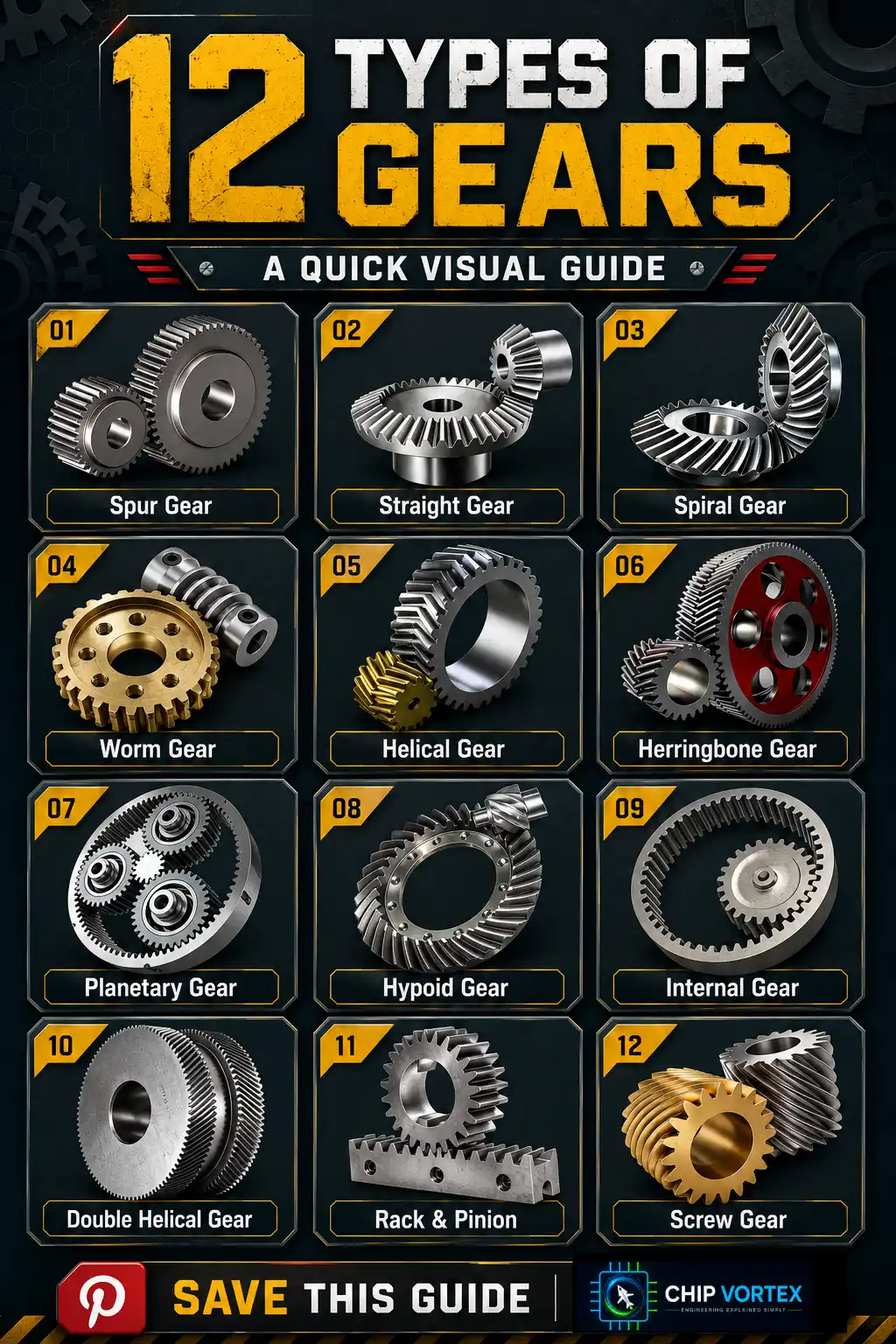
Save the chart, then let’s work through the families: parallel shafts first, then angles, then the specialists.
The Parallel-Shaft Family
1. Spur Gear
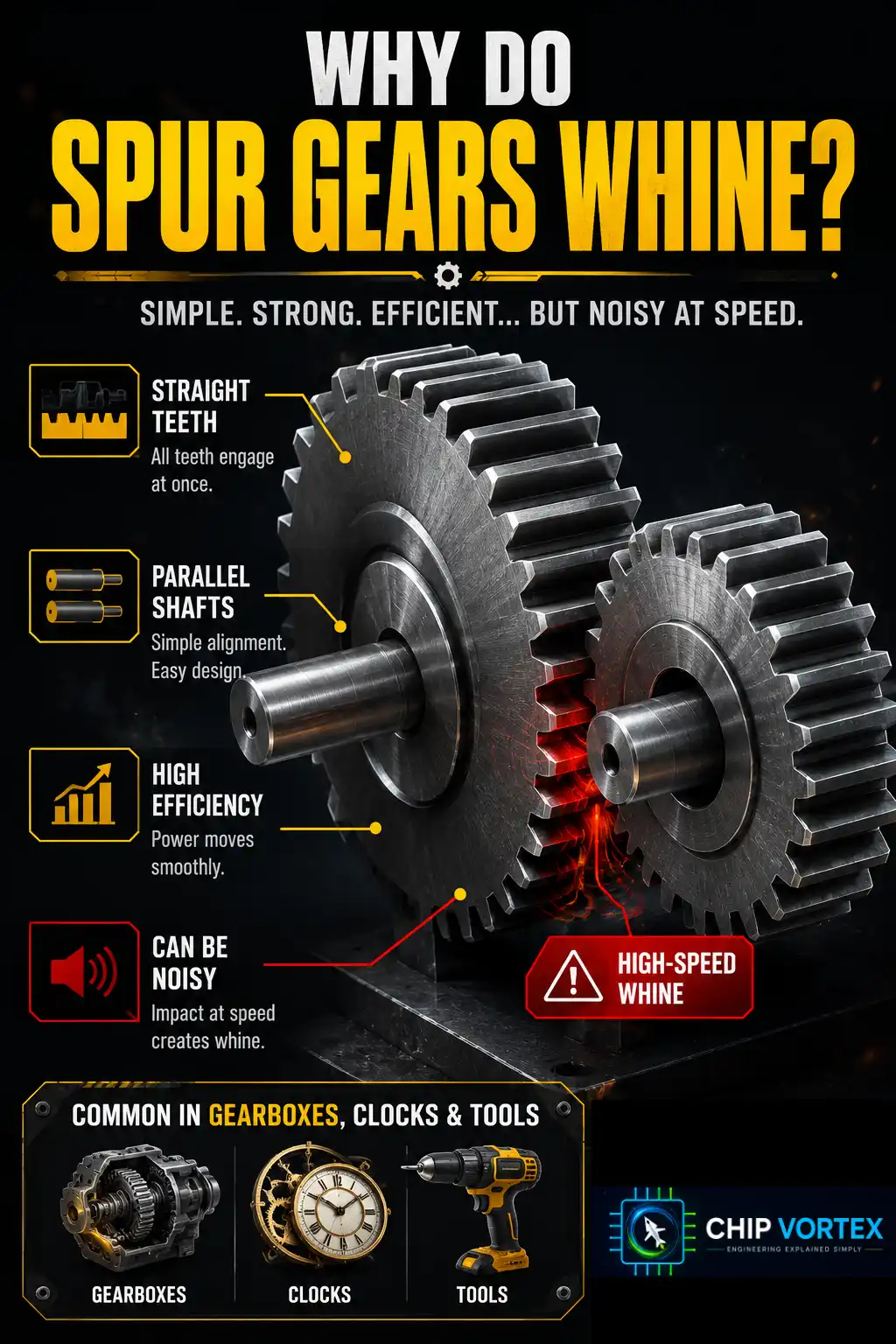
The gear everyone draws: straight teeth, parallel to the shaft, on parallel shafts. Simple to make, cheap, and mechanically efficient — but each tooth engages all at once with a tiny impact, and at speed those impacts become the famous gear whine. That’s why racing gearboxes scream: motorsport chooses straight-cut spurs for their strength and efficiency and accepts the soundtrack. Clocks, hand tools, and simple gearboxes live here.
2. Helical Gear
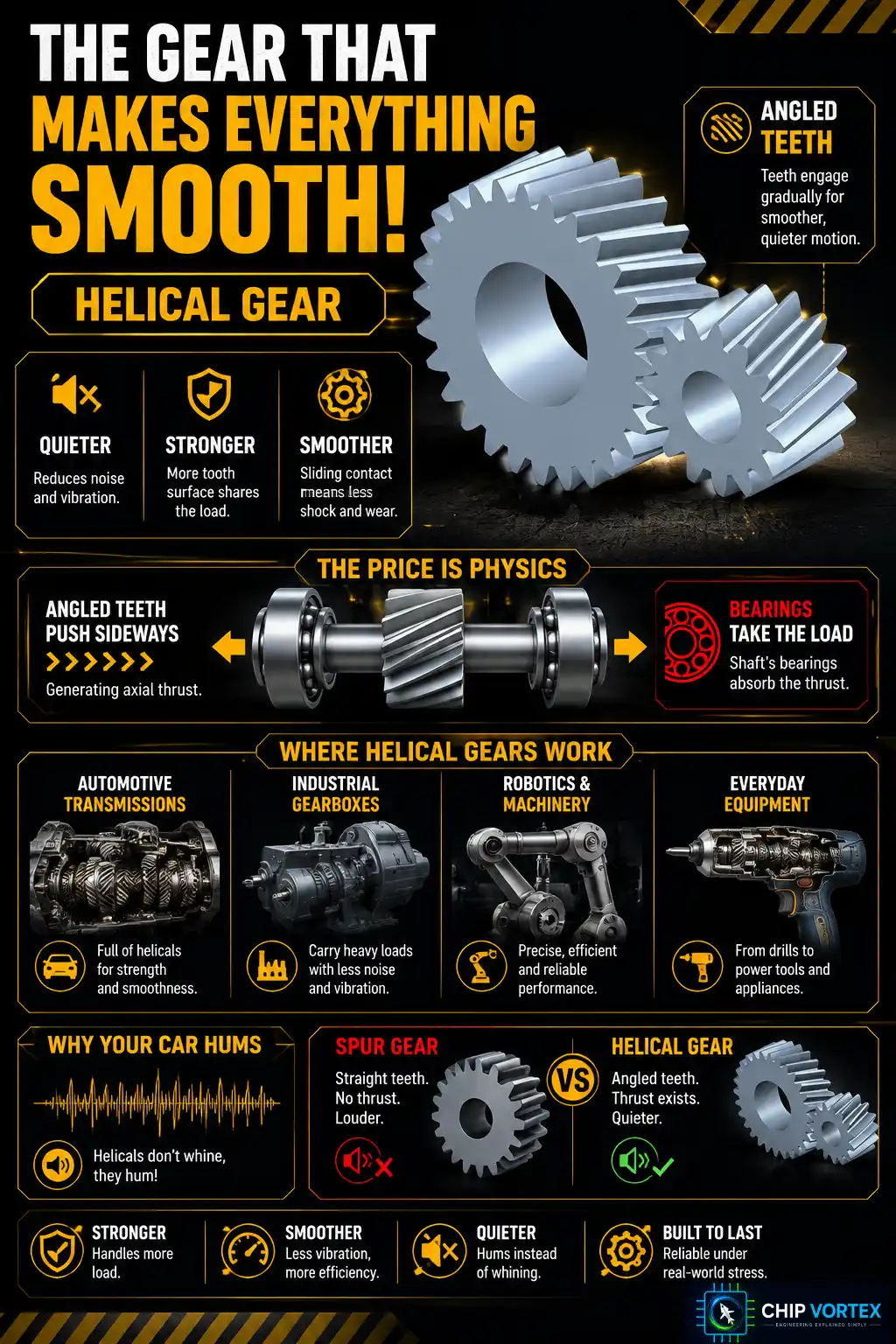
Cut the teeth at an angle and everything smooths out: each tooth engages gradually, sliding into contact instead of slapping — quieter, smoother, and stronger, with more tooth surface sharing the load. The price is physics: angled teeth push sideways, generating axial thrust that the shaft’s bearings must absorb — one big reason the thrust and angular-contact designs from our bearings guide exist. Your car’s transmission is full of helicals; that’s why it hums instead of whining.
3. Herringbone (Double Helical) Gear
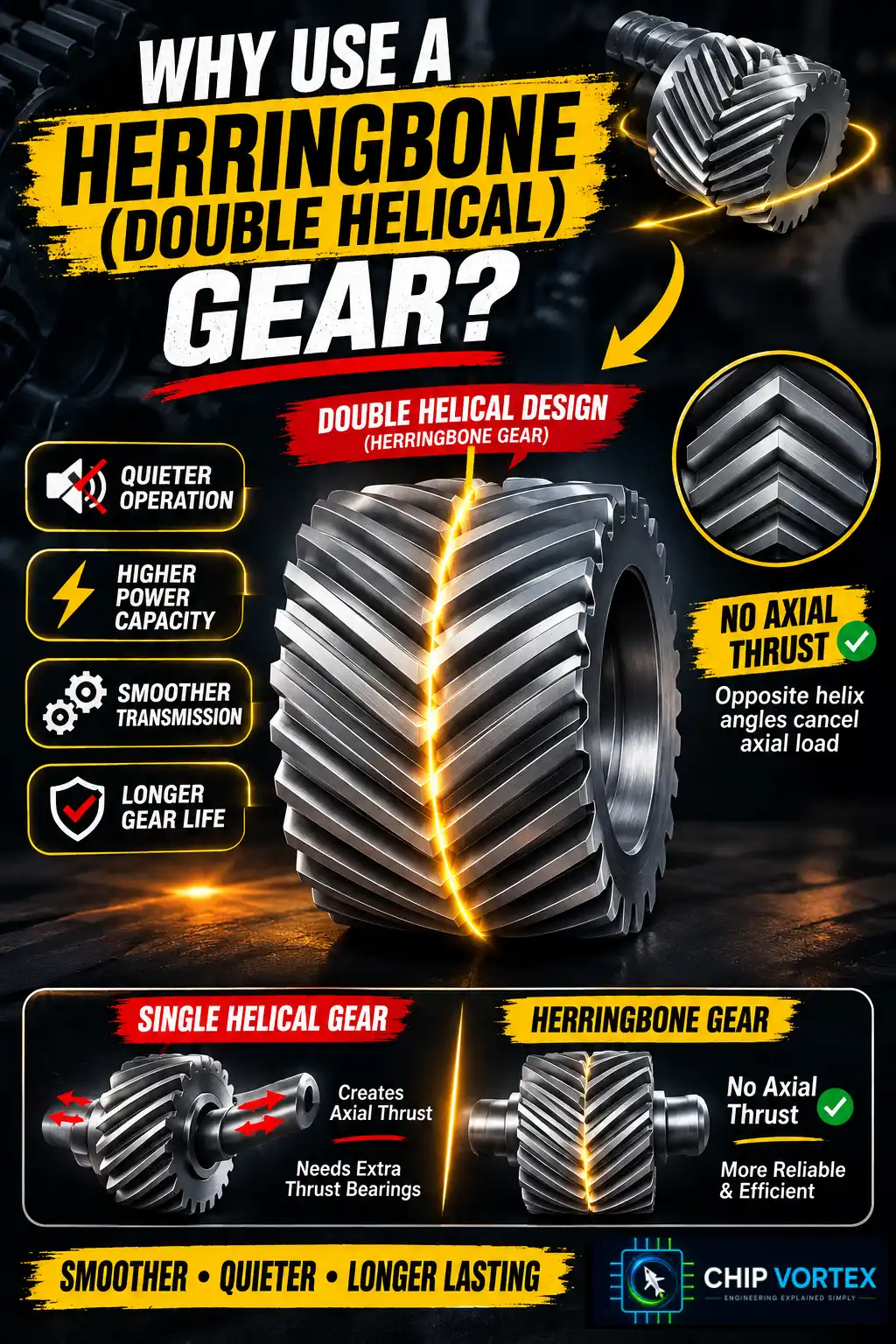
Two helical gears mirrored into a V — and the sideways pushes cancel each other perfectly. All of the helical’s smoothness, none of its thrust, and enormous power capacity, which is why herringbones drive ships and heavy industry. Naming note: a true herringbone has no gap at the V’s center; a double helical has a groove there for easier manufacturing — twins, separated only by a machining detail. And one story worth telling forever: André Citroën built his fortune on herringbone gears — look at the Citroën badge and you’re looking at two gear teeth. The double chevron is this gear.
4. Internal Gear
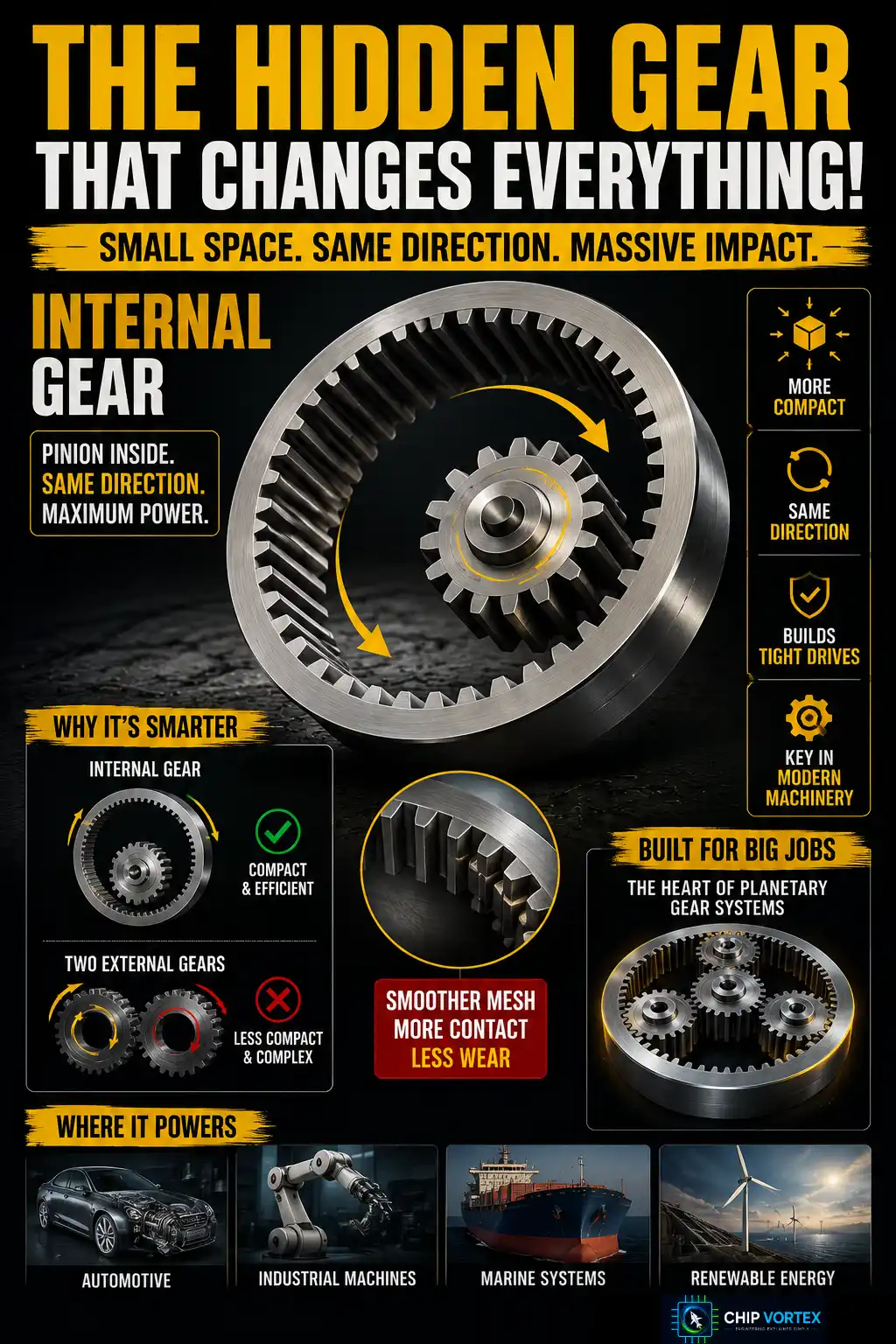
Flip the teeth to the inside of a ring and you get the internal gear: a pinion runs inside it, both turning the same direction, in a mesh far more compact than two external gears. On its own it builds tight drives; as the outer ring of a planetary system, it becomes one of the most important components in modern machinery — hold that thought for #12.
The Intersecting-Shaft (Bevel) Family
5. Straight Bevel Gear
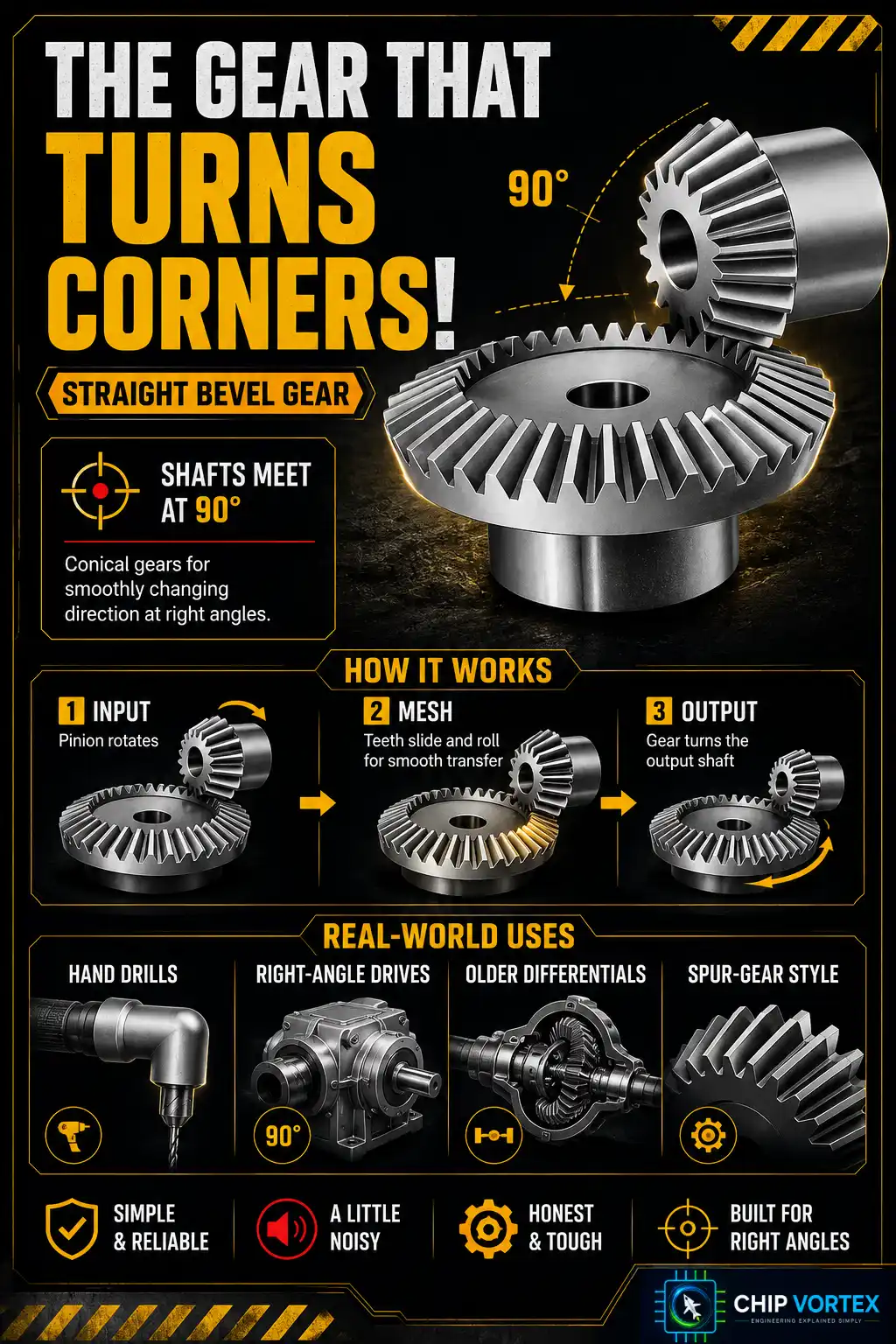
When shafts meet at an angle — usually 90° — the gears become cones. Straight bevels are the simple version: straight teeth on conical bodies, turning the corner honestly and a little noisily, spur-gear style. Hand drills, right-angle drives, and older differentials run on them.
6. Spiral Bevel Gear
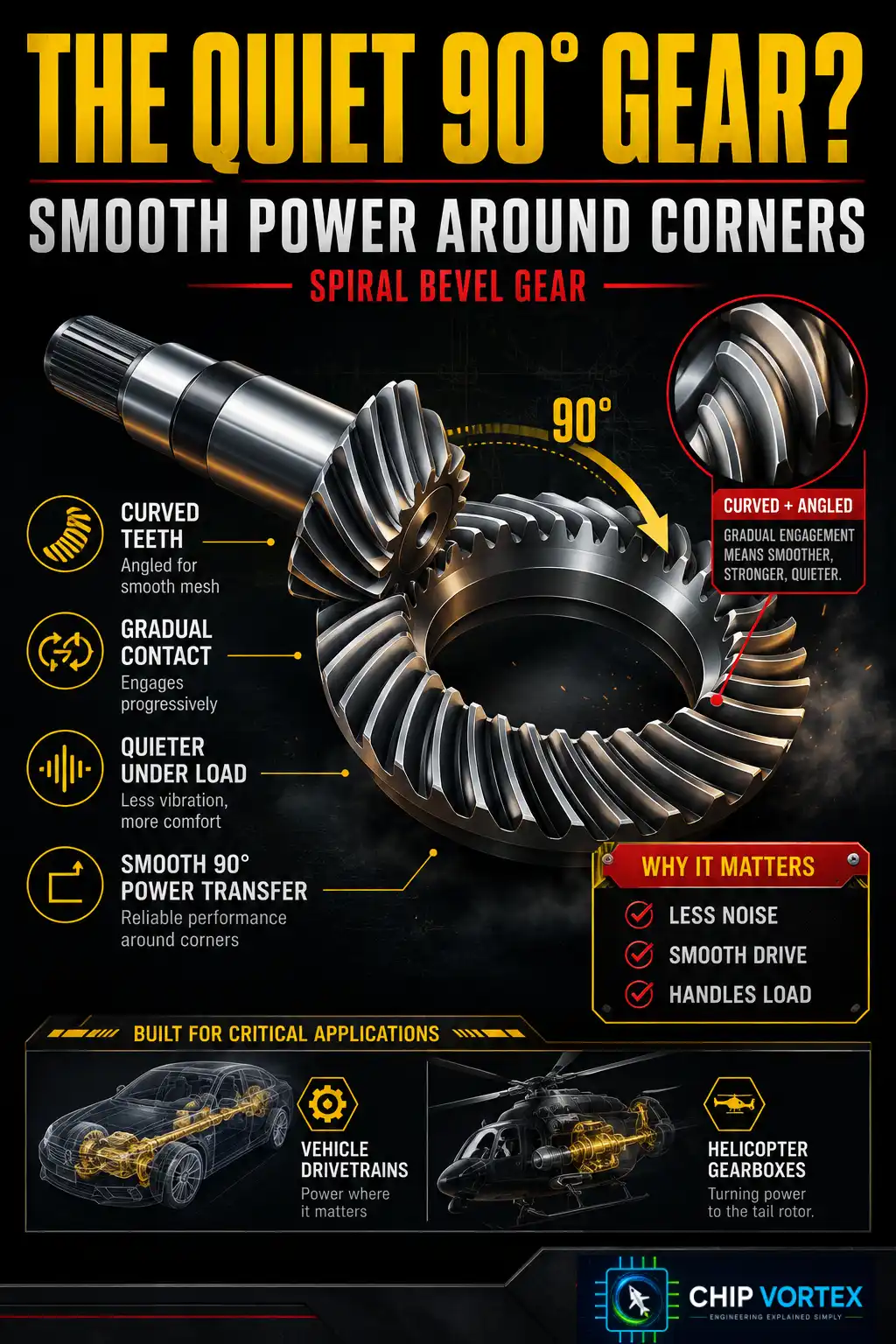
The helical idea, applied to the cone: curved, angled teeth that engage gradually. The result is the bevel family’s refined member — quiet, smooth, and strong under load — which is why spiral bevels take the corner in vehicle drivetrains and in one of aviation’s most critical meshes: the gearboxes that turn a helicopter’s drive around corners to the tail rotor.
7. Miter Gear
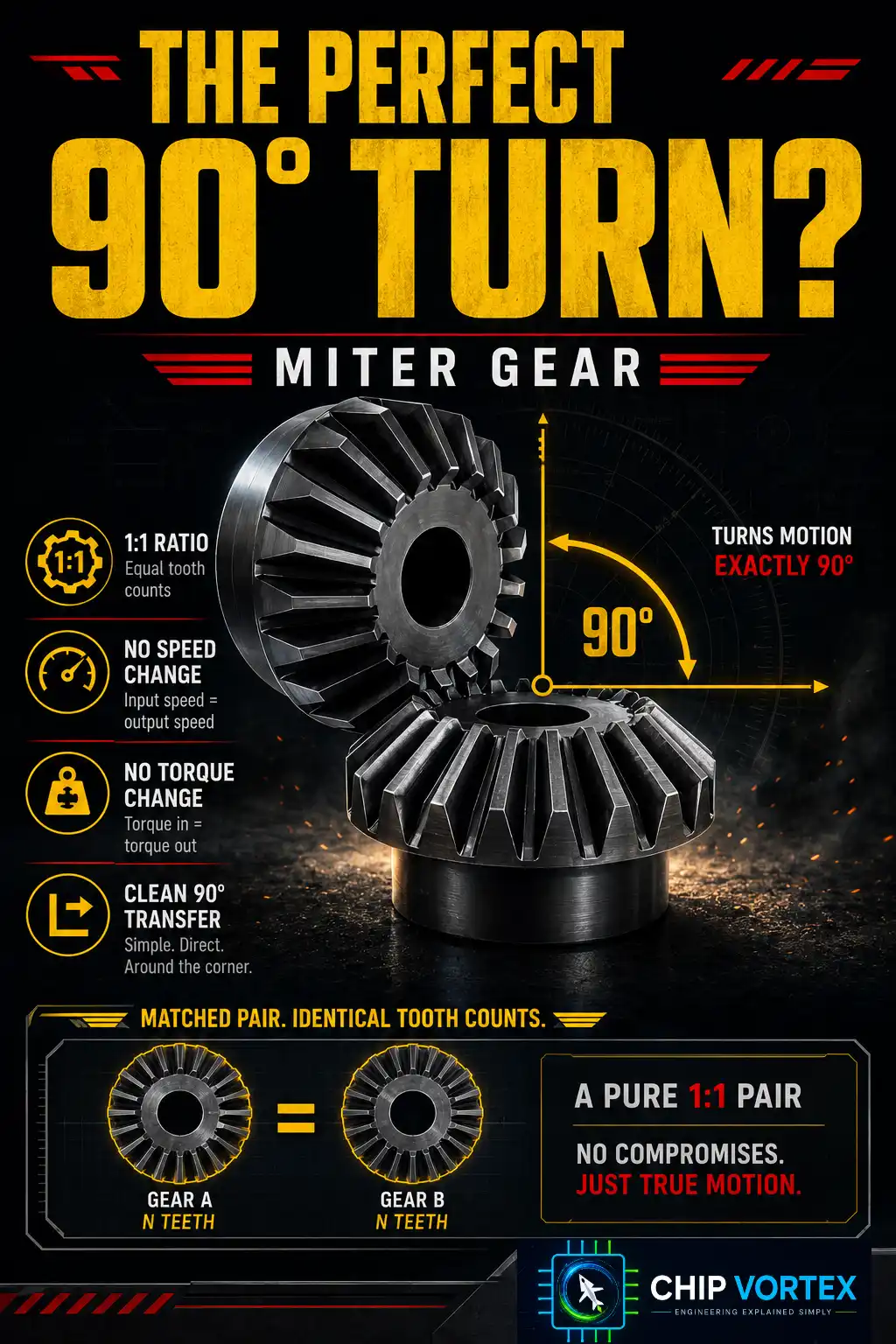
A matched pair of bevels with identical tooth counts: a pure 1:1 corner. No speed change, no torque change — just rotation turned exactly 90°. When a design only needs to send motion around a corner, the miter pair is the clean, honest answer.
8. Hypoid Gear
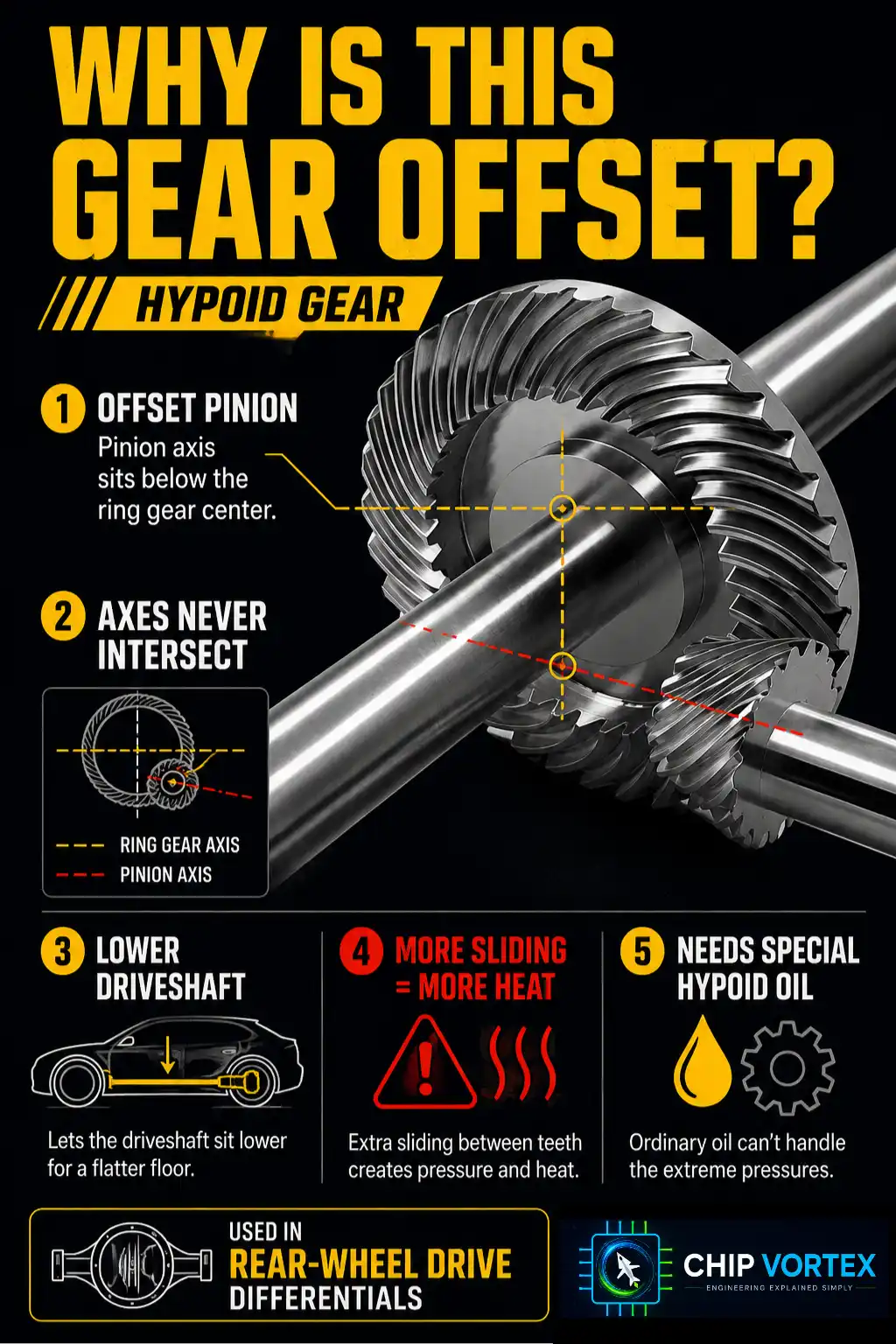
A spiral bevel with a twist: the pinion’s axis is offset below the ring gear’s center — the axes never intersect. That offset is why your car’s floor is flat: the driveshaft can sit lower. The cost is extra sliding between teeth, generating pressure and heat ordinary oil can’t survive — which is the exact answer to “why does my differential need special hypoid oil?” Nearly every rear-wheel-drive axle on the road turns its corner through a hypoid.
The Crossed-Shaft Specialists
9. Worm Gear
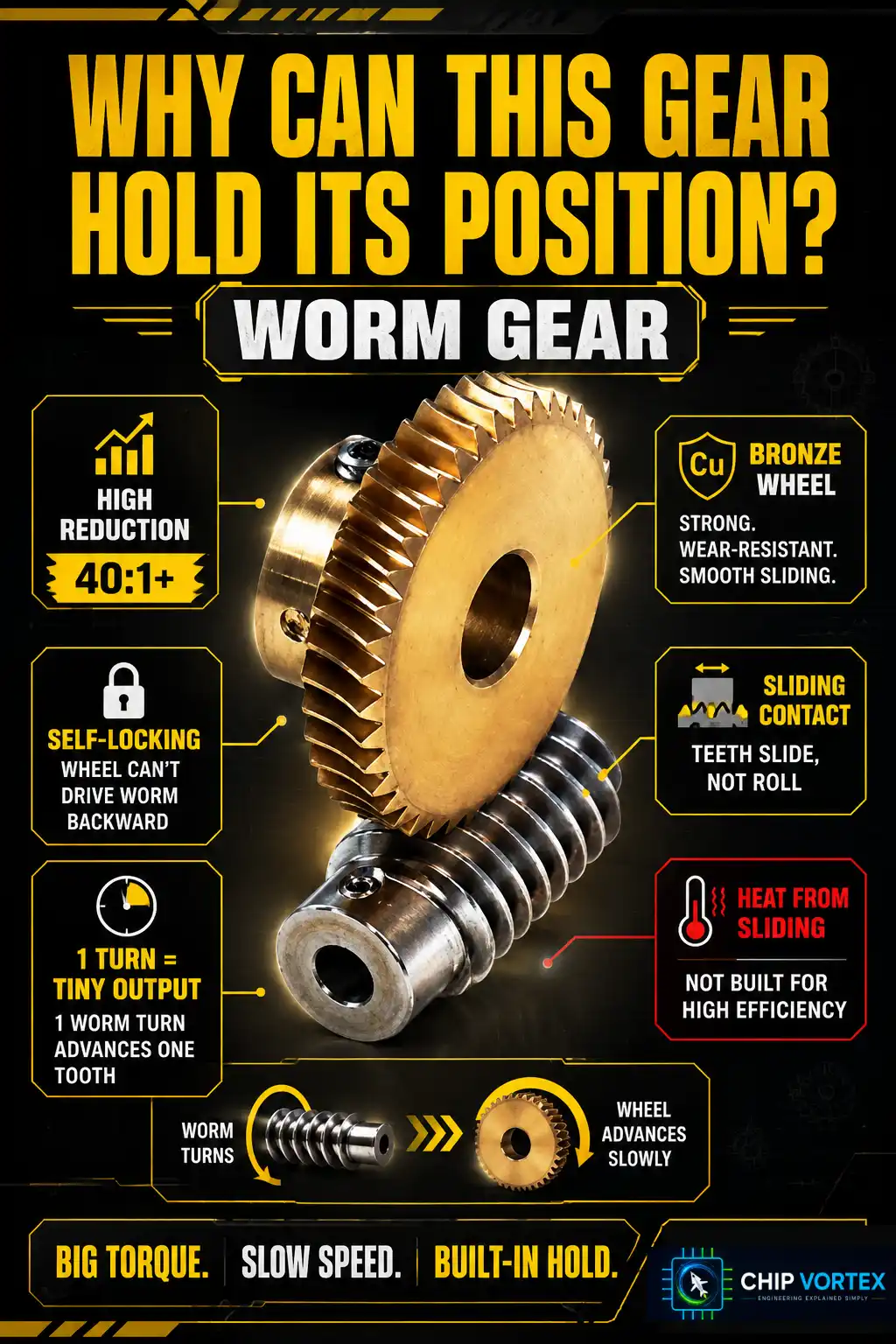
A screw (the worm) driving a toothed wheel: one full turn of the worm advances the wheel just one tooth, so a single stage can deliver reductions of 40:1 and beyond. Even better, most worm sets are self-locking — the wheel cannot drive the worm backward — a built-in brake that hoists, lifts, and guitar tuning pegs depend on. The trade: teeth slide rather than roll, so efficiency drops and heat rises — the reason the wheel is classically bronze (exactly the golden gear in the chart), a metal that forgives sliding.
10. Screw Gear (Crossed Helical)
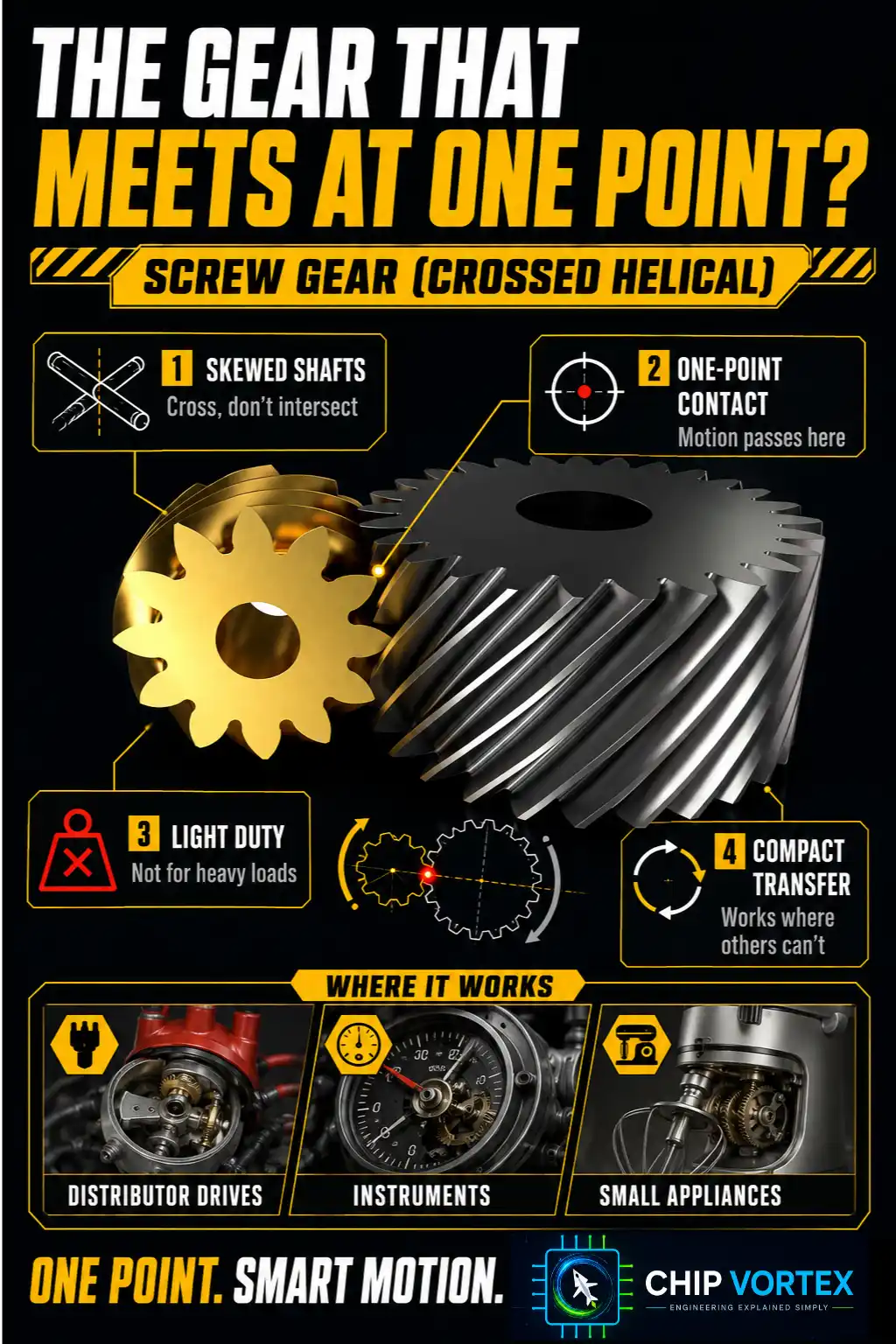
Two helical gears on shafts that cross without intersecting — meeting at a single point of contact. That point limits them to light duty, but for transmitting modest motion between skewed shafts (distributor drives, instruments, small appliances), the screw gear does neatly what nothing else does at all.
11. Rack & Pinion
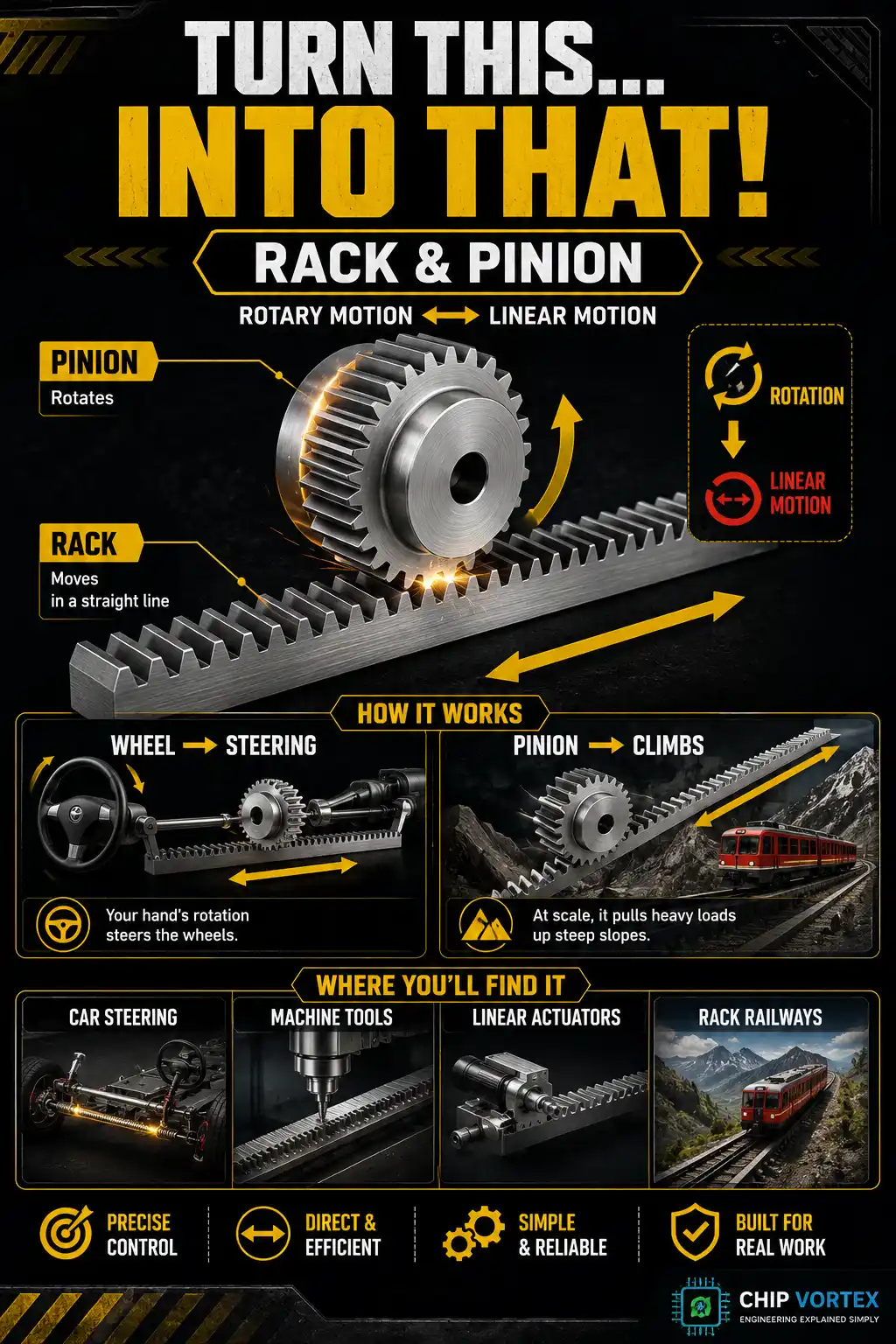
Unroll one gear into a straight bar — the rack — and the pinion rolling along it converts rotation into linear motion. Turn the wheel of almost any car and a rack and pinion translates your hands’ rotation into the wheels’ steering — the directness drivers praise as “feel.” Run it the other way at scale and the pinion climbs the rack: that’s how rack railways haul trains up mountainsides too steep for wheels alone.
The System
12. Planetary Gear
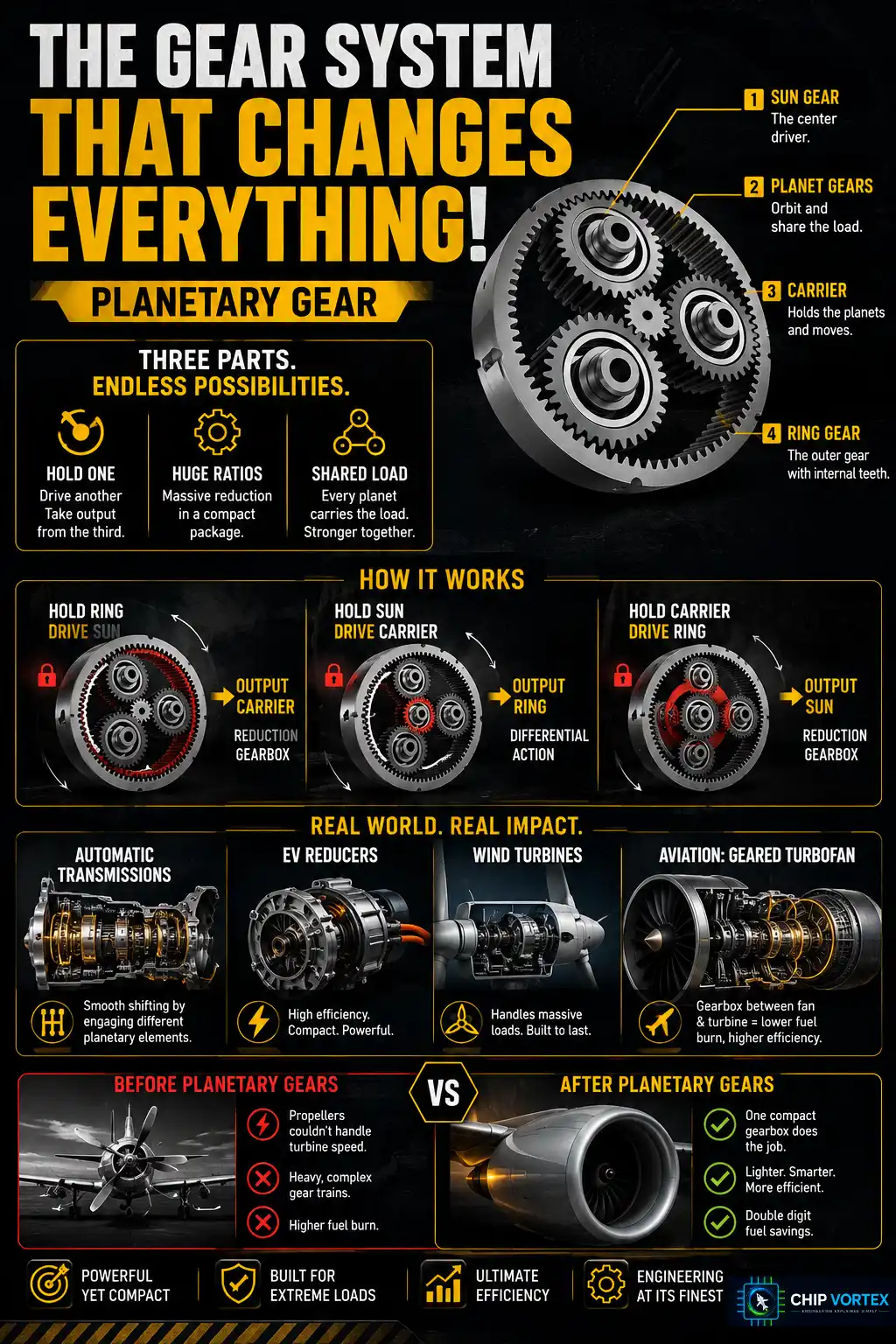
Not a tooth shape but an arrangement — and the most elegant one in engineering. A central sun gear, several planet gears orbiting it in a carrier, and an internal ring gear around them all. Hold one element, drive another, take output from the third: huge ratios, shared load across every planet, all packed around a single axis. Automatic transmissions shift by clutching different planetary elements; EV reducers and wind turbines rely on the same trick. And aviation’s newest chapter belongs to it: the geared turbofan puts a planetary gearbox between the fan and the turbine so each can spin at its own ideal speed — a single gear system that cut airliner fuel burn by double digits. The turboprop’s reduction gearbox has quietly done the same job for decades, because a propeller could never survive turbine speed. When a gear finally made jet engines meaningfully better, it was this one.
FAQ: Types of Gears
Why are helical gears quieter than spur gears?▾
Engagement style. Spur teeth meet all at once — a tiny impact per tooth that becomes a whine at speed. Helical teeth slide into contact gradually, spreading the load and killing the noise.
What is hypoid oil and why does a differential need it?▾
Hypoid gears’ offset axes make their teeth slide heavily against each other, creating pressures ordinary gear oil can’t survive. Hypoid oils carry extreme-pressure additives built for exactly that sliding contact.
Why can’t a worm gear be driven backward?▾
The worm’s shallow thread angle means the wheel pushing back just wedges against it — friction wins. That self-locking is a feature: hoists and lifts use it as a built-in brake.
What’s the difference between herringbone and double helical gears?▾
The groove. A true herringbone’s two helix halves meet at a sharp continuous V; a double helical leaves a gap at the center for manufacturing. Functionally, they’re the same thrust-cancelling idea.
Why do modern jet engines have gearboxes?▾
Because the fan and the turbine want completely different speeds. The geared turbofan’s planetary gearbox lets the big fan turn slowly and the turbine spin fast — each at its best — unlocking major fuel savings.
Now look at the machines around you with new eyes: the hum of your transmission, the badge on a Citroën, the tuning pegs on a guitar — all gear choices, all deliberate. Which story surprised you most? Tell us in the comments. Save the chart, and follow the gears into their machines: the bearings that absorb their thrust and the piston engine their timing sprockets keep in step.