
A spark plug spends its whole life inside the combustion chamber — the one place you can’t see. Everything that happens in there leaves a mark on it: the color of the insulator, the deposits on the tip, the shape of the electrodes. Pull a plug and you’re holding your engine’s medical report. This guide shows you how to read all 12 spark plug conditions — what each one looks like, what it means, and what to do next.
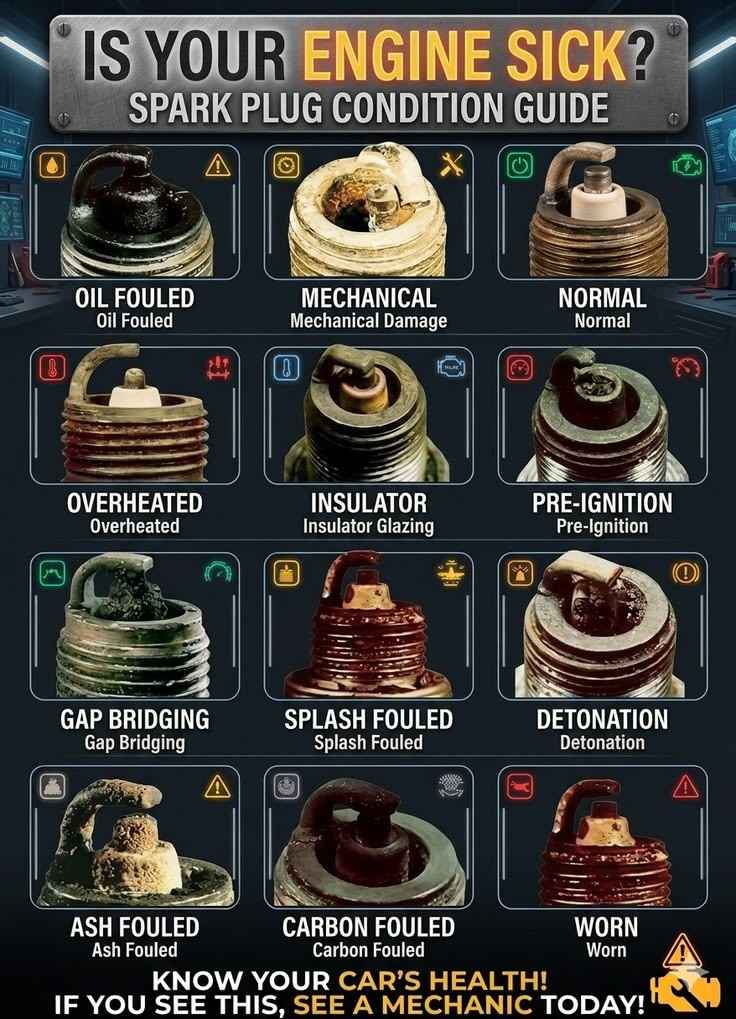
Save the chart for the garage wall, then let’s learn to read the report.
Before You Diagnose: How to Pull Plugs Properly
Three rules make the reading trustworthy. Work on a cool engine — plugs and threads are easily damaged hot. Keep the plugs in cylinder order (an old egg carton with numbered cups works perfectly) — because a plug doesn’t just tell you the engine is sick, it tells you which cylinder is sick. And read before you clean — the deposits are the evidence. One more thing to hold onto throughout this guide: the plug is usually the symptom, not the disease. Replacing a fouled plug without fixing what fouled it just schedules the next fouling.
Quick Reference: All 12 Spark Plug Conditions
| # | Condition | What You See | What It Means | Action |
|---|---|---|---|---|
| 1 | Normal | Light tan/gray insulator | Healthy engine, correct plug | Replace at interval |
| 2 | Oil Fouled | Wet, black, oily tip | Oil entering the cylinder | Find the oil source |
| 3 | Mechanical Damage | Bent/broken electrodes | Impact — object or wrong plug | Inspect cylinder first |
| 4 | Overheated | Blistered white insulator | Too hot: lean, timing, heat range | Fix the heat source |
| 5 | Insulator Glazing | Shiny yellow glaze | Deposits melted to glass | Replace the plug |
| 6 | Pre-Ignition | Melted electrodes | Ignition before the spark | Stop — find the hot spot |
| 7 | Gap Bridging | Deposit bridges the gap | Loose deposits shorted the plug | Clean/replace, find source |
| 8 | Splash Fouled | Spotty splashed deposits | Old deposits loosened after tune-up | Often just clean and refit |
| 9 | Detonation | Cracked/chipped insulator | Knock hammering the cylinder | Fix octane/timing/mixture |
| 10 | Ash Fouled | Light crusty ash coating | Oil or additive residue | Check oil consumption |
| 11 | Carbon Fouled | Dry, fluffy black soot | Rich mixture or weak spark | Fix mixture/ignition |
| 12 | Worn | Rounded, eroded electrodes | End of service life | Replace with correct spec |
1. Normal — Know Health Before You Diagnose Sickness
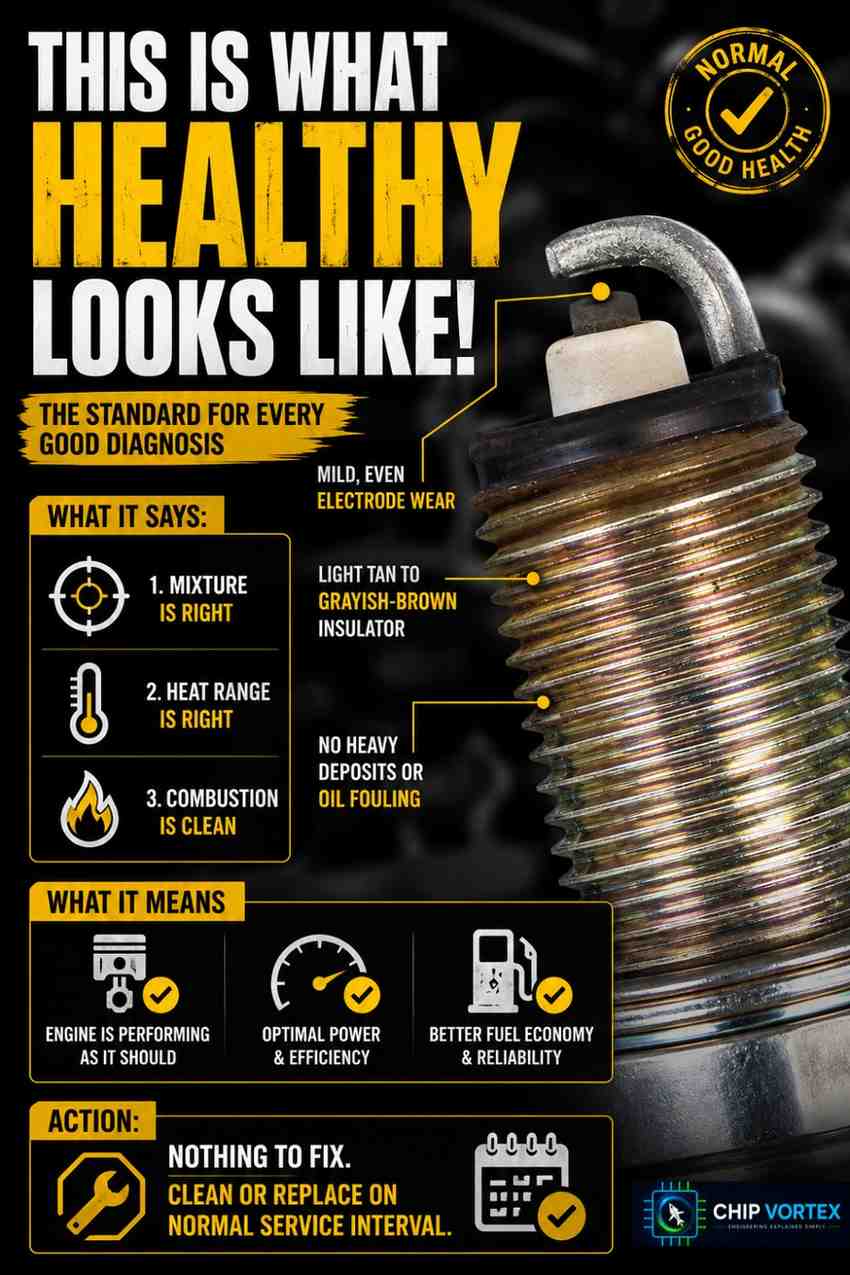
A healthy plug wears a light tan to grayish-brown insulator with mild, even electrode wear and no heavy deposits. It says three things at once: the mixture is right, the heat range is right, and combustion is clean. Burn this image into memory — every diagnosis below is a comparison against it.
Action: Nothing to fix. Clean or replace on the normal service interval.
2. Oil Fouled
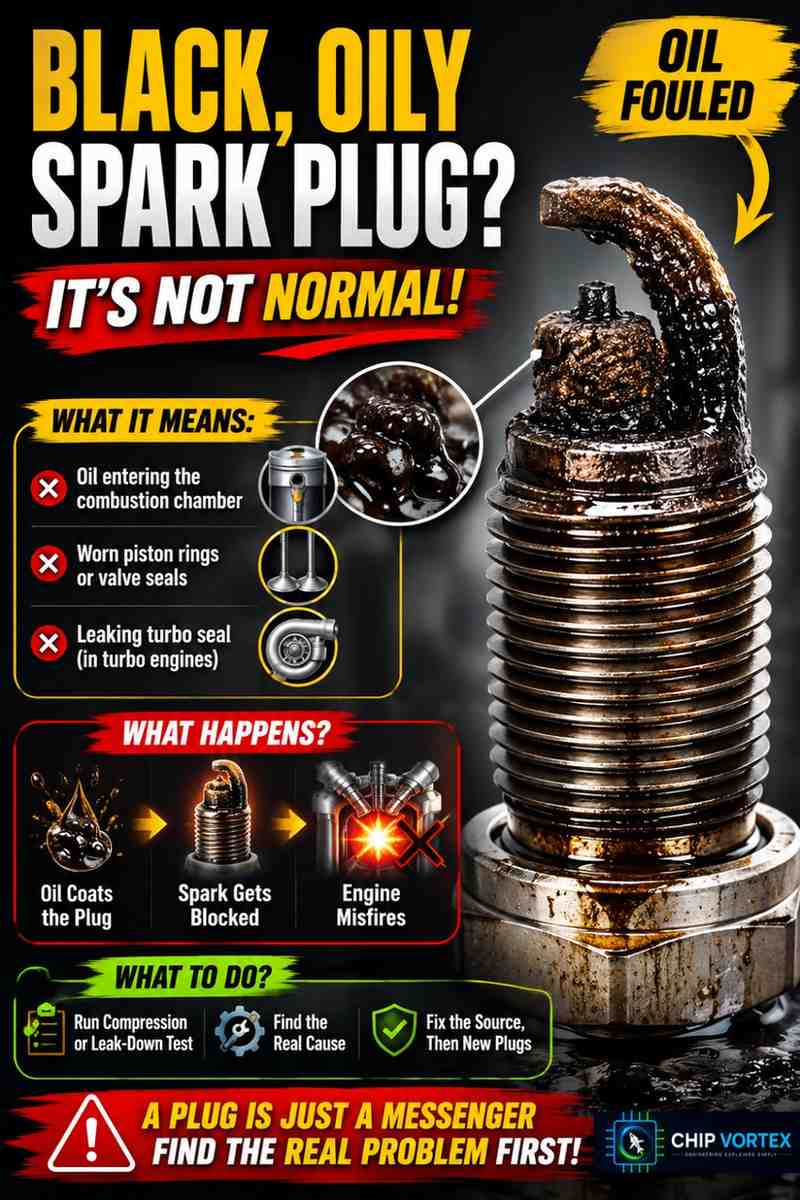
What you see: a wet, black, oily coating on the insulator and electrodes — it glistens.
What it means: oil is getting into the combustion chamber. The usual suspects are worn valve guides or seals, worn piston rings, or on turbocharged engines, a leaking turbo seal. The plug misfires because oil conducts the spark away.
Action: the plug is only the messenger. A compression or leak-down test will point to rings versus valves. Fix the source, then fit fresh plugs.
3. Mechanical Damage
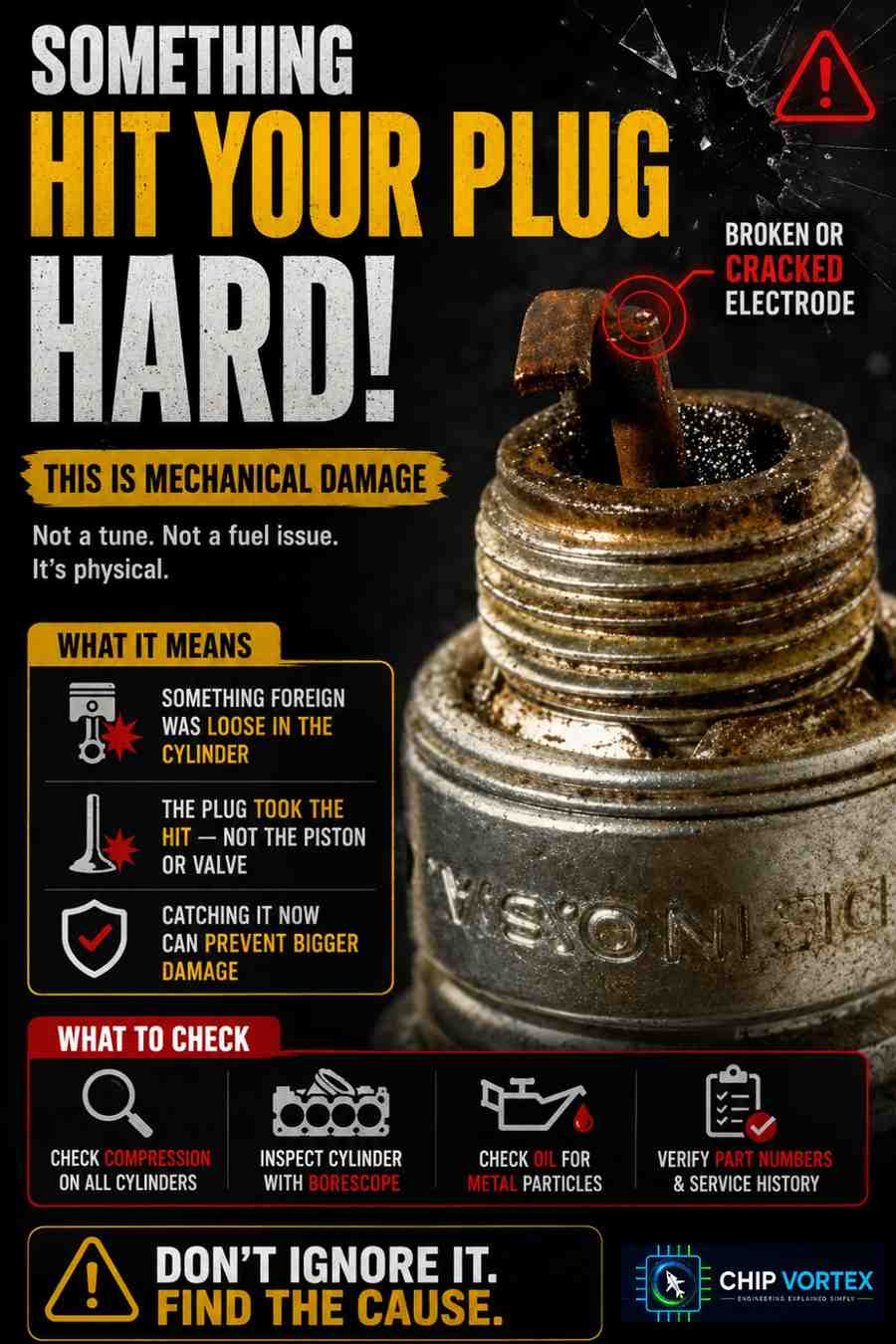
What you see: bent or broken electrodes, a smashed or cracked insulator — physical violence, not chemistry.
What it means: either a foreign object was loose in the cylinder, or the plug itself was the wrong reach — too long, so the piston or a valve struck it.
Action: never just screw in a new plug. Verify the correct part number, and inspect the cylinder (a borescope earns its keep here) — whatever did the damage may still be inside.
4. Overheated
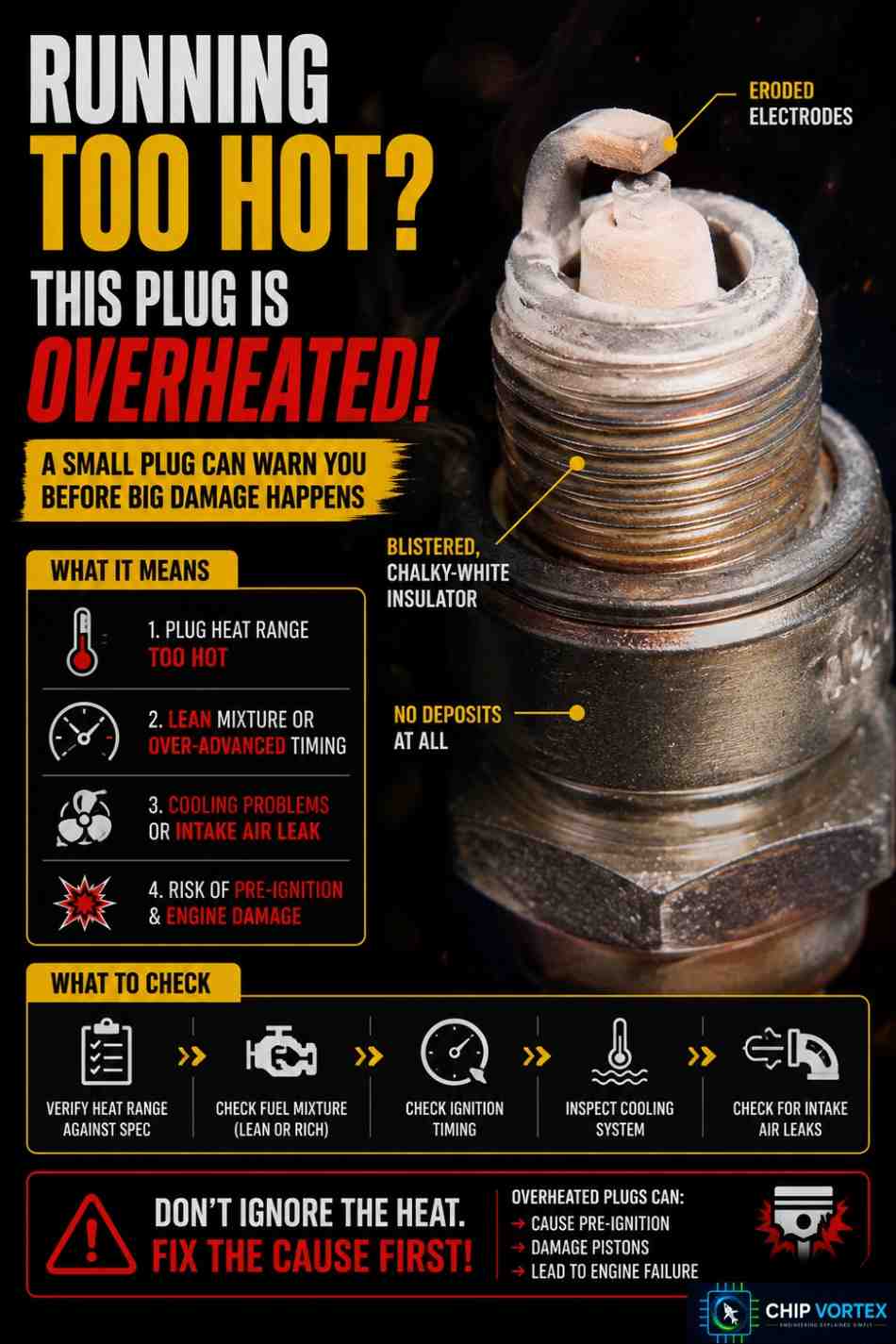
What you see: a blistered, chalky-white insulator with eroded electrodes and no deposits at all — the plug has been running far too hot.
What it means: a plug heat range too hot for the engine, a lean mixture, over-advanced timing, cooling problems, or an intake air leak. Left alone, an overheated plug becomes a glowing ignition source — the doorway to pre-ignition.
Action: verify heat range against spec, then chase mixture, timing, and cooling until the cause is found.
5. Insulator Glazing
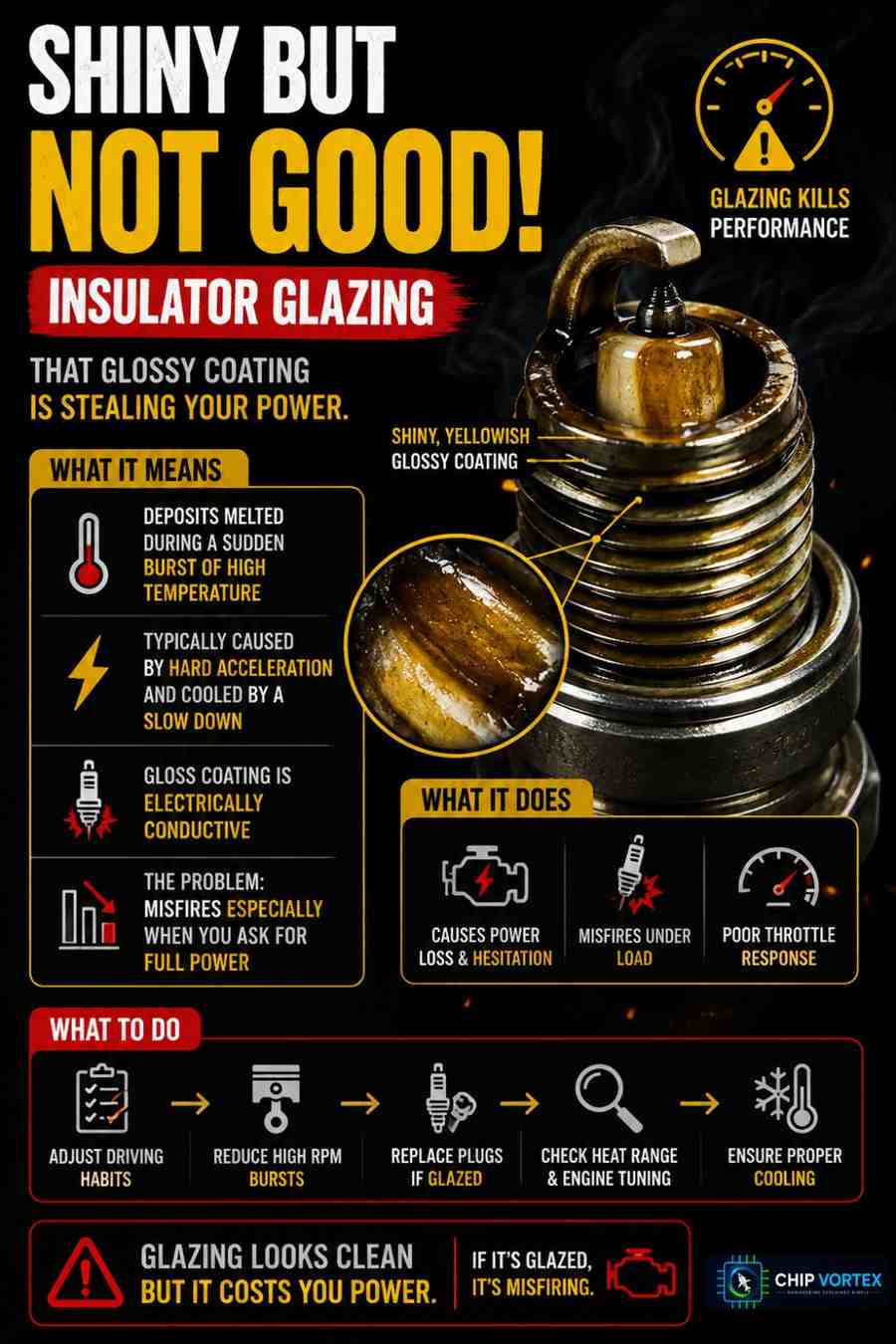
What you see: a shiny, yellowish, glass-like coating on the insulator.
What it means: deposits melted during a sudden burst of high temperature — typically hard acceleration — and cooled into a glaze. The problem: that glaze is electrically conductive, so the plug misfires exactly when you ask for full power.
Action: glazing can’t really be cleaned off — replace the plug, and review heat range and deposit sources if it keeps returning.
6. Pre-Ignition
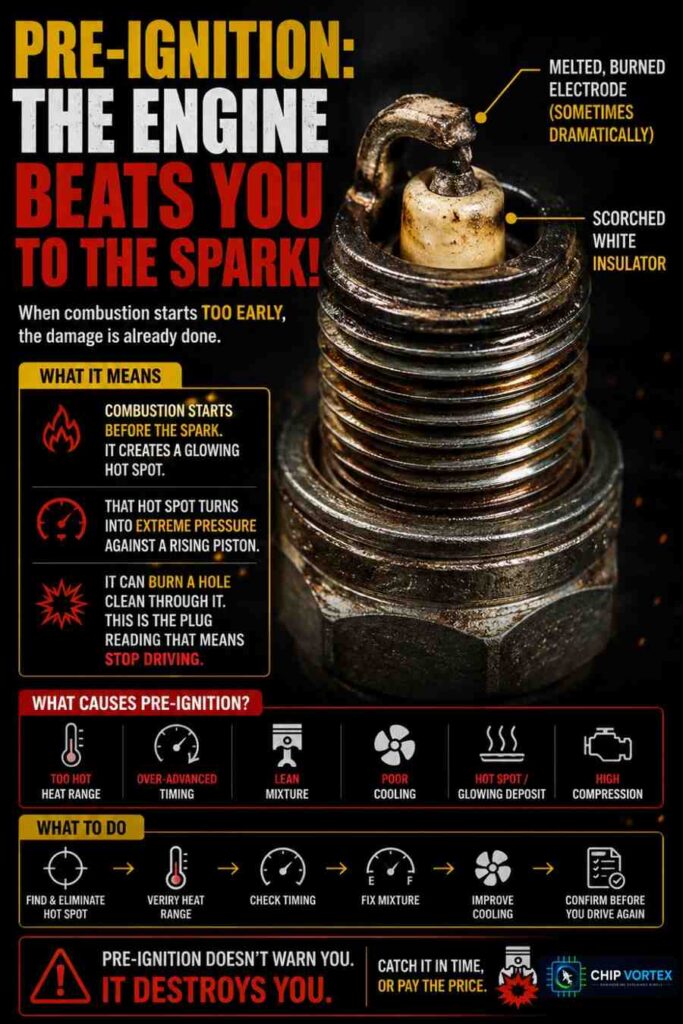
What you see: melted, burned electrodes — sometimes dramatically — with a scorched white insulator.
What it means: combustion is starting before the spark, lit by a glowing hot spot: an overheated plug, a red-hot deposit, or the wrong heat range. Pre-ignition builds pressure against a rising piston and can burn a hole clean through it. This is the plug reading that means stop driving.
Action: find and eliminate the hot spot — heat range, timing, mixture, cooling — before the engine pays the bill.
7. Gap Bridging
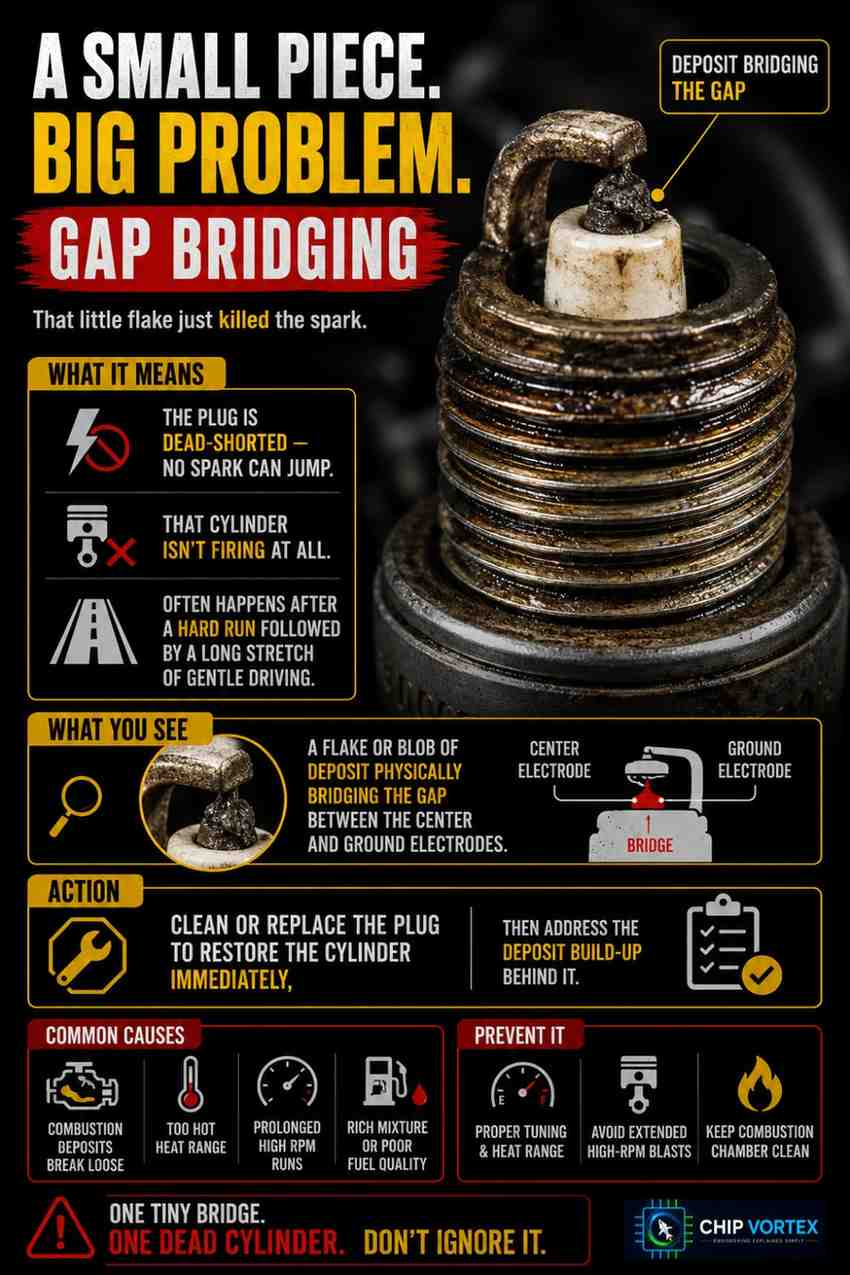
What you see: a flake or blob of deposit physically bridging the gap between the center and ground electrodes.
What it means: the plug is dead-shorted — that cylinder isn’t firing at all. Combustion chamber deposits broke loose and landed in exactly the wrong spot, often after a hard run following a long stretch of gentle driving.
Action: clean or replace the plug to restore the cylinder immediately, then address the deposit build-up behind it.
8. Splash Fouled

What you see: spotty, splashed-on deposits scattered across an otherwise decent insulator.
What it means: here’s the guide’s one piece of good news. Splash fouling classically appears right after a tune-up — restored performance and higher combustion temperatures loosen old accumulated deposits, which splash onto the fresh plugs.
Action: often the plugs can simply be cleaned and refitted. It looks alarming; it’s usually the engine cleaning house.
9. Detonation
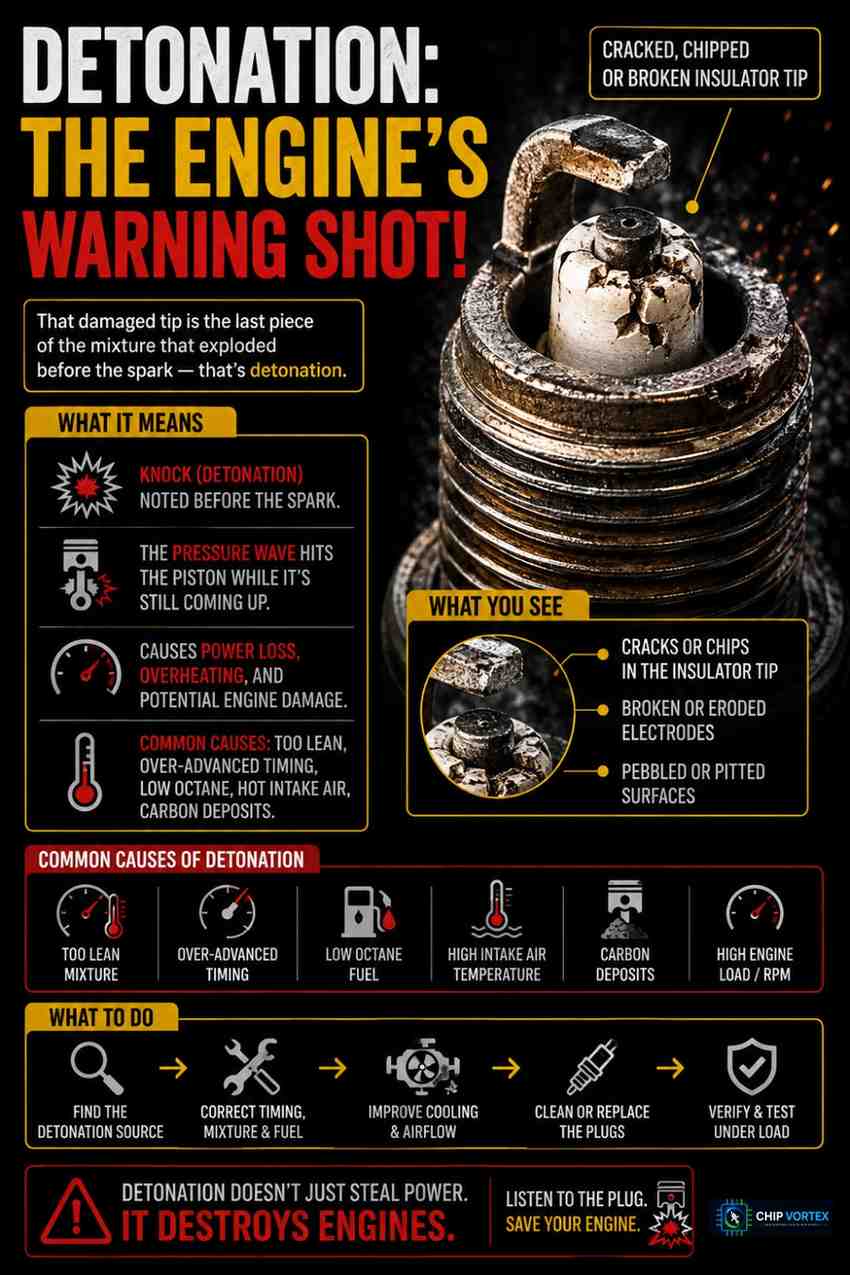
What you see: a cracked, chipped, or broken insulator tip — the plug looks hammered, because it was.
What it means: knock. Instead of burning smoothly, the last portion of the mixture exploded, sending shock waves through the chamber. The plug shatters first; pistons and rings are next in line. Causes: fuel octane too low, over-advanced timing, lean mixture, hot intake air, or glowing carbon deposits.
Action: correct the octane, timing, and mixture — and if detonation ran for long, inspect the engine for deeper damage.
10. Ash Fouled
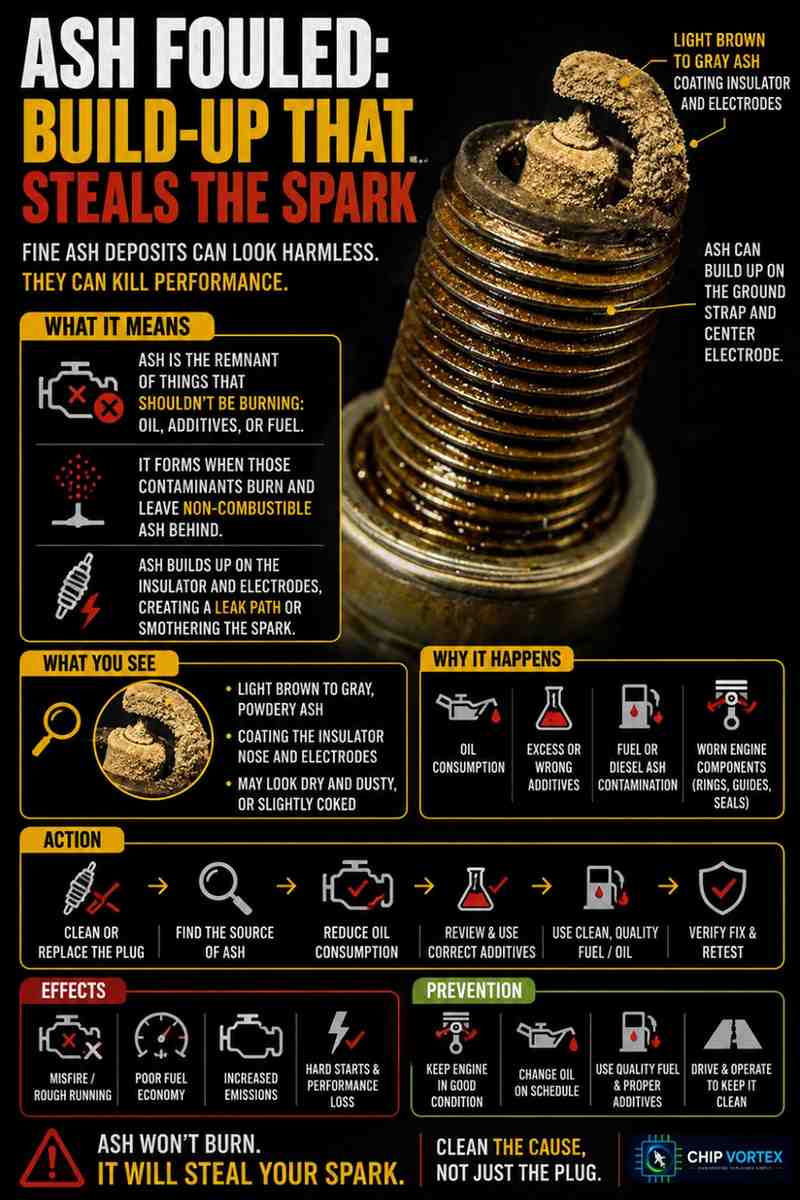
What you see: light brown to whitish crusty deposits caked on the insulator and electrodes.
What it means: ash is the mineral residue of things that shouldn’t be burning in quantity — engine oil sneaking past seals, or heavy-handed fuel and oil additives. Enough ash can mask the spark and misfire the cylinder.
Action: track the oil consumption, reconsider the additive habit, and fit fresh plugs once the source is under control.
11. Carbon Fouled
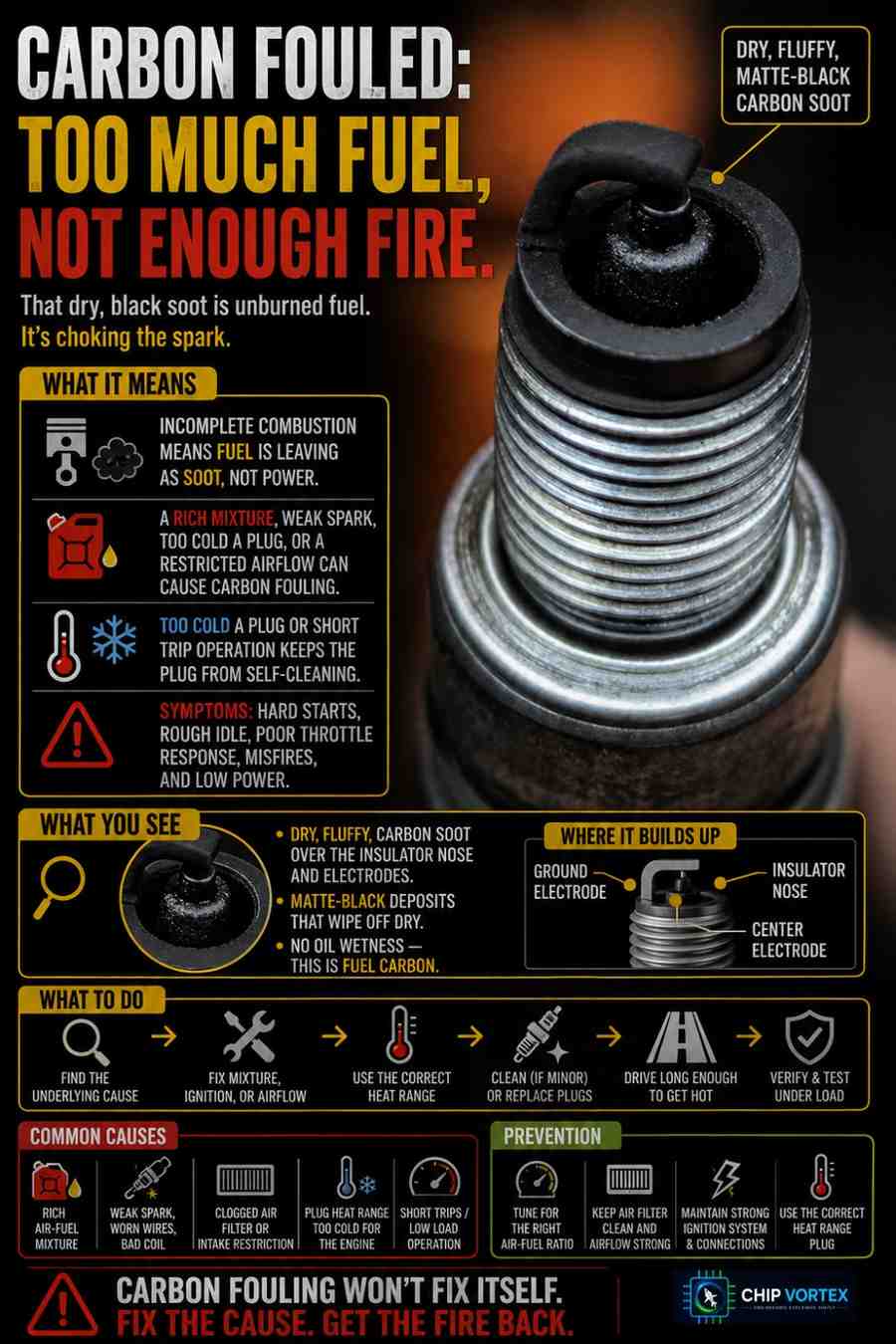
What you see: dry, fluffy, matte-black soot over the insulator and electrodes — black, but dry, which is what separates it from oil fouling.
What it means: incomplete combustion. A rich mixture, a clogged air filter, a weak spark, a plug heat range too cold, or a life of short trips and idling that never lets the plug reach self-cleaning temperature. Symptoms: hard starts and misfires.
Action: fix the richness or ignition weakness first; clean or replace the plugs; and if the engine’s duty is genuinely all short trips, a one-step-hotter plug (within manufacturer limits) can help it stay clean.
12. Worn
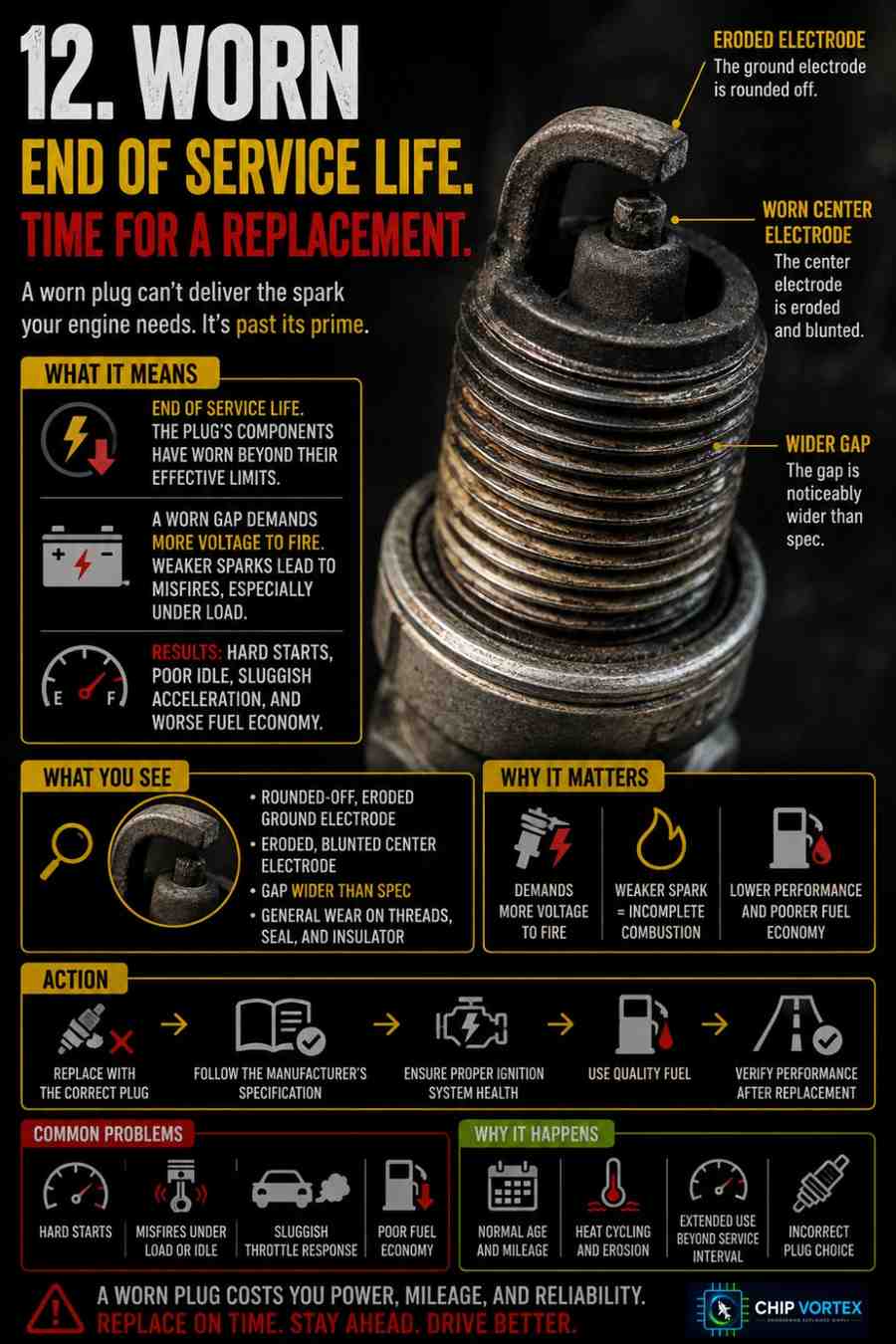
What you see: rounded-off, eroded electrodes and a gap visibly wider than spec — no drama, just age.
What it means: end of service life. A worn gap demands more voltage than the ignition can comfortably supply, so you get misfires under load, sluggish starts, and worse fuel economy.
Action: replace with the correct specification — and note that modern iridium and platinum plugs hold their gap several times longer than old copper-core plugs ever could.
Reading Plugs the Aviation Way
Spark plug reading isn’t just a car skill — it’s a living part of aircraft maintenance. Piston aircraft engines carry two spark plugs per cylinder, fired by two independent magnetos: redundancy first, but also cleaner, more complete combustion. Plugs are pulled, read, cleaned, gapped, and rotated between positions at inspections — plug reading on a schedule, not just when trouble appears.
And aviation has a plug condition car mechanics almost never see anymore: lead fouling. Avgas (100LL) still contains tetraethyl lead, which can form conductive lead deposits and beads that short out plugs. Pilots manage it in flight with proper leaning technique, and engineers manage it on the bench during cleaning. Even the pre-takeoff magneto check is really a live plug-and-ignition health test — switch to one magneto, watch the rpm drop, and you’ve just diagnosed half the ignition system in five seconds.
FAQ: Reading Spark Plugs
What should a healthy spark plug look like?▾
A light tan to grayish-brown insulator with mild, even electrode wear and no heavy deposits. That color means correct mixture, correct heat range, and clean combustion.
What causes black spark plugs?▾
It depends on wet versus dry. Dry, fluffy black soot is carbon fouling — a rich mixture or weak spark. Wet, oily black deposits mean oil is entering the cylinder — worn rings, valve seals, or a leaking turbo seal. The distinction changes the entire diagnosis.
Can I clean and reuse spark plugs?▾
Lightly carbon-fouled or splash-fouled plugs can often be cleaned and refitted. Glazed, oil-fouled, damaged, or worn plugs should be replaced — and with modern iridium/platinum plugs, replacement at interval is usually the smarter economy anyway.
Do bad spark plugs always mean an engine problem?
Not always — sometimes a plug is simply worn out. But most abnormal readings are the engine reporting an upstream cause: mixture, ignition, heat range, oil control, or fuel quality. Read the plug, then fix what wrote the message.
Why do aircraft engines have two spark plugs per cylinder? Redundancy and combustion quality. Two independent magneto-fired plugs mean an ignition failure never silences a cylinder, and two flame fronts burn the mixture more completely — which is also why the pre-takeoff magneto check exists.
Which of the 12 have you actually pulled out of an engine? Tell us in the comments — worn and carbon-fouled are common, but someone always has a detonation story. Save the chart to your workshop board, and if boost is part of your engine’s life, pair this with our guide to the types of turbochargers — turbo seals and plug readings are old friends.