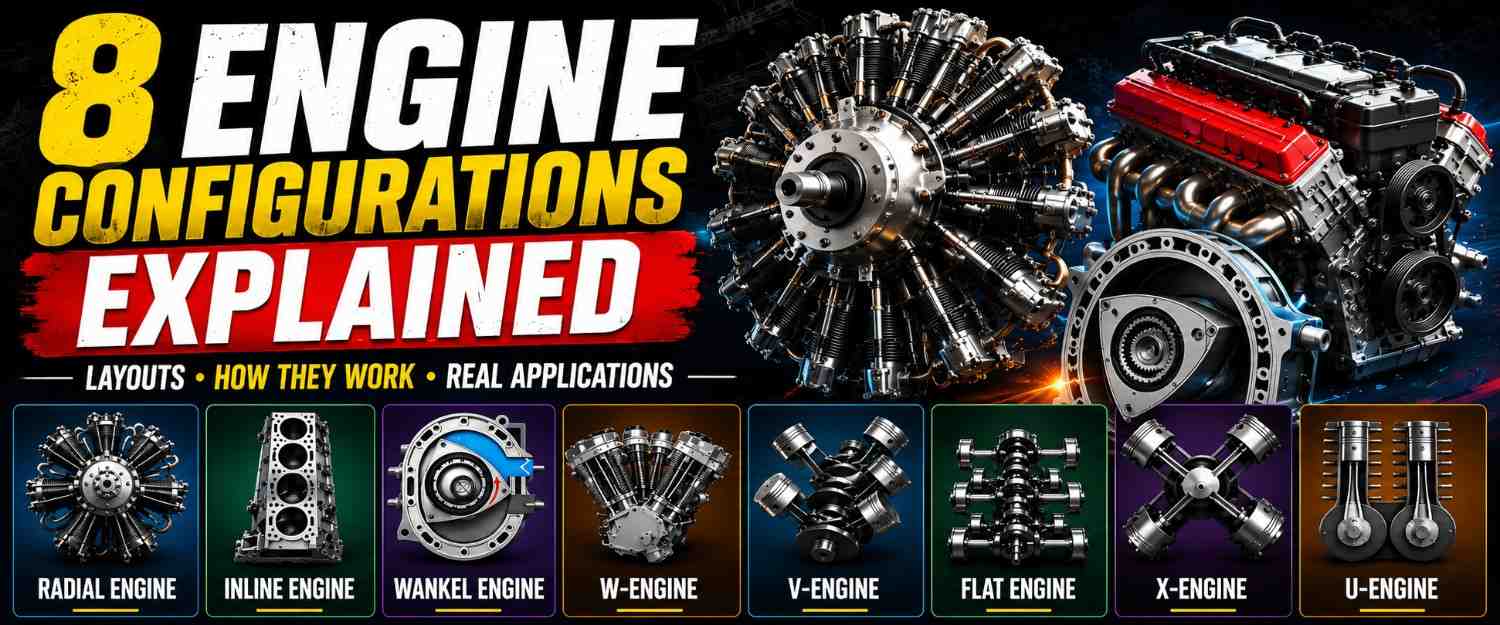
Internal combustion engines are available in several configurations based on the position of their cylinders, pistons, rotors and crankshafts. The most recognized layouts include radial, inline, V, flat, W, X and U engines, while the Wankel uses a rotating triangular rotor instead of conventional pistons.
Each engine configuration creates a different balance between size, weight, vibration, cooling, power output and maintenance access. Some layouts are widely used in modern cars, while others were developed mainly for aircraft, military vehicles, ships or specialized machinery.
In this guide, you will learn how eight important engine configurations work, where they are used and why engineers choose one layout over another.
Important distinction: These are engine configurations, not a complete list of all engine types. Engines can also be classified by fuel, combustion cycle, cooling system, ignition method and application.
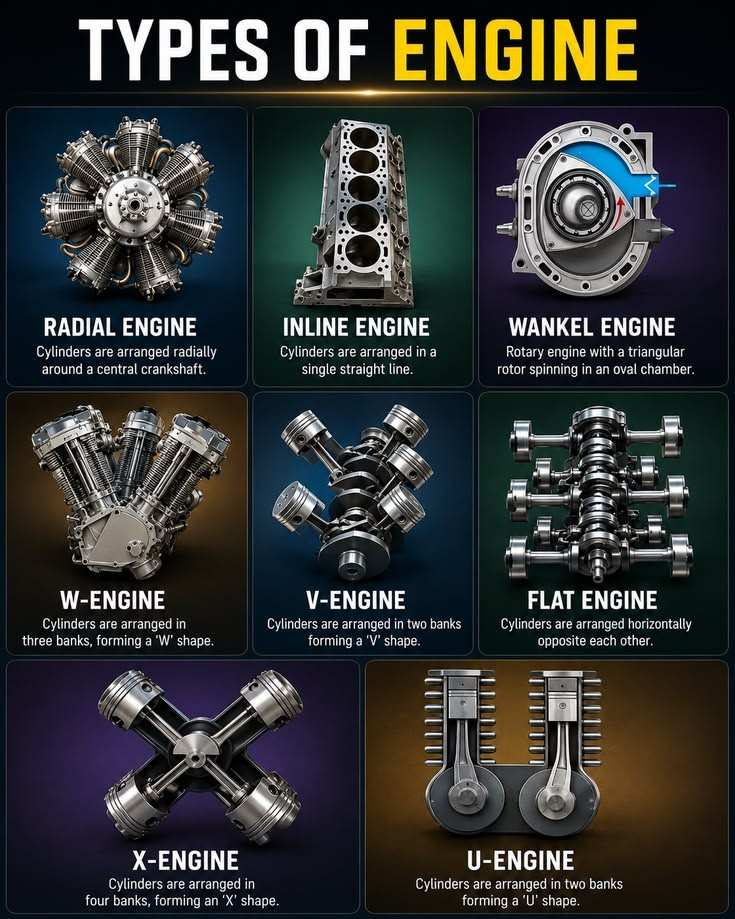
Engine Configurations at a Glance
| Configuration | Basic Arrangement | Main Advantage | Main Limitation | Common Application |
|---|---|---|---|---|
| Radial | Cylinders arranged around a central crankshaft | Strong cooling and power-to-weight ratio | Large frontal area | Historic aircraft |
| Inline | Cylinders arranged in one straight row | Simple and narrow design | Becomes long with more cylinders | Cars, trucks and motorcycles |
| Wankel | Triangular rotor inside a shaped housing | Compact and smooth at high RPM | Seal wear and fuel-efficiency challenges | Sports cars and experimental aircraft |
| W | Three or four cylinder rows in a compact block | High displacement in a short package | Complex construction | Luxury and high-performance vehicles |
| V | Two angled cylinder banks | Shorter than an equivalent inline engine | Wider and mechanically more complex | Cars, trucks and marine engines |
| Flat | Cylinders positioned horizontally opposite each other | Low center of gravity | Requires greater width | Light aircraft, Porsche and Subaru |
| X | Four cylinder banks around one crankshaft | High power in a short engine | Difficult cooling and maintenance | Experimental aircraft and military systems |
| U | Two inline engines connected through a common output | Can combine existing engine designs | Heavy and mechanically complicated | Historic vehicles and marine systems |
What Does Engine Configuration Mean?
An engine configuration describes the physical arrangement of an engine’s cylinders, pistons, connecting rods, crankshafts or rotors.
In a conventional reciprocating engine, combustion pressure pushes a piston through a cylinder. The piston is connected to the crankshaft through a connecting rod. Its up-and-down movement is converted into rotating motion that can turn a propeller, transmission, generator or other mechanical load. (Federal Aviation Administration)
Changing the cylinder arrangement affects several important engineering factors:
- Engine length and width
- Center of gravity
- Mechanical balance
- Cooling airflow
- Crankshaft strength
- Maintenance access
- Manufacturing complexity
- Power-to-weight ratio
There is no single layout that is best for every application. Engineers choose a configuration according to available space, required output, operating speed, cooling needs and manufacturing cost.
1. Radial Engine
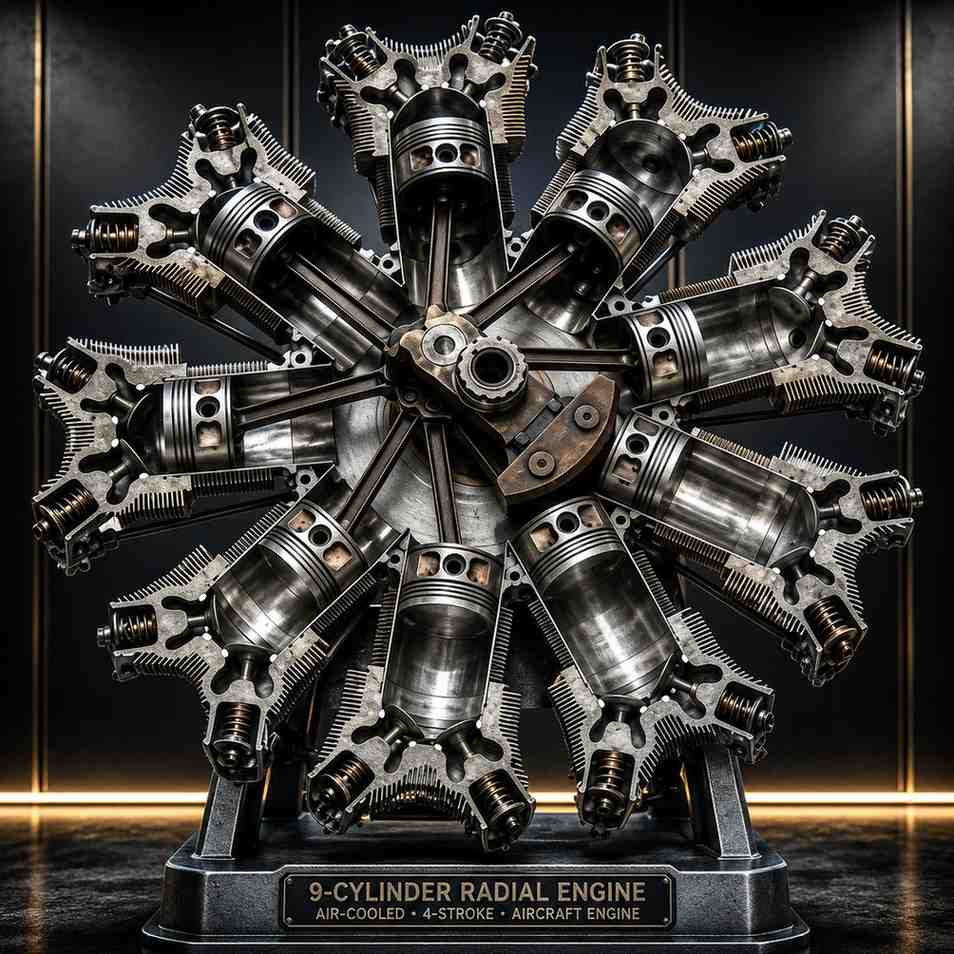
A radial engine positions its cylinders in a circular pattern around a central crankshaft. When viewed from the front, the cylinders resemble the spokes of a wheel.
How a radial engine works
The pistons cannot all use conventional connecting rods on the same crankpin. Radial engines commonly use a master-and-articulating rod assembly. One piston connects to the crankshaft through the master rod, while the remaining pistons connect to articulated rods attached to it.
Many four-stroke radial engines use an odd number of cylinders in each row. This arrangement helps create an evenly spaced firing sequence.
Main advantages
Radial engines became highly suitable for early aircraft because their exposed cylinders received strong cooling airflow. They could also produce substantial power without requiring a long engine block.
Their short crankshaft and compact longitudinal shape helped create a strong, relatively light powerplant.
Main limitations
The circular cylinder layout gives the engine a large frontal area. This increases aerodynamic drag and can make the aircraft nose wider.
Large radial engines may also have complicated lubrication behavior. Oil can collect in lower cylinders while the aircraft is parked, which must be considered before starting the engine.
Common applications
Radial engines were widely used in military and commercial aircraft before gas turbines became dominant. Famous radial-powered aircraft include the:
- Douglas DC-3
- Boeing B-17 Flying Fortress
- Republic P-47 Thunderbolt
- Vought F4U Corsair
Radial engines are now mainly found in preserved aircraft, restored warbirds, specialist aviation applications and scale models. The FAA’s powerplant training material discusses radial and horizontally opposed reciprocating-engine arrangements as important aircraft-engine configurations. (Federal Aviation Administration)
Maintenance consideration
Radial-engine maintenance requires careful inspection of cylinder fins, pushrod tubes, oil leaks, ignition harnesses and the master-rod system. Access to front cylinders may be good, but components behind the cylinder rows can be difficult to reach.
2. Inline Engine
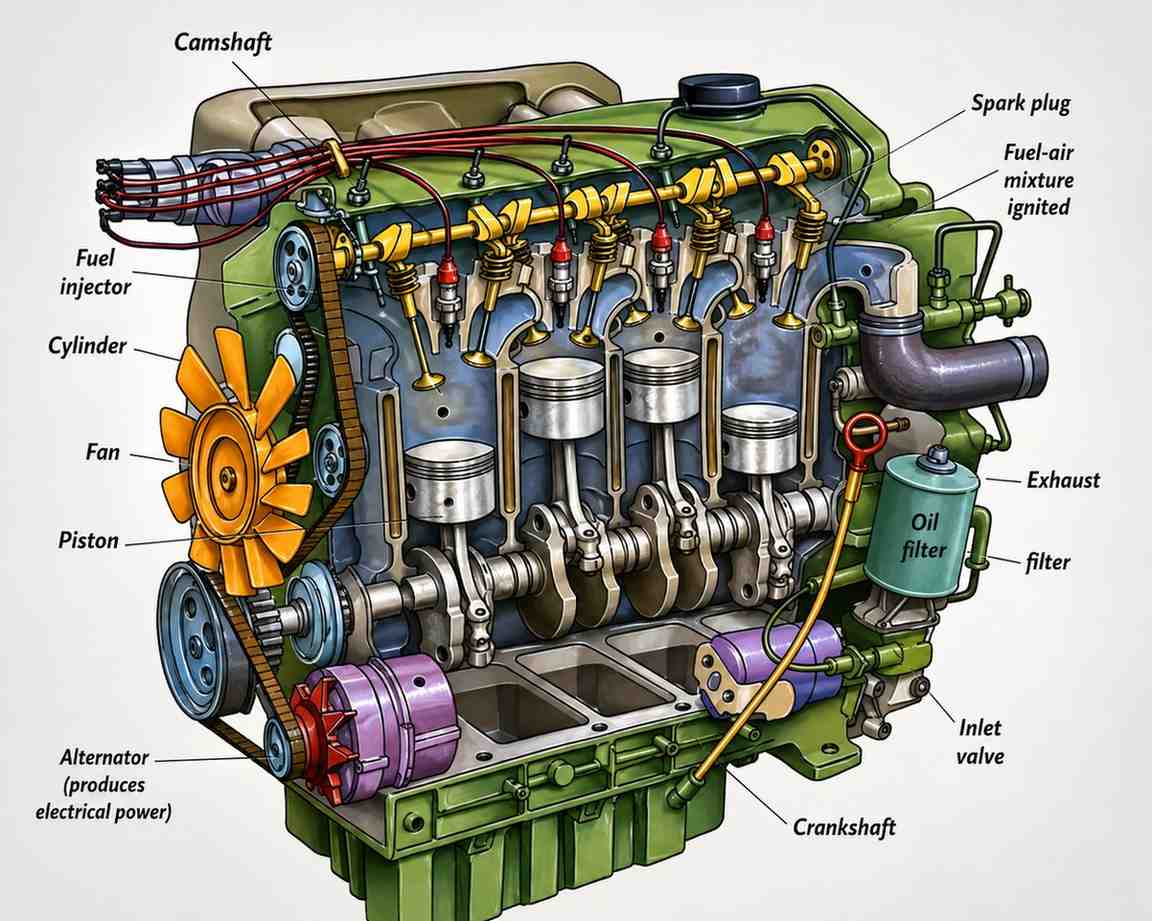
An inline engine, also called a straight engine, places all its cylinders in one row along a common crankshaft.
Common examples include the inline-three, inline-four and inline-six.
How an inline engine works
Each piston moves inside its own cylinder and connects to a crankshaft journal through a connecting rod. The cylinder head, valve train and intake system can usually be arranged along one side or across the top of the engine.
The inline-four has become one of the most widely used configurations in passenger vehicles because it offers a useful combination of simplicity, efficiency and compact width.
Main advantages
Inline engines generally have:
- One cylinder head
- A relatively simple valve train
- Narrow engine width
- Straightforward manufacturing
- Easier access to many components
An inline-six can also achieve excellent natural primary and secondary balance when correctly designed. This creates smooth operation without requiring the same level of vibration control used by some other layouts.
Main limitations
The engine becomes longer as more cylinders are added. A straight-six may be smooth, but it needs more longitudinal space than many V6 engines.
The long crankshaft can also experience torsional vibration and bending loads, particularly in large or high-output applications.
Common applications
Inline engines are used in:
- Passenger cars
- Motorcycles
- Light trucks
- Commercial diesel vehicles
- Agricultural equipment
- Generators
- Historic aircraft
Early aircraft sometimes used upright or inverted inline engines. An inverted layout improved pilot visibility and provided more propeller clearance in certain airframes.
Maintenance consideration
A single cylinder head can simplify inspection and repair. However, access depends heavily on whether the engine is mounted longitudinally, transversely, upright or inverted.
3. Wankel Engine
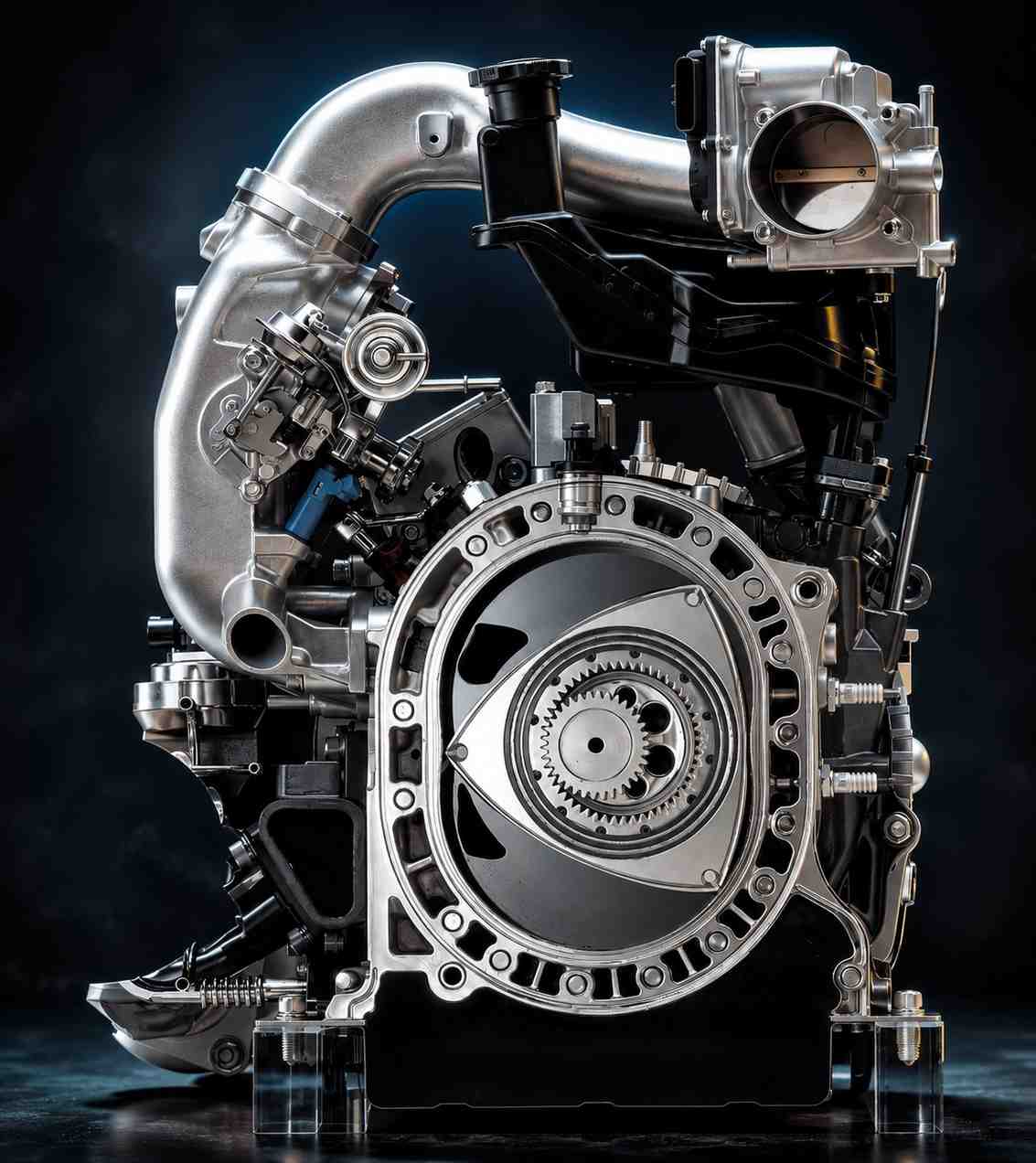
The Wankel engine, often called a rotary engine, is different from the other configurations in this guide because it does not use conventional reciprocating pistons.
Instead, a triangular rotor moves inside a specially shaped housing.
How a Wankel engine works
The rotor turns eccentrically inside an epitrochoid-shaped housing. Its three faces create moving combustion chambers whose volumes expand and contract as the rotor travels.
During operation, these chambers pass through the intake, compression, combustion and exhaust regions of the housing. The rotor drives an eccentric shaft, which produces the engine’s useful output.
NASA has studied Wankel-type rotary engines for general aviation because of their compact dimensions, low vibration and potential power-to-weight advantages. (NASA Technical Reports Server)
Main advantages
The Wankel engine contains fewer major moving components than a conventional piston engine. It does not require connecting rods, conventional pistons or a reciprocating valve train.
Its important characteristics include:
- Compact physical size
- Smooth rotary motion
- High power output for its dimensions
- Strong high-RPM capability
- Low reciprocating vibration
Main limitations
The tips of the rotor use apex seals to maintain compression between adjacent chambers. These seals operate under demanding thermal and lubrication conditions.
Common challenges include:
- Apex-seal wear
- Oil consumption
- Combustion-chamber sealing
- Heat distribution
- Fuel efficiency
- Exhaust emissions
NASA research has examined rotary-engine sealing, combustion, airflow and performance because these areas strongly influence reliability and efficiency. (NASA Technical Reports Server)
Common applications
The Wankel is best known for its use in Mazda vehicles such as the RX-7 and RX-8. Rotary engines have also appeared in:
- Racing vehicles
- Unmanned aircraft
- Experimental general aviation aircraft
- Range extenders
- Compact generators
Maintenance consideration
Rotary engines require close attention to lubrication, compression condition, cooling and apex-seal health. Their small number of moving parts does not automatically make them maintenance-free.
4. W-Engine
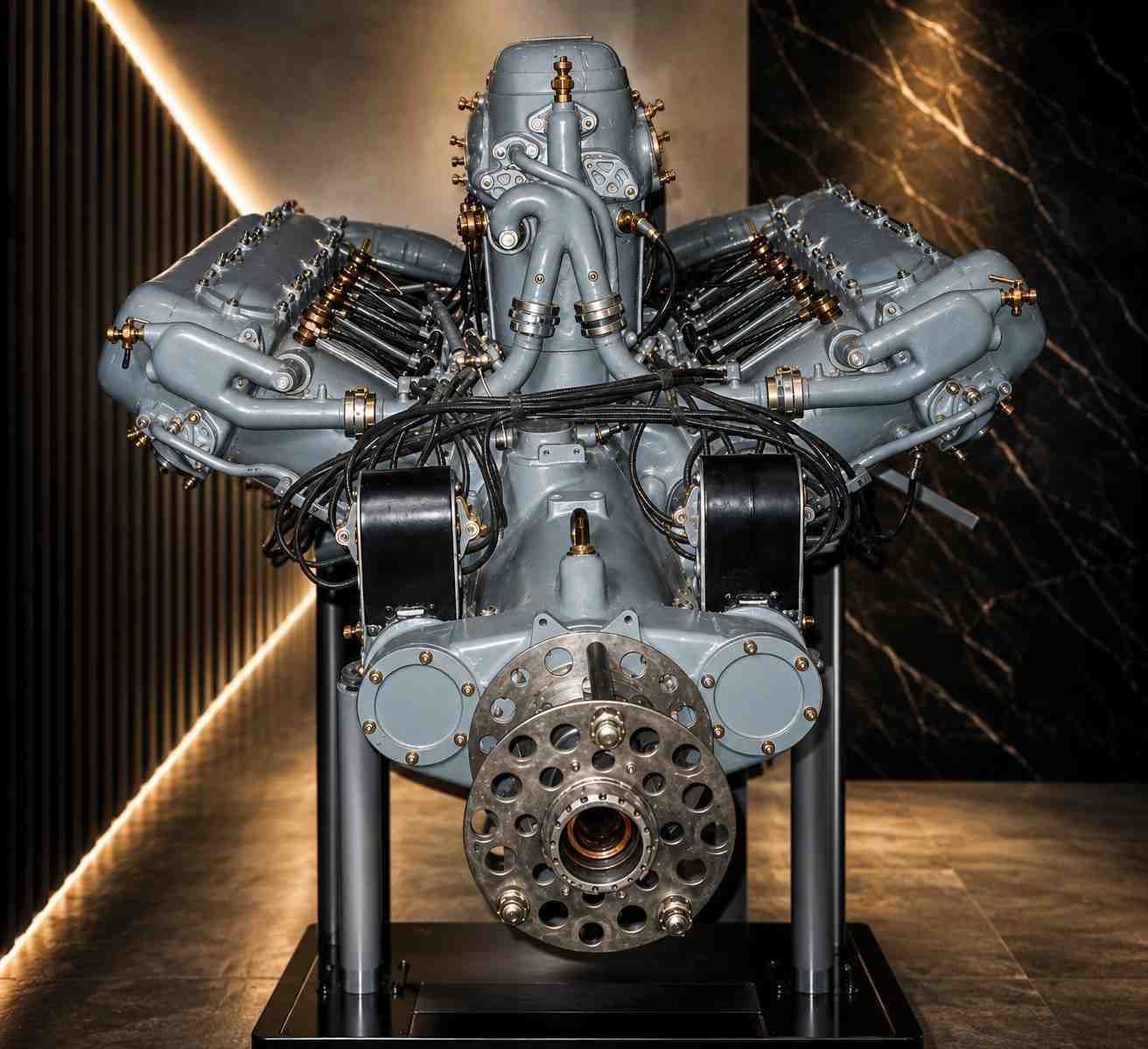
A W-engine uses multiple cylinder banks or narrow cylinder rows arranged around one crankshaft to create a short, high-displacement engine.
The term covers more than one mechanical arrangement.
How a W-engine works
Some historical W-engines used three distinct cylinder banks. Viewed from the front, the arrangement resembled the letter W.
Modern automotive W12 and W16 engines are different. Volkswagen Group designs combine narrow-angle cylinder groups to produce four closely positioned cylinder rows around one crankshaft.
This allows engineers to fit a large number of cylinders into an engine that is shorter than a conventional V12 or V16.
Main advantages
A W-engine can provide:
- High displacement
- Large torque output
- Short overall engine length
- Compact packaging for its cylinder count
- Strong performance potential
Main limitations
The layout requires complicated:
- Cylinder heads
- Intake passages
- Exhaust routing
- Cooling circuits
- Timing systems
- Crankshaft design
The large number of cylinders and closely packed components also increases cost, weight and maintenance difficulty.
Common applications
Modern W-engines are associated mainly with high-performance and luxury vehicles, including:
- Bugatti Veyron
- Bugatti Chiron
- Bentley Continental GT
- Volkswagen Phaeton
- Audi A8 W12
Historical W configurations also appeared in experimental aircraft and specialized engines.
Maintenance consideration
Tightly packed cylinder rows leave limited space around the intake, exhaust, ignition and cooling systems. Even relatively small repairs may require the removal of surrounding assemblies.
5. V-Engine
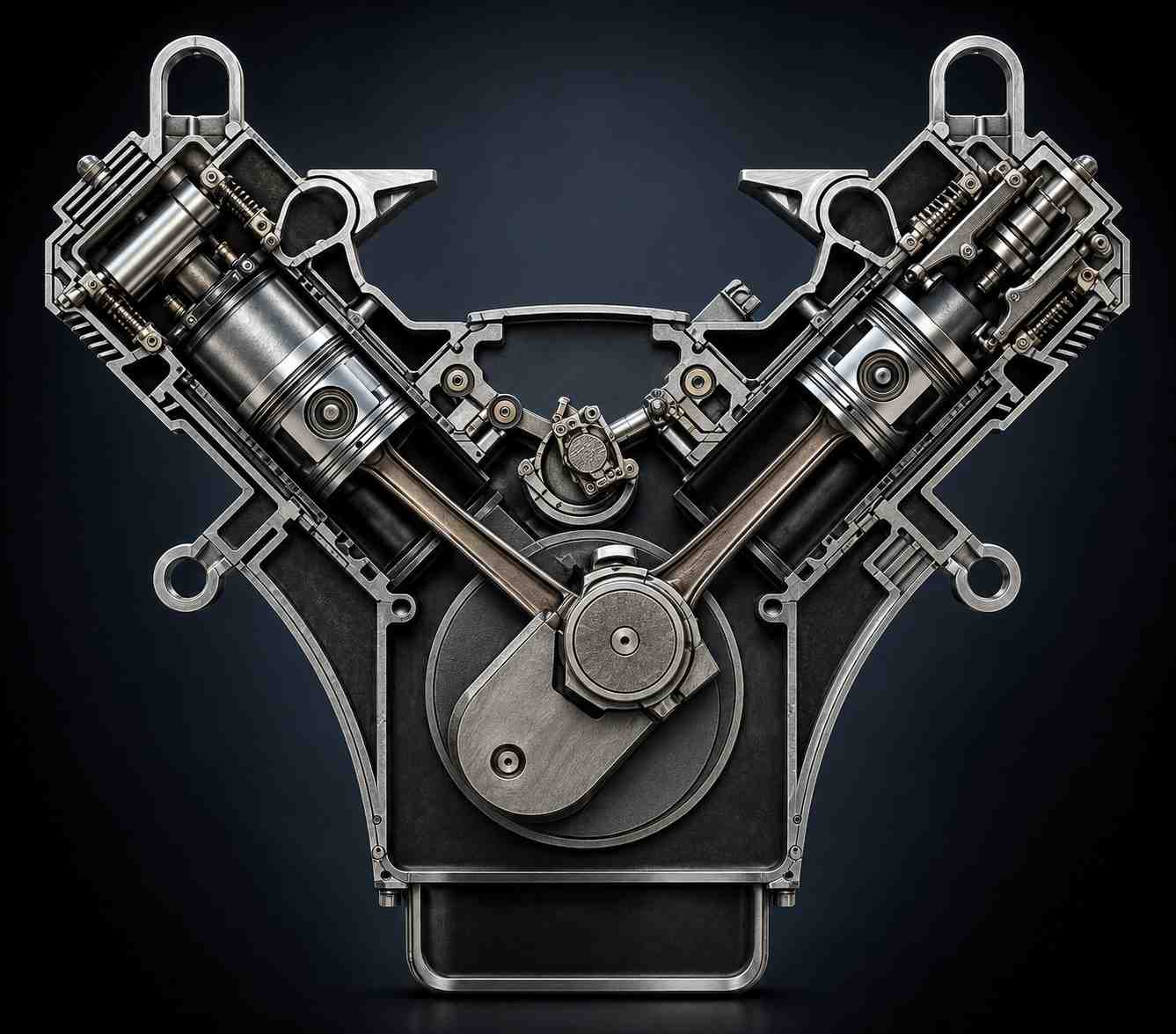
A V-engine places its cylinders in two banks angled away from each other above a common crankshaft.
Viewed from the front, the cylinder banks form the shape of the letter V.
How a V-engine works
Pistons from both cylinder banks connect to one crankshaft. Depending on the design, connecting rods may share crankpins, use adjacent journals or use split crankpins.
Common bank angles include:
- Approximately 60 degrees for many V6 engines
- Approximately 90 degrees for many V8 engines
- Around 60 degrees for many V12 engines
The correct bank angle depends on cylinder count, firing intervals, crankshaft design and packaging requirements.
Main advantages
A V-engine is shorter than an inline engine with the same number of cylinders. This makes it easier to fit six, eight, ten or twelve cylinders into a limited engine bay.
It also provides:
- High displacement potential
- Strong structural rigidity
- Flexible engine-bay packaging
- High torque capability
- Compatibility with many vehicle platforms
Main limitations
V-engines are wider than inline engines and normally require two cylinder heads, two exhaust manifolds and a more complicated valve train.
Some V configurations also need balance shafts, specialized crankshafts or carefully designed engine mounts to control vibration.
Common applications
V-engines are widely used in:
- Passenger vehicles
- Performance cars
- Pickup trucks
- SUVs
- Marine powerplants
- Industrial equipment
- Historic aircraft
V6, V8 and V12 arrangements are among the most familiar V-engine designs. (Wikipedia)
Maintenance consideration
Having two cylinder banks can make access uneven. Components placed between the banks—sometimes called the engine valley—may be difficult to inspect or replace.
6. Flat Engine
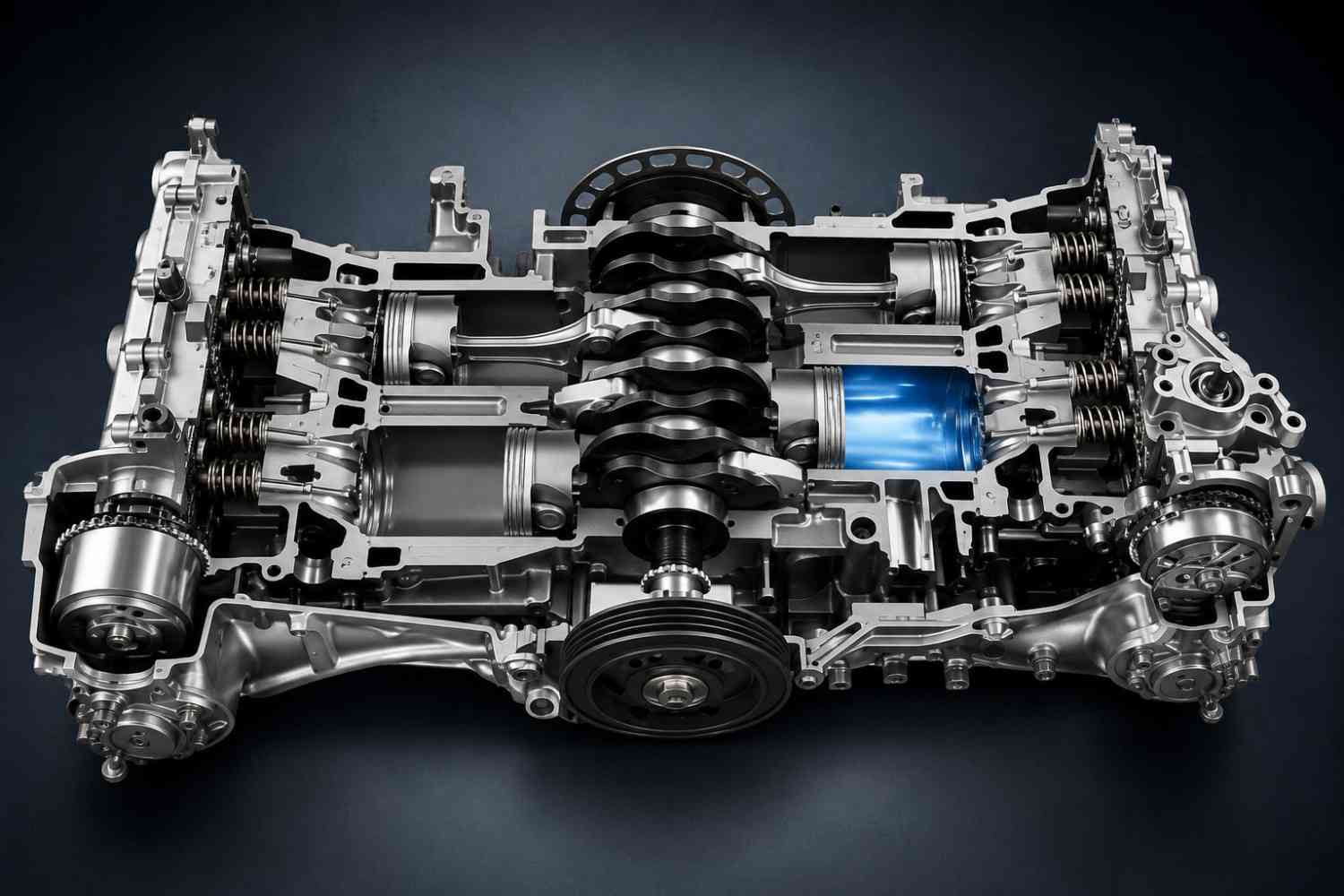
A flat engine places its cylinder banks horizontally on opposite sides of a central crankshaft.
It may also be described as a horizontally opposed engine, although “flat engine,” “opposed engine” and “boxer engine” should not always be treated as identical terms.
Boxer engine versus 180-degree V-engine
In a true boxer engine, each opposing piston normally uses a separate crankpin. The pistons move inward and outward in opposite directions, resembling two boxers striking toward each other.
In a 180-degree V-engine, opposing connecting rods may share crankpins. This produces different piston movement and balance characteristics.
Both designs appear flat from the outside, but their crankshaft arrangements are not necessarily the same.
Main advantages
Flat engines provide a low center of gravity because the cylinders lie horizontally rather than standing above the crankshaft.
Other advantages include:
- Short engine height
- Good mechanical balance
- Smooth operation
- Direct exposure of aircraft cylinders to cooling airflow
- Reduced vertical vibration in many designs
Main limitations
The engine is wide. This can create installation challenges in vehicles with narrow engine bays.
Cylinder heads, spark plugs and exhaust components may also be located close to the surrounding body structure.
Common applications
Flat engines are strongly associated with:
- Subaru vehicles
- Porsche sports cars
- Volkswagen Beetles
- BMW motorcycles
- Light aircraft
Horizontally opposed, air-cooled piston engines remain common in general aviation because they offer a low profile, useful cooling exposure and practical power-to-weight performance. The FAA includes opposed reciprocating engines in its aircraft powerplant training materials. (Federal Aviation Administration)
Maintenance consideration
Light-aircraft opposed engines provide direct cylinder access after the cowling is removed. Technicians must still inspect cooling baffles carefully because poor airflow distribution can produce uneven cylinder temperatures.
7. X-Engine
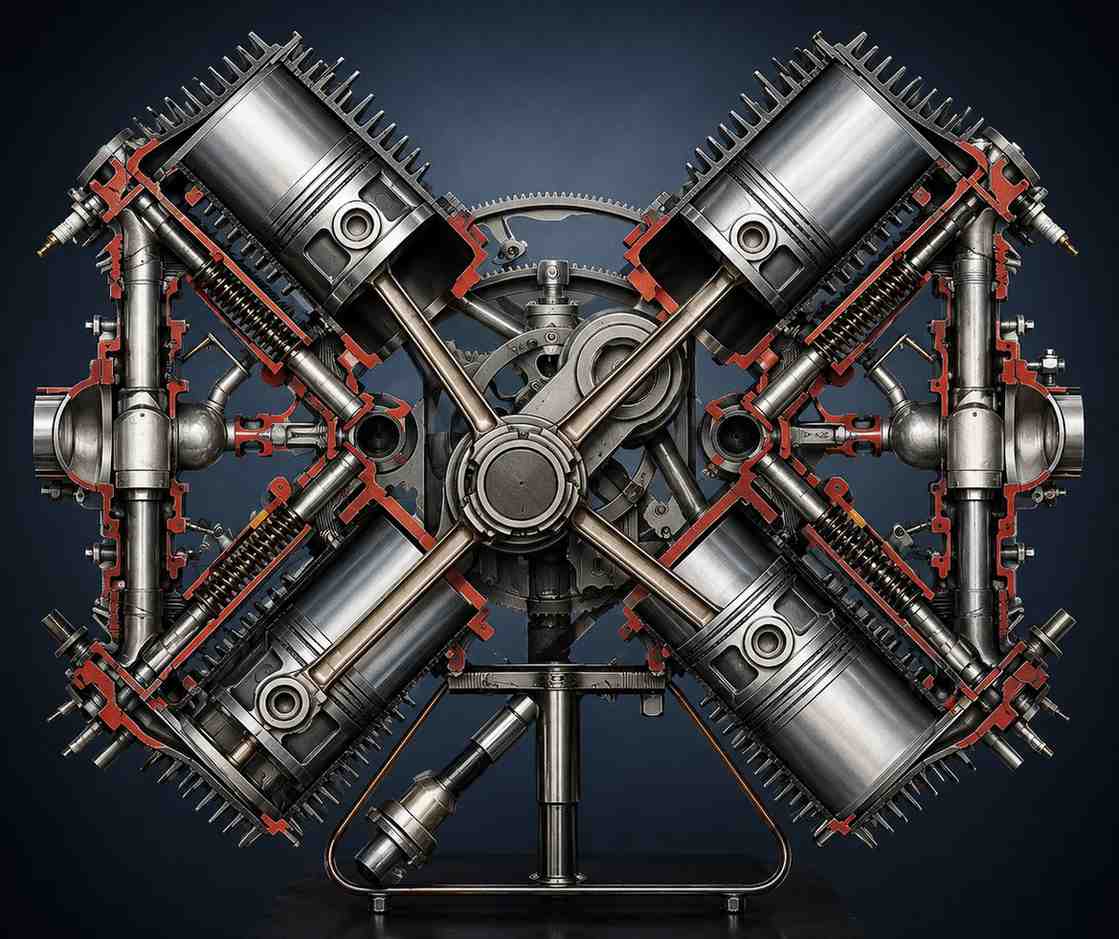
An X-engine places four cylinder banks around one central crankshaft. Viewed from the front, the banks resemble the letter X.
It can be visualized as two V-shaped cylinder arrangements crossing around a common axis.
How an X-engine works
Four banks of pistons transfer force to one crankshaft through a complex connecting-rod arrangement. The design makes it possible to install a large number of cylinders without creating an extremely long engine.
Main advantages
The main benefit is high power density in a relatively short longitudinal package.
An X-engine can provide:
- Large cylinder count
- High potential output
- Shorter overall length
- Reduced frontal area compared with some radial layouts
Main limitations
The configuration is mechanically difficult to design, manufacture and service.
Common engineering challenges include:
- Complex connecting rods
- Difficult cooling distribution
- Restricted maintenance access
- Heavy crankcase construction
- Complicated lubrication
- High production cost
Common applications
X-engines have mostly appeared in experimental or limited-production applications, including:
- Large military aircraft projects
- Armored vehicles
- Marine systems
- Prototype high-output engines
They never became common in passenger vehicles because simpler V and inline engines could provide adequate power with lower cost and easier maintenance.
Maintenance consideration
The lower and inner cylinder banks can be difficult to reach. Cooling and oil distribution must also work effectively at several different cylinder positions.
8. U-Engine
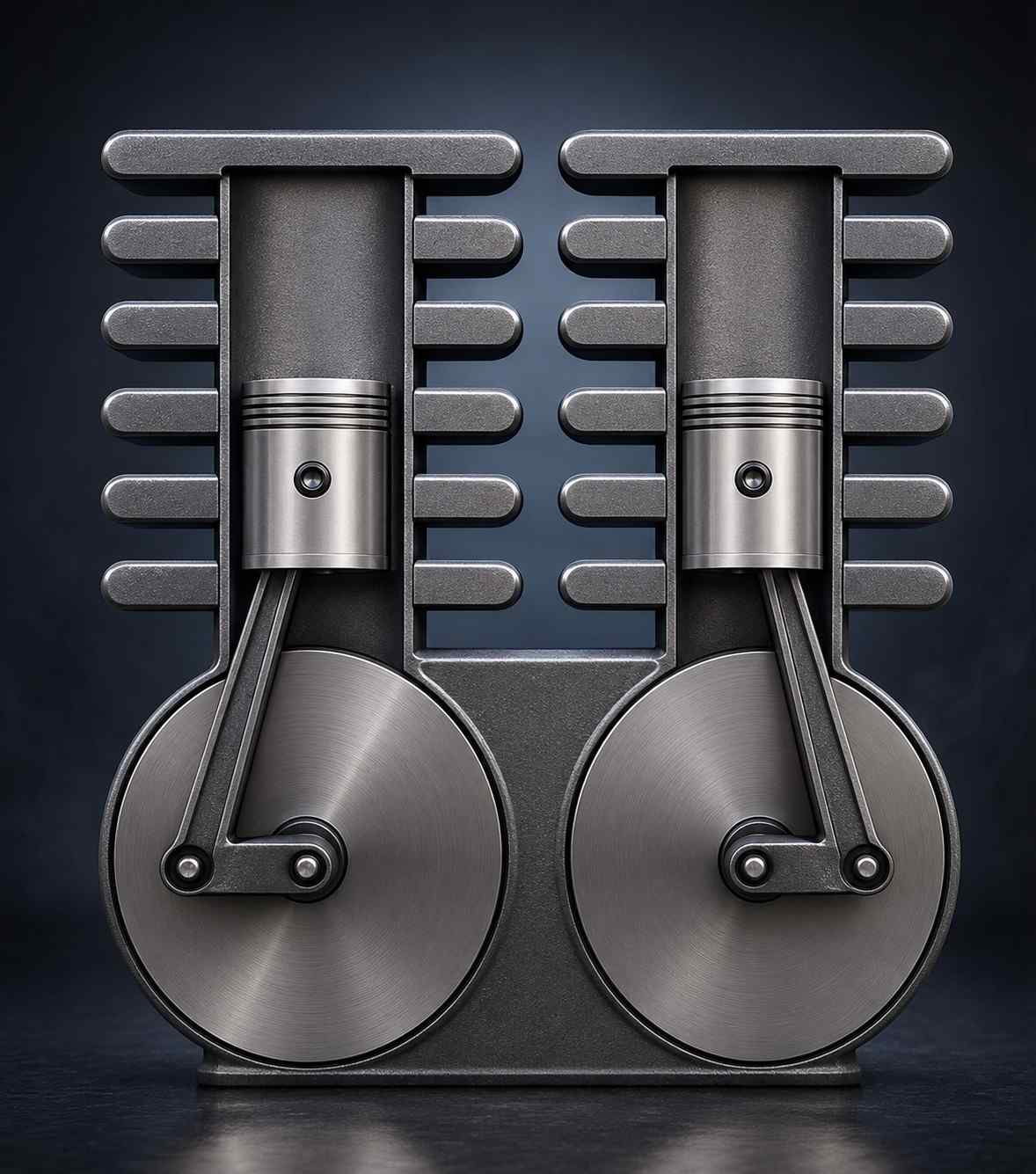
A U-engine combines two separate inline engines placed side by side.
Unlike a V-engine, which uses one crankshaft, a conventional U-engine has two crankshafts connected through gears, chains or another common output system.
How a U-engine works
Each cylinder row operates like an independent inline engine. The two crankshafts rotate together and transfer power to a shared output shaft.
The end view of the two cylinder rows and connecting structure can resemble the letter U.
Main advantages
A U-engine can be created by combining existing inline-engine components. This historically allowed manufacturers to increase displacement and output without developing an entirely new large crankshaft.
Its potential advantages include:
- Reuse of existing engine parts
- Large combined displacement
- Independent cylinder rows
- Compact length compared with some long inline engines
Main limitations
The second crankshaft, connecting gears and additional structure increase:
- Weight
- Friction
- Mechanical losses
- Parts count
- Maintenance requirements
Synchronizing both crankshafts also adds complexity.
Common applications
U-engines have mainly appeared in historical:
- Racing cars
- Marine engines
- Locomotives
- Armored vehicles
- Experimental powerplants
They should not be confused with every vehicle that combines multiple separate engines. A multi-engine installation is only a U-engine when the units form the specific parallel, linked-crankshaft arrangement.
Maintenance consideration
Technicians must inspect not only two cylinder assemblies but also the gear or chain system connecting both crankshafts. Timing and synchronization errors can cause severe mechanical damage.
How Engine Layout Affects Performance
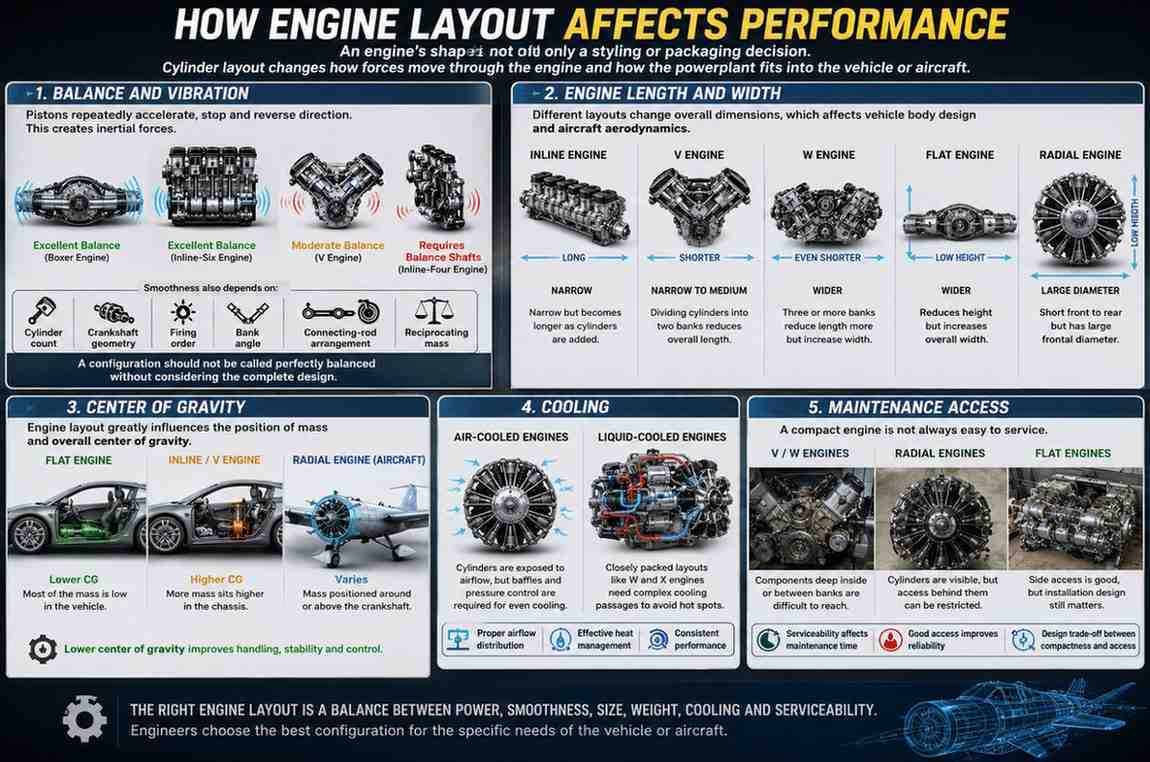
An engine’s shape is not only a styling or packaging decision. Cylinder layout changes how forces move through the engine and how the powerplant fits into the vehicle or aircraft.
Balance and vibration
Pistons repeatedly accelerate, stop and reverse direction. This creates inertial forces.
Some configurations naturally cancel more of these forces than others. Inline-six and boxer layouts can achieve excellent balance, while many inline-three, inline-four and V-engine designs may use counterweights, balance shafts or special engine mounts.
Smoothness also depends on:
- Cylinder count
- Crankshaft geometry
- Firing order
- Bank angle
- Connecting-rod arrangement
- Reciprocating mass
A configuration should not be called perfectly balanced without considering the complete design.
Engine length and width
Inline engines are narrow but become longer as cylinders are added.
V and W engines reduce overall length by dividing cylinders into multiple banks. Flat engines reduce height but increase width. Radial engines are short from front to rear but have a large frontal diameter.
These differences directly influence vehicle body design and aircraft aerodynamics.
Center of gravity
Flat engines position much of their mass low in the airframe or vehicle. This can improve handling and stability.
Inline, V and radial engines may position more mass above or around the crankshaft. The final center of gravity also depends on accessories, cooling systems, mounting position and transmission placement.
Cooling
Air-cooled engines need controlled airflow around the cylinder heads and barrels. Radial and horizontally opposed aircraft engines expose cylinders to incoming air, but they still need baffles and pressure control to distribute that air correctly.
Closely packed W and X layouts may require complex liquid-cooling passages to prevent localized hot areas.
Maintenance access
A mechanically compact engine is not always easy to service.
Components deep inside a W-engine or between the banks of a V-engine may be difficult to reach. Radial engines provide visible cylinders but may restrict access behind them. Flat aircraft engines can offer direct access from the sides, although installation design remains important.
Which Engine Configurations Are Still Common Today?
The most common modern layouts are:
- Inline engines, especially inline-three and inline-four designs
- V-engines, particularly V6 and V8 configurations
- Flat engines in selected automotive and aviation applications
W-engines are limited mainly to expensive high-performance vehicles. Wankel engines remain uncommon but continue to attract interest for specialized propulsion and range-extender applications.
Radial, X and U engines are now mainly historical, experimental or highly specialized.
Which Engine Configuration Is Best?
There is no universally best engine layout.
An inline-four may be ideal for an economical passenger car because it is simple and compact. A flat engine may be better when a low center of gravity is important. A V8 may be selected when high torque is needed within a limited engine length.
Aircraft engineers may prefer a horizontally opposed piston engine for a light aircraft because of its low profile and cooling arrangement. Historic high-power aircraft used radial engines because they provided strong output and effective air cooling with the technology available at the time.
The best configuration is the one that satisfies the application’s requirements with acceptable weight, vibration, cost, cooling and maintenance demands.
Frequently Asked Questions
What is the most common engine configuration?▾
The inline-four is one of the most common configurations in modern passenger vehicles. It is relatively simple, narrow, economical to manufacture and suitable for many front-wheel-drive platforms.
Is a boxer engine the same as a flat engine?▾
A boxer engine is a type of flat engine, but not every flat engine is necessarily a boxer. The difference depends primarily on crankpin and connecting-rod arrangement.
Is a Wankel engine an internal combustion engine?▾
Yes. A Wankel is an internal combustion engine, but it uses a rotor rather than conventional reciprocating pistons.
Why were radial engines popular in aircraft?▾
Radial engines offered a strong power-to-weight ratio, a short crankcase and good exposure to cooling airflow. Their large frontal area, however, increased aerodynamic drag.
Why are X-engines rare?▾
X-engines are difficult to manufacture, cool and maintain. Simpler V, inline and turbine powerplants can usually provide the required output with fewer mechanical complications.
Does a U-engine have two crankshafts?▾
Yes. A conventional U-engine uses two parallel cylinder blocks and two crankshafts linked to a common output.
Which engine layout has the lowest center of gravity?▾
A flat or horizontally opposed engine generally allows a lower engine mass position than an equivalent upright inline or V-engine. The vehicle’s complete center of gravity still depends on installation and surrounding components.
Final Takeaway
Engine configuration determines far more than the external shape of a powerplant. It influences mechanical balance, engine dimensions, cooling, vibration, center of gravity, manufacturing cost and maintenance access.
Inline and V-engines dominate modern road vehicles because they offer practical packaging and manufacturing advantages. Flat engines remain valuable in light aircraft and selected vehicles, while radial engines played a major role in aviation history.
The W, X and U layouts show how engineers have used multiple cylinder banks and crankshafts to fit greater power into limited space. The Wankel engine takes a completely different approach by replacing reciprocating pistons with a rotating combustion system.
Understanding these layouts creates a useful foundation for studying aircraft piston engines, automotive powerplants and advanced propulsion systems.