Every machine that moves does one of two things to the world: it pushes or it twists. Thrust is the push — the force that sends rockets up and aircraft forward in a straight line. Torque is the twist — the force that turns crankshafts, drills, and wheels around an axis. People mix them up because both feel like “engine strength,” but they live in different geometries, carry different units, and answer different questions. Here’s the clean split — and the beautiful secret the comparison hides: most machines spend their whole lives converting one into the other.
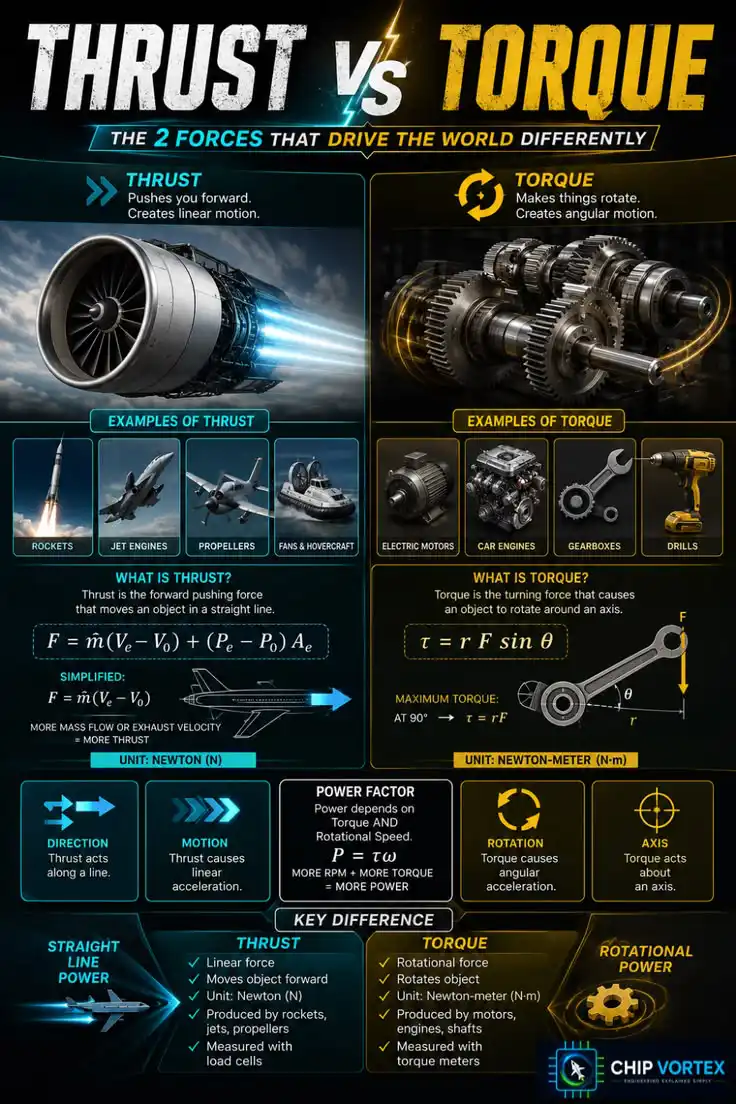
Save the chart, then let’s take each force apart.
Quick Answer: The Key Differences
| Thrust | Torque | |
|---|---|---|
| What it does | Pushes in a straight line | Rotates about an axis |
| Type of motion | Linear acceleration | Angular acceleration |
| Unit | Newton (N) | Newton-meter (N·m) |
| Produced by | Rockets, jets, propellers, fans | Motors, engines, gearboxes |
| Measured with | Load cells | Torque meters, dynamometers |
What Is Thrust?
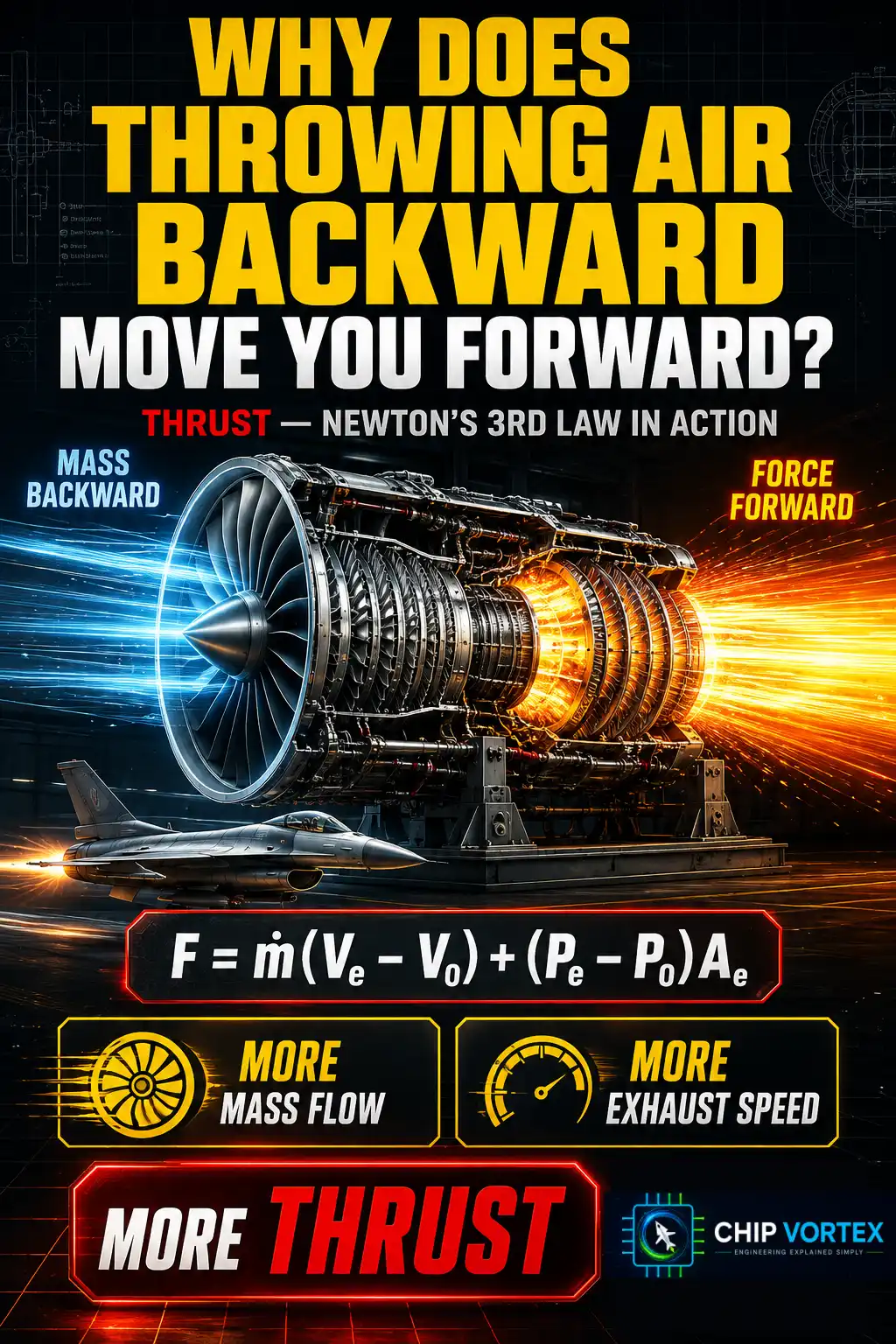
Thrust is Newton’s third law with ambition: throw mass backward, and the reaction pushes you forward. A jet engine swallows air and hurls it out the back faster than it came in; a rocket does the same with its own propellant; a propeller does it by accelerating a huge column of air rearward. The pin’s formula says exactly this in symbols:
F = ṁ(Vₑ − V₀) + (Pₑ − P₀)Aₑ
Read it gently: ṁ is how much mass flows through per second, (Vₑ − V₀) is how much faster it leaves than it arrived — multiply them and you have momentum thrust, the main event. The second term is a pressure bonus at the nozzle exit that matters mostly for rockets. The design lesson falls straight out: more mass flow, or more exhaust velocity, equals more thrust — move a lot of air a little faster (the big quiet fan) or a little air a lot faster (the screaming turbojet). Thrust is a pure force, measured in newtons, and on a test stand it’s measured by literally pushing against load cells.
What Is Torque?
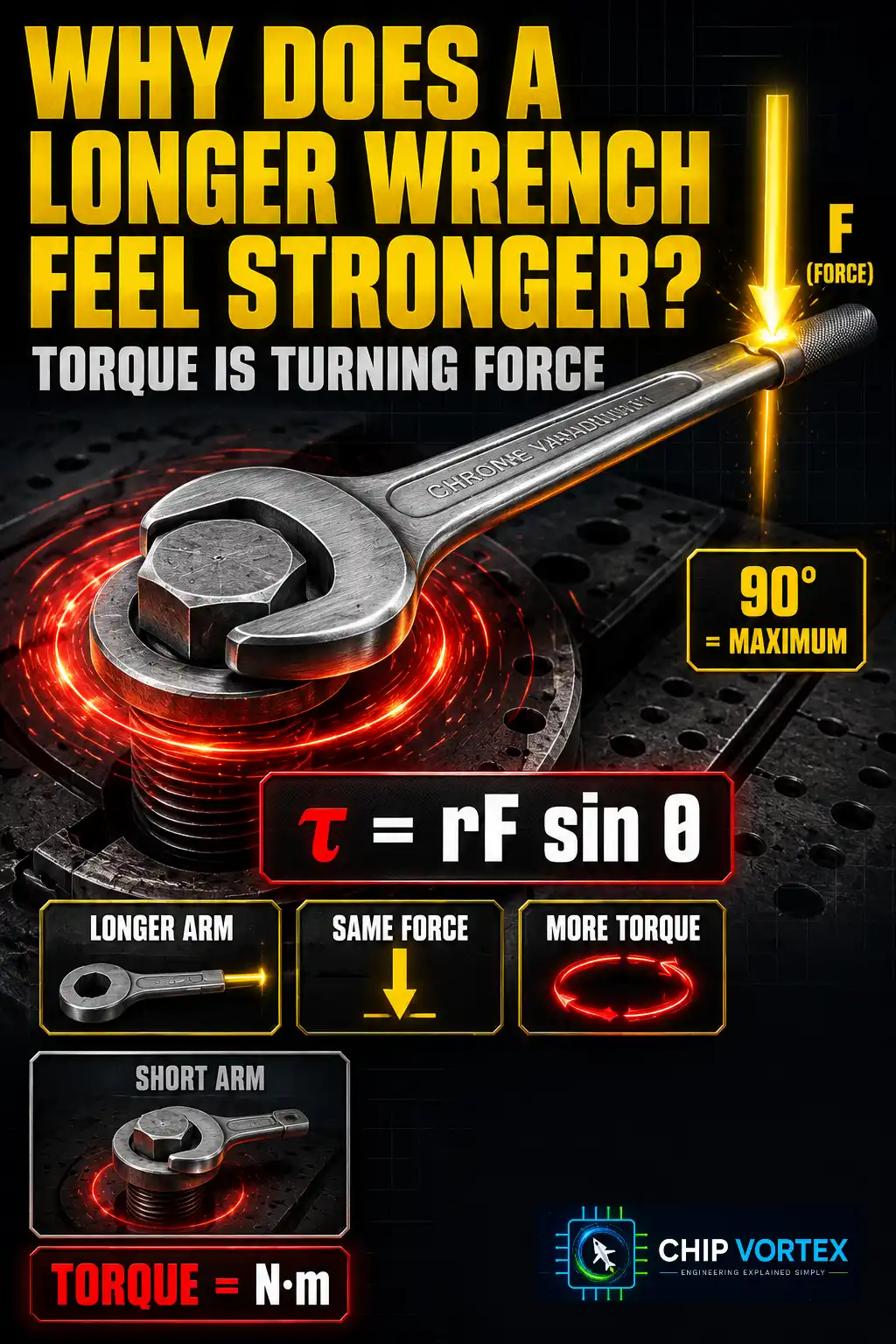
Torque is the turning force — and your hands already know its formula. Push on a wrench and the twist you create is:
τ = r F sin θ
F is your force, r is the length of the arm, and θ is the angle between them. Push at 90° to the handle and sin θ = 1: every newton works — τ = rF, maximum torque. Push along the handle toward the bolt and sin θ = 0: you can shove all day and nothing turns. That’s also why the forbidden “cheater pipe” works — slipping a pipe over a wrench doubles r, doubling the twist from the same arm. Torque rotates crankshafts, spins drill chucks, and is the entire product of a gearbox, whose gear ratios trade rotational speed for torque like a currency exchange. Its unit — the newton-meter — carries its own biography: a force and the arm it acts through.
The Secret: Machines Are Translators
Here’s what a versus chart can’t show — the two forces constantly become each other:
Linear → rotational: inside a piston engine, combustion shoves the piston down in a straight line, and the crankshaft’s offset journals — wrench arms in disguise — convert that push into torque. Every engine is a thrust-to-torque converter running thousands of times a minute.
Rotational → linear: bolt a propeller onto that torque and each blade — a rotating wing — accelerates air backward, and the twist becomes thrust. A rack and pinion does the same conversion in steel: rotation in, straight-line motion out.
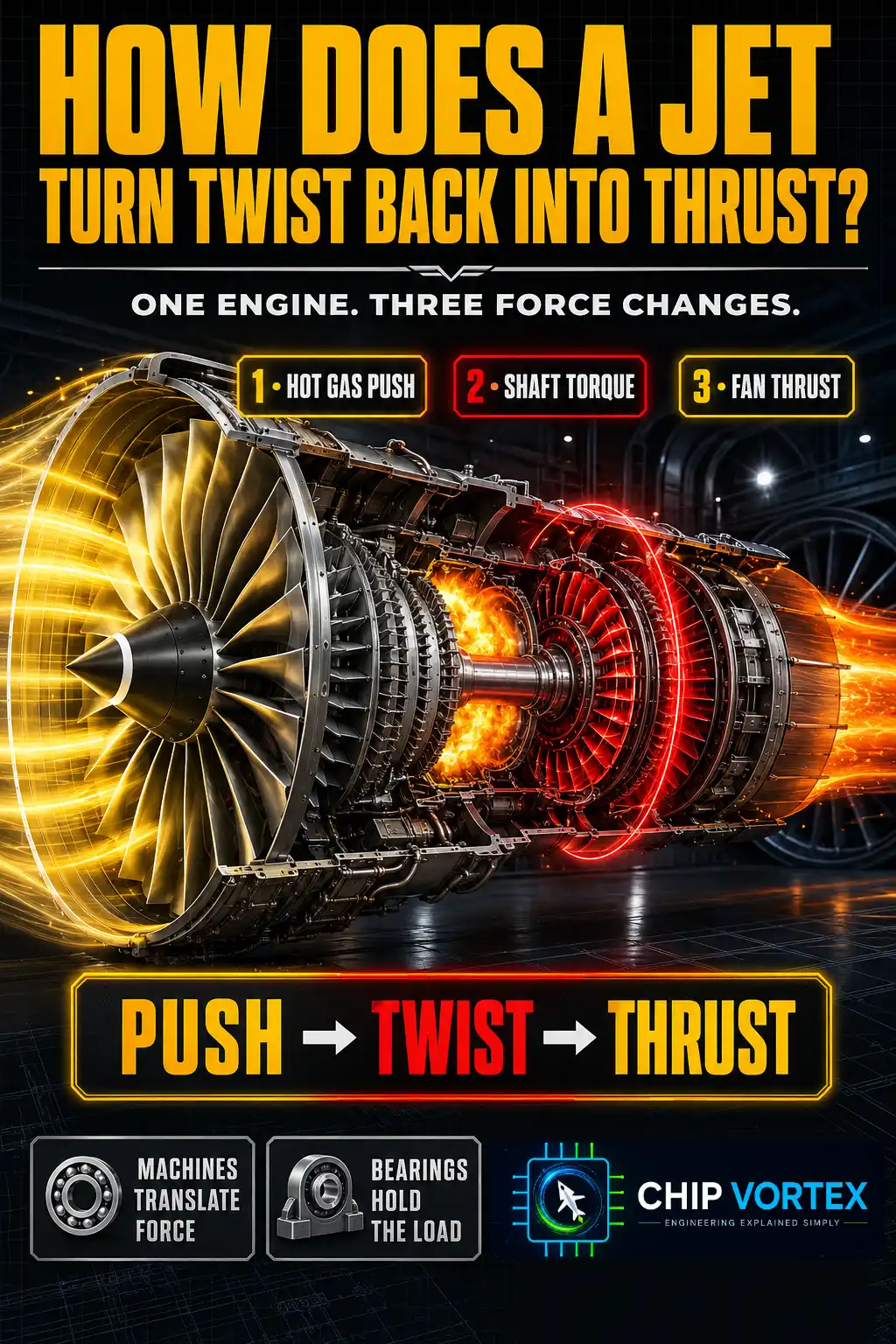
Both at once: a turbofan’s turbine harvests torque from hot gas, that torque spins the giant fan, and the fan turns it back into thrust. Follow the forces through any machine and you’re watching a conversation between push and twist, with bearings — including the thrust bearings literally named for the job — holding the line wherever the forces change direction.
Where Power Fits In
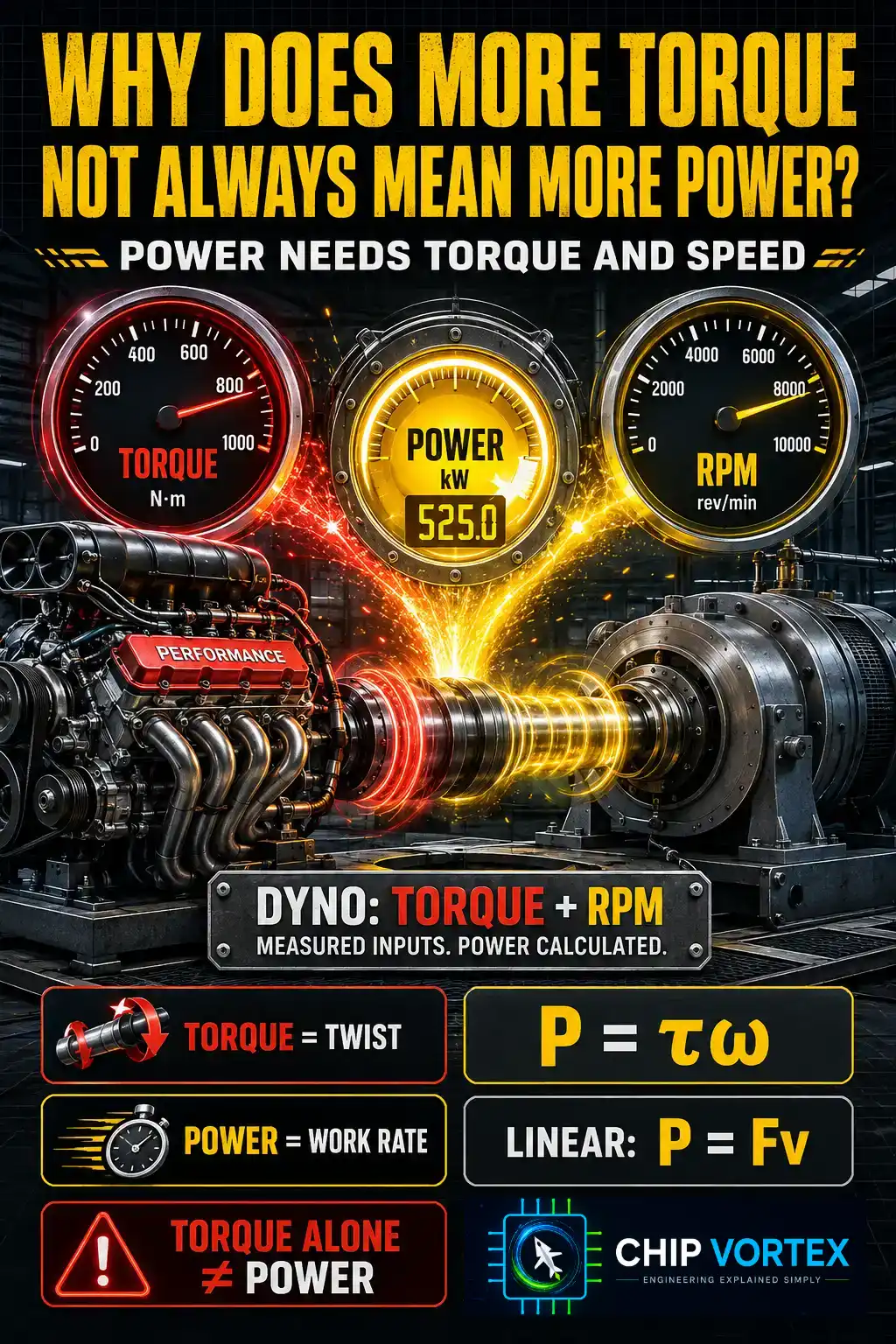
Power is the referee that connects them. For rotation, P = τω — torque times rotational speed; for straight lines, P = Fv — force times velocity. This is why “more torque” alone means nothing: a hand winch makes enormous torque at a crawl and almost no power. It’s also the honest answer to the eternal garage debate — torque vs horsepower: torque is how hard you can twist right now; power is how much twisting you can sustain per second. An engine’s dyno chart doesn’t even measure power directly — the dynamometer measures torque and RPM, and power is calculated from them. “Horsepower sells cars, torque wins races” is a great bumper sticker, but physics says they’re the same story told at different RPM.
The Aviation Corner: When Torque Fights Back
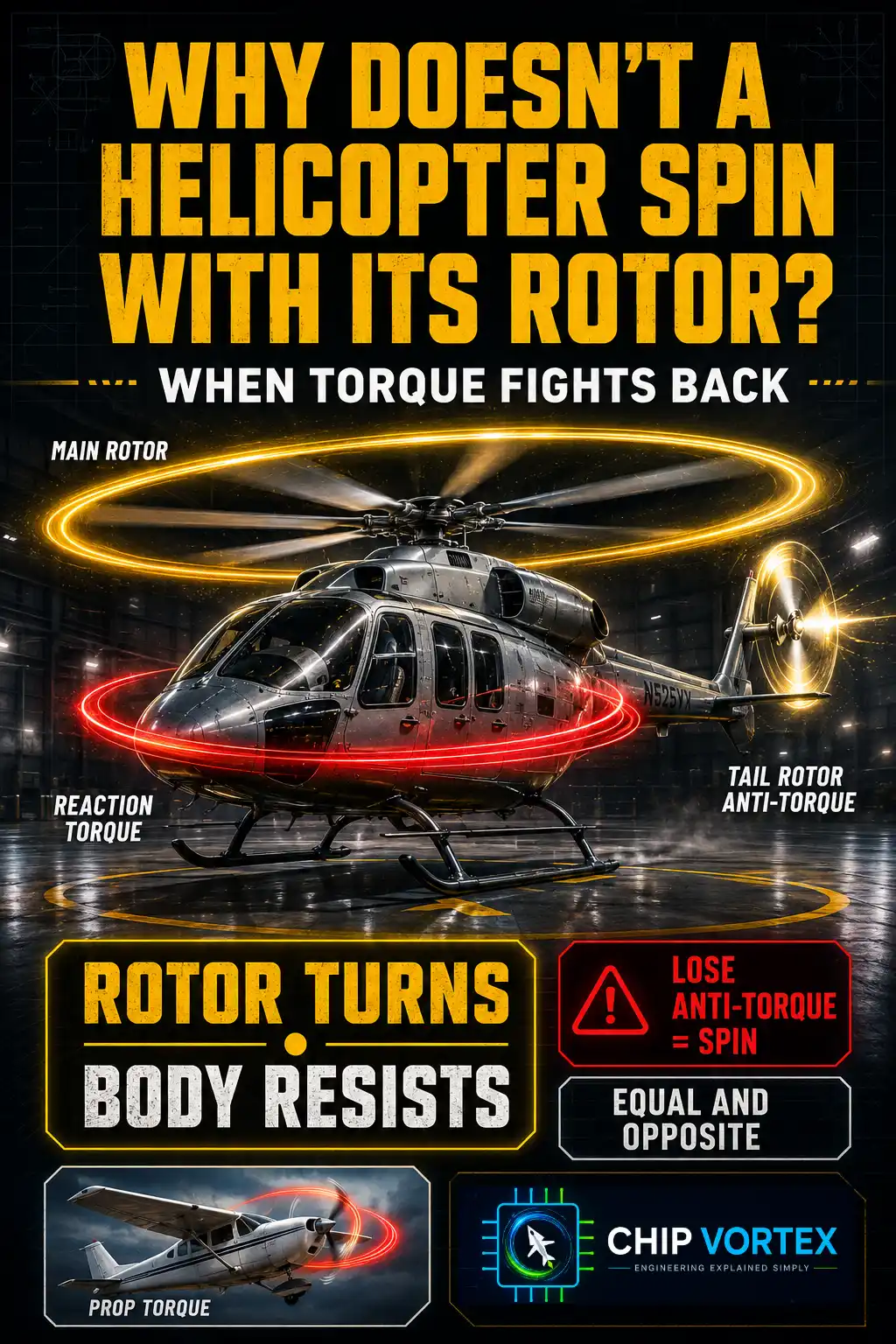
Aviation offers the most dramatic proof that torque is real: the helicopter. Spin a massive rotor one way and Newton insists the fuselage spin the other — torque reaction. The entire tail rotor exists to cancel that twist; lose it, and the helicopter demonstrates torque to everyone aboard. Fixed-wing pilots meet the same physics more politely: a single propeller’s torque and slipstream try to roll and yaw the aircraft, which is why rudder trim and a firm right leg are part of every high-power climb. And the propeller itself is the conversion made visible — engine torque in, thrust through the thrust bearing out, the aircraft pulled forward by a twist it never feels as a twist.
FAQ: Thrust vs Torque
Is thrust a force or a power?▾
A force, measured in newtons. Multiply thrust by velocity and then you have power (P = Fv) — an engine producing fixed thrust delivers more power the faster the aircraft flies.
Torque vs horsepower — which matters more?▾
Neither, alone: power is torque × rotational speed (P = τω). Torque tells you how hard the twist is; power tells you how much work gets done per second. Towing loves torque at low RPM; top speed is bought with power.
Why do helicopters need tail rotors?▾
Torque reaction. The engine twists the main rotor one way, so the airframe is twisted the other. The tail rotor pushes sideways to cancel that spin — a thrust device employed to defeat a torque.
How does a propeller turn torque into thrust?▾
Each blade is a rotating wing. Torque spins the blades; the blades accelerate air backward; the reaction to that accelerated air is forward thrust. Twist in, push out.
Why is torque maximum at 90 degrees?▾
Because only the force component perpendicular to the arm creates rotation — that’s the sin θ in τ = rF sin θ. At 90°, all of your force turns the bolt; along the handle, none of it does.
So — straight line or rotation: which force runs your favorite machine? Trace it and you’ll probably find both, taking turns. Tell us the best conversion you can think of in the comments, save the chart, and follow the forces onward: into the gears that trade speed for torque, the engine that turns fire into twist, and the bearings that hold it all steady.