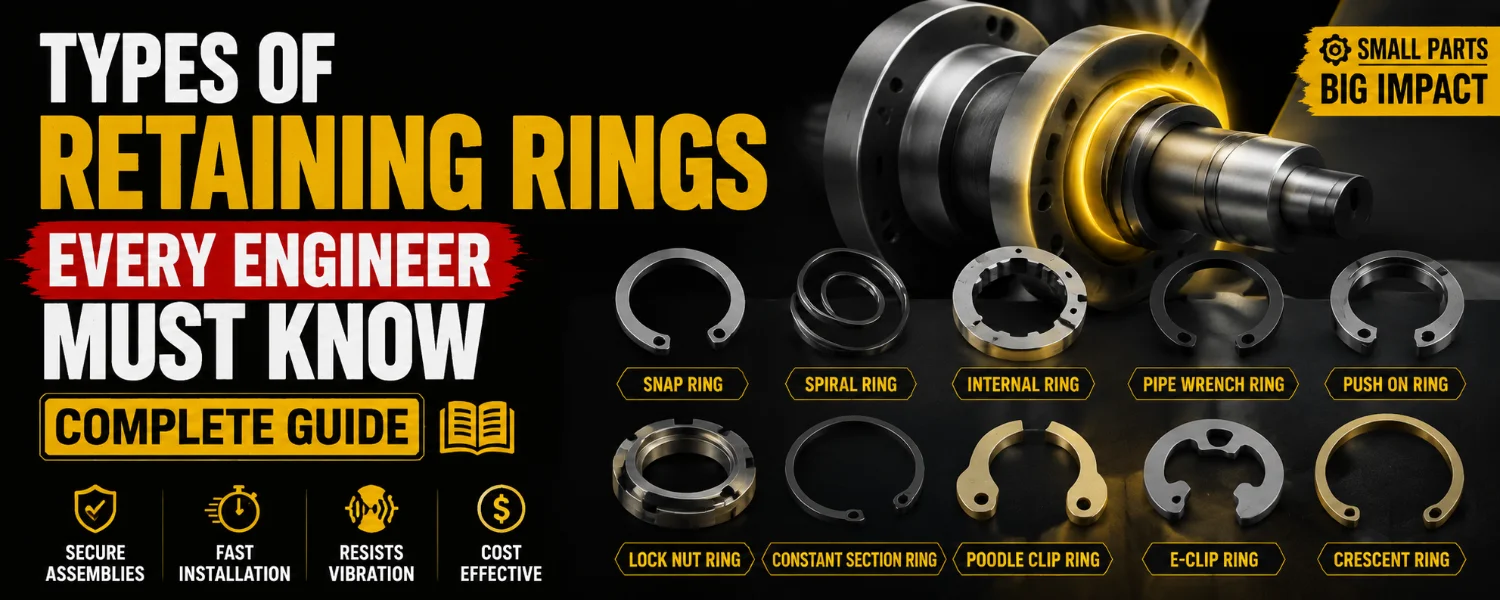
Retaining rings are some of the smallest components on an engineering drawing — and some of the easiest to get wrong. Pick the wrong style for a shaft, bore, or thrust load, and you end up with a part that pops loose, a groove that wears prematurely, or an assembly that costs more to machine than it needs to. Pick the right one, and a five-cent stamped ring can replace a machined shoulder, a nut, or a snap-fit feature — saving weight, material, and assembly time.
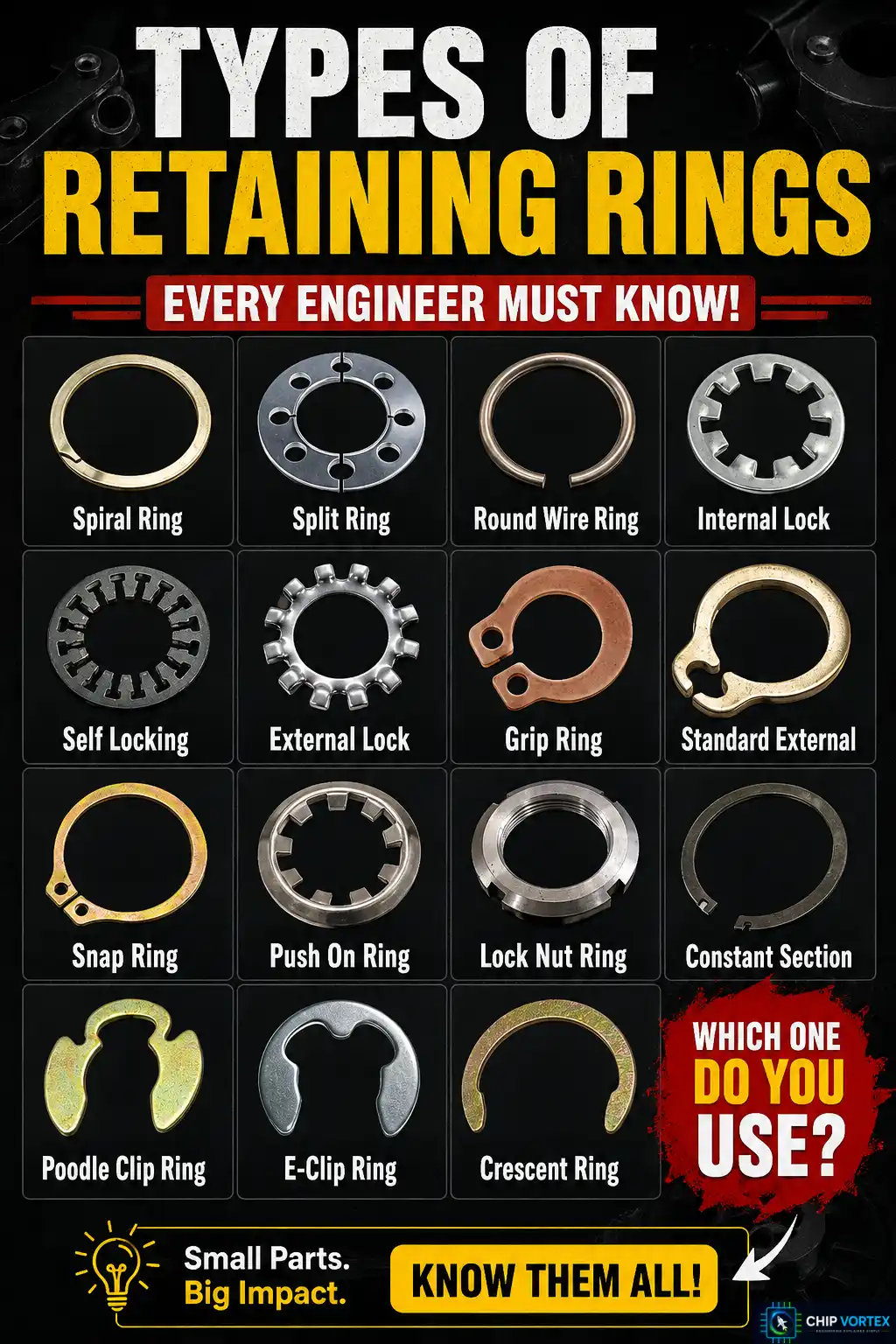
This guide walks through all 15 major retaining ring styles — spiral rings, split rings, round wire rings, internal and external lock rings, self-locking rings, grip rings, snap rings, push-on rings, lock nut rings, constant section rings, poodle clip rings, E-clip rings, and crescent rings — explaining how each one works, where it’s used, and how to choose between them. By the end, you’ll be able to look at a shaft or bore groove and know exactly which ring belongs there.
What Is a Retaining Ring?
A retaining ring (also called a snap ring or circlip) is a fastener that seats into a groove machined — or in some cases pressed — into a shaft or bore. Once installed, it creates a shoulder that keeps a bearing, gear, pulley, or other component from sliding axially along the shaft or out of the housing. Retaining rings are used instead of a threaded nut, a machined shoulder, or a welded stop because they’re lighter, cheaper to install at scale, and easy to remove for maintenance.
Almost every retaining ring falls into one of two installation categories:
- Internal rings install inside a bore or housing, expanding outward to seat into a groove on the internal wall.
- External rings install onto a shaft or pin, compressing inward to seat into a groove on the outer diameter.
From there, rings are further classified by cross-section (tapered vs. constant width), installation method (axial vs. radial), and whether they require a machined groove at all.
1. Spiral Ring
A spiral retaining ring is a coiled, two-and-a-half to three-turn band of flat wire with no ears, tabs, or gaps to catch on mating parts. Because it wraps around the groove in a continuous spiral rather than a single split loop, it makes contact around the entire circumference of the groove instead of at just a few points.
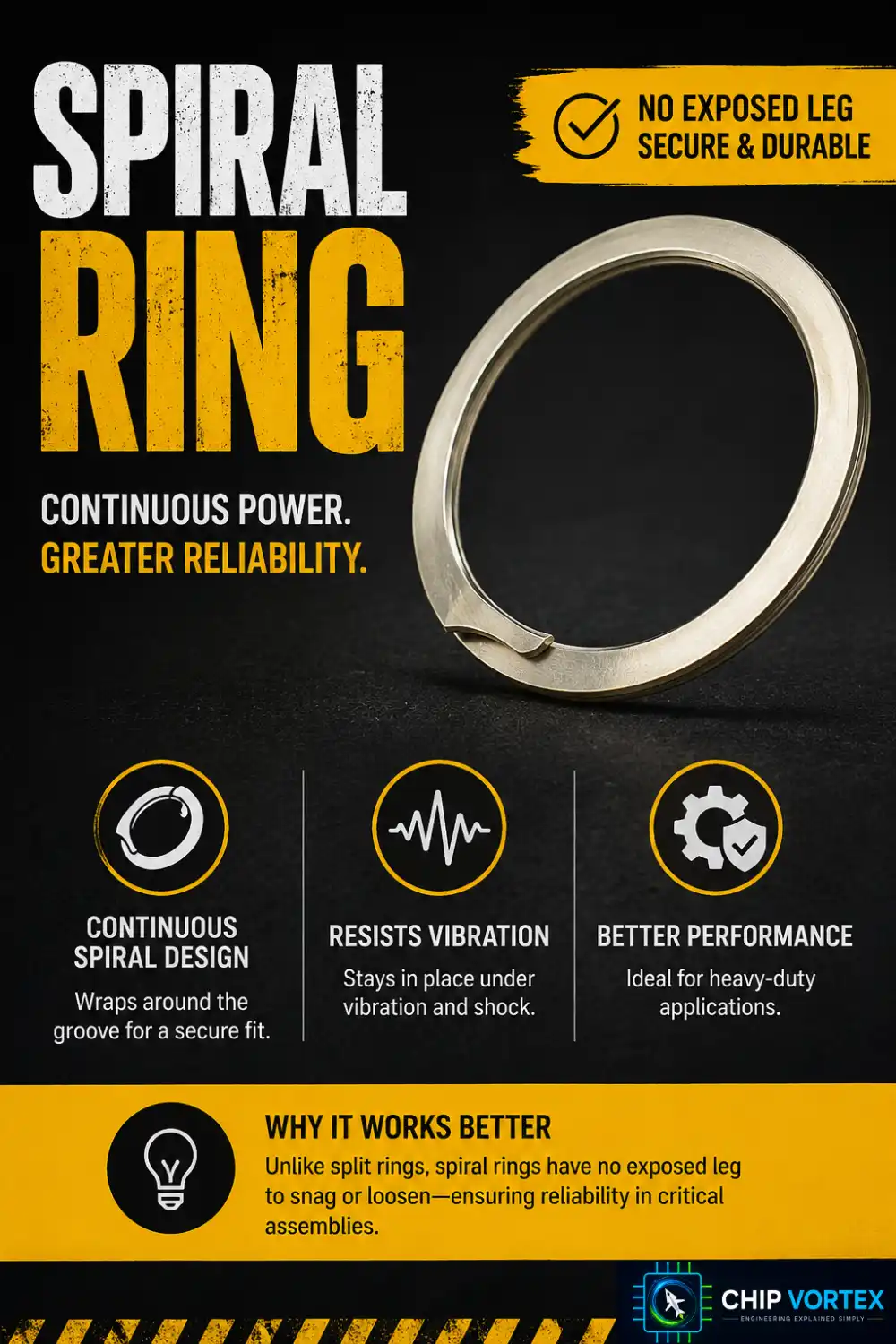
That full-contact design is what makes spiral rings stand out: there’s no exposed lug to snag hoses, wiring, or an operator’s hand, and the ring resists rotation and dislodging under vibration far better than a stamped ring. Spiral rings are common in hydraulic cylinders, gearboxes, and rotating shaft assemblies where a low-profile, snag-free fastener is required. The trade-off is a slightly more involved installation, typically done with a dedicated spiral-ring pliers or arbor tool rather than a simple squeeze.
2. Split Ring
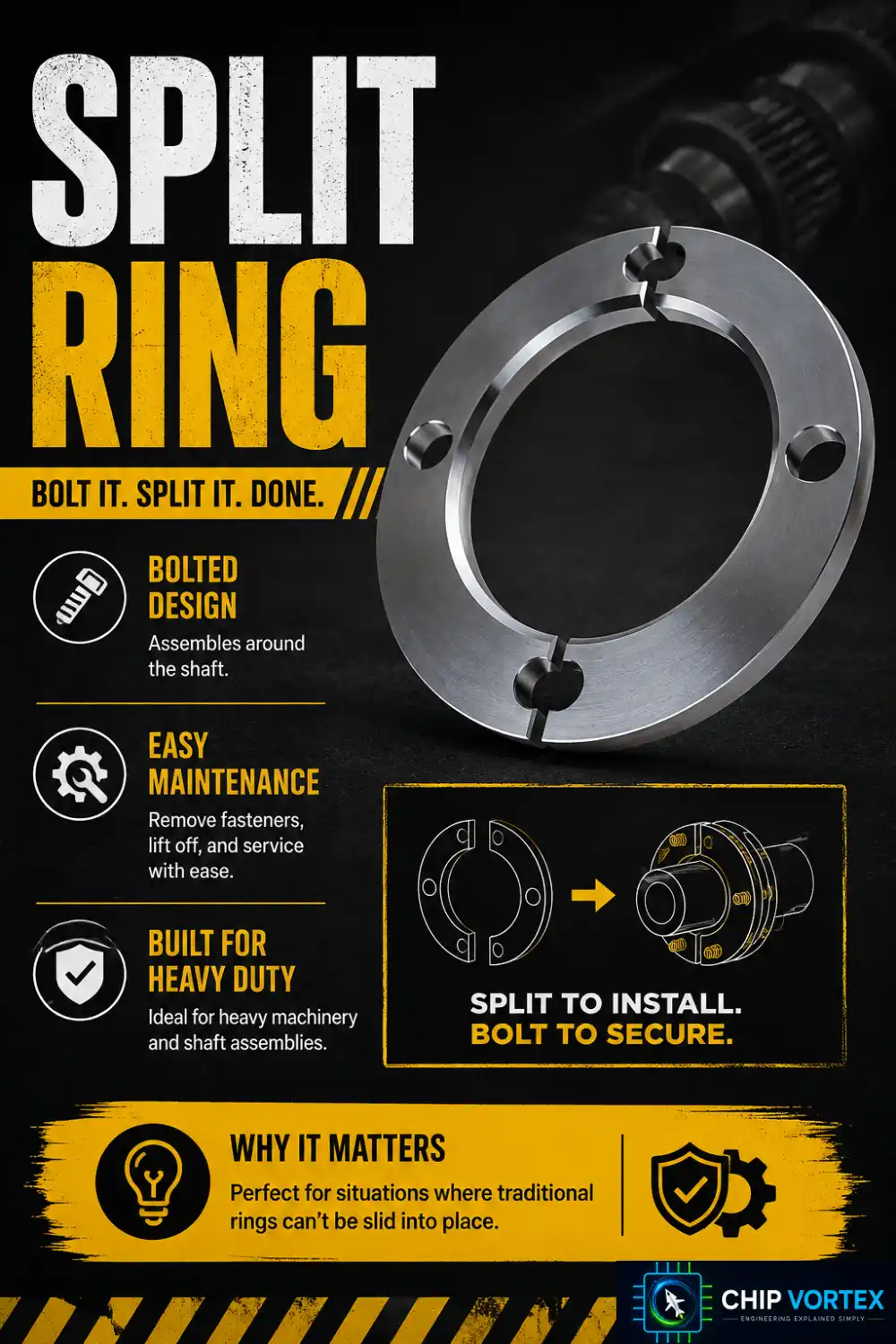
A split ring is a flat, perforated disc — often with multiple mounting holes — that splits into two or more segments along a diameter. Rather than gripping a groove through spring tension alone, a split ring is usually bolted or pinned together around a shaft, making it useful in situations where the ring needs to be installed after other components are already in place and a single continuous ring couldn’t be slid on.
Split rings show up most often in heavy machinery and shaft assemblies where disassembly for maintenance needs to be quick — remove the fasteners, lift both halves off, and the shaft is exposed without pulling other components first.
3. Round Wire Ring
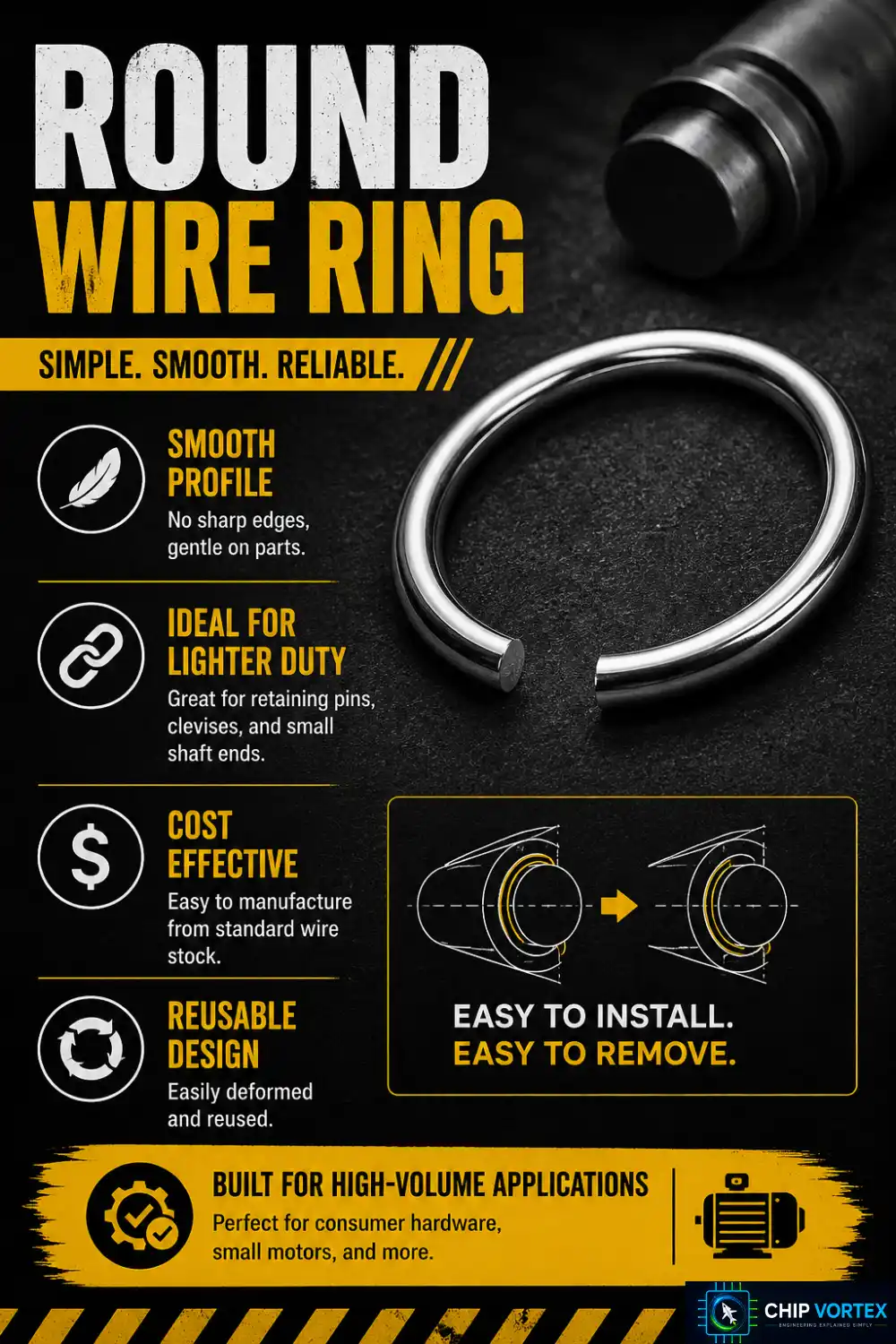
Round wire retaining rings are formed from round-section wire rather than flat stock, giving them a smooth profile with no sharp edges. Because round wire distributes stress differently than flat stock, these rings are often chosen for lighter-duty axial retention where a low-cost, easily deformed-and-reused fastener is acceptable, such as retaining pins, clevises, or small shaft ends.
Their round cross-section also makes them easier to manufacture from standard wire stock, which keeps unit costs low for high-volume applications like consumer hardware and small motors.
4. Internal Lock Ring
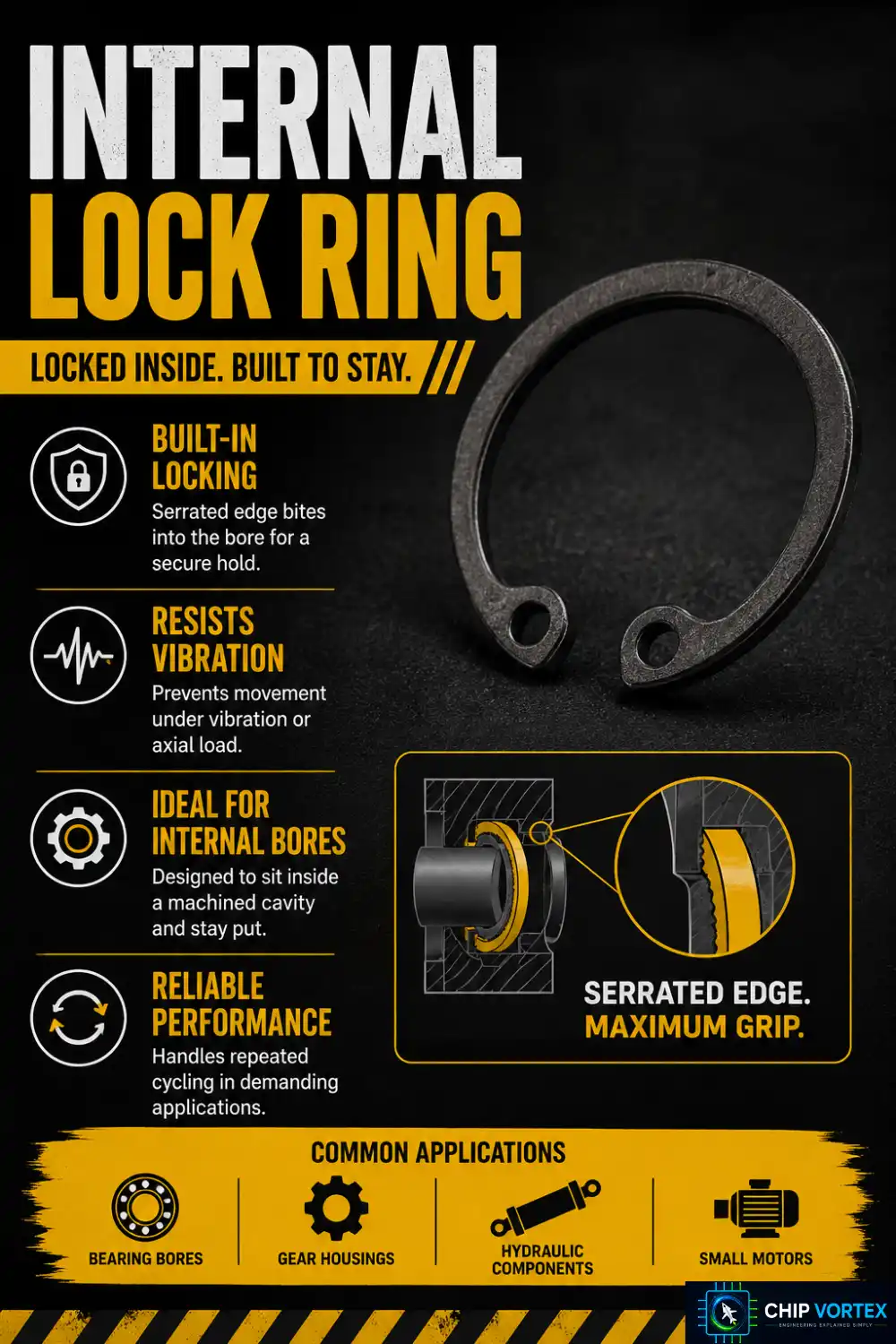
An internal lock ring (also known as an internal tooth or internal locking retaining ring) is a toothed ring installed inside a bore. The serrated outer edge bites into the groove wall, adding resistance to rotation and preventing the ring from working its way out under vibration or axial load. Internal lock rings are common in bearing bores, gear housings, and hydraulic components where the ring sits inside a machined cavity and needs to stay put through repeated cycling.
5. Self Locking Ring
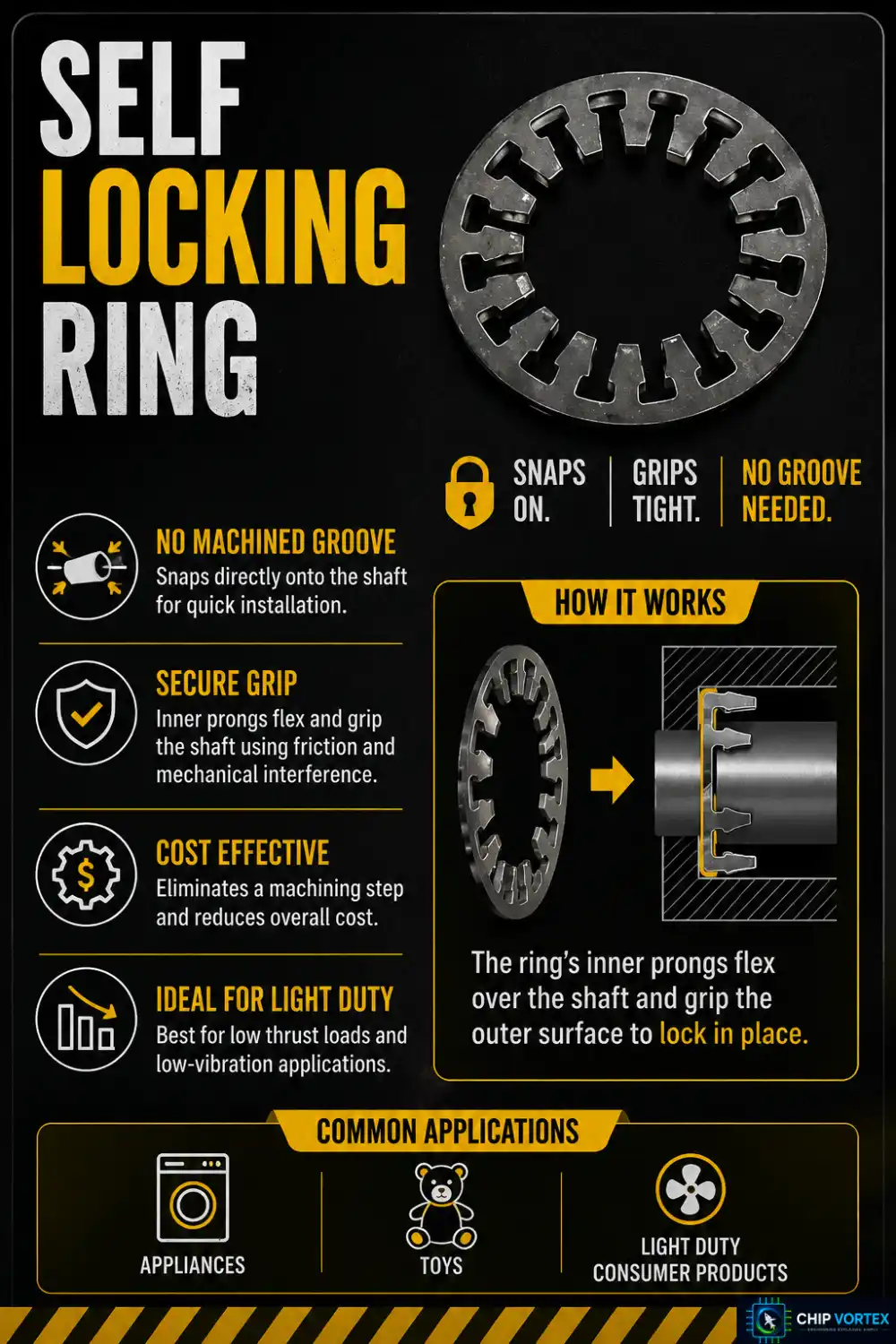
Self-locking rings are designed to snap directly onto a shaft without a machined groove. Instead of seating into a cut recess, the ring’s inner prongs flex and grip the shaft’s outer surface through friction and mechanical interference. This eliminates a machining step entirely, which is why self-locking rings are popular in cost-sensitive, high-volume assemblies — appliances, toys, and light-duty consumer products — where thrust loads are low and grooving every shaft isn’t economical.
6. External Lock Ring
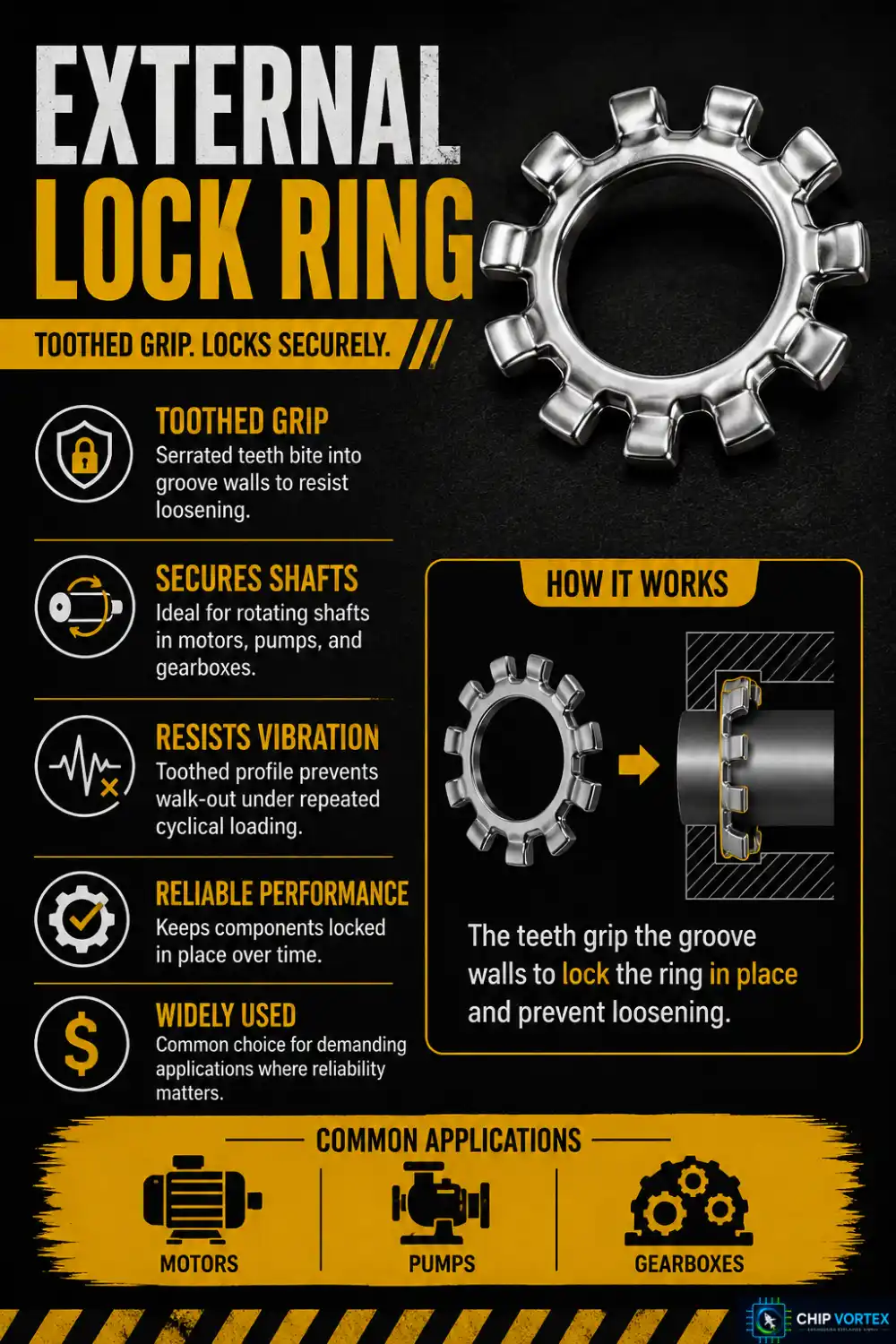
The external counterpart to the internal lock ring, an external lock ring has the same serrated, toothed profile but is sized to compress onto a shaft rather than expand into a bore. The teeth grip the groove walls to resist loosening from vibration, making these rings a common choice for rotating shafts in motors, pumps, and gearboxes where repeated cyclical loading would otherwise walk a smooth-edged ring out of its groove over time.
7. Grip Ring
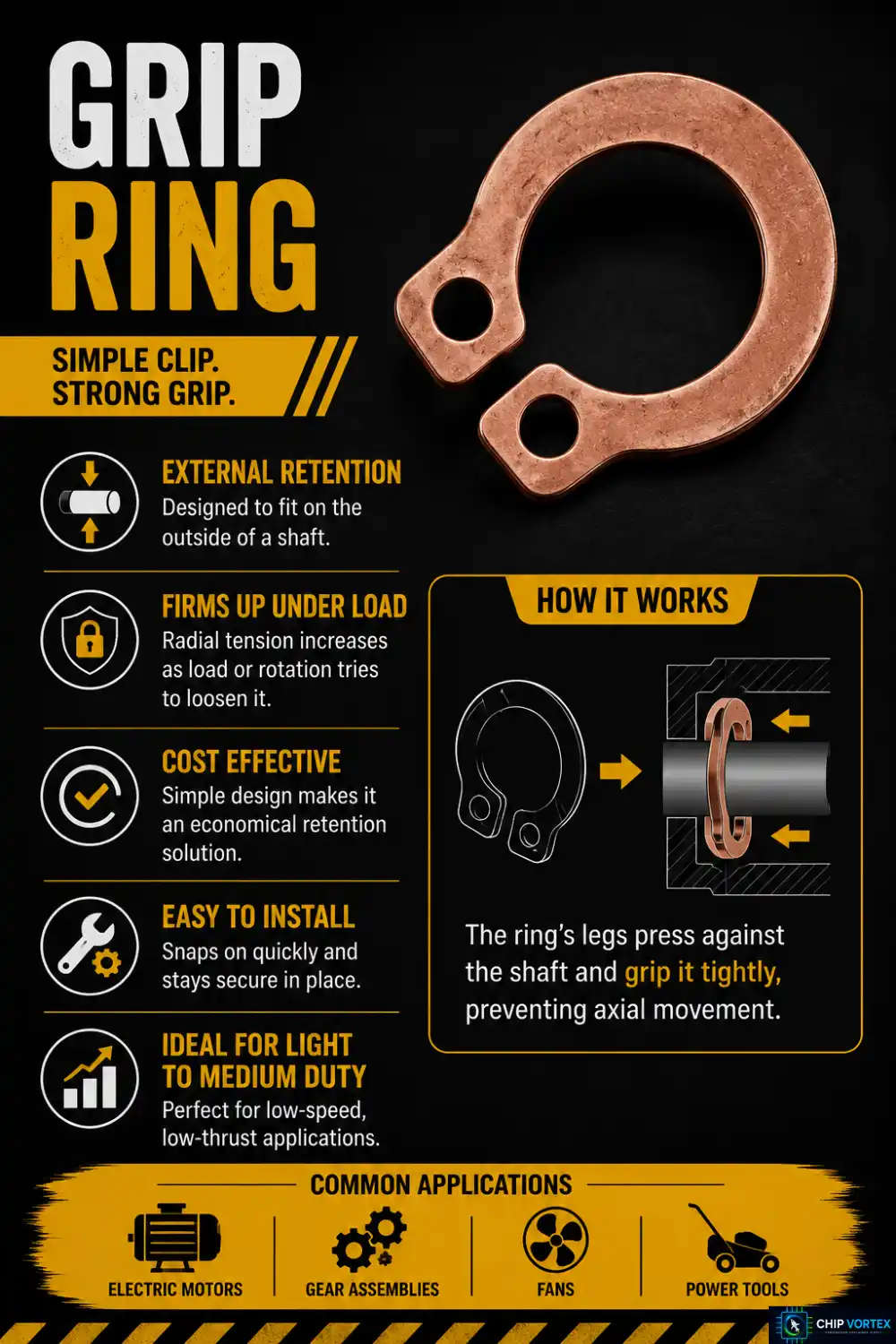
Grip rings combine a retaining function with a built-in installation tab — typically two small lugs joined by a curved arm — that lets the ring be installed and removed with simple pliers rather than a specialized spreading tool. The “grip” comes from a slightly undersized inner diameter relative to the groove, so the ring clamps onto the shaft with extra holding force even before any axial load is applied. These are frequently specified where field maintenance technicians (not just factory assembly lines) need to service the joint.
8. Standard External Ring
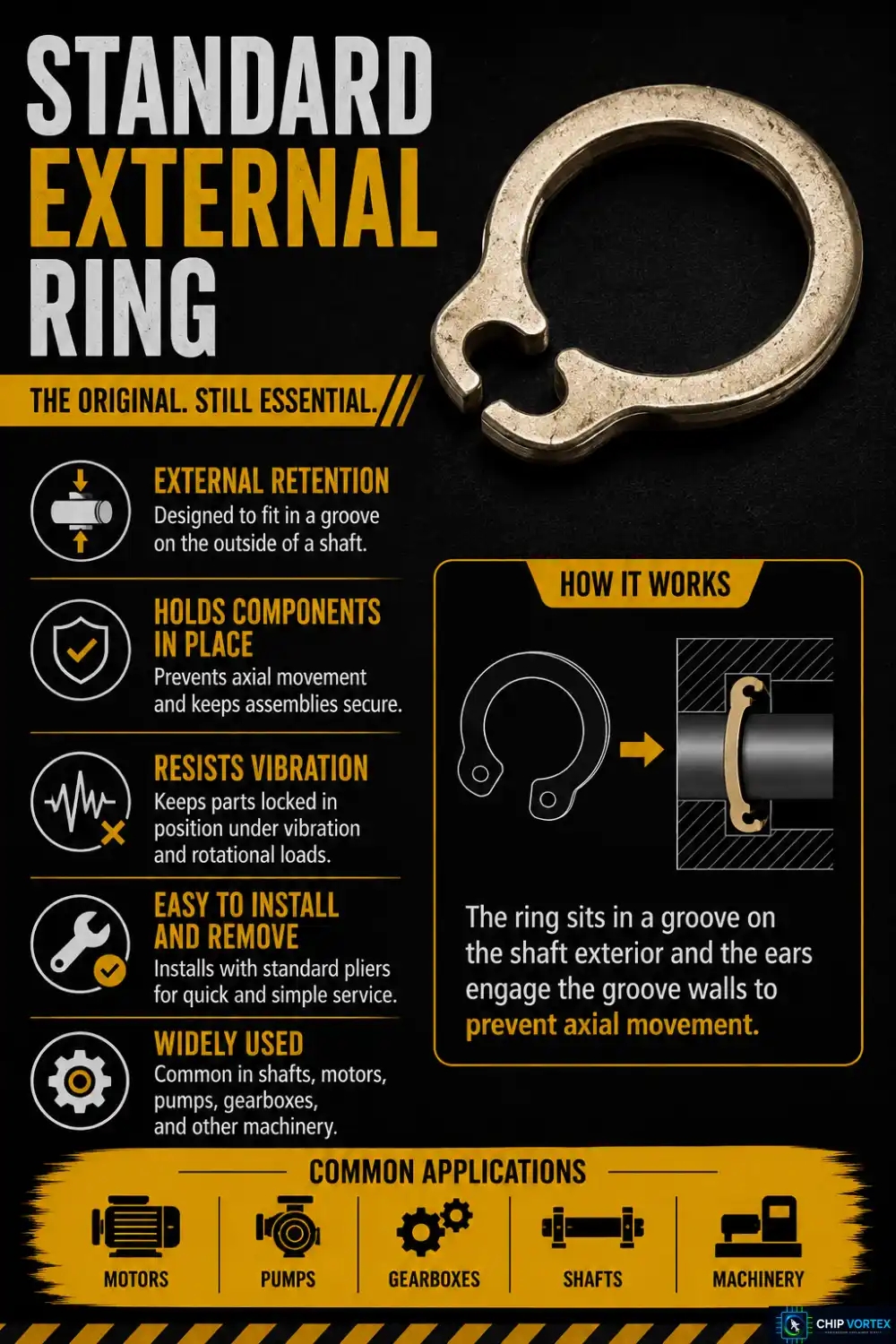
The standard external retaining ring is the archetypal circlip: a tapered-width ring with two lugs (each with a small hole) at the gap, sized to compress onto a shaft using standard retaining-ring pliers. Because the ring’s cross-section tapers from full width at the lugs down to a thinner section opposite the gap, it flexes evenly and grips the entire groove circumference more securely than a constant-width ring of the same material. This is the ring most engineers picture when they hear “snap ring,” and it’s the default choice for shaft retention across the automotive, industrial, and consumer equipment industries.
9. Snap Ring
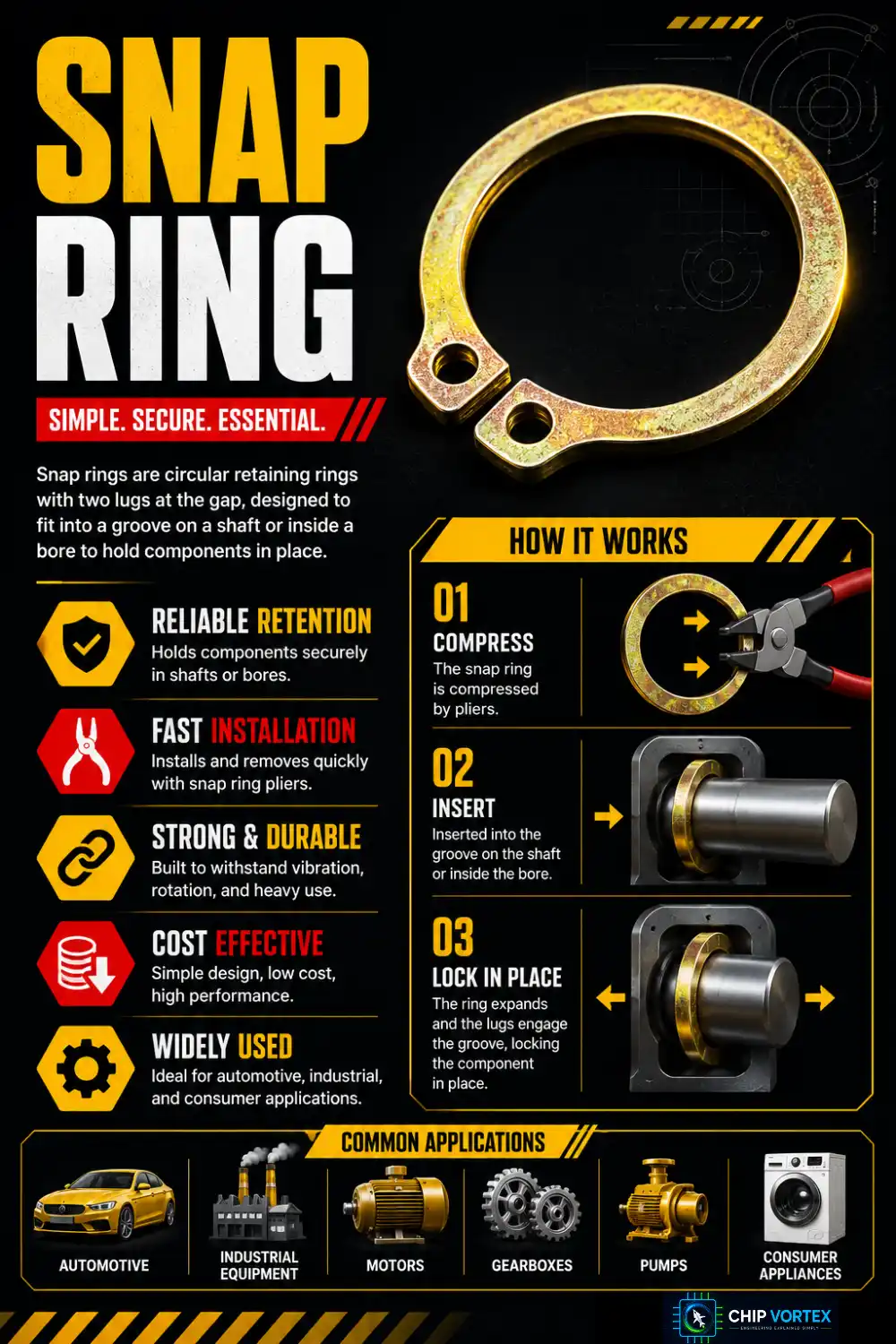
“Snap ring” is often used interchangeably with retaining ring in general, but as a distinct style it usually refers to a tapered-section ring — internal or external — installed and removed with a squeeze-type or spread-type pliers in a single motion (hence “snap”). Snap rings are prized for assembly-line speed: an operator can install one in under a second with the right tool, which is why they dominate high-volume manufacturing of gearboxes, transmissions, and bearing assemblies.
10. Push On Ring
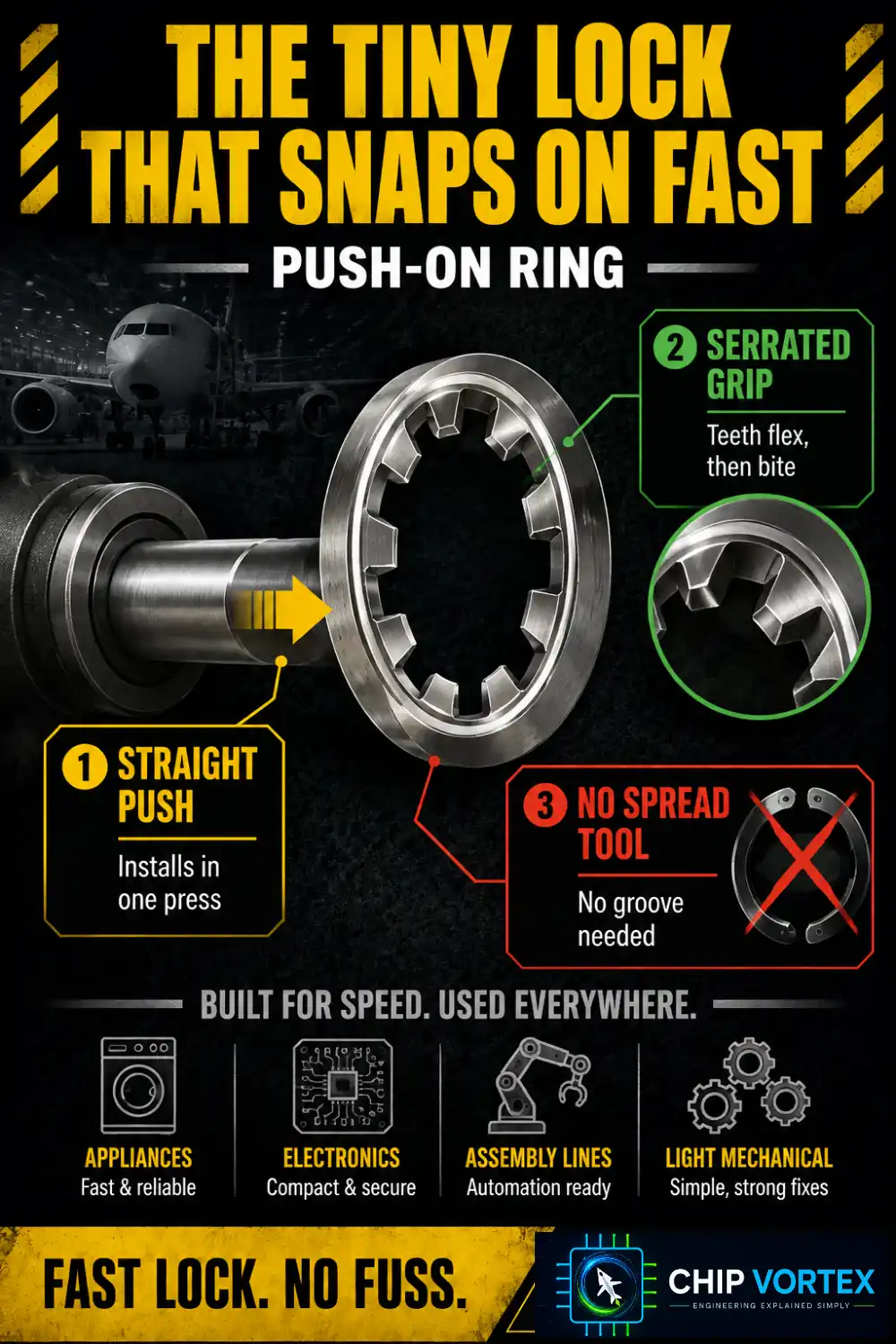
Push-on rings (also called push-nuts or E-push rings) install with a straight axial push rather than a squeeze or spread motion. The ring’s internal serrations deform slightly as it’s pressed onto the shaft, then spring back to grip the shaft’s surface, again without requiring a machined groove. Because installation takes a fraction of a second and needs no tooling beyond a light press, push-on rings are a staple of automated assembly lines building appliances, electronics, and light mechanical assemblies.
11. Lock Nut Ring
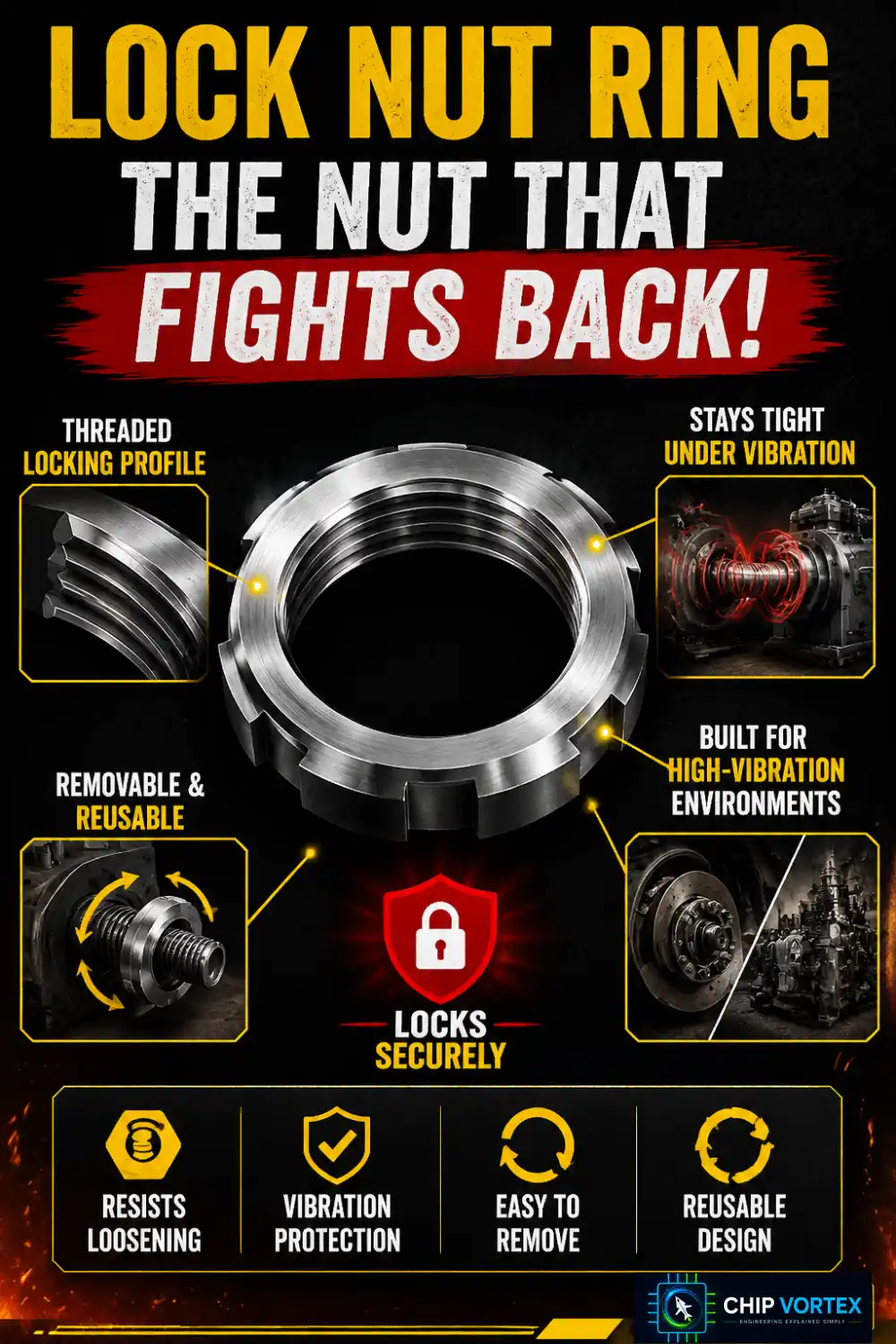
A lock nut ring functions like a threaded locknut but is designed as a retaining ring with an internally or externally threaded, notched profile that both retains a component axially and resists loosening from vibration — similar in purpose to a prevailing-torque nut. These are used where a component needs to be periodically removed and reinstalled (unlike a permanent snap ring), while still resisting back-off in a high-vibration environment such as rotating equipment or automotive drivetrains.
12. Constant Section Ring
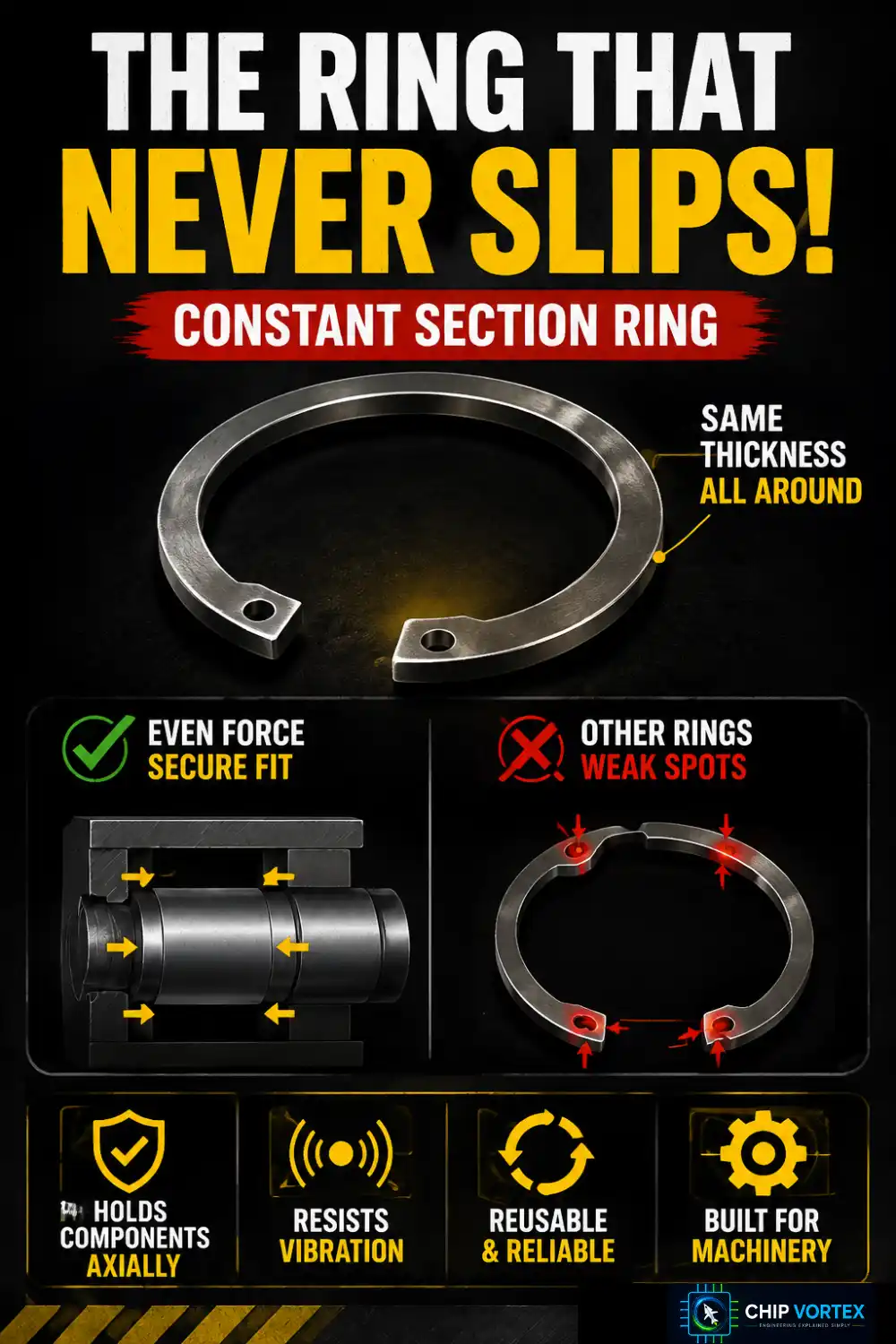
Unlike tapered-section rings, a constant section ring maintains the same width and thickness all the way around its circumference, with no ears or lugs. This uniform cross-section makes it inherently stronger against impact loads and better suited to very tight radial clearances, since there’s no protruding lug to account for in the design envelope. Constant section rings — sometimes called Spirolox-style or wire-formed rings — are common in compact assemblies like small gearboxes, pumps, and precision instruments where space is at a premium and shock loading is a real concern.
13. Poodle Clip Ring
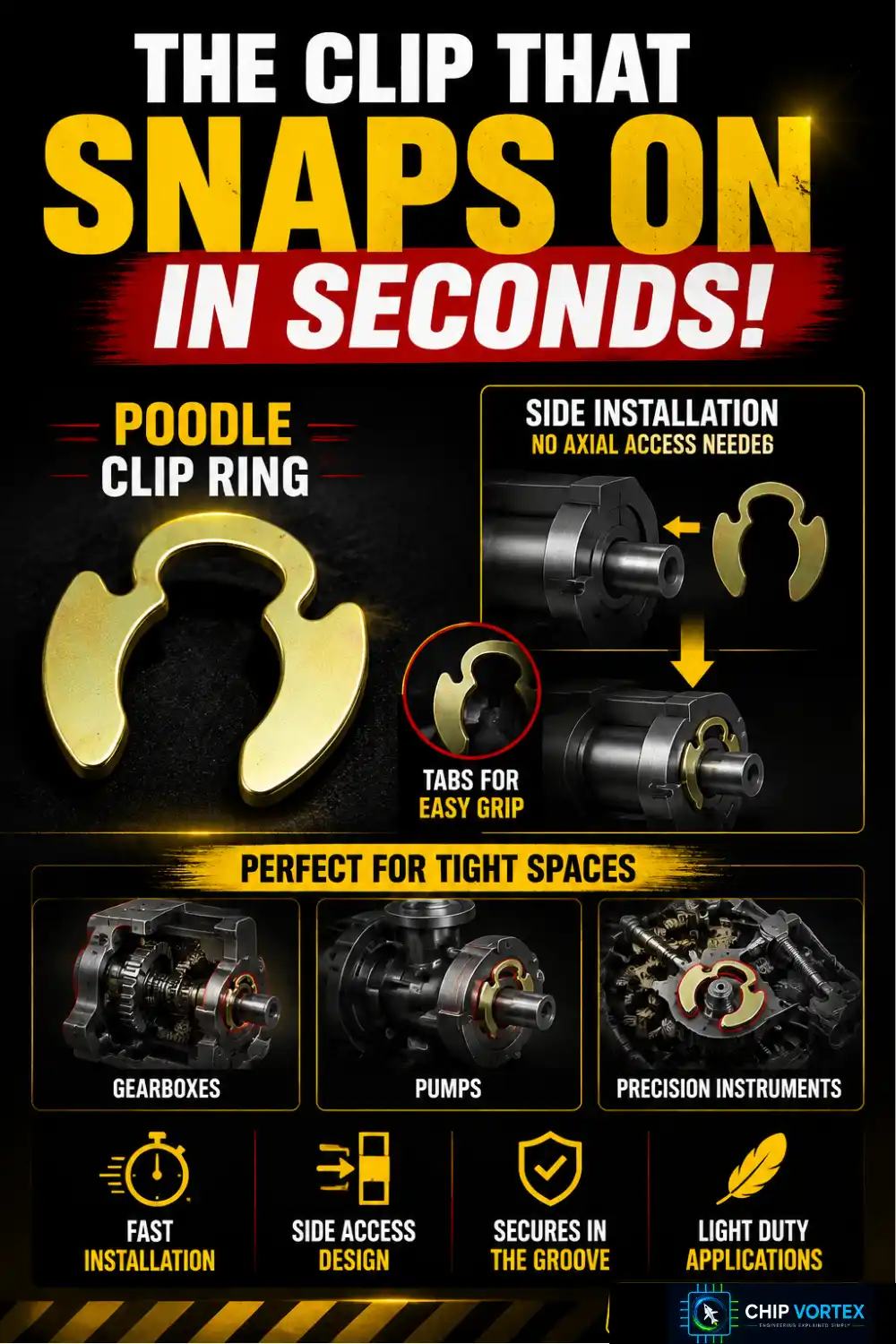
A poodle clip ring (sometimes called a poodle ring, for its resemblance to a stylized animal silhouette) is a radially installed external ring with an open, curved profile and small tabs for gripping. Like other radial-style rings, it installs by pushing directly onto the groove from the side rather than sliding down the shaft axially, which makes it useful when axial access to the shaft end is blocked by other components. Poodle rings are typically specified for lighter-duty applications where installation speed matters more than maximum thrust capacity.
14. E-Clip Ring
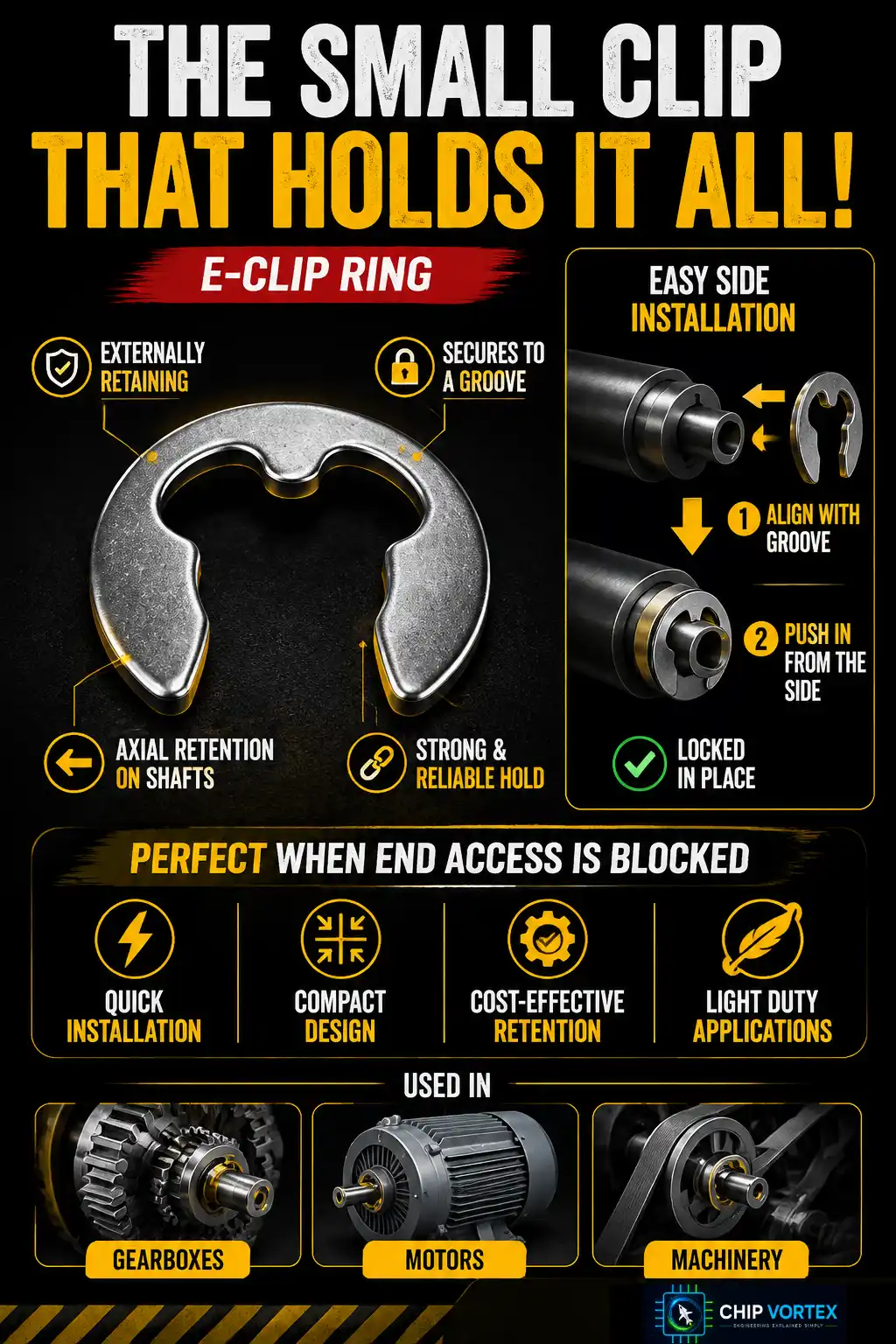
The E-clip (E-ring) is one of the most recognizable retaining rings, named for its E-shaped silhouette. It installs radially — pushed sideways into a shaft groove — rather than sliding over the end of the shaft, which makes it ideal for retaining components near the tip of a shaft or in assemblies where the shaft end isn’t accessible. E-clips are inexpensive, fast to install with basic pliers, and extremely common in small motors, linkages, pins, and consumer electronics.
15. Crescent Ring
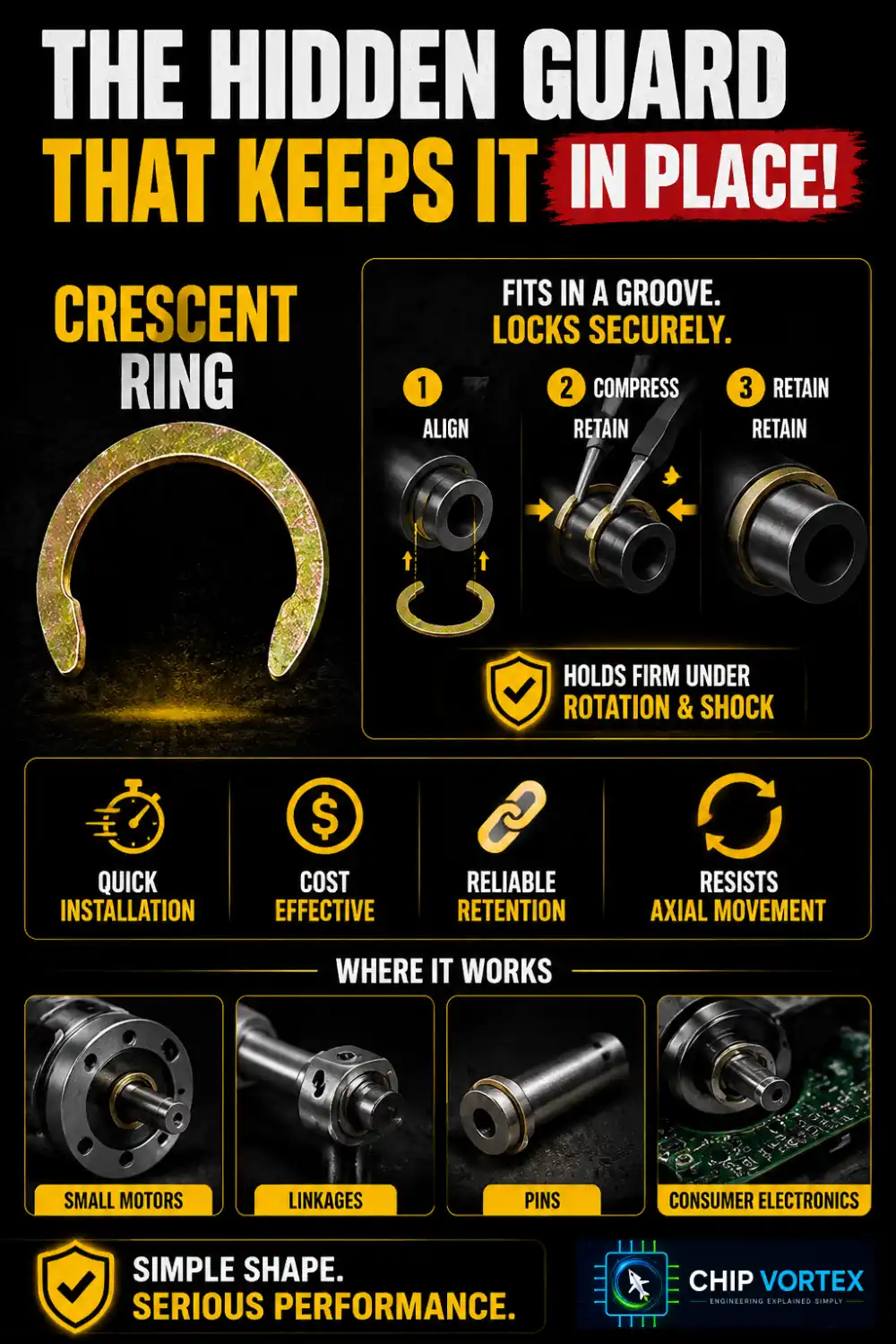
Crescent rings share the E-clip’s radial installation style but use a simpler, curved crescent-moon profile instead of the three-pronged E shape. They’re typically used on smaller-diameter shafts and pins where a lighter, lower-cost radial ring is sufficient and the added prong strength of an E-clip isn’t necessary. Crescent rings are a common sight in small appliances, toys, and instrument-grade assemblies.
Retaining Ring Comparison Table
| Ring Type | Installation | Groove Required? | Best For |
|---|---|---|---|
| Spiral Ring | Axial (spiral wind) | Yes | Snag-free, full-contact retention |
| Split Ring | Bolted/pinned | Yes | Post-assembly installation |
| Round Wire Ring | Axial | Yes | Light-duty, low-cost retention |
| Internal Lock Ring | Axial, into bore | Yes | Bore/housing retention with anti-rotation |
| Self Locking Ring | Push-on, radial | No | High-volume, low-cost assembly |
| External Lock Ring | Axial, onto shaft | Yes | Vibration-resistant shaft retention |
| Grip Ring | Axial (pliers) | Yes | Field-serviceable joints |
| Standard External Ring | Axial (pliers) | Yes | General-purpose shaft retention |
| Snap Ring | Axial (squeeze/spread) | Yes | High-speed assembly lines |
| Push On Ring | Axial push | No | Automated, tool-light assembly |
| Lock Nut Ring | Threaded | Yes (threaded) | Serviceable, vibration-resistant joints |
| Constant Section Ring | Axial | Yes | Tight clearances, impact resistance |
| Poodle Clip Ring | Radial | Yes | Blocked shaft ends, light duty |
| E-Clip Ring | Radial | Yes | Small shafts, fast field installation |
| Crescent Ring | Radial | Yes | Small pins, low-cost light duty |
How to Choose the Right Retaining Ring
Selecting a retaining ring comes down to four questions:
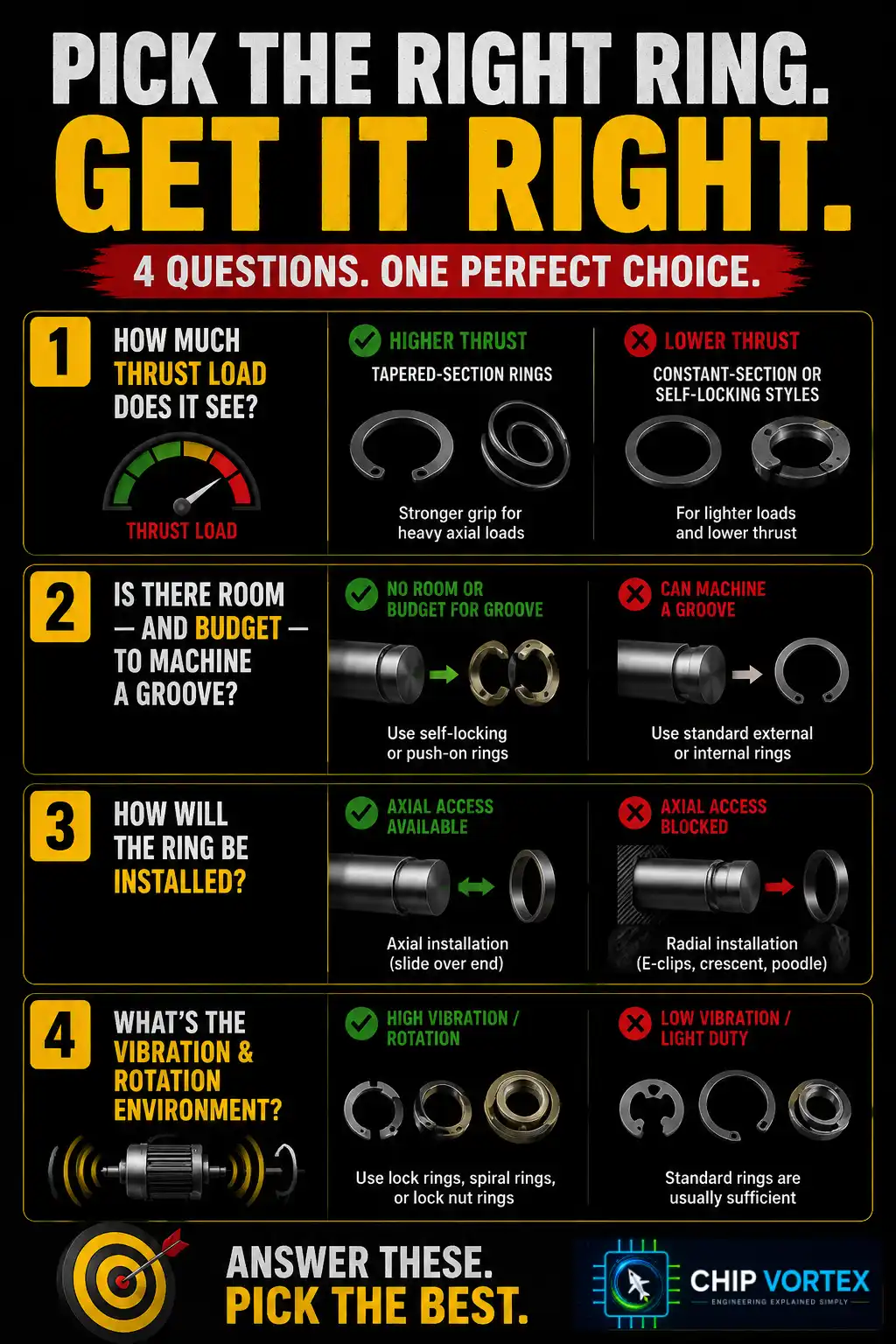
How much thrust load does the joint see? Tapered-section rings (standard external, snap rings, spiral rings) generally handle higher thrust loads than constant-section or self-locking styles, because their cross-section is engineered to grip the full groove more aggressively.
Is there room — and budget — to machine a groove? If the shaft or bore can’t accommodate a groove, or the cost of adding one isn’t justified, self-locking or push-on rings are the answer.
How will the ring be installed? Axial installation (sliding over the shaft end) works when the shaft end is accessible; radial installation (E-clips, crescent rings, poodle rings) is necessary when it isn’t.
What’s the vibration and rotation environment? High-vibration assemblies benefit from internal/external lock rings, spiral rings, or lock nut rings, all of which resist loosening better than a plain tapered ring.
Frequently Asked Questions
What’s the difference between a circlip and a retaining ring?▾
They’re the same thing — “circlip” is simply the more common term in the UK and parts of Europe, while “retaining ring” and “snap ring” are used more often in North America.
Can retaining rings be reused after removal?▾
Tapered-section rings like standard external and internal lock rings can typically be reused a few times if they weren’t overstressed during removal. Self-locking and push-on rings, however, deform their gripping prongs on installation and generally shouldn’t be reused.
Do retaining rings need a specific groove tolerance?▾
Yes — groove diameter, width, and edge condition all directly affect how much thrust load a ring can hold. Manufacturers publish groove specifications for each ring size, and deviating from them is one of the most common causes of retaining ring failure in the field.
Which retaining ring is strongest under impact loading?▾
Constant section rings generally outperform tapered rings under shock and impact loads because their uniform cross-section doesn’t have a thin point that concentrates stress.