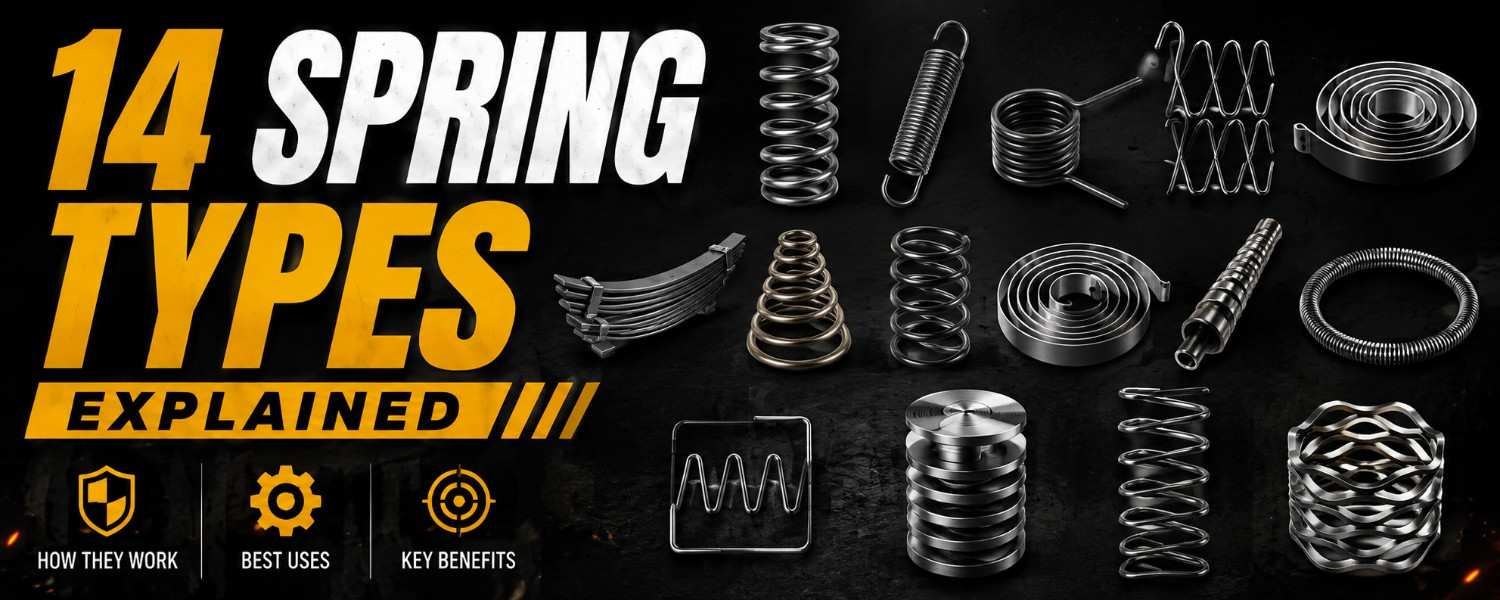
Every spring does the same fundamental job: store mechanical energy when a force is applied, and give it back when the force is removed. What separates the 14 types below is which force they’re built to handle — a push, a pull, a twist, or a radial squeeze — and the shape engineers gave them to do it. This guide covers all 14 types of springs: how each one works and exactly where you’ll find it in real machines.
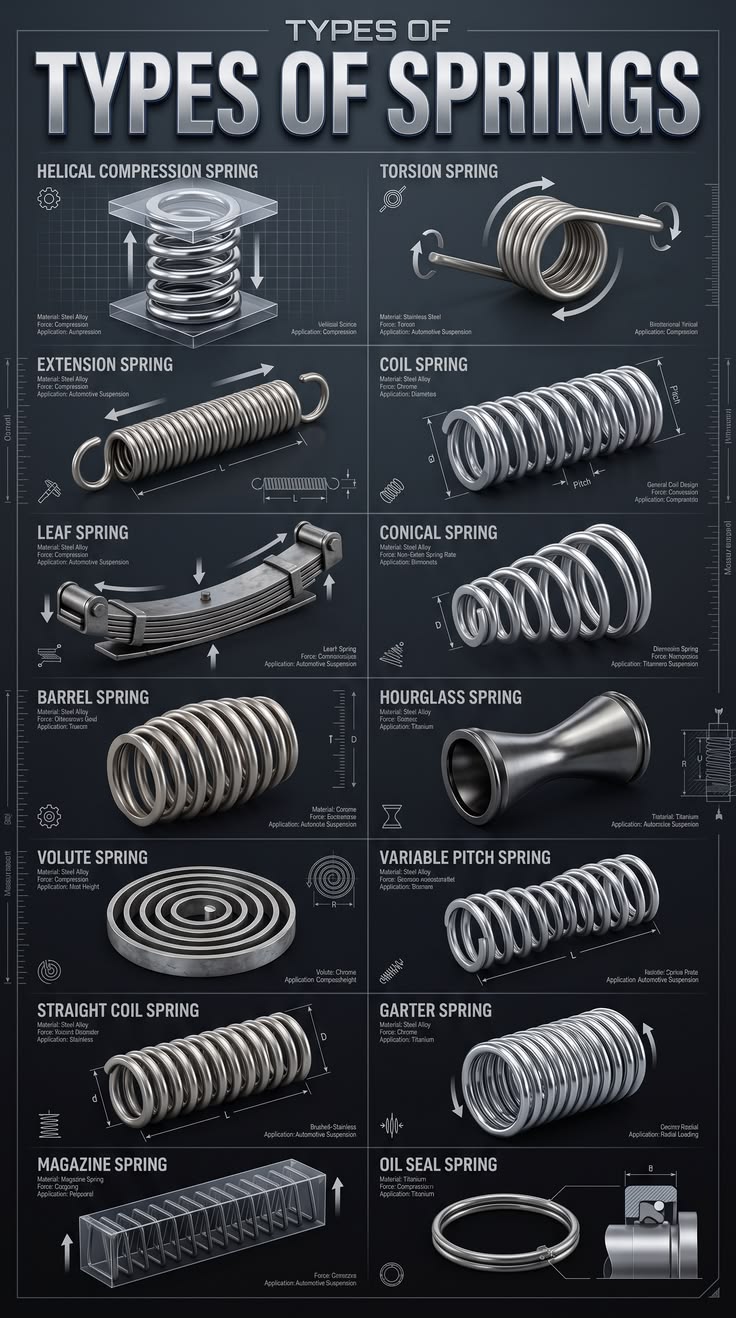
Save the chart for quick reference, then let’s go through them one by one.
Quick Reference: All 14 Types of Springs
| # | Spring Type | Force It Handles | Common Uses |
|---|---|---|---|
| 1 | Helical Compression | Push (compression) | Pens, engine valves, suspension |
| 2 | Extension | Pull (tension) | Garage doors, trampolines |
| 3 | Torsion | Twist (rotation) | Clothespins, hinges, mousetraps |
| 4 | Leaf | Bending under heavy load | Truck and trailer suspension |
| 5 | Conical | Push, progressive rate | Battery contacts, push buttons |
| 6 | Barrel | Push, extra stability | Seats, automotive suspension |
| 7 | Hourglass | Push, self-centering | Mattress cores, suspension |
| 8 | Variable Pitch | Push, progressive rate | Motorcycle and car suspension |
| 9 | Spiral (Clock) | Stored rotational energy | Clocks, tape measures, recliners |
| 10 | Volute | Push, high load + damping | Heavy vehicles, pruning shears |
| 11 | Garter | Radial squeeze | Oil seals, shaft seals |
| 12 | Magazine | Push in a rectangular housing | Firearm magazines |
| 13 | Belleville (Disc) | Huge push in tiny space | Bolted joints, clutches |
| 14 | Wave | Push in half the height | Bearing preload, compact assemblies |
The Big Four: Springs by Force Type
The first four are the classics — each one owns a different direction of force.
1. Helical Compression Spring
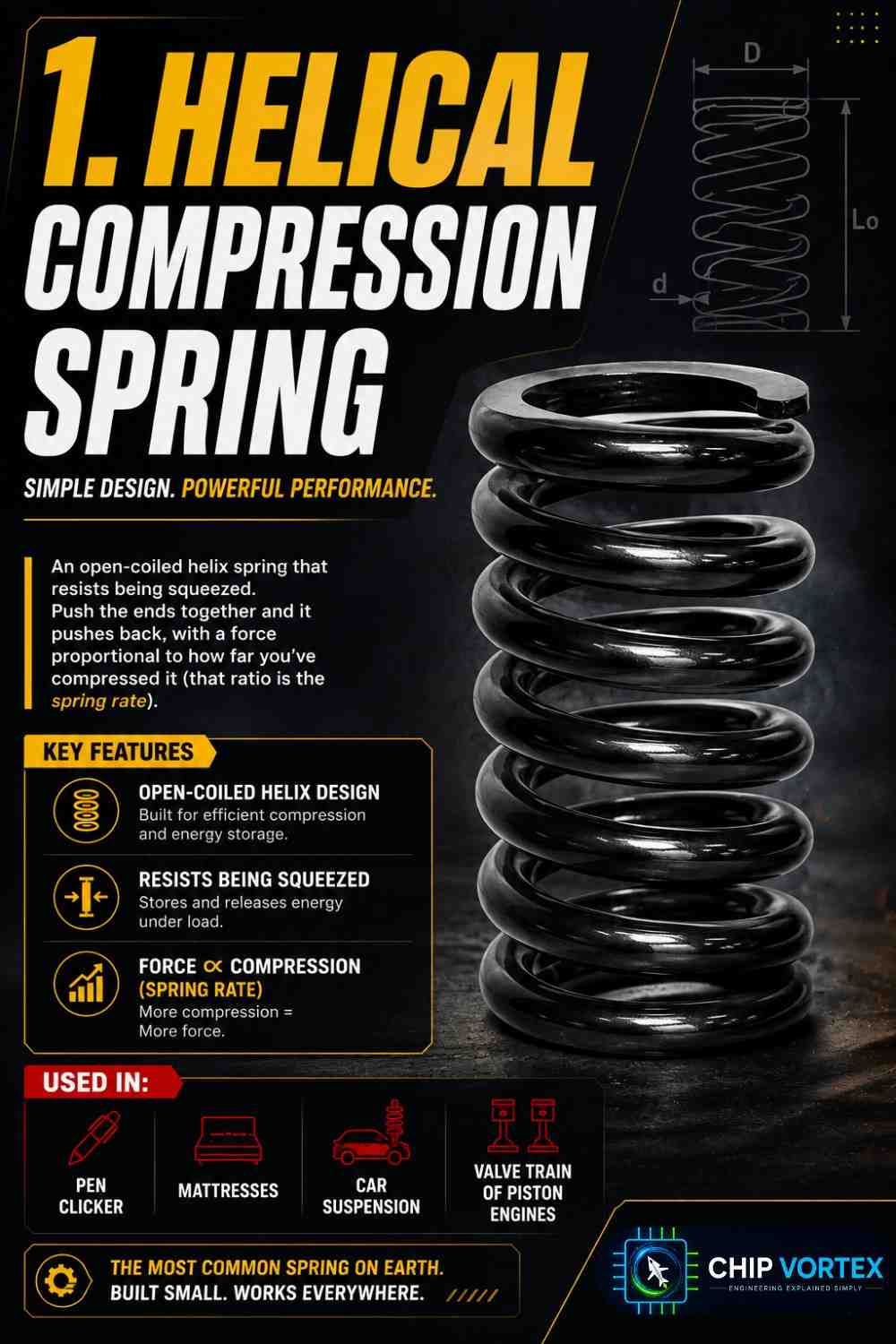
The most common spring on Earth: an open-coiled helix that resists being squeezed. Push the ends together and it pushes back, with a force proportional to how far you’ve compressed it (that ratio is the spring rate). It’s in your pen clicker, your mattress, your car’s suspension, and the valve train of every piston engine.
Best for: Any job that needs push-back resistance — which is why it’s everywhere.
2. Extension Spring
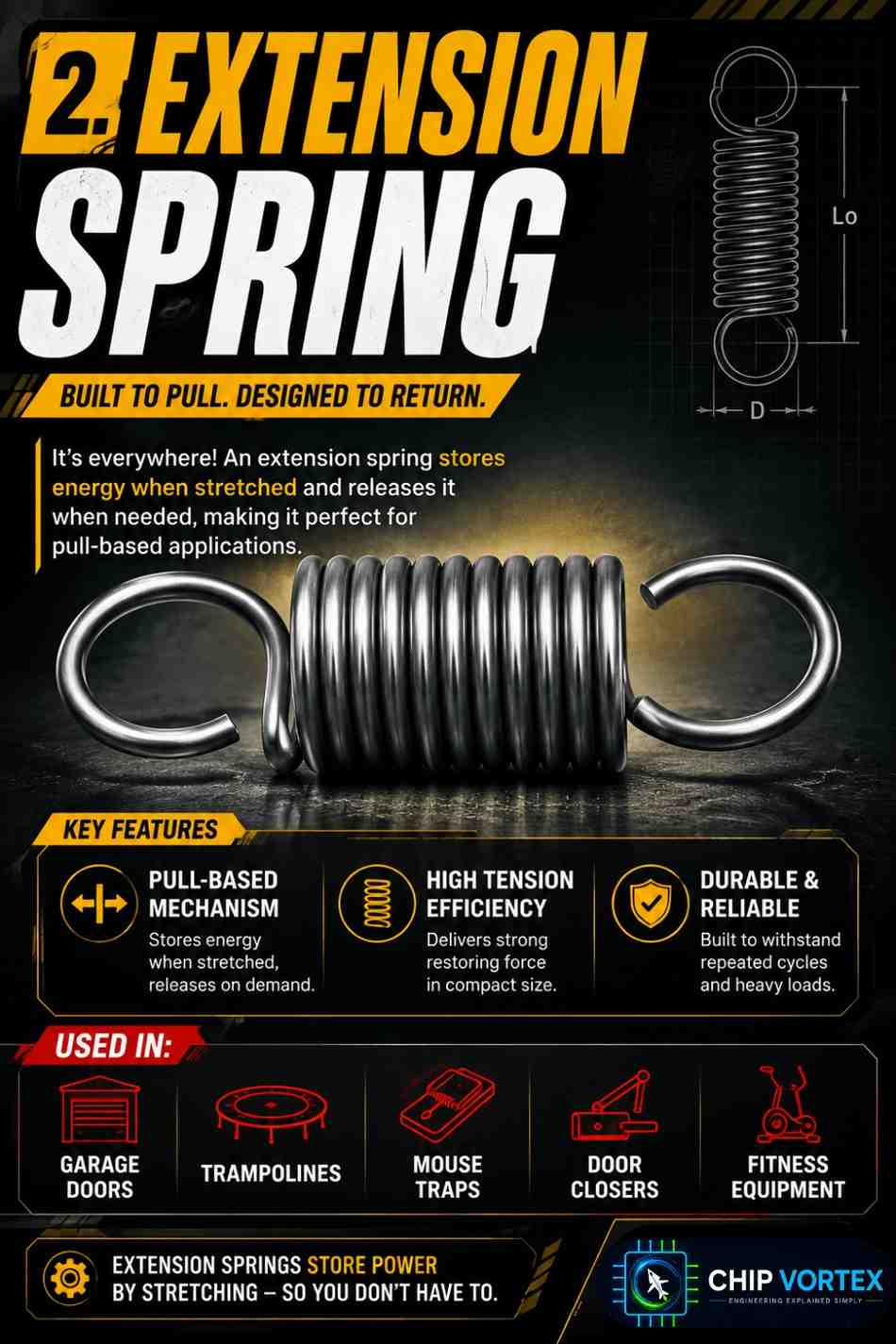
The mirror image of compression: tightly wound coils that touch at rest, with hooks or loops at each end, built to resist being stretched. Most are wound with initial tension — the coils grip each other even at rest, so the spring fights you from the very first millimeter of pull. Garage doors, trampolines, screen doors, and weighing scales all hang their function on extension springs.
Best for: Pulling two things back together after they’ve been separated.
3. Torsion Spring
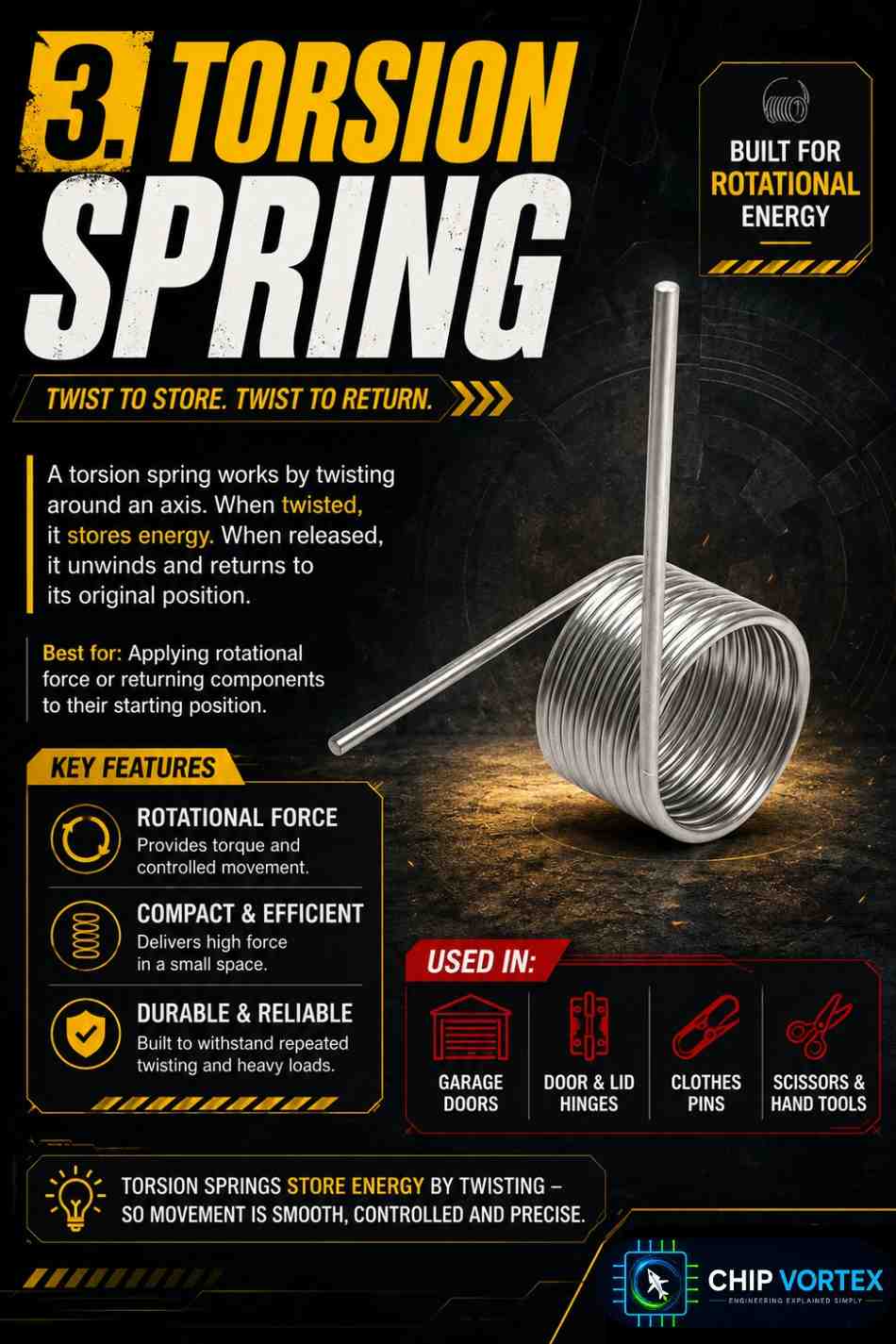
A torsion spring resists twisting. Its coiled body stays anchored while two legs extend outward; rotate one leg and the spring stores rotational energy, snapping back when released. It’s the spring in a clothespin, a mousetrap, a door hinge — and, in heavy-duty form, the counterbalance shaft that makes a garage door light enough to lift.
Best for: Anything that rotates and needs to return — lids, levers, hinges.
4. Leaf Spring
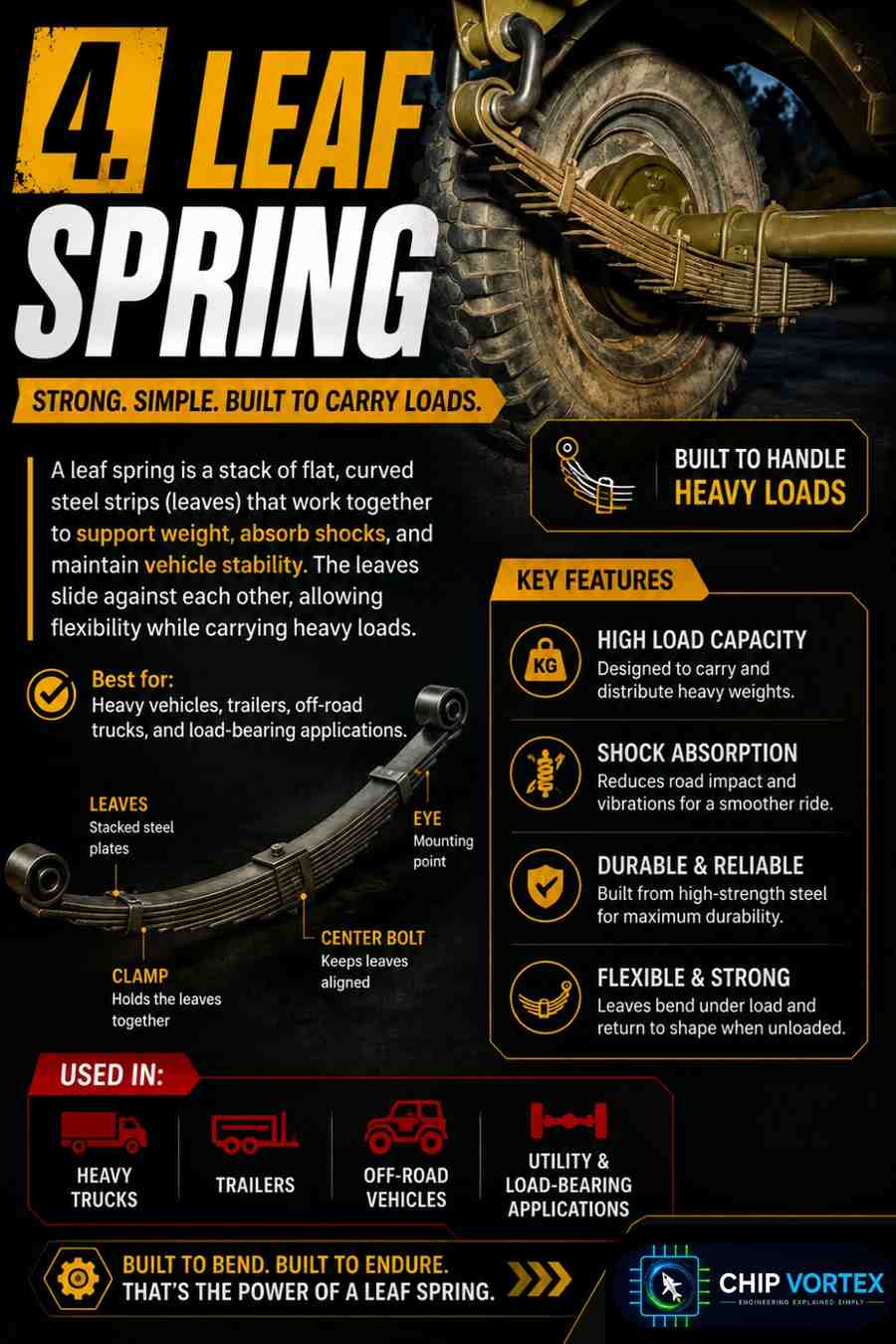
The oldest design here, straight from the horse-carriage era: several flat steel strips (leaves) stacked and clamped together, flexing as a unit under load. The stack spreads huge weights across its length, and the friction between leaves adds natural damping. That combination of load capacity and toughness is why trucks and trailers still ride on leaf springs today.
Best for: Heavy vehicle suspension where load capacity beats ride refinement.
Shape Variants of the Compression Spring
The next four are all compression springs at heart — the coil shape changes to solve a specific problem.
5. Conical Spring
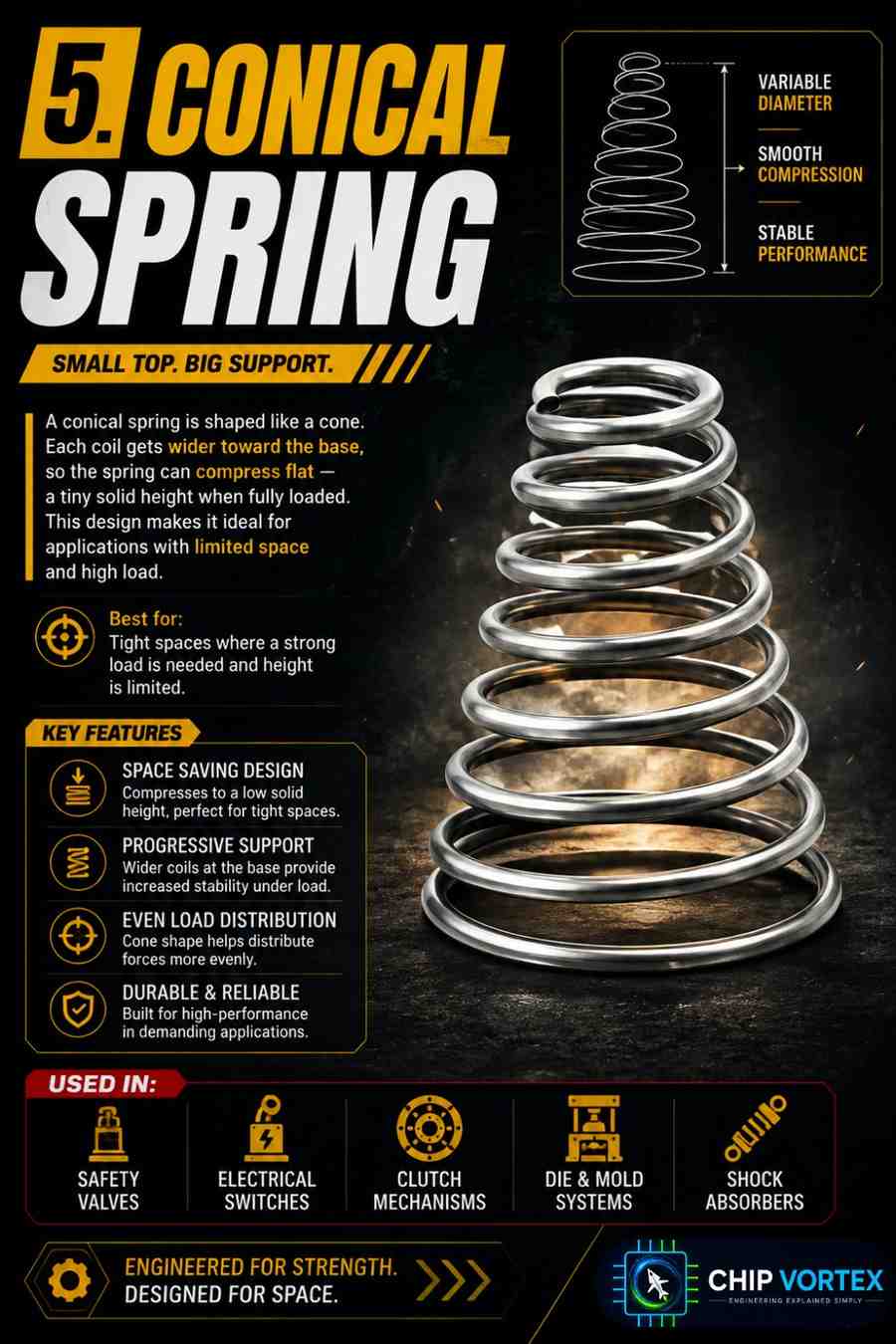
A compression spring tapered into a cone. Each coil can nest inside the next, so the spring can compress nearly flat — a tiny solid height no cylindrical spring can match. The taper also makes it very stable against buckling, and gives a progressive rate: soft at first, stiffer as it compresses. That’s why it lives in battery compartments and push buttons.
Best for: Tight spaces where a spring must collapse almost completely flat.
6. Barrel Spring
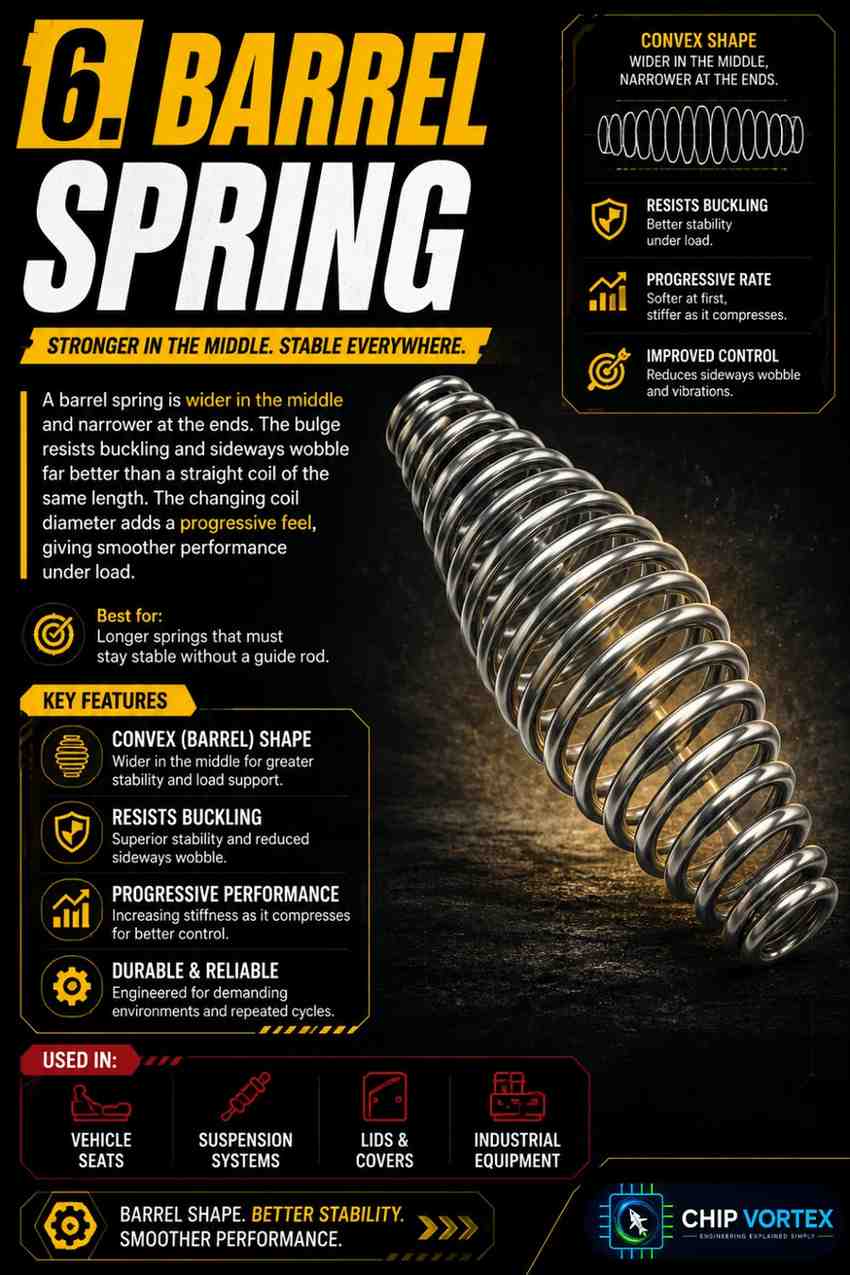
Also called a convex spring — wider in the middle, narrower at the ends. That bulge resists buckling and sideways wobble far better than a straight coil of the same length, and the changing coil diameter adds a progressive feel. You’ll find barrel springs in vehicle seats and suspension systems where stability under movement matters.
Best for: Longer springs that must stay stable without a guide rod.
7. Hourglass Spring
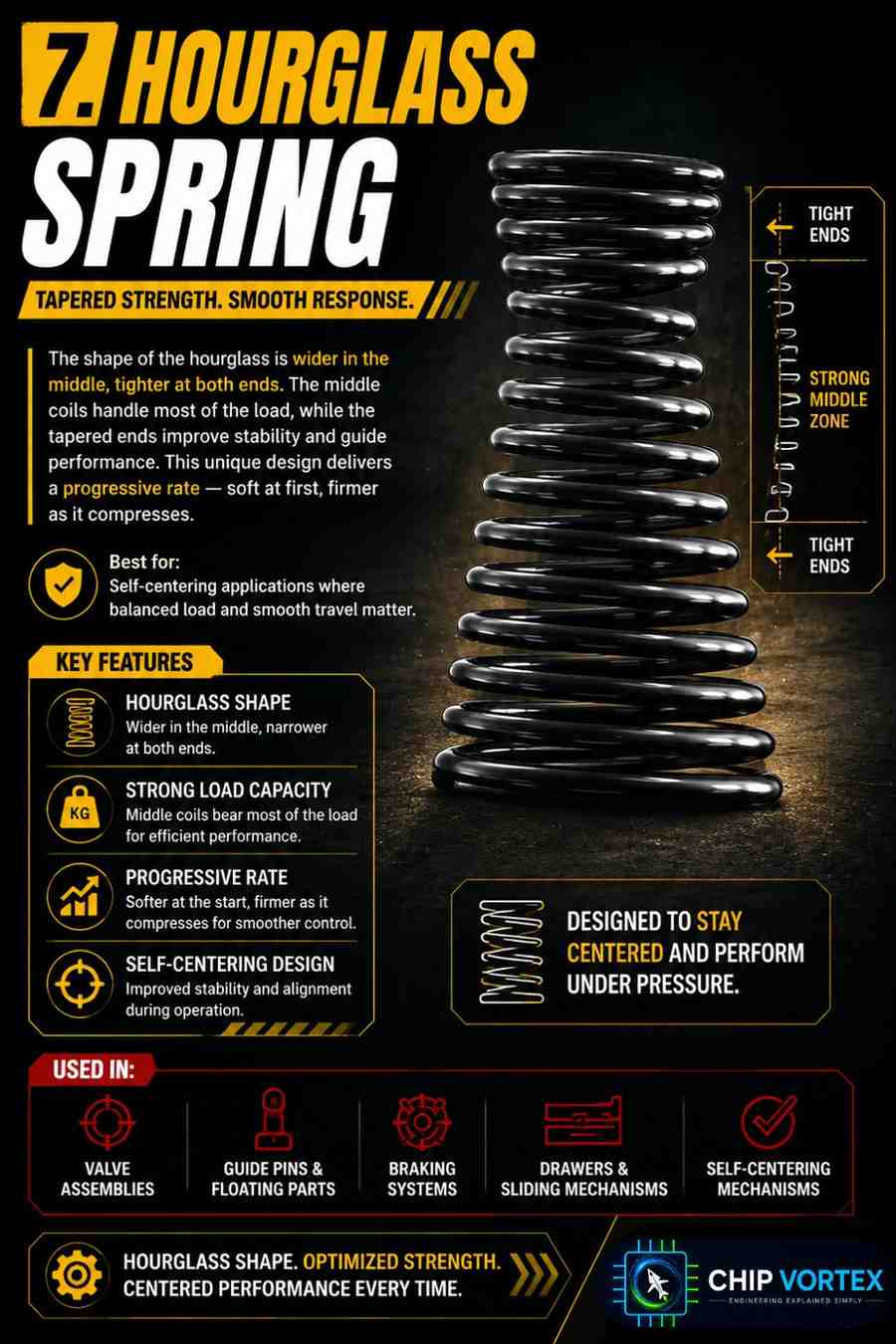
The reverse of the barrel: pinched in the middle, wider at both ends. The symmetric shape centers itself under load and stays put on flat seats. It’s the classic shape inside traditional innerspring mattresses, and it appears in suspension applications for the same self-centering stability.
Best for: Self-centering support with even, balanced compression.
8. Variable Pitch Spring
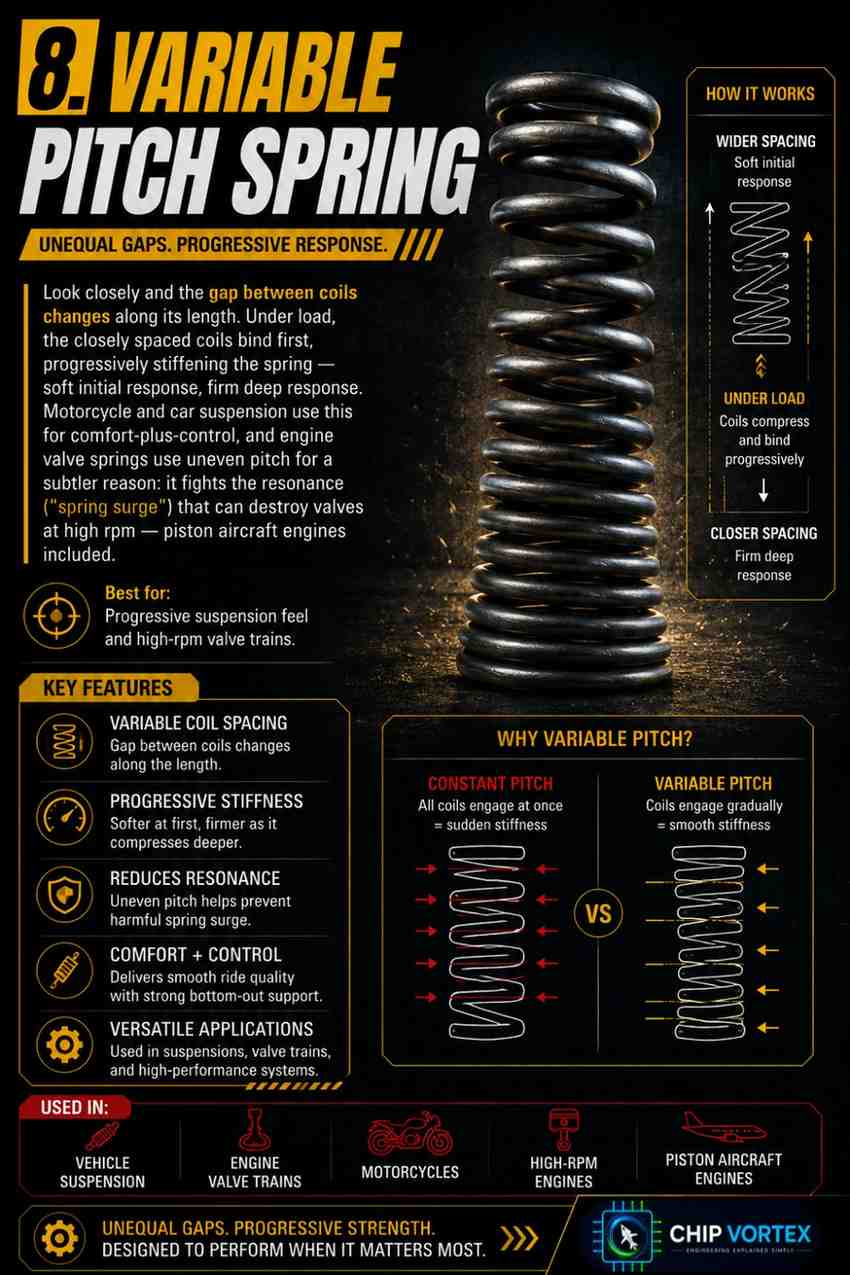
Look closely and the gap between coils changes along its length. Under load, the closely spaced coils bind first, progressively stiffening the spring — soft initial response, firm deep response. Motorcycle and car suspension use this for comfort-plus-control, and engine valve springs use uneven pitch for a subtler reason: it fights the resonance (“spring surge”) that can destroy valves at high rpm — piston aircraft engines included.
Best for: Progressive suspension feel and high-rpm valve trains.
Flat-Strip Springs
Two designs made from flat strip instead of round wire — and the pair most often confused with each other.
9. Spiral (Clock) Spring
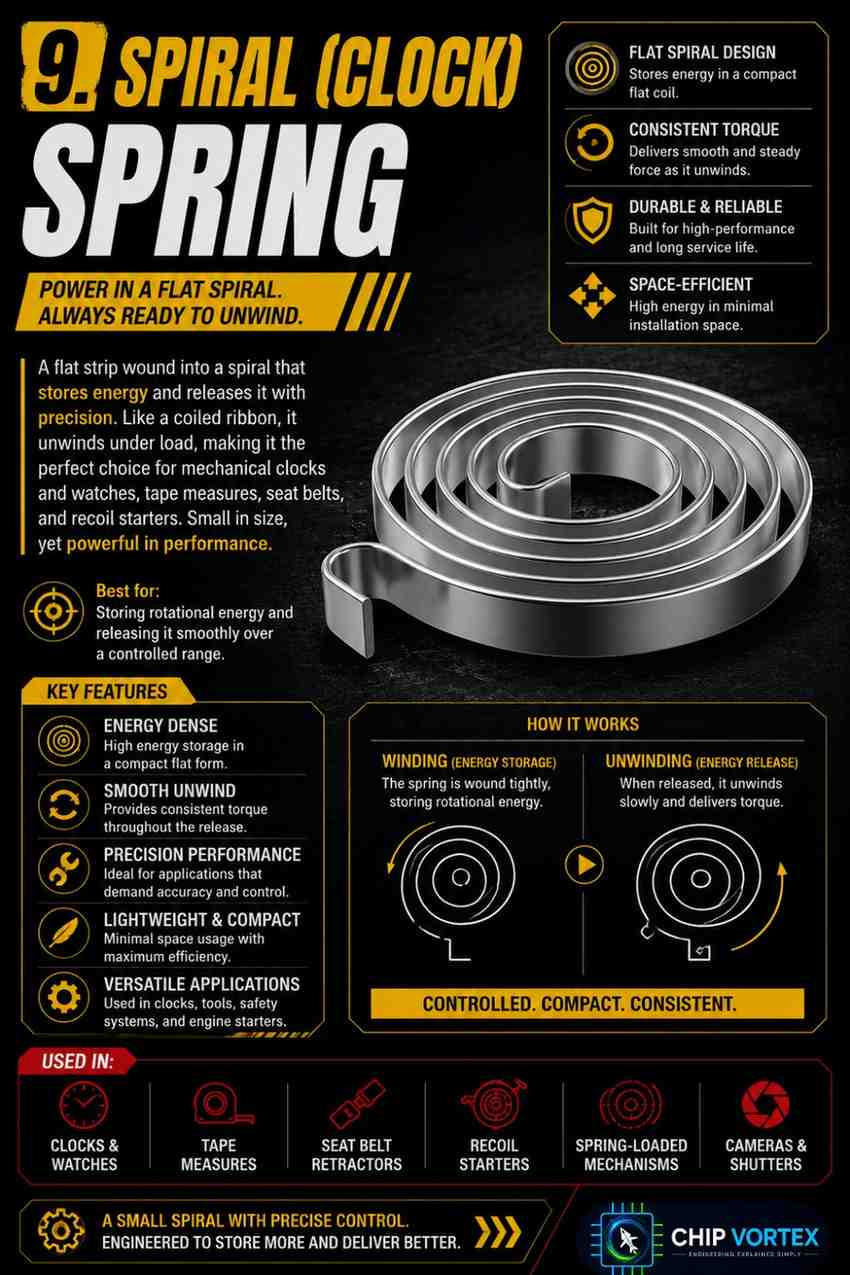
A flat strip wound into a spiral in a single plane — like a cinnamon roll. Wind it up and it stores rotational energy, releasing it steadily over many turns. That near-constant torque across a long rotation is why it powered mechanical clocks and watches for centuries, and why it still recoils your tape measure and reclines your car seat today.
Best for: Storing rotational energy and releasing it smoothly over many turns.
10. Volute Spring
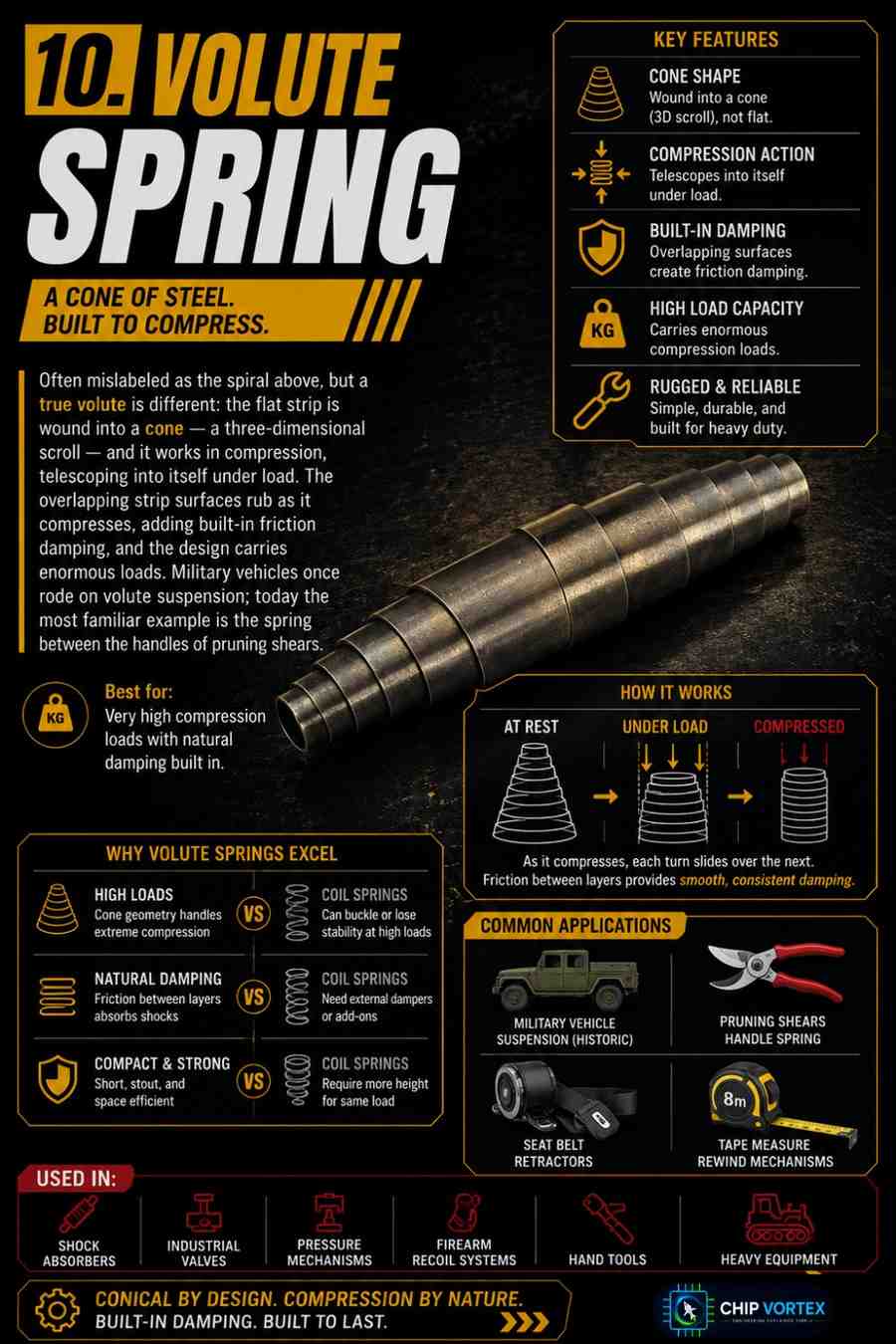
Often mislabeled as the spiral above, but a true volute is different: the flat strip is wound into a cone — a three-dimensional scroll — and it works in compression, telescoping into itself under load. The overlapping strip surfaces rub as it compresses, adding built-in friction damping, and the design carries enormous loads. Military vehicles once rode on volute suspension; today the most familiar example is the spring between the handles of pruning shears.
Best for: Very high compression loads with natural damping built in.
Specialty Springs
11. Garter Spring
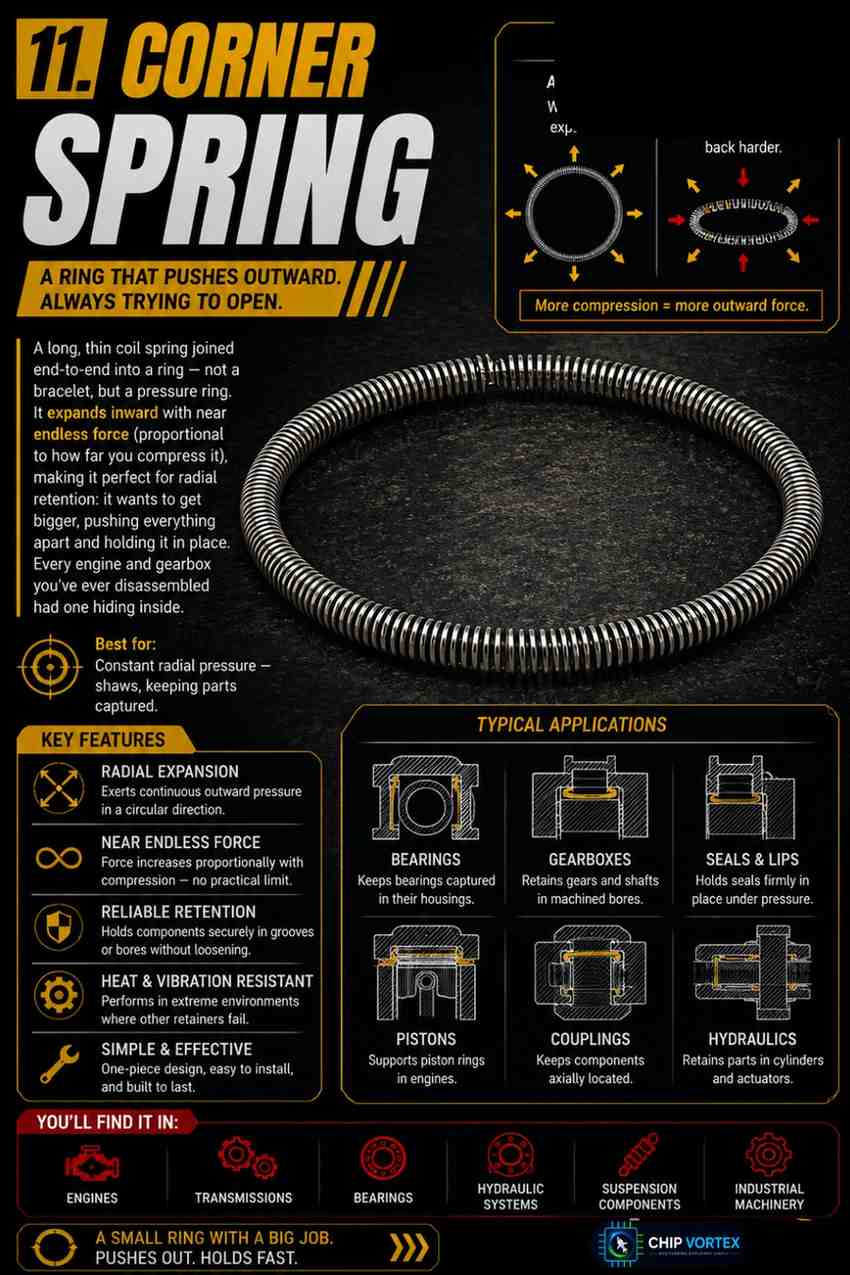
A long, thin coil spring joined end-to-end into a ring — like a bracelet — that squeezes inward with even radial force (expansion versions push outward instead). Its defining job: sitting inside rotary shaft oil seals, holding the sealing lip snugly against the spinning shaft and maintaining that grip as the lip wears. Every engine and gearbox oil seal you’ve ever changed had one hiding inside. They also appear in electrical connectors and mechanical seals.
Best for: Constant radial pressure — above all, keeping oil seals sealing.
12. Magazine Spring
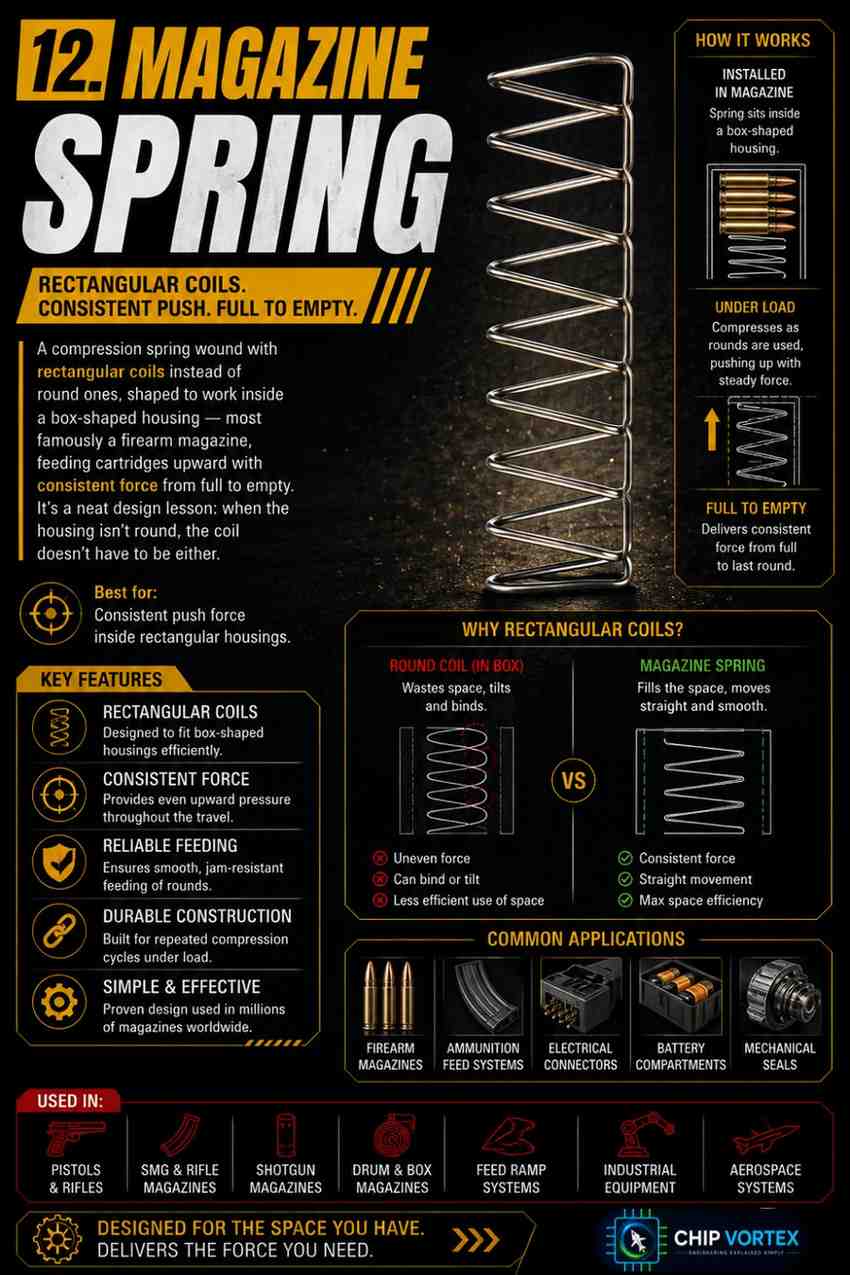
A compression spring wound with rectangular coils instead of round ones, shaped to work inside a box-shaped housing — most famously a firearm magazine, feeding cartridges upward with consistent force from full to empty. It’s a neat design lesson: when the housing isn’t round, the coil doesn’t have to be either.
Best for: Consistent push force inside rectangular housings.
Space-Saving Industrial Springs
The final two replace the duplicate entries you’ll see on many charts — and they’re two of the most important springs in modern industry.
13. Belleville (Disc) Spring
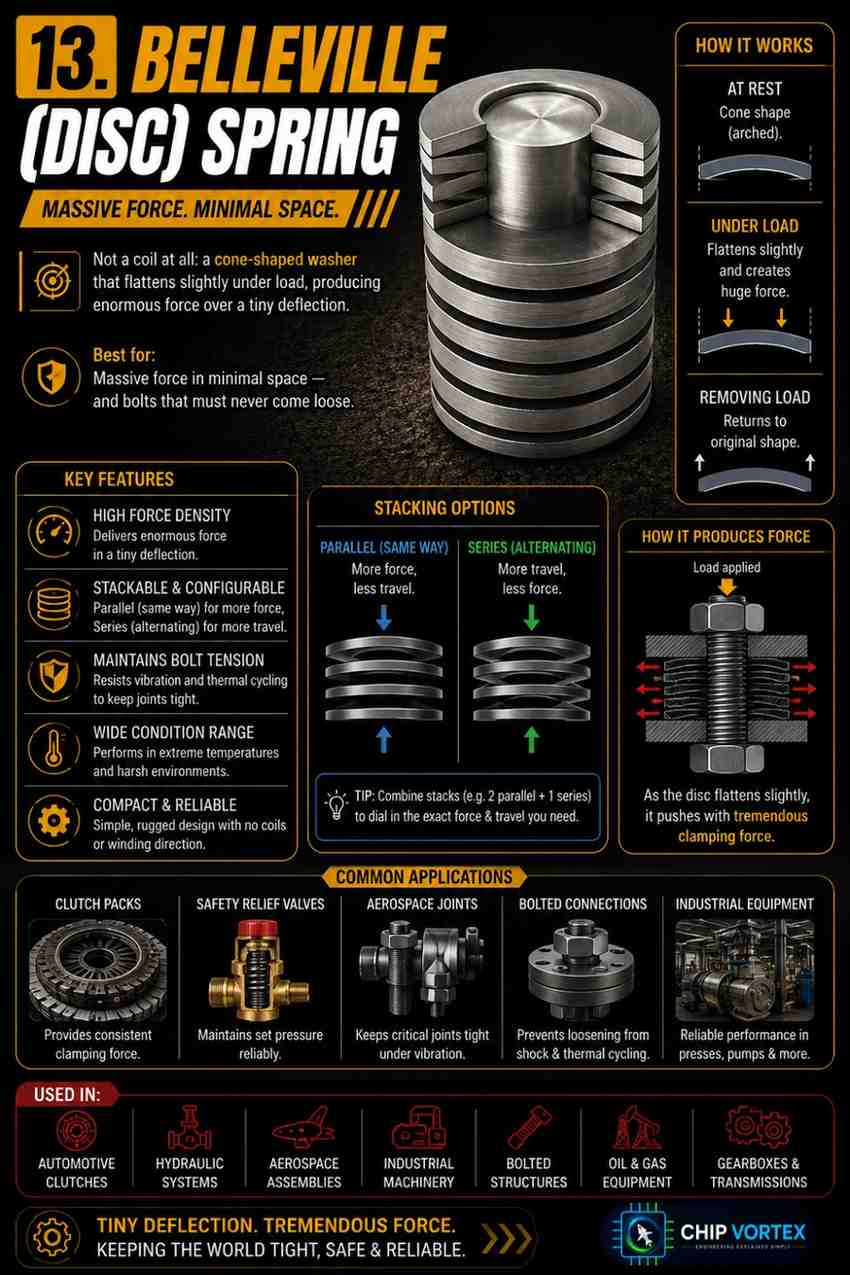
Not a coil at all: a cone-shaped washer that flattens slightly under load, producing enormous force over a tiny deflection. Stack them facing the same way (parallel) for more force, or alternating (series) for more travel — a configurable spring system in millimeters of space. Their signature job is keeping bolted joints tight: a Belleville stack maintains bolt tension through vibration and thermal cycling, which is exactly why they’re standard in clutches, safety valves, and aerospace bolted assemblies.
Best for: Massive force in minimal space — and bolts that must never come loose.
14. Wave Spring
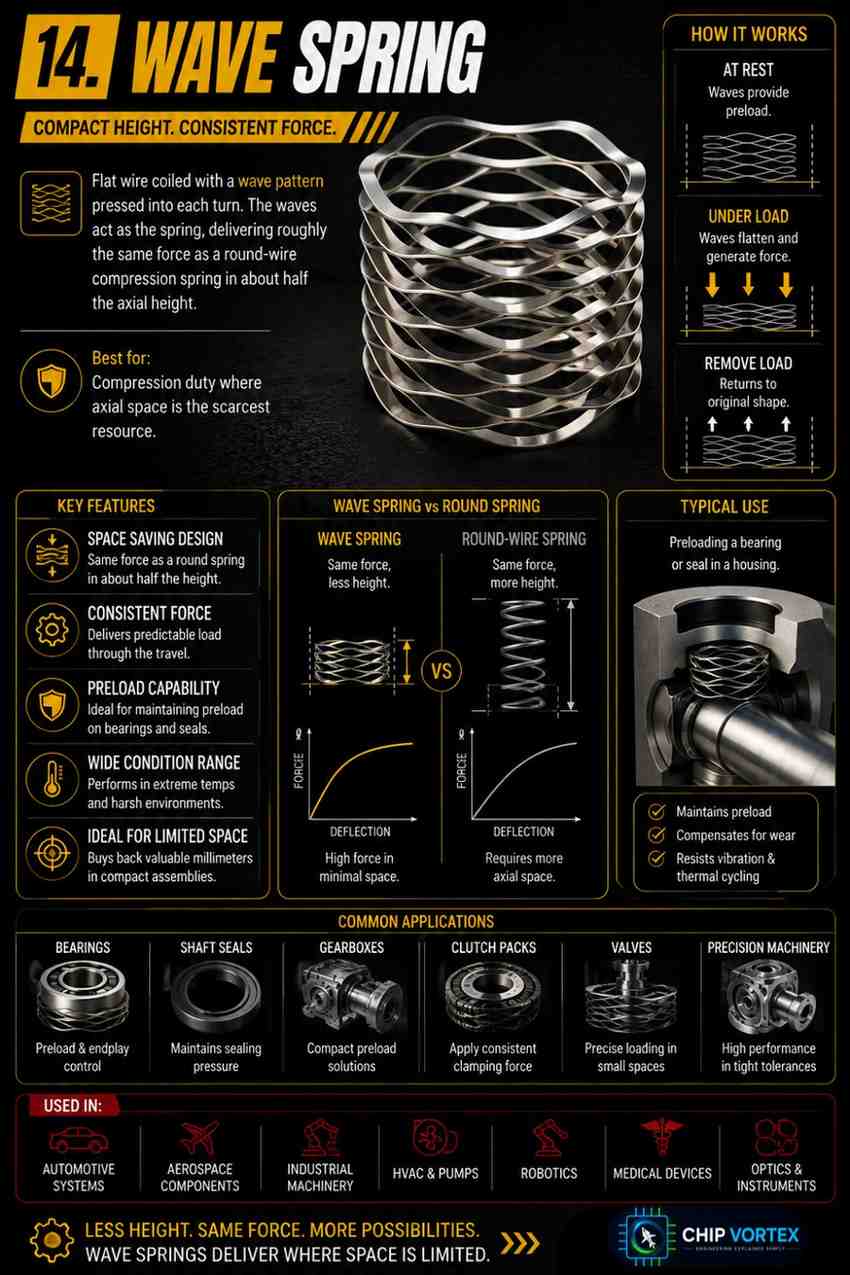
Flat wire coiled with a wave pattern pressed into each turn. The waves act as the spring, delivering roughly the same force as a round-wire compression spring in about half the axial height. When engineers need to preload a bearing or seal inside a cramped assembly, a wave spring buys back precious millimeters — which is why they’re everywhere in compact and precision machinery.
Best for: Compression duty where axial space is the scarcest resource.
How to Choose the Right Spring
Start with the force direction: a push points to the compression family (1, 5–8, 10, 12–14), a pull to extension, a twist to torsion or spiral, and a radial squeeze to garter. Then let the constraints narrow it: tight axial space favors wave or Belleville; a need to collapse flat favors conical; heavy loads with damping favor leaf or volute; and if you want the response to stiffen as it compresses, choose a progressive design — conical, barrel, or variable pitch. The right spring is simply the one whose geometry matches your force, your space, and your rate.
FAQ: Types of Springs
What’s the difference between compression and extension springs?▾
Compression springs resist being squeezed and have open, spaced coils. Extension springs resist being stretched, have closed coils with hooks at the ends, and are usually wound with initial tension so they resist from the first pull.
Which springs give a progressive (rising) rate?▾
Conical, barrel, and variable pitch springs — each starts soft and stiffens as coils progressively bind. That’s why they dominate suspension applications.
What spring is inside an oil seal?▾
A garter spring — a coil joined into a ring that presses the seal lip against the rotating shaft with even radial force, keeping the seal tight as the lip wears.
Why do springs sag or weaken over time?▾
Two culprits: metal fatigue from millions of load cycles, and “set” — permanent deformation from being over-compressed or overheated. A correctly designed spring working within its limits keeps its strength for a very long life.
What are Belleville washers used for?▾
Maintaining bolt tension. A Belleville stack under a bolt head keeps the joint preloaded through vibration and temperature swings — enormous holding force from a part only millimeters thick.
Found this useful? Save the chart to your engineering board — and since springs are only half the story of holding machines together, pair this with our guide to types of nuts for the fastener side.