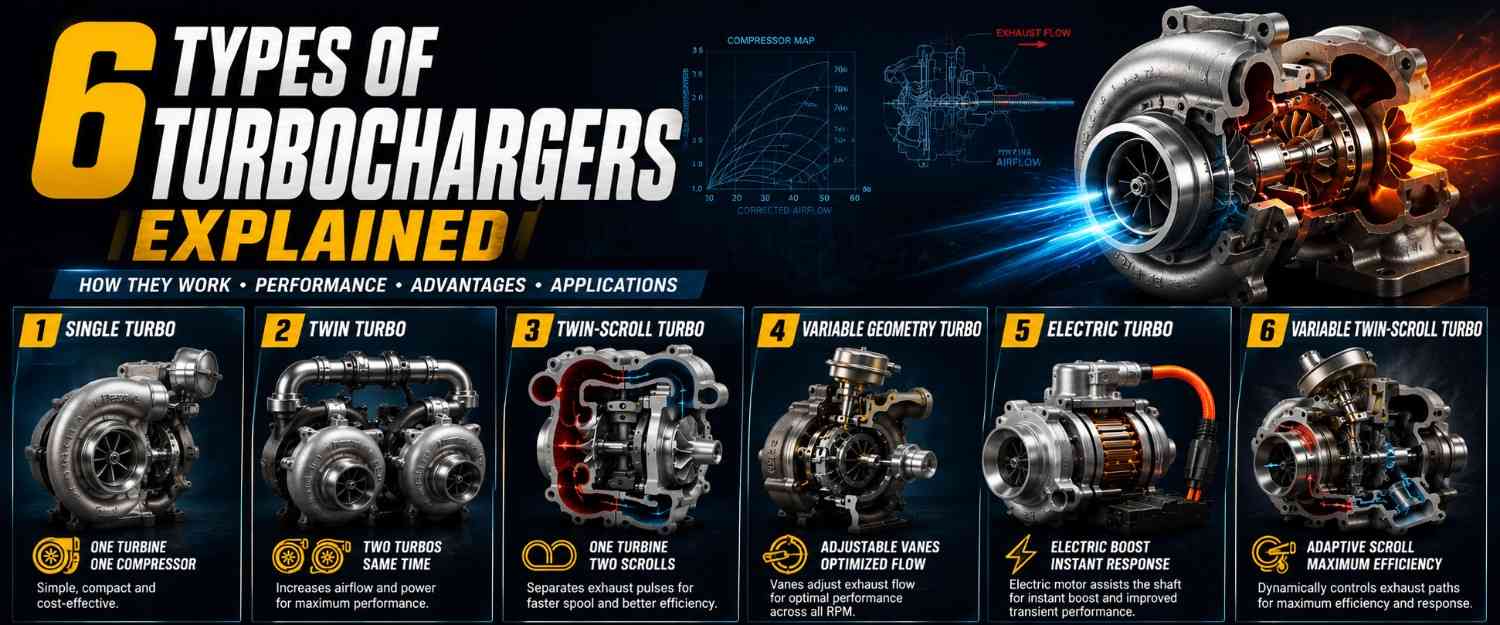
Every turbocharger does the same basic job — force more air into the engine so it can burn more fuel and make more power. But how a turbo does that job is what separates a laggy, old-school setup from a modern engine that pulls the instant you touch the throttle. This guide explains all 6 types of turbochargers: how each one works, its trade-offs, and which setup fits which goal.
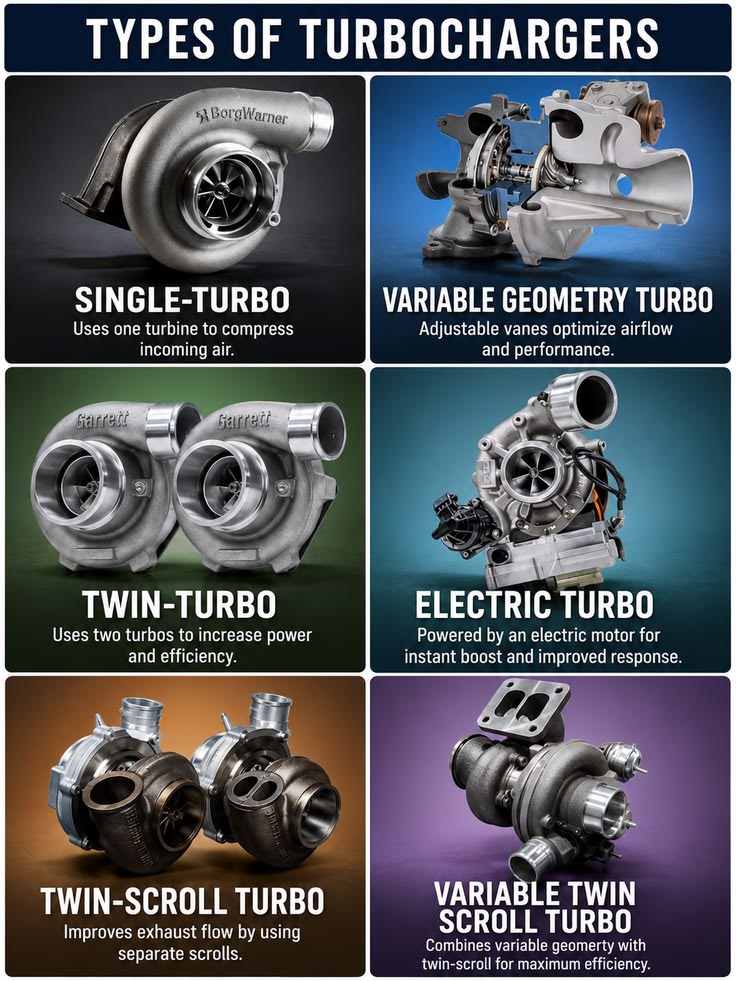
Save the chart above for quick reference, then let’s break each one down.
Quick Comparison: All 6 Types of Turbochargers
| # | Turbo Type | How It Works | Best For |
|---|---|---|---|
| 1 | Single-Turbo | One turbine-compressor unit fed by all the exhaust | Simplicity, budget builds, big single-turbo power |
| 2 | Variable Geometry Turbo (VGT) | Movable vanes adjust exhaust flow onto the turbine | Diesels, wide powerband, minimal lag |
| 3 | Twin-Turbo | Two turbos working in parallel or in sequence | V-engines, response plus top-end power |
| 4 | Electric Turbo | Electric motor spins the compressor instantly | Near-zero lag, hybrid performance cars |
| 5 | Twin-Scroll Turbo | Divided housing keeps exhaust pulses separated | Modern 4-cylinders, faster spool |
| 6 | Variable Twin-Scroll | Valve feeds one or both scrolls as needed | Maximum efficiency across the rev range |
How a Turbo Works in 30 Seconds
Hot exhaust gas spins a turbine wheel. That turbine shares a shaft with a compressor wheel, which squeezes incoming air and stuffs more of it into the cylinders. More air means more fuel can burn, which means more power — all driven by exhaust energy that would otherwise be wasted out the tailpipe. Every type below is a different answer to the same engineering question: how do we spin that shaft faster, sooner, and smarter?
1. Single-Turbo
The classic setup: one turbine, one compressor, fed by the exhaust from every cylinder. As the pin says, it uses one turbine to compress all the incoming air — and that simplicity is its biggest strength. Fewer parts, lower cost, easier packaging, and a massive range of sizes to choose from.
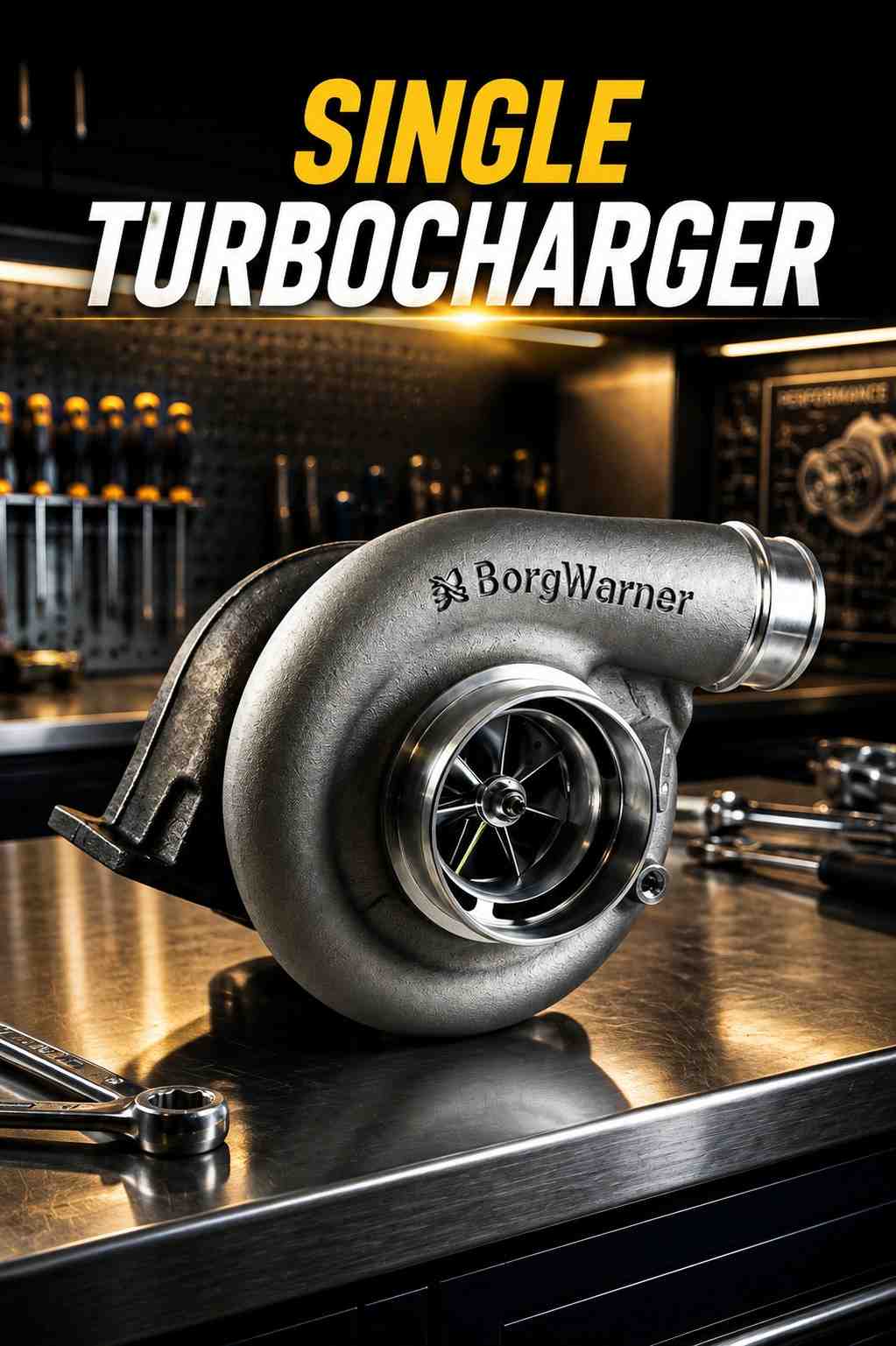
The trade-off lives in that size choice. A small single turbo spools quickly and feels responsive but runs out of breath at high rpm. A large single makes serious top-end power but suffers turbo lag — that pause between pressing the throttle and the boost arriving. That’s the exact compromise the other five designs on this list exist to solve.
Best for: Budget builds, everyday cars, and drag-style setups chasing big power from one turbo.
2. Variable Geometry Turbo (VGT)
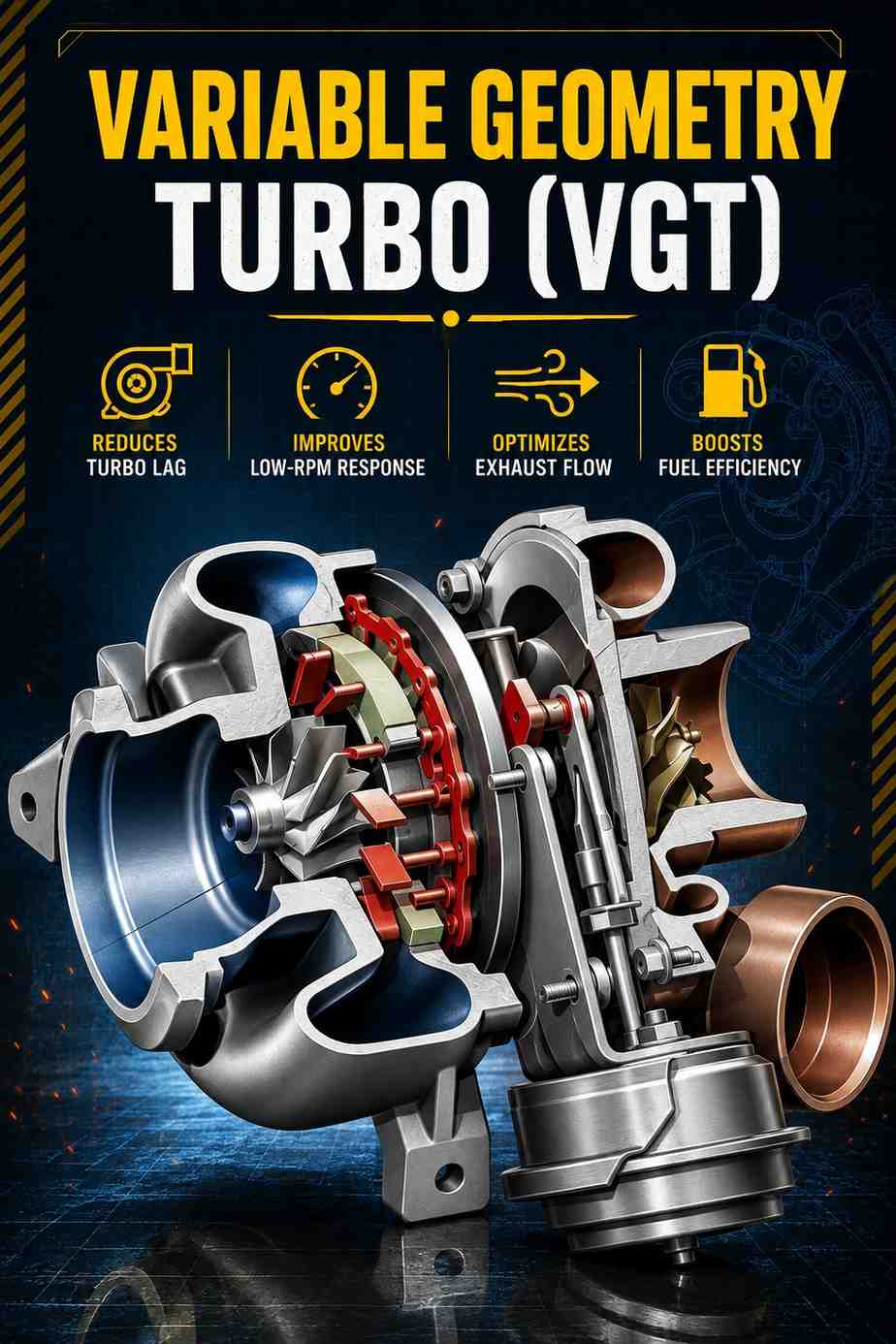
A VGT surrounds its turbine with a ring of small adjustable vanes. At low rpm the vanes close down, squeezing the exhaust into a faster jet that spools the turbine quickly — the turbo behaves like a small unit. As revs climb, the vanes open wide to let the full exhaust flow through — now it behaves like a big unit. Adjustable vanes optimizing airflow, exactly as the chart promises.
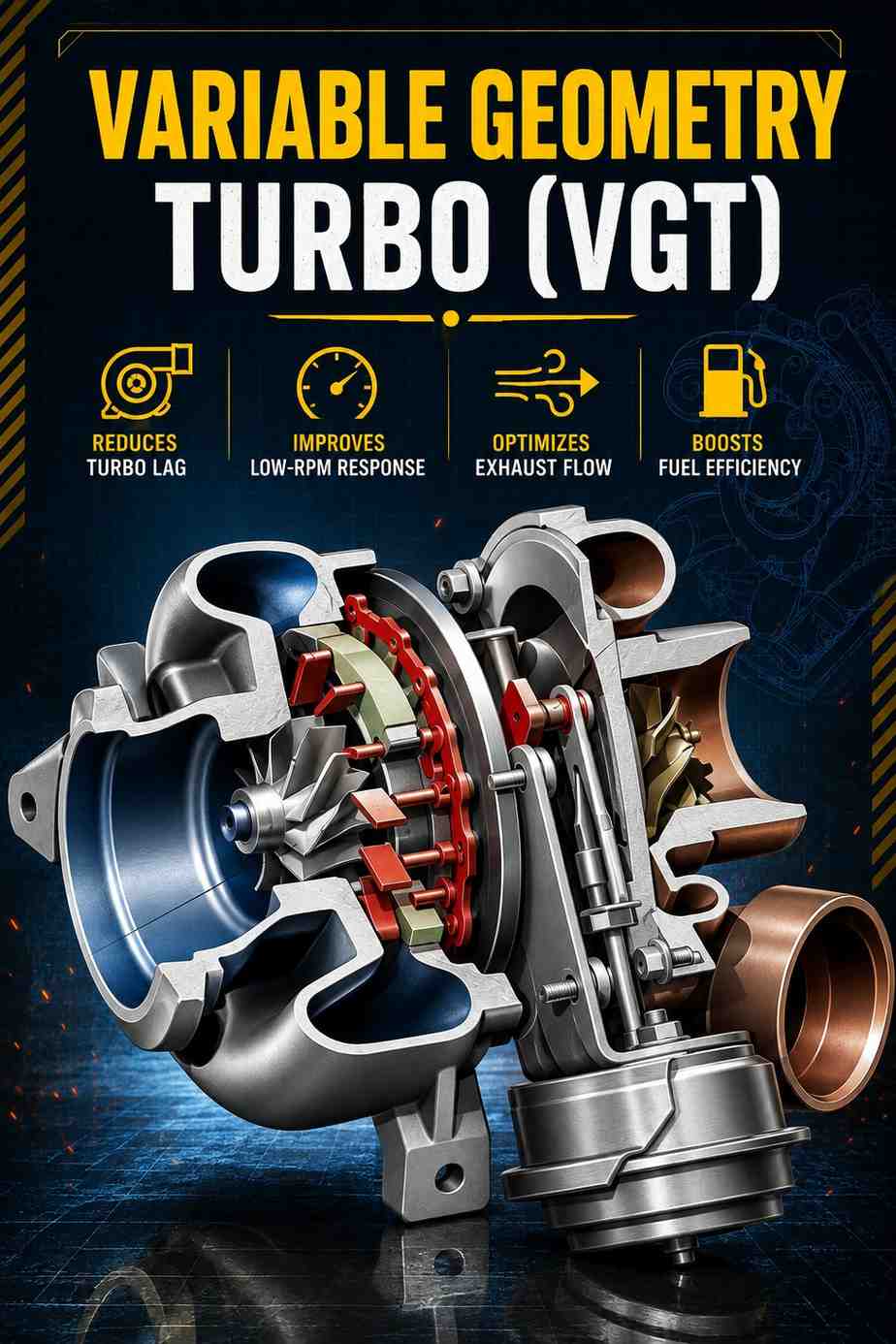
The result is a wide, flexible powerband with very little lag. You’ll find VGTs on nearly every modern turbodiesel, because diesel exhaust runs cool enough for the vane mechanism to survive. Petrol engines run hotter, which is why VGT petrol applications are rarer and rely on expensive high-temperature alloys.
Best for: Diesel engines and any application where a wide, lag-free powerband matters more than peak numbers.
3. Twin-Turbo
Twin-turbo means two complete turbochargers on one engine, and there are two main ways to arrange them. Parallel: each turbo handles one bank of cylinders (perfect for V6s and V8s), with two small turbos spooling faster than one big one would. Sequential: a small turbo provides boost at low rpm, then a larger one takes over (or joins in) as revs rise — response early, power late.
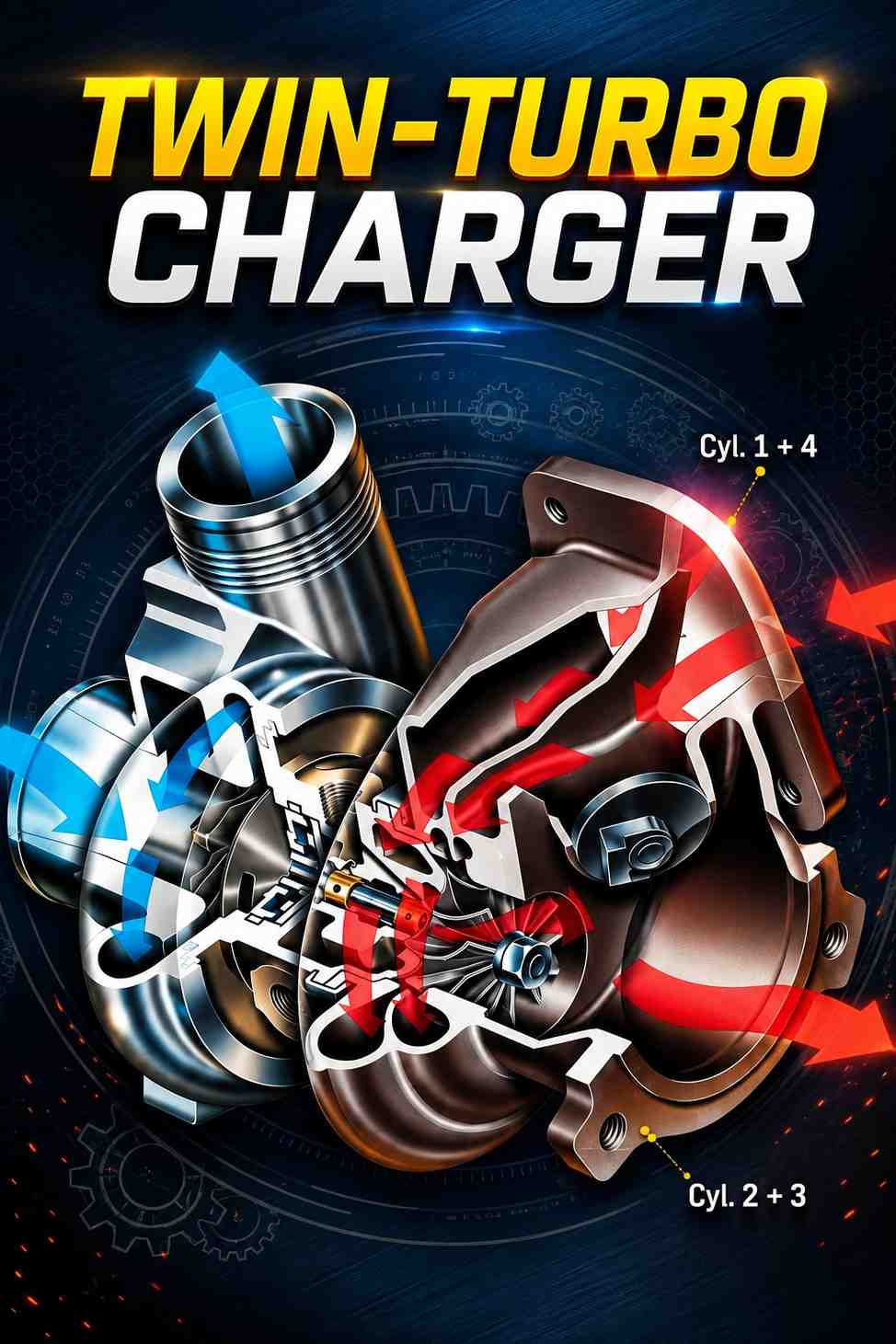
Either way, the goal matches the pin’s caption: more power and more efficiency, because each turbo is sized closer to its ideal operating window. The cost is complexity — twice the plumbing, twice the heat management, and more to maintain.
Best for: V-configuration engines and performance cars that want both instant response and strong top-end power.
4. Electric Turbo
The newest idea on the chart: add an electric motor so boost no longer depends on exhaust gas alone. This comes in two flavors. An electric compressor spins up instantly on battery power and fills the gap while the main turbo spools. A motor-assisted turbo mounts the motor directly on the turbo shaft — it can spin the turbo up on demand and harvest energy from the exhaust when there’s excess, a concept proven in Formula 1’s hybrid era before reaching road cars.
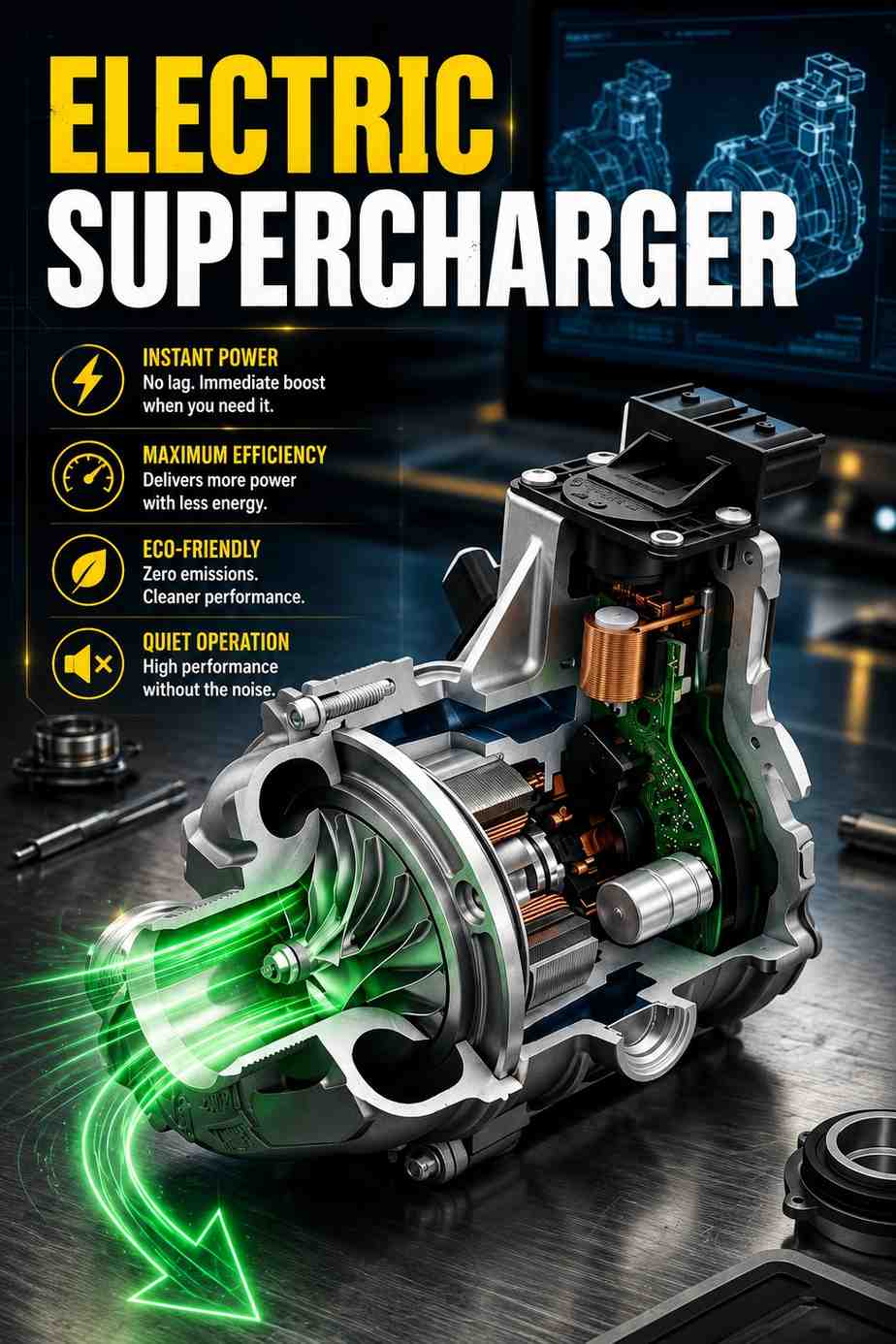
The payoff is boost that arrives the moment you ask for it — effectively zero lag — plus energy recovery a normal turbo simply throws away. The catch: these systems need 48-volt (or stronger) hybrid electrics, which is why they currently live in premium performance cars.
Best for: Instant throttle response and hybrid performance applications where lag is unacceptable.
5. Twin-Scroll Turbo
Don’t confuse this with twin-turbo — a twin-scroll is one turbocharger with a divided turbine housing. The exhaust manifold pairs up cylinders by firing order (on a four-cylinder, typically 1 & 4 into one scroll, 2 & 3 into the other) so their exhaust pulses never collide on the way to the turbine.
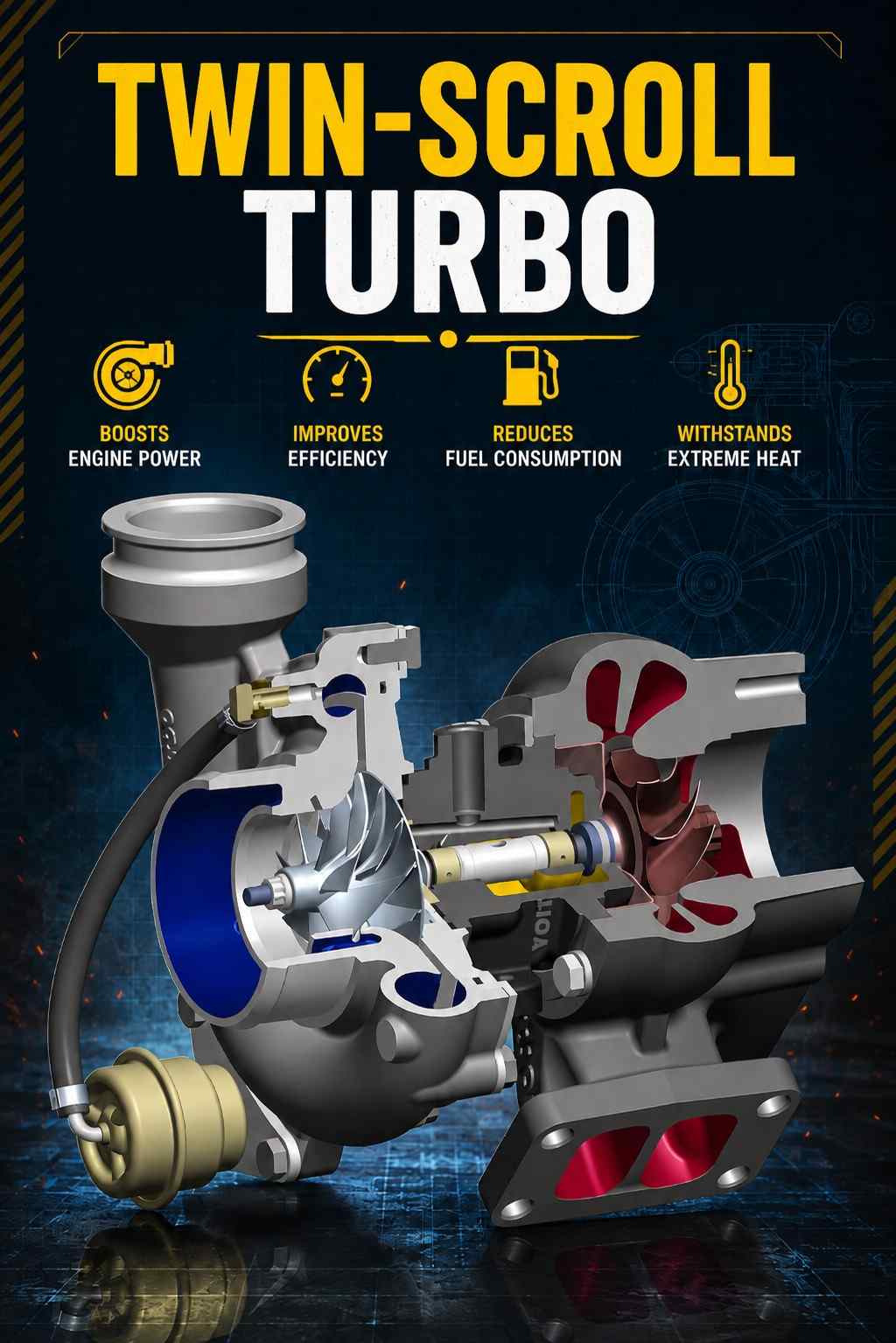
Why does that matter? Each exhaust pulse carries a punch of energy. Merge the pulses at the wrong time and they interfere, wasting energy and slowing the turbine. Keep them separated — separate scrolls, as the chart says — and each pulse hits the turbine cleanly. The result is faster spool, less lag, and better cylinder scavenging than a single-scroll design, from a single, relatively simple unit. It’s why so many modern turbocharged four-cylinders use exactly this layout.
Best for: Modern 4- and 6-cylinder engines that want near-VGT response without VGT complexity.
6. Variable Twin-Scroll Turbo
The chart saves the most advanced design for last: variable geometry thinking combined with twin-scroll architecture. A valve controls how exhaust enters the divided housing. At low rpm it directs all flow into just one scroll — concentrated energy, rapid spool. As load and revs increase, the valve opens the second scroll for maximum flow and minimum backpressure.
In effect, the turbo re-sizes itself on the fly, like a VGT, but using a simpler and more heat-tolerant valve mechanism instead of a delicate vane ring — which makes the concept friendlier to hot petrol exhaust. It remains rare and costly, but it points at where turbo design is heading: maximum efficiency at every point in the rev range.
Best for: Cutting-edge petrol engines chasing VGT-style flexibility with better heat tolerance.
The Aviation Connection
Turbochargers aren’t just a car thing. Piston aircraft engines face a problem no road car does: air gets thinner with altitude, and a naturally aspirated engine loses power the higher it climbs. A turbocharger solves this elegantly — by compressing the thin high-altitude air back to sea-level density, it lets an aircraft engine keep making full rated power thousands of feet up.
And here’s the bigger picture: take a turbocharger’s compressor and turbine, put a combustion chamber between them instead of a piston engine, and you’ve built the core of a gas turbine — the same fundamental machine as a jet engine. Two industries, one brilliant principle.
Which Turbo Setup Is Right?
It comes down to what you’re optimizing for. Daily-driver response: twin-scroll gives the best result per dollar. Diesel torque: VGT is the standard for good reason. Maximum power on a V-engine: twin-turbo. Big power on a budget: a well-sized single. Zero lag, money no object: electric-assisted. The bleeding edge of efficiency: variable twin-scroll. There’s no “best turbo” — only the best match between design and goal, which is exactly why all six types exist.
FAQ: Types of Turbochargers
What’s the difference between twin-turbo and twin-scroll?▾
Twin-turbo means two separate turbochargers on one engine. Twin-scroll means one turbocharger with a divided housing that keeps exhaust pulses separated. They solve different problems and aren’t interchangeable terms.
Which turbo type has the least lag?▾
Electric turbos — the motor spins the compressor instantly, so boost is effectively immediate. Among conventional designs, VGT and twin-scroll setups minimize lag best.
Why are variable geometry turbos mostly on diesels?▾
Diesel exhaust runs cooler than petrol exhaust, so the delicate vane mechanism survives. Petrol VGT applications exist but need expensive high-temperature alloys.
Is a bigger turbo always better?▾
No. A bigger turbo flows more air at high rpm but takes longer to spool, creating lag. The right turbo is sized for the engine’s powerband and the driver’s goals — not for the biggest number.
Do airplanes use turbochargers?▾
Yes. Many piston aircraft engines are turbocharged so they can maintain sea-level power in the thin air at altitude — one of the most practical uses of turbocharging anywhere.
Found this useful? Save the chart to your Pinterest board for the next time a spec sheet says “twin-scroll” and you want to know what it actually means. For the bigger version of this machine, read our guide on [how a jet engine works — internal link when live].