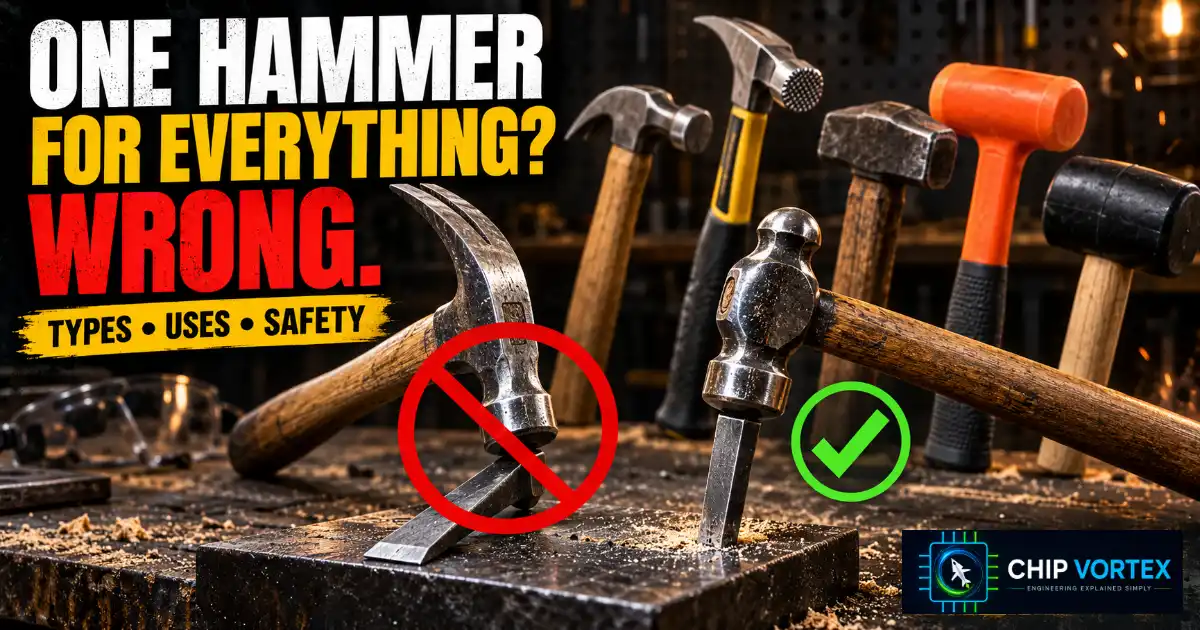
Most people own one hammer and use it for everything. That works until the day it doesn’t — and the day it doesn’t usually involves a chip of hardened steel leaving a hammer face at high speed.
This guide covers the main types of hammers, what each is actually designed for, and the small number of safety rules that matter more than all the rest.
Parts of a Hammer
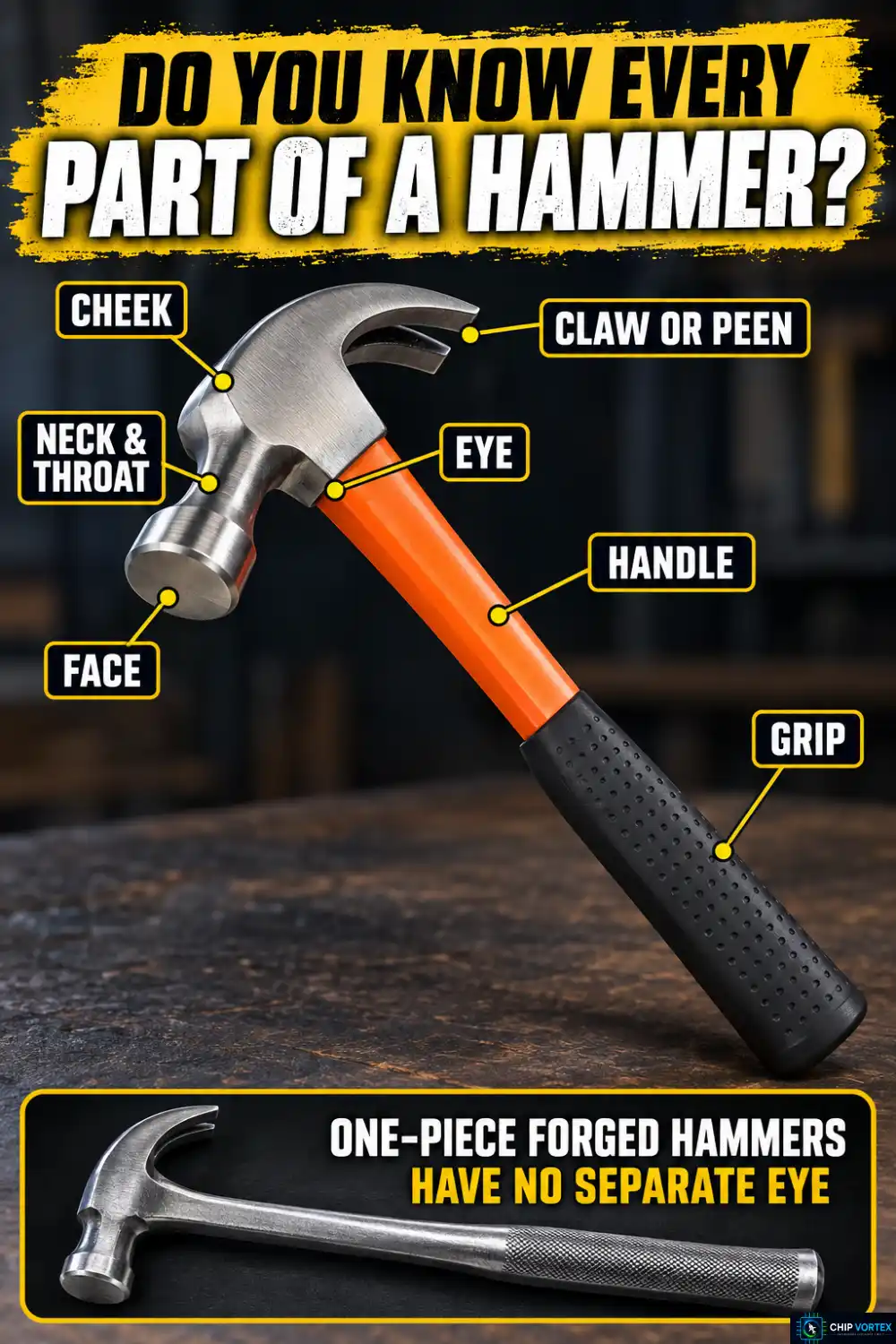
Worth knowing before the types, because the names come up constantly:
- Face — the striking surface. Usually slightly crowned, so a nail can be driven flush without the rim marking the timber.
- Cheeks — the sides of the head. Never strike with these.
- Eye — the tapered hole the handle passes through.
- Neck and throat — the narrowed section between head and handle.
- Claw or peen — the business end opposite the face.
- Handle and grip.
One-piece forged hammers such as Estwing’s have no eye at all — head and handle are a single piece of steel.
The Everyday Hammers
Claw hammer
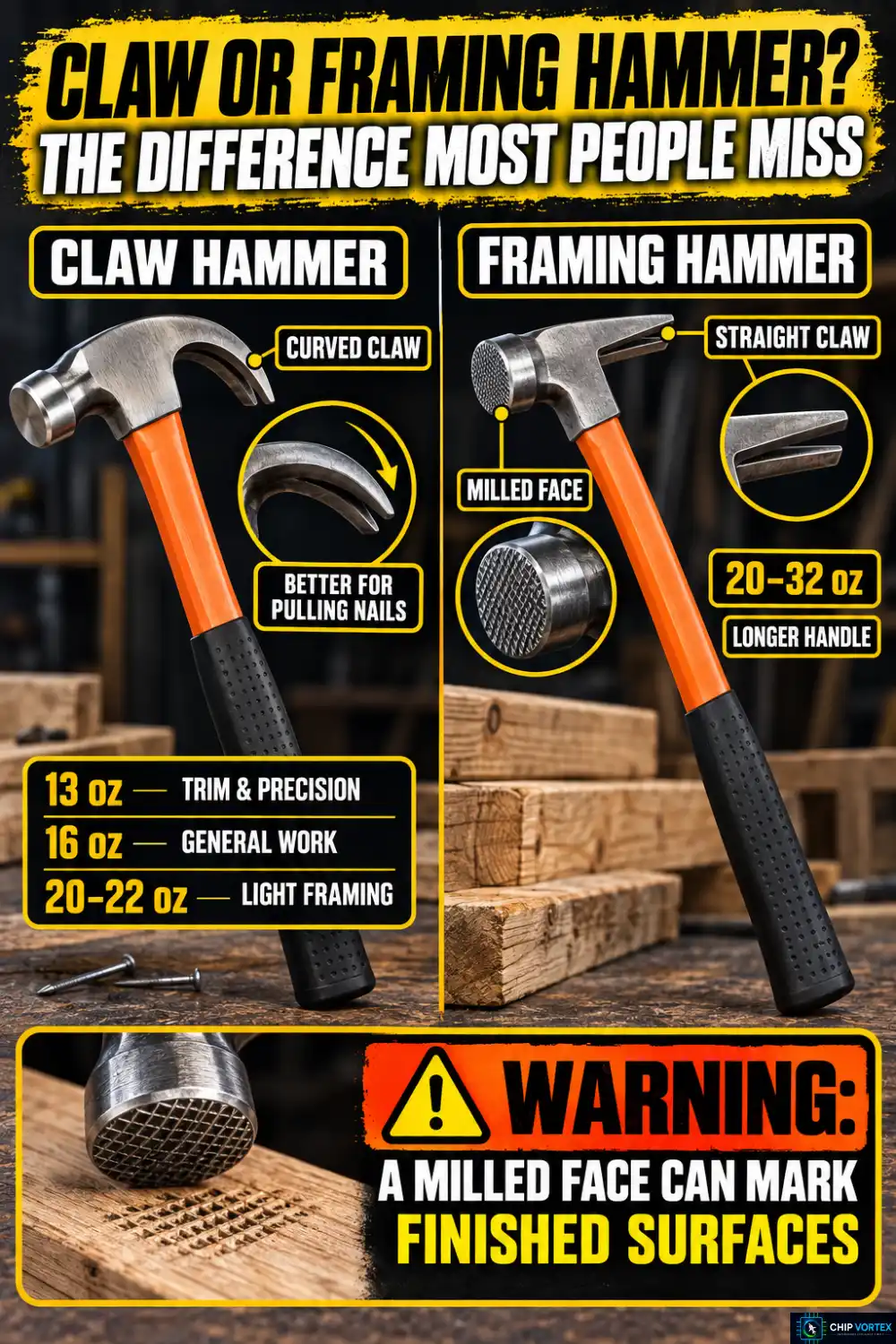
The general-purpose carpentry hammer. Rough sizing:
- 13 oz — trim and precision work
- 16 oz — the standard household and general carpentry size
- 20–22 oz — light framing
Curved claw versus straight (rip) claw is the real distinction. Compared at the same handle length, a curved claw gives more leverage for pulling nails — though a long-handled straight-claw framing hammer often out-pulls a short curved-claw one, because leverage comes from handle and curvature together. A straight claw is built for prying boards apart and demolition.
Note the scope limit, in the manufacturer’s own words: “Nail Hammers are for driving and withdrawing common nails only.” Not chisels, not punches, not other tools.
And one limit on the prying: a claw is not a pry bar. Side-loading it cracks the claw section — which is on Estwing’s own list of reasons to bin a hammer.
Framing hammer
A claw hammer scaled up for structural work: 20 to 32 oz, a longer 16-inch handle, a straight claw, and usually a milled face. All three features work together — more head mass and more leverage sink a 16d nail in fewer swings.
The milled “waffle” face needs a warning. Its dimpled surface stops the head skating off a toe-nailed fastener, which is exactly what you want in framing. It also embosses a waffle print into whatever it touches. Never use a milled face on trim, flooring, or anything that will be visible.
The Metalworking Hammers
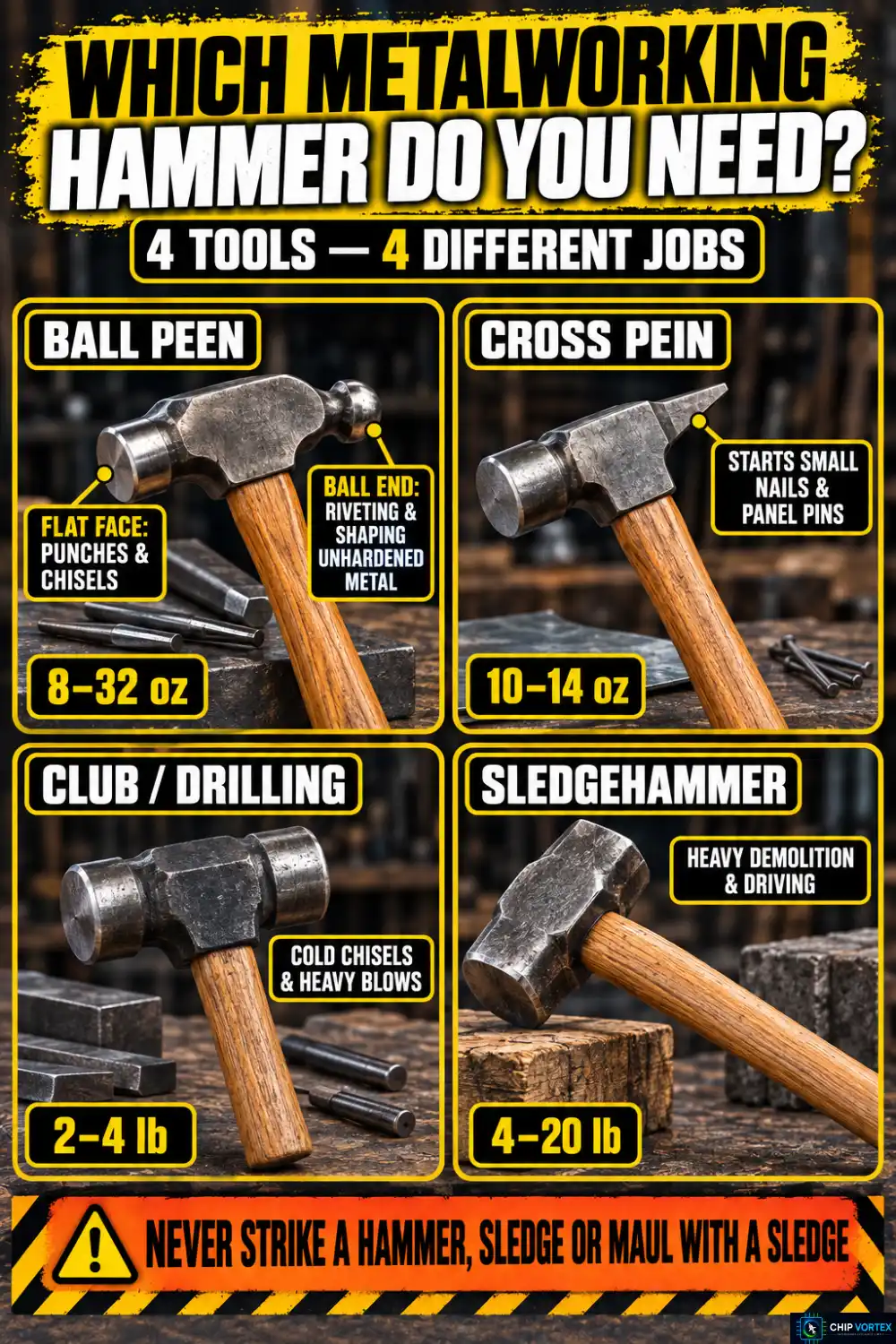
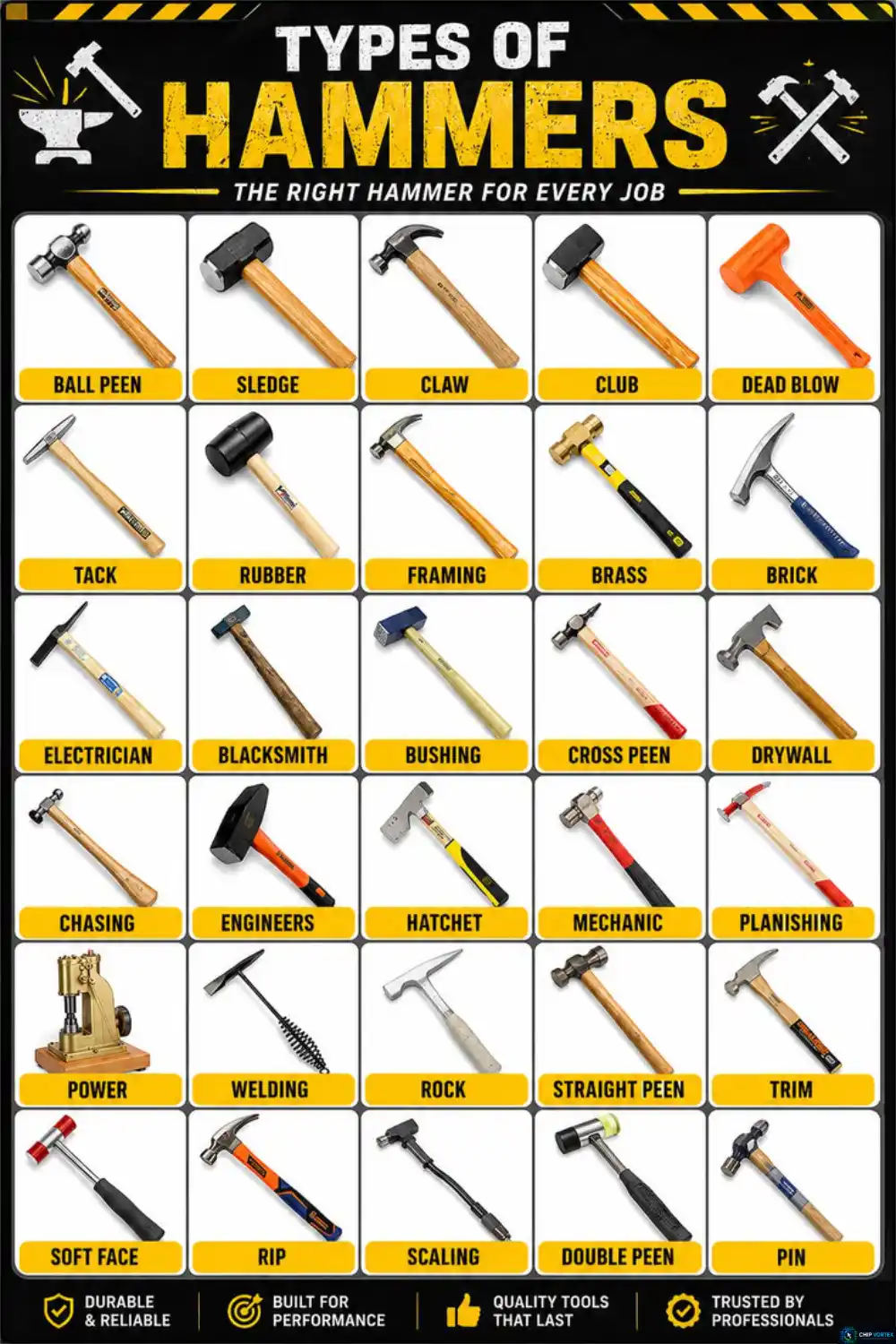
Ball peen hammer
The most misunderstood hammer in the box, so here is the manufacturer’s exact description:
“Ball Peen Hammers have two separate uses. The striking face of the ball peen is used for striking punches and chisels. The ball peen end is used for riveting, shaping and straightening unhardened metals.”
Two things follow. The flat face — not the ball — is the half you will use most, and it is the correct tool for hitting a chisel or punch. And the ball end is for unhardened metal only. Typical weights run 8 to 32 oz.
Three conditions before you strike anything with it: the hammer face must be undamaged, the struck tool must be free of mushrooming, and the hammer face should be about 3/8 inch larger in diameter than the face you are striking. Too small a face means edge contact, and edge contact is how faces chip.
A terminology trap worth knowing: the ball peen’s European cousin is the engineer’s hammer, but that tool most often carries a cross pein rather than a ball — a ball-ended version is sold as a separate pattern. In American usage “engineer’s hammer” frequently means something else again: a short-handled sledge. Say which you mean. Both “peen” and “pein” are correct spellings; just be consistent.
Cross pein and the Warrington pattern
The thin, chisel-like pein is a nail-starting tool, not a striking tool. It passes either side of your fingertips, so you can start a panel pin without hitting your thumb, then flip to the round face to drive it home. Warrington heads typically run 10 to 14 oz, and the pattern takes its name from the town of Warrington in England.
Club, lump or drilling hammer
Three names for one tool: a short-handled, double-faced hammer of roughly 2 to 4 lb. Estwing describes it as “for use with chisels, punches, star drills and hardened nails” and notes it “permits heavy blows with limited swing.”
This is the correct hammer for cold chisels and bolsters — not your claw hammer.
Sledgehammer
Heavy demolition and driving. Handle length is the useful dividing line: around 16 inches means one-handed use, 30 to 36 inches means a full two-handed swing. Weights typically run from about 4 lb up to 20 lb.
The Hand Tools Institute rule is blunt: “Never use a sledge to strike a hammer, sledge, or maul.”
The Non-Marring Hammers
Dead blow hammer
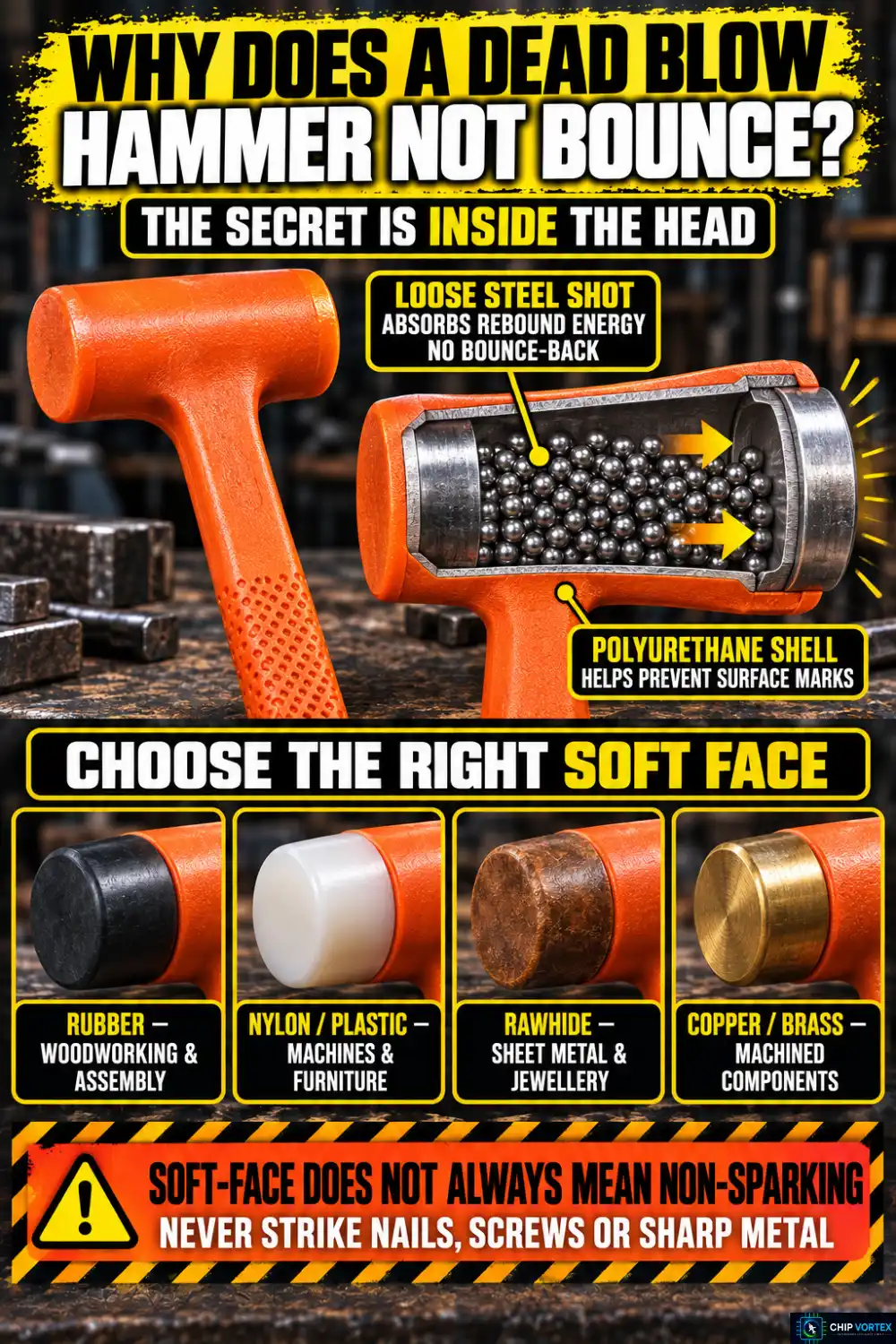
A steel canister filled with hundreds of loose steel shot, wrapped in polyurethane. Two separate things are going on, and they are usually credited to the same cause.
The shot kills the rebound. On impact the loose shot piles forward against the cavity wall and against itself, and those countless small collisions dissipate the elastic energy as heat instead of returning it to your hand. So the head stops dead — no bounce-back and no accidental second strike.
The polyurethane shell does the non-marring. That is a separate property from the shot.
Ideal for seating and separating machined assemblies. Sizes range from around 16 oz to over 5 lb.
Soft-face mallets
| Face | Best for |
|---|---|
| Rubber | Woodworking, general assembly; white rubber will not mark the work |
| Nylon / plastic | Machine assembly, furniture |
| Rawhide | Sheet metal forming, jewellery — absorbs shock while transferring force |
| Copper / brass | Machined components, where a heavy blow is needed over a small area |
Copper and brass are used for two distinct reasons that people conflate. First, they are softer than the workpiece, so the mallet deforms instead of your machined part. Second, non-ferrous tools resist sparking — OSHA advises spark-resistant non-ferrous tools “where flammable gases, highly volatile liquids, and other explosive substances are stored or used.”
But do not mix those two up. A copper face on a steel head and steel shaft is not a non-sparking tool. As Thor’s own literature puts it: “Never use these soft faced hammers as a non-sparking tool in hazardous areas.” Certified non-sparking tools are a separate category — and even those are not magic. There is no such thing as a truly non-sparking tool; certified ones still produce cold sparks, must be kept free of ferrous contamination, and never replace proper isolation, ventilation and purging.
Two mallet rules worth keeping. The Hand Tools Institute’s: never use one to drive nails or screws, or to strike sharp metal objects. And Thor’s: replace striking faces before they wear down far enough for the hammer body to contact the work.
Specialist Types of Hammers
Beyond the general-purpose tools, most trades have their own hammer built for one job:
| Hammer | Purpose |
|---|---|
| Brick / masonry | Setting and splitting bricks, masonry tile and block. Square face one end, chisel blade the other. Never strike other steel tools with it. |
| Drywall hatchet | Crowned face dimples board without tearing the paper; hatchet edge scores and trims. |
| Roofing hatchet | Installing and trimming shingles, usually with an adjustable exposure gauge. |
| Tack / upholstery | One magnetised face — often split, for a stronger hold — starts a tack one-handed. |
| Body / panel hammer | Pick, bumping, chisel and shrinking patterns for dent work, used with a dolly. |
| Welding chipping | Cone and chisel ends for removing slag and spatter from unhardened metal. |
| Rock pick | Pointed tip for prying and splitting; chisel edge for sedimentary rock and trimming specimens. |
Handle Materials
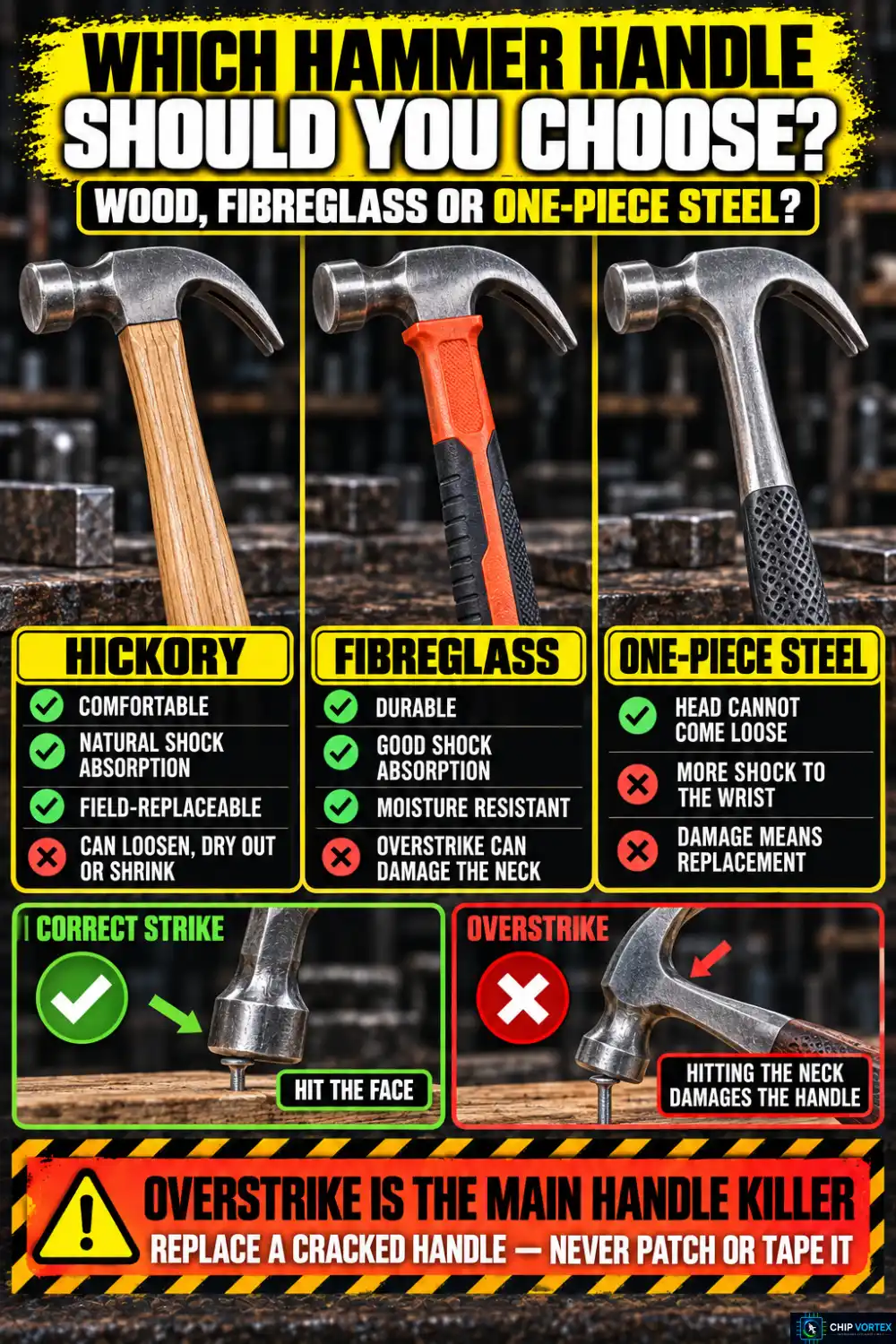
- Hickory — comfortable, naturally shock-absorbing, and the only genuinely field-replaceable handle. It can work loose, dry out and shrink in storage, and it breaks under heavy prying. A cracked handle is replaced, never patched or taped.
- Fibreglass — durable, good shock absorption, unaffected by moisture. Vulnerable to overstrike, which shreds the resin at the neck.
- One-piece steel — the head cannot come loose because there is no joint. It transmits more shock to your wrist, which good grips partly offset, and it cannot be repaired: damage means replacement.
Overstrike — hitting with the neck rather than the face — is the main killer of handles in every material. And never store wooden-handled tools somewhere they will dry out and shrink, which is the classic reason a head flies off.
The Safety Rules That Actually Matter
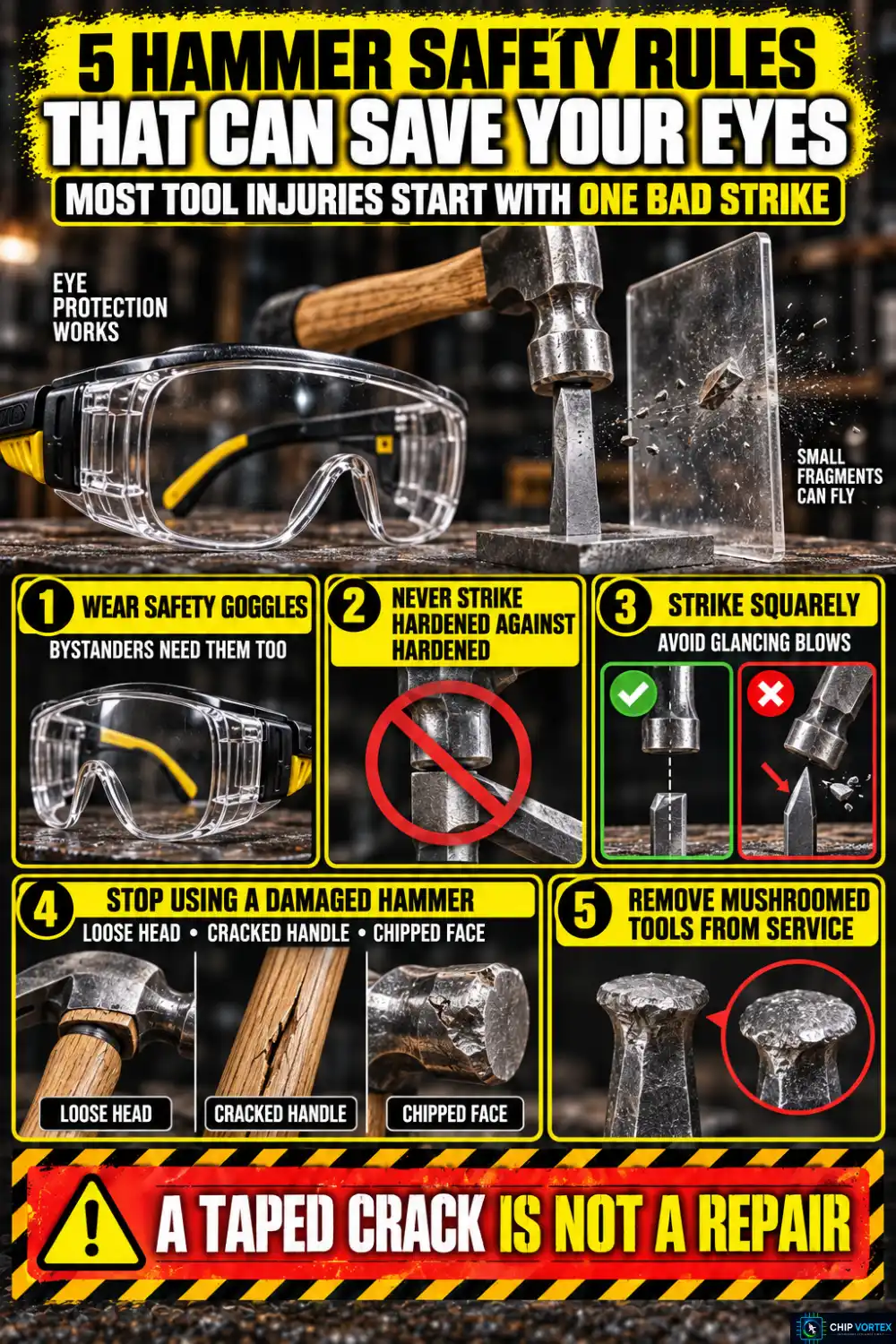
Always wear safety goggles when using striking tools — goggles, not just spectacles with side shields. That is the first rule in every manufacturer’s safety sheet, and it applies at home exactly as it does on site.
Never strike hardened against hardened
Hammer faces are hardened so that nails cannot dent them. Under Germany’s DIN 1041, an engineer’s hammer face is specified at 50–58 HRC, hardened to a depth of at least 3 mm. US nail and framing hammers are covered by a different standard, ASME B107.400, but the principle is the same: the face is hard.
Hardened high-carbon steel is strong but has low fracture toughness. Strike it against another hardened object — a cold chisel, a punch, another hammer — and the contact stresses, concentrated at whatever edge or point actually touches first, can exceed the steel’s fracture strength. It chips rather than dents, and the fragment leaves fast.
Estwing states the rule without qualification: “Never strike a hammer or any striking tool against another tool or hardened object.” And specifically: “Never use a nail hammer to strike another tool.” Use a ball peen or club hammer instead.
One apparent contradiction worth explaining, because you will meet it: Estwing’s own drilling hammer is sold “for use with chisels, punches, star drills and hardened nails.” A hammer designed and rated for striking hardened objects may do so; a nail hammer never may. Follow the tool’s stated purpose, not a general instinct.
Strike squarely
Hardness mismatch is not the only way faces chip. The Hand Tools Institute is explicit: strike squarely and avoid glancing blows, which “may cause the edge of the face to chip, possibly resulting in eye or other serious injury.” Edge contact chips faces on entirely legitimate targets too.
Stop using a damaged hammer immediately
This is the rule most often ignored, so it gets its own heading. Never use a hammer with a loose head or a split, cracked or damaged handle. Taping a cracked handle is not a repair — it hides the crack while the head keeps working loose.
Estwing’s discard criteria for one-piece hammers:
- Chips or dents on the face
- A mushroomed face
- Cracks in the claw section
- Dents in the handle
For wooden and fibreglass-handled hammers, add the two that list cannot cover: any looseness between head and handle, and any crack or splinter in the handle. A wooden handle is replaced, not patched.
Mushroomed heads
The struck end of a chisel is left deliberately soft so it deforms rather than shatters. Repeated blows spread it outward into a thin, unsupported, work-hardened lip — and that lip has nothing behind it. OSHA’s description:
“If impact tools such as chisels, wedges, or drift pins have mushroomed heads, the heads might shatter on impact, sending sharp fragments flying toward the user or other employees.”
In US construction work this is a regulation, not advice — 29 CFR 1926.301(c) requires that impact tools “shall be kept free of mushroomed heads.”
The fix is to grind the mushroom back to a flat top with the sides chamfered at about 45°, cooling the tool in water frequently so you do not draw the temper out of the steel. Wear eye protection while grinding, too.
But dressing is not always the answer. Never use a chisel that is cracked or badly deformed, or a punch with a chipped or deformed point. Some struck tools have been re-dressed as often as they safely can be — at that point they are scrap, not a grinding job.
Eye protection, including for bystanders
NIOSH reports that each day about 2,000 US workers sustain a job-related eye injury requiring medical treatment, with small particles striking the eye among the leading causes. In US workplaces, OSHA requires eye protection providing side protection wherever there is a hazard from flying objects, meeting an accepted edition of ANSI/ISEA Z87.1.
Estwing adds the part people forget: “Bystanders should also wear safety goggles.” Fragments travel.
One sizing rule worth knowing
Estwing’s guidance for striking another tool: the hammer’s face should be about 3/8 inch larger in diameter than the struck face. Too small a face guarantees edge contact — and edge contact is how faces chip.
Frequently Asked Questions
What is a ball peen hammer used for?▾
Its flat face strikes punches and chisels; its ball end is for riveting, shaping and straightening unhardened metal. The flat face is the half you will use most.
Can I hit a chisel with a claw hammer?▾
No. A claw hammer is for driving and pulling common nails. Hardened face against hardened chisel is how chips fly. Use a ball peen or club hammer.
What size claw hammer should I buy first?▾
16 oz. It is the standard general-purpose size, light enough for control and heavy enough for most household work.
Related reading: how to use a multimeter.