Every gearbox on Earth runs on one beautifully simple trade: spin a small gear against a big one, and you exchange speed for torque — or run it the other way and buy speed with torque. That single idea starts trucks, wins bicycle climbs, lets a hand drill out-twist a human arm forty times over, and spins a turboprop’s propeller at a speed its screaming turbine could never touch. In our types of gears guide we met the shapes; this is the math that makes them useful — and it’s friendlier than it looks.
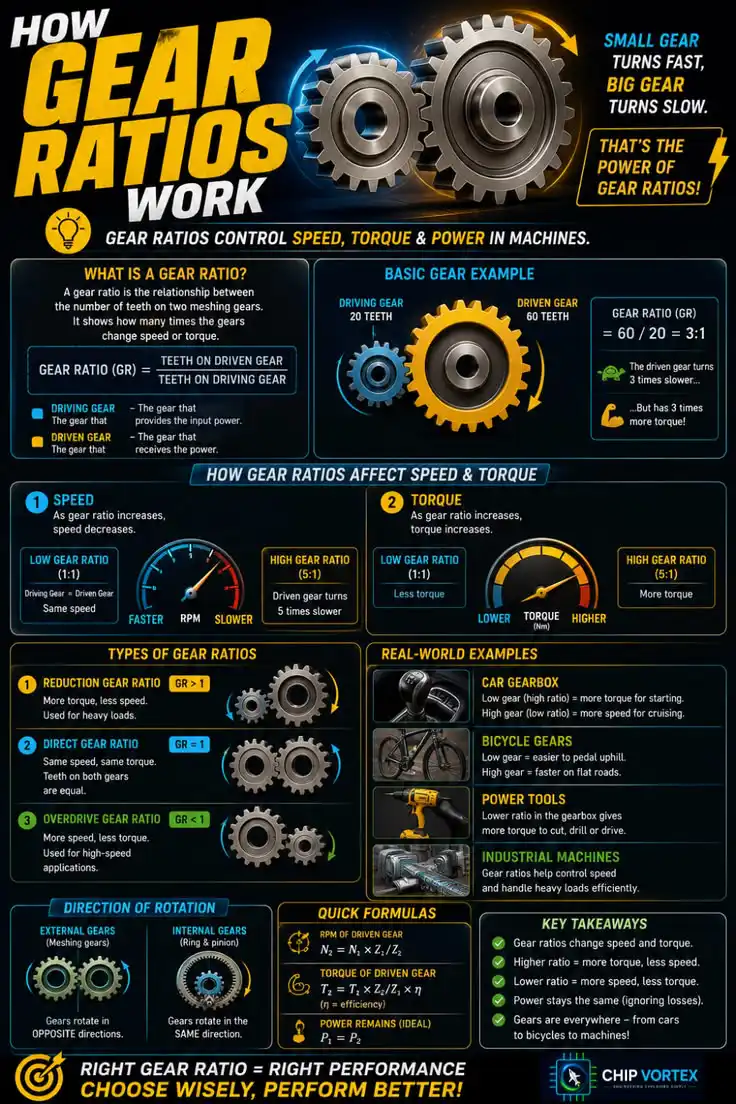
Save the chart, then let’s count some teeth.
What Is a Gear Ratio? (Quick Answer)
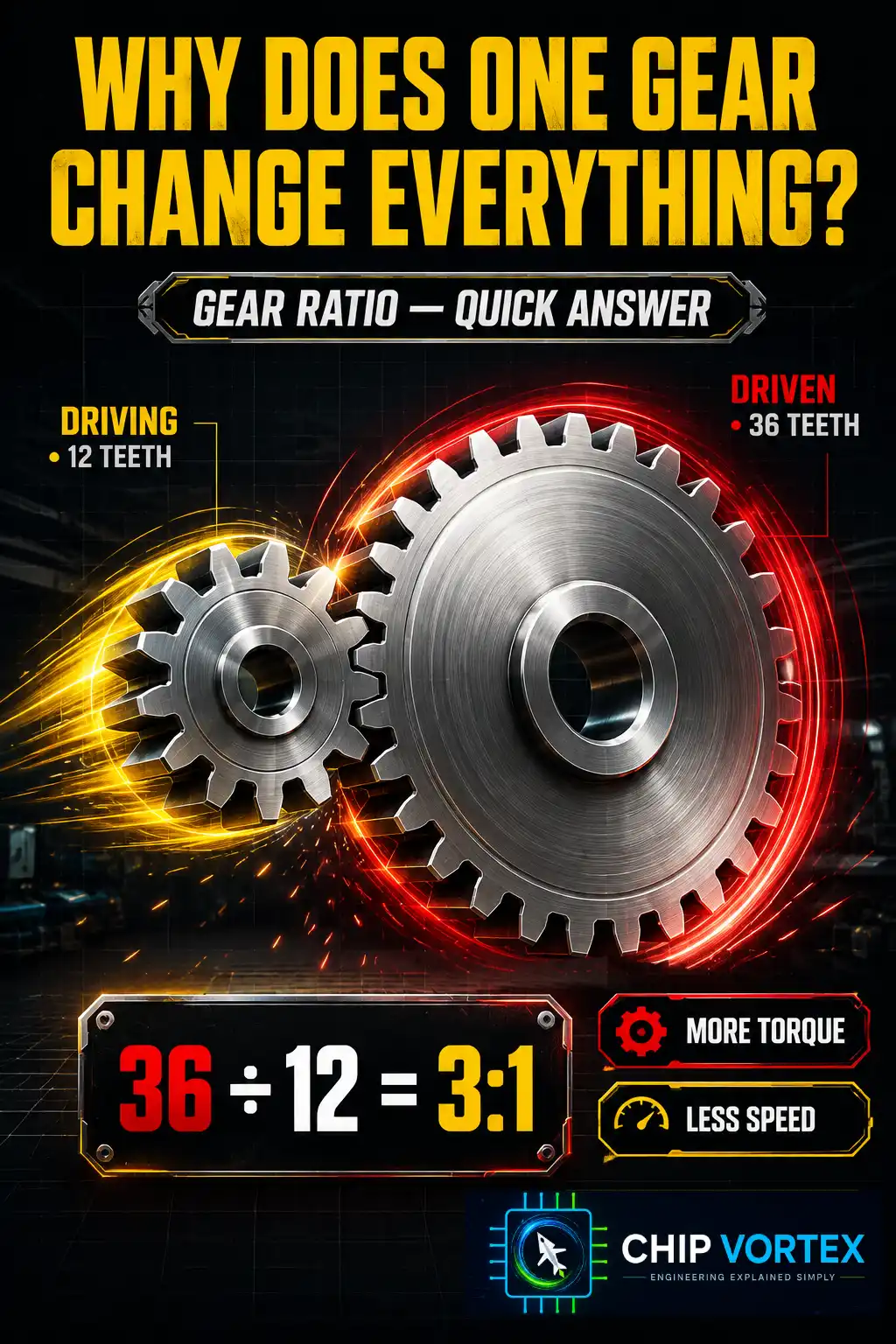
A gear ratio is the relationship between the tooth counts of two meshing gears — it tells you how many times the pair multiplies torque and divides speed (or vice versa). The convention:
Gear Ratio = Teeth on Driven Gear ÷ Teeth on Driving Gear
The driving gear is the one delivering input power (from the motor, engine, or your legs); the driven gear is the one receiving it. Two tooth counts, one division — that’s the entire entry fee.
The Worked Example: 3:1
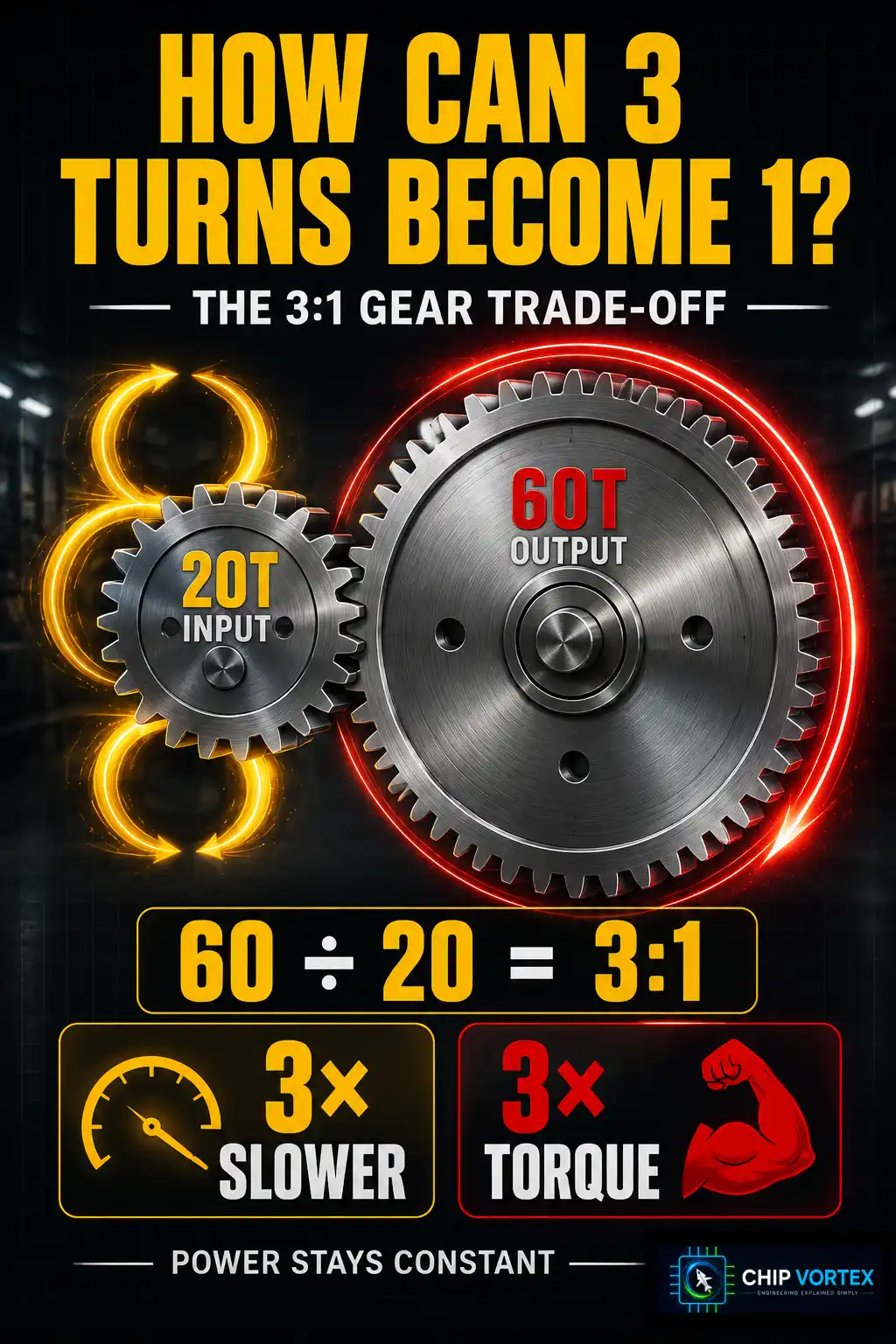
Take the pin’s pair: a 20-tooth driving gear meshed with a 60-tooth driven gear. Ratio = 60 ÷ 20 = 3:1. The small gear must turn three full times to walk the big gear through one revolution — so the driven gear turns three times slower. But nothing is lost: it turns with three times the torque. The big gear is effectively a longer lever, and every tooth of engagement works that leverage.
Here’s the law underneath, and it’s the same referee we met in thrust vs torque: power stays constant (P = τω, and ideally P₁ = P₂). Speed and torque are two halves of one budget — a gearbox can move money between the accounts, but it can never print more. Gears are a currency exchange, not a mint.
Speed Falls, Torque Climbs
Run the ratio upward and the two dials move in opposition, exactly as the pin shows: at 1:1, driving and driven turn together — same speed, same torque, just relocated. At 5:1, the driven gear crawls at one-fifth speed while twisting five times harder. There’s no setting where both dials rise — and any machine promising otherwise is selling perpetual motion.
The Three Regimes
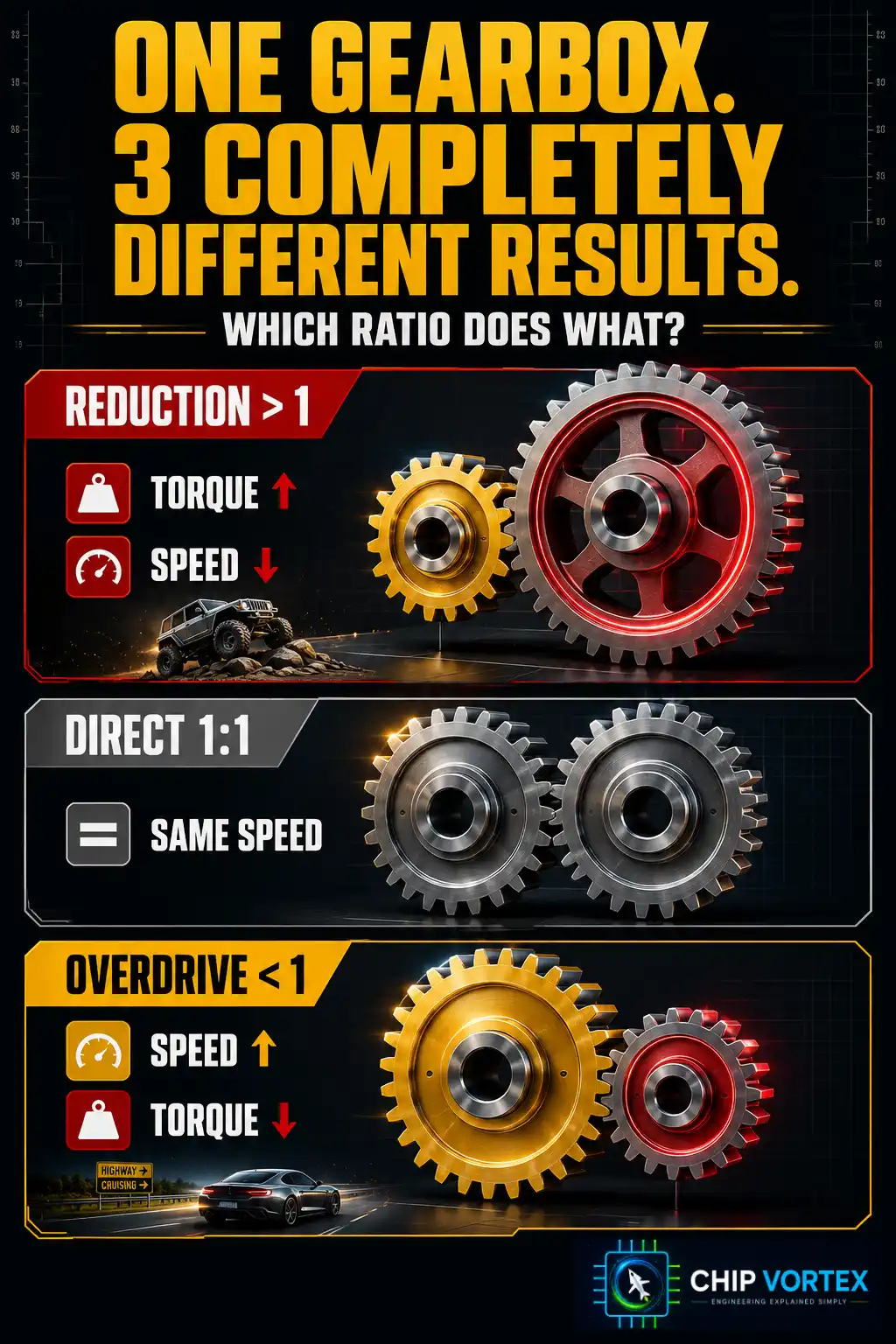
Reduction (ratio > 1): driven gear bigger — more torque, less speed. The regime of starting, climbing, and hauling. Direct (1:1): equal teeth — a clean handoff. Overdrive (ratio < 1): driven gear smaller — more speed, less torque. The regime of cruising, where the load is light and economy matters.
The Vocabulary Trap: Why “Low Gear” Is a High Ratio
Here’s the phrase that confuses everyone, resolved in one breath: in a car, “low gear” means a numerically high ratio (first gear might be 3.5:1 — huge torque, low road speed), and “high gear” means a numerically low ratio (sixth might be 0.7:1 overdrive). “Low” and “high” describe the speed regime you’re in, not the number. Say it once — low gear, high ratio; high gear, low ratio — and a lifetime of gearbox conversations suddenly makes sense.
Four Machines, One Trade

Car gearbox: first gear’s big ratio multiplies engine torque to get two tons rolling; the climb through the gears is a staircase of shrinking ratios until overdrive trades the last torque for quiet, economical cruising — with the differential’s hypoid final drive multiplying everything once more on the way to the wheels.
Bicycle: the only gearbox you feel. Low gear uphill: legs spin easy, wheel turns slow, torque hauls you up. High gear on the flat: every pedal stroke buys distance. Your thighs are running the P = τω experiment live.
Power tools: a drill’s secret is a high reduction ratio. The little motor screams at 20,000+ rpm with barely any torque; a compact planetary gearset (often two stages) knocks that down ~40:1, and the chuck emerges turning slow and irresistibly strong. That’s why a palm-sized tool out-twists your whole arm.
Industrial machines: conveyor drives, crushers, winches — everywhere a modest motor must move an immodest load, a reduction ratio is doing the negotiating.
Direction: Who Turns Which Way
Two external gears meshed together always rotate in opposite directions — every mesh flips the spin. An internal gear (ring and pinion, as in our gears guide) turns the same direction as its pinion, one reason planetary systems are so compact and cooperative. And the classic workshop trick the pin leaves out: slip an idler gear between two externals and the output direction flips back — the idler changes rotation without changing the ratio at all, since its teeth cancel out of the math.
The Formulas, Unpacked
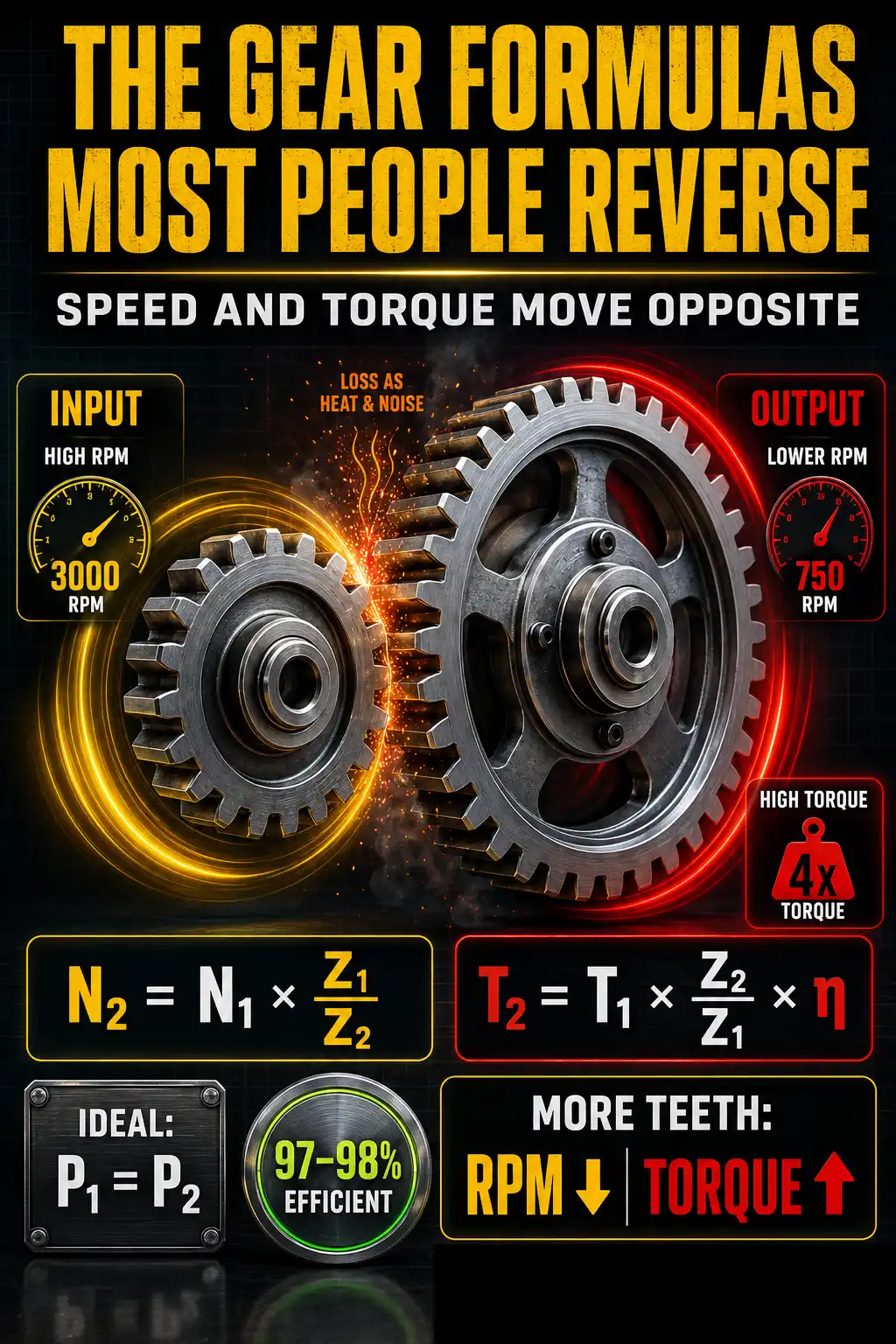
Speed of the driven gear: N₂ = N₁ × Z₁/Z₂ — driven RPM equals driving RPM times the tooth ratio, upside down. More teeth downstream, fewer RPM out.
Torque of the driven gear: T₂ = T₁ × Z₂/Z₁ × η — the mirror image, times efficiency. That η is honesty in a symbol: a good gear mesh delivers roughly 97–98% of its power, the missing sliver leaving as heat and noise. (A worm drive’s sliding teeth pay a much steeper toll — the price of its 40:1 single stage.)
Power (ideal): P₁ = P₂. The budget, conserved. Everything else is bookkeeping.
Compound Ratios: Stacking the Trade
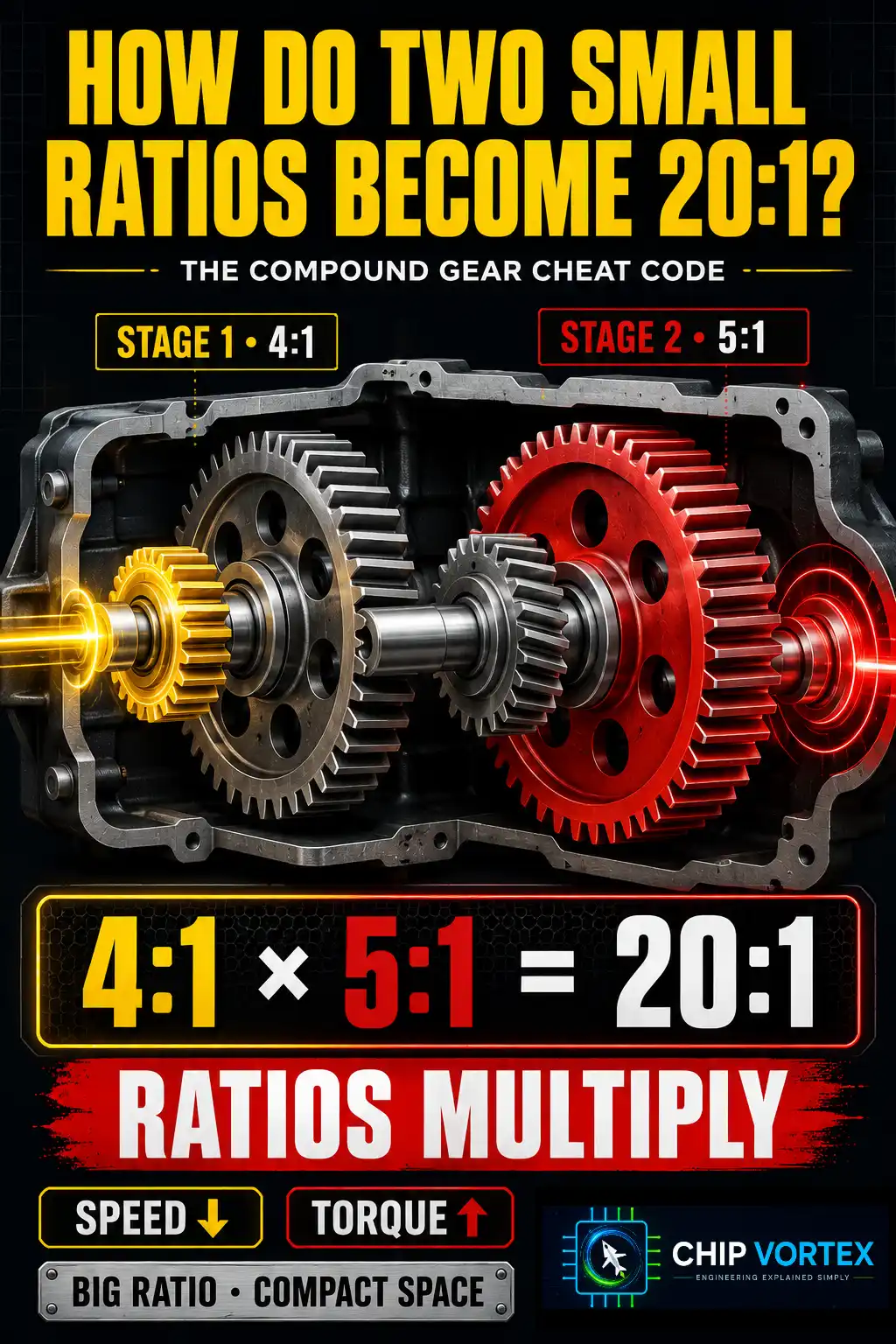
The pin stops at one gear pair; machines rarely do. Put stages in series and the ratios multiply: a 4:1 stage feeding a 5:1 stage is 20:1 overall. That’s how a drill reaches 40:1 in a housing you can palm, how a car’s 3:1 gearbox times 3.7:1 final drive becomes 11:1 at the wheels in first gear, and — run in reverse — how a wristwatch gears a slow spring up into a fast balance wheel. Compounding is the cheat code: modest pairs, multiplied, reach ratios no single mesh could.
The Aviation Corner: The Most Important Ratio in the Sky
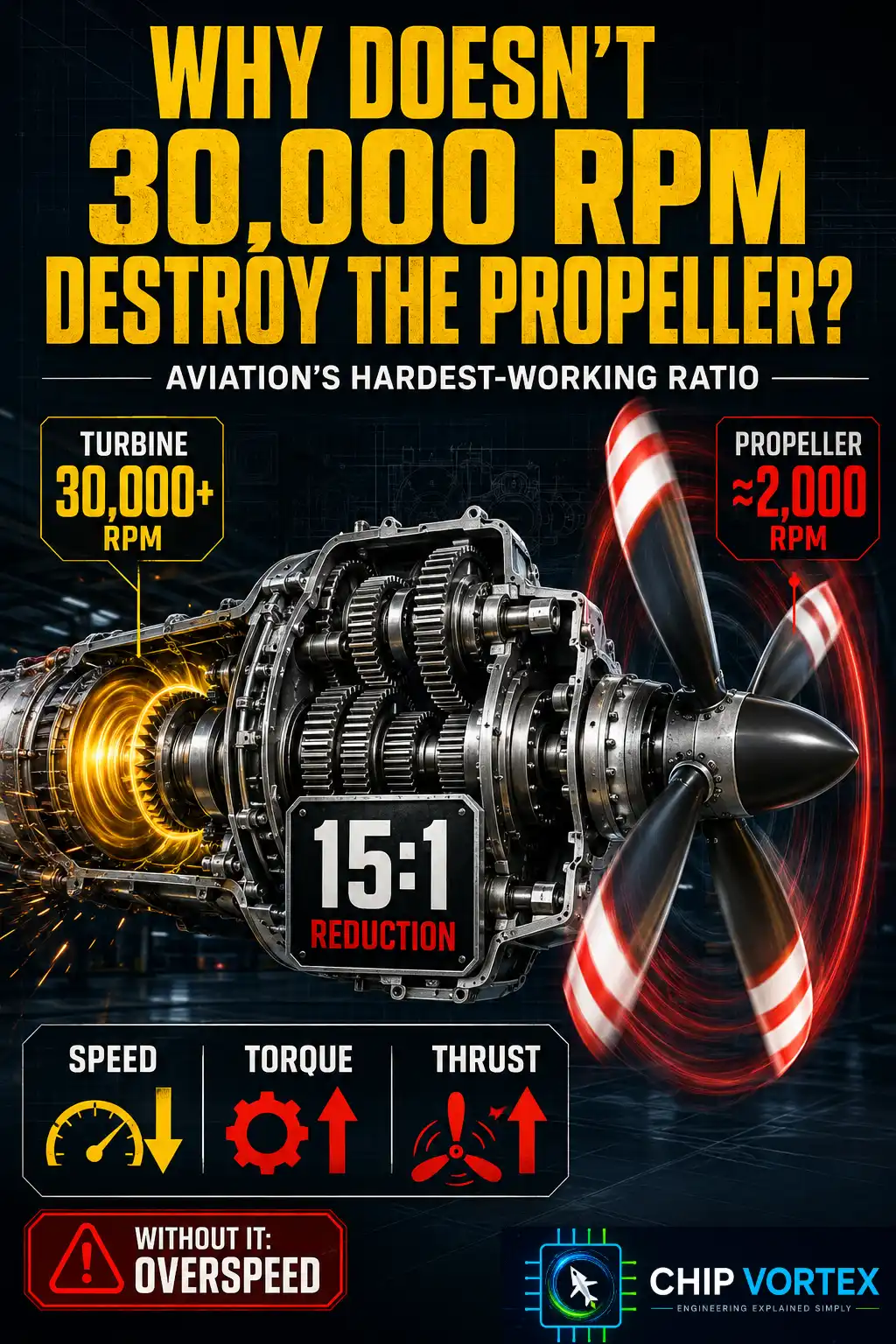
A turboprop’s turbine spins at 30,000+ rpm; its propeller would tear itself apart above about 2,000. Between them sits a reduction gearbox of roughly 15:1 — arguably the hardest-working ratio in aviation, converting turbine frenzy into propeller authority (and the torque it delivers is exactly the twist-into-thrust conversion from thrust vs torque). The geared turbofan finale from our gears guide gets its numbers here too: a ~3:1 planetary lets the fan loaf while the turbine sprints, each at its ideal speed — one ratio, double-digit fuel savings.
FAQ: Gear Ratios
What does a 3:1 gear ratio mean?▾
The driving gear turns three times for every one turn of the driven gear — output spins three times slower with three times the torque (minus small losses).
Does a higher gear ratio mean more speed or more torque?▾
More torque, less speed. Numerically higher ratios are reduction ratios; below 1 (overdrive), speed rises and torque falls.
Why is low gear a high ratio?▾
“Low” refers to the road-speed regime, not the number. First gear’s big ratio gives maximum torque at minimum speed — a high number for the low range. High gear reverses both.
How do I find a gear ratio without counting teeth?
Turn the input by hand and count the output’s turns (ten input turns ÷ output turns = ratio), or divide the gears’ pitch diameters — teeth-per-inch is constant across a mesh, so diameters carry the same ratio.
Do gear ratios increase power? Never. Power in equals power out, minus friction (that η). Gears trade speed against torque within a fixed power budget — the trade is the whole product.
Now spot the ratios around you: the cassette on your bicycle, the “1st… 6th” in your car, the drill that shames your wrist. Which machine’s hidden ratio surprised you most? Tell us in the comments, save the chart, and complete the trilogy: the gear shapes that carry the teeth, and the forces the ratios are trading.