
A Flight Management System (FMS) is an advanced onboard computer system that plans, manages, and optimizes the entire flight from takeoff to landing. The pilot tells it where to go; the FMS works out how — the exact route, the fuel required, the speeds and altitudes to fly — and then guides the aircraft along that plan while monitoring everything continuously.
It’s been called the brain behind every safe and smooth flight — and that’s barely an exaggeration.
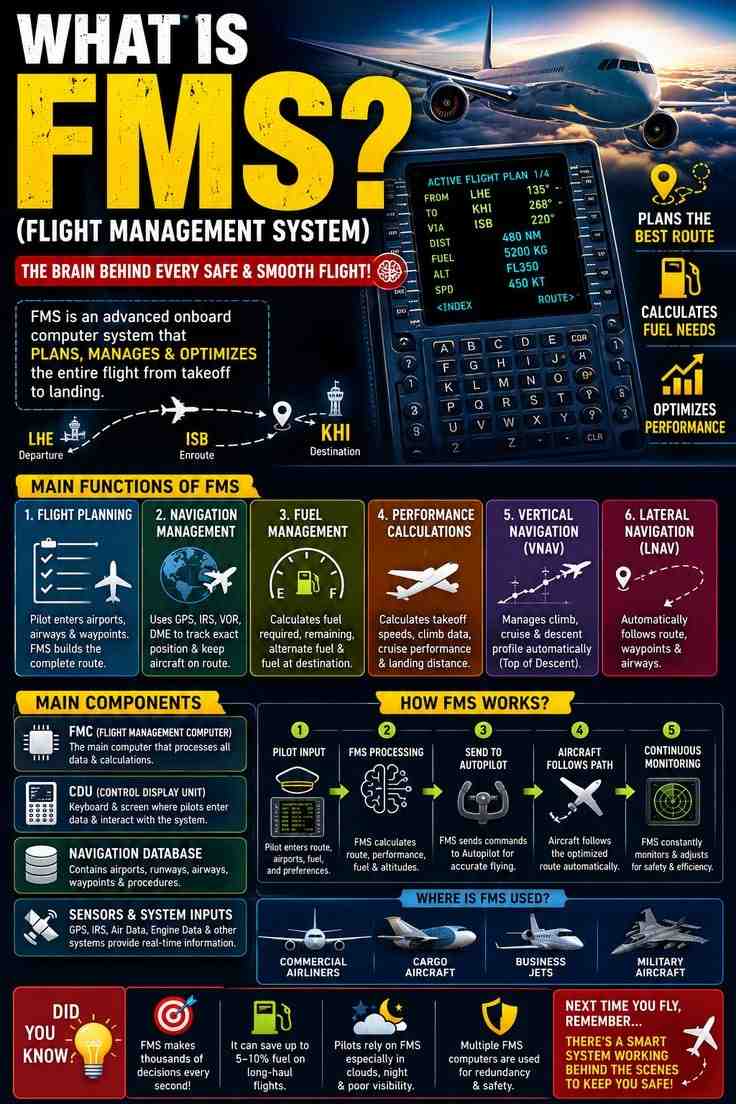
Save the chart above for your notes, then let’s go through each part properly.
🔧 Try It Yourself: Interactive FMS Simulator
What Does an FMS Actually Do?
Strip away the acronyms and the FMS has three headline jobs: it plans the best route, it calculates fuel needs, and it optimizes performance at every stage of flight. Before modern FMS, these jobs belonged to a human — early airliners carried a flight engineer and a navigator alongside the pilots. Today, one computer system handles that workload with far greater precision, which is a big part of why modern two-crew cockpits are possible at all.
Those three headline jobs break down into six main functions.
The 6 Main Functions of an FMS
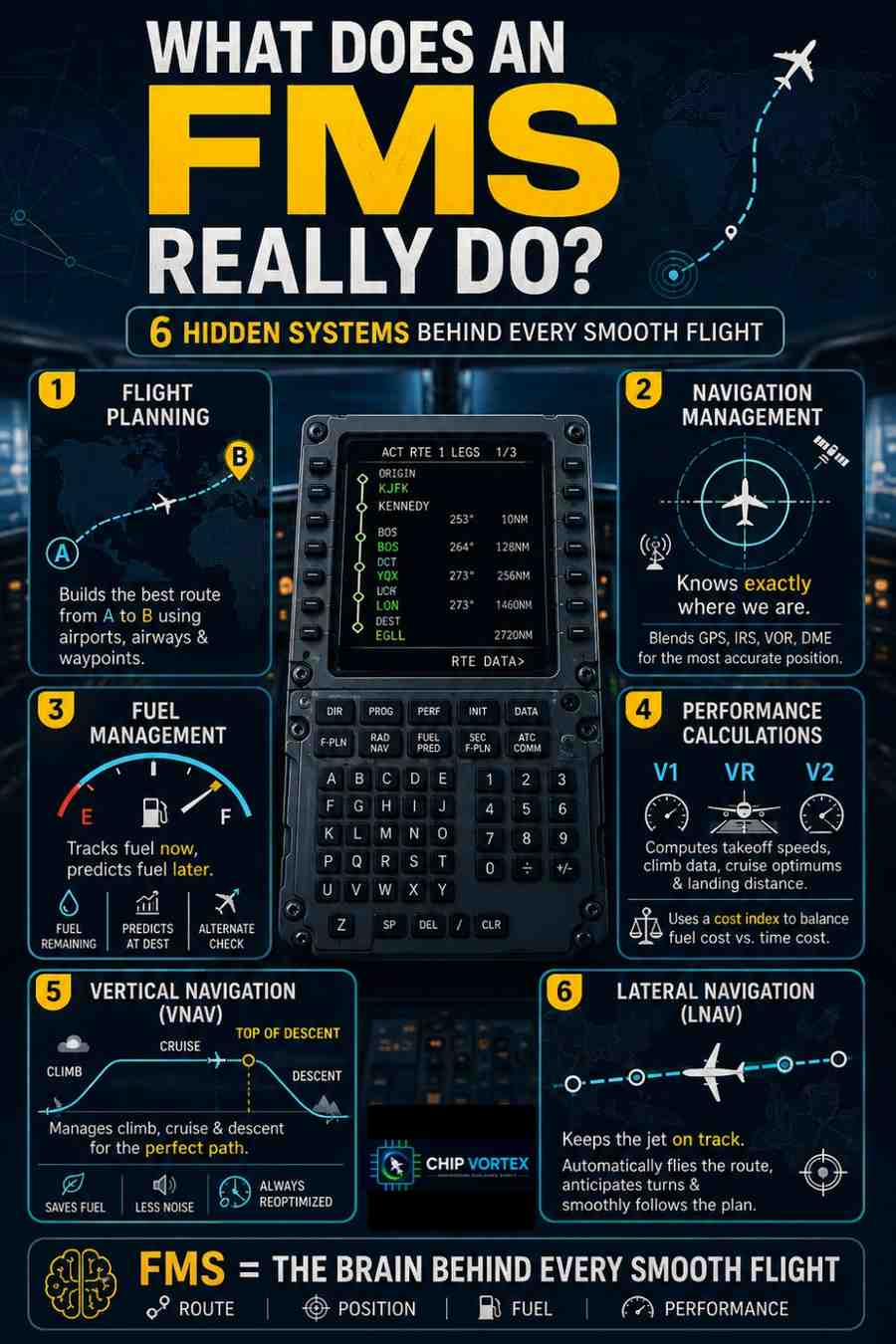
1. Flight Planning
Before departure, the pilot enters the airports, airways, and waypoints for the trip, and the FMS builds the complete route. It pulls each element from its navigation database — departure procedures out of the origin airport, the airway structure enroute, and arrival procedures into the destination — and strings them into one continuous, flyable path. Airlines can even store their standard company routes, so a frequently flown city pair loads in seconds.
2. Navigation Management
Once airborne, the FMS has to answer one question relentlessly: where exactly are we right now? It does this by blending inputs from GPS, IRS (inertial reference systems), and ground-based radio aids like VOR and DME, cross-checking them against each other to produce the most accurate position possible — and to keep the aircraft precisely on route. The blend is also the backup plan: if GPS signal is ever lost, the inertial systems carry on navigating without missing a beat.
3. Fuel Management
The FMS calculates the fuel required for the trip, tracks fuel remaining against the plan in real time, and continuously predicts the fuel that will be left at the destination — and at the alternate airport if a diversion is needed. If headwinds strengthen or a reroute stretches the trip, those predictions update immediately, giving the crew early warning long before fuel ever becomes a problem.
4. Performance Calculations
Numbers pilots once pulled from thick paper manuals now come from the FMS: takeoff speeds (V1, VR, V2), climb data, optimal cruise altitude and speed, and landing distance. Many systems also use a cost index — a number the airline sets to balance fuel cost against time cost — letting the FMS fly slightly faster when schedule matters more, or slightly slower when fuel matters more.
5. Vertical Navigation (VNAV)
VNAV manages the climb, cruise, and descent profile automatically. Its signature calculation is the Top of Descent — the exact point where the aircraft should leave cruise altitude to fly a smooth, near-idle descent to the runway. Get that point right and the engines barely work all the way down, saving fuel and cutting noise. The FMS recomputes it constantly as winds and ATC instructions change.
6. Lateral Navigation (LNAV)
LNAV is the steering half of the brain: it automatically follows the route, waypoints, and airways in the plan. It tracks each leg, anticipates upcoming turns so the aircraft cuts them smoothly rather than overshooting, and keeps the jet locked onto the planned track — the line pilots famously call “the magenta line” on their navigation display.
Main Components of an FMS
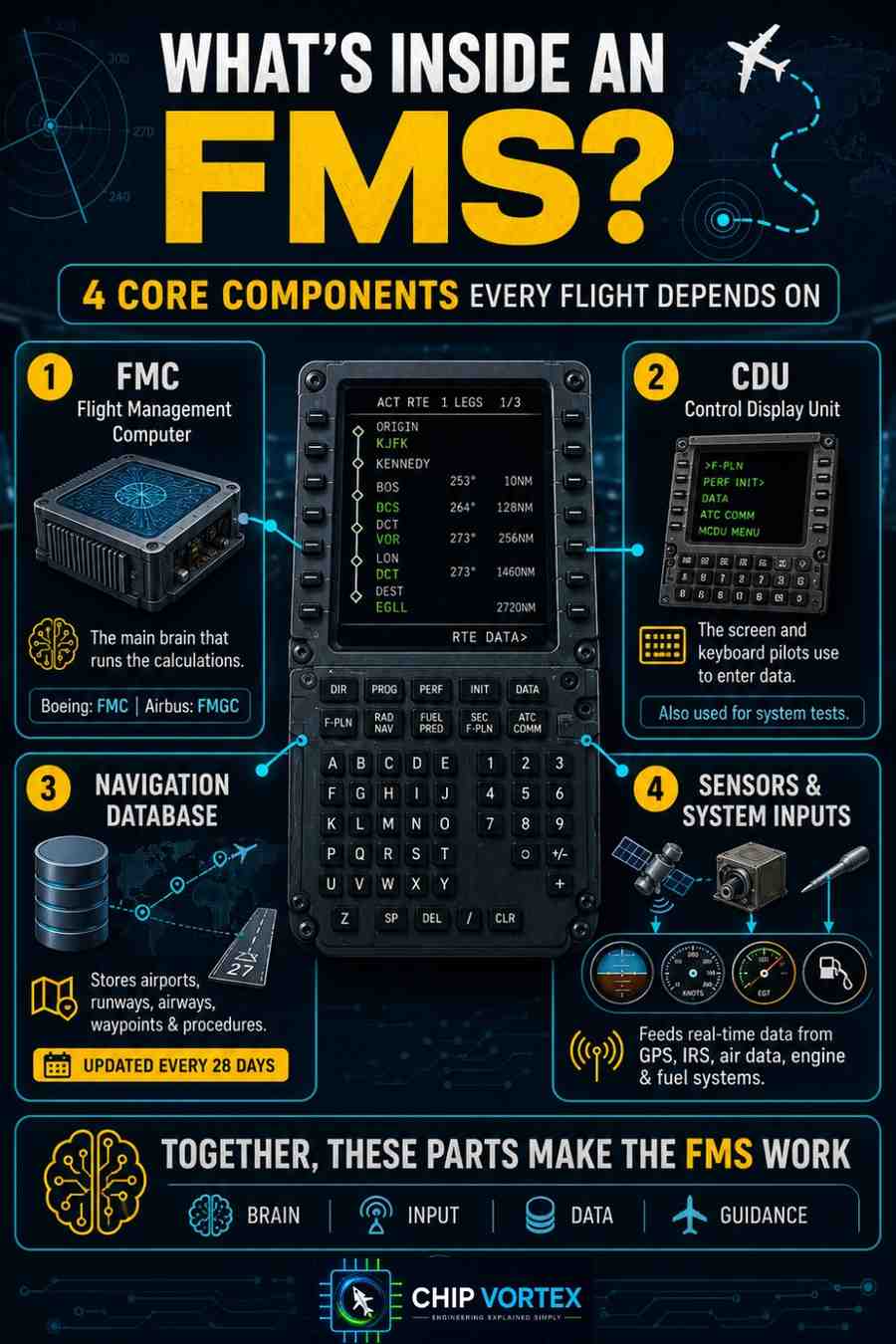
FMC (Flight Management Computer). The main computer that processes all the data and calculations — the physical brain. Boeing calls it the FMC; on Airbus aircraft the equivalent unit is the FMGC (Flight Management and Guidance Computer). Airliners carry at least two.
CDU (Control Display Unit). The keyboard and screen where pilots enter data and interact with the system — that distinctive unit with the small green screen you see in every cockpit photo. Maintenance engineers use it too: on many aircraft, the CDU is the gateway for running built-in system tests (BITE) during troubleshooting.
Navigation Database. The FMS’s world map: airports, runways, airways, waypoints, and instrument procedures for the entire region the aircraft operates in. It’s kept current on a strict 28-day update cycle (the AIRAC cycle), because navigating precisely with outdated data isn’t an option.
Sensors & System Inputs. GPS receivers, inertial reference systems, air data (speed, altitude, temperature), engine and fuel-flow data, and radio navaids all feed real-time information into the FMS. The quality of every calculation above depends on this constant stream of inputs.
How an FMS Works: 5 Steps from Input to Touchdown
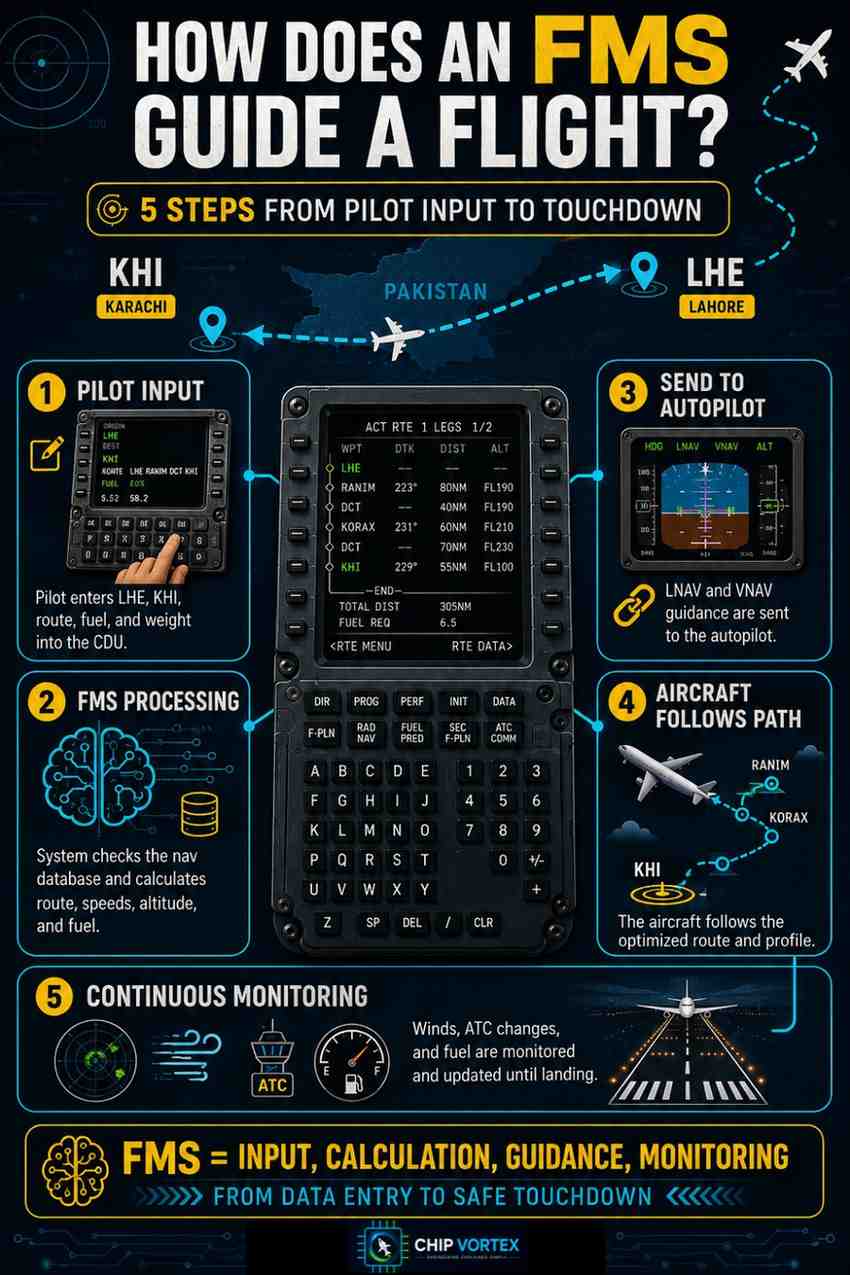
Take the route from the chart — Lahore (LHE) to Karachi (KHI):
Step 1 — Pilot Input. At the gate, the pilot enters the route, airports, fuel figures, aircraft weight, and preferences into the CDU: departing LHE, destination KHI, the planned airways and waypoints in between.
Step 2 — FMS Processing. The FMS cross-checks everything against its navigation database and computes the full picture: the lateral route, the climb and descent profile, the target speeds and altitudes, and the fuel predictions for the whole trip.
Step 3 — Send to Autopilot. After takeoff, the crew engages LNAV and VNAV. The FMS now sends its steering and profile commands to the autopilot for accurate flying.
Step 4 — Aircraft Follows Path. The aircraft tracks the optimized route automatically — turning at each waypoint, climbing and descending exactly where the plan says — while the pilots monitor and talk to ATC.
Step 5 — Continuous Monitoring. Nothing is set-and-forget. Winds shift, ATC issues shortcuts or reroutes, and the FMS constantly recalculates and adjusts for safety and efficiency, updating its predictions all the way to touchdown in Karachi.
Where Is FMS Used?
Commercial airliners — every modern jet you’ve boarded has one at its core. Cargo aircraft — the same airframes and avionics, hauling freight instead of passengers. Business jets — full FMS capability in a smaller cabin. Military aircraft — transports, tankers, and patrol aircraft rely on FMS for precise mission routing. And the technology keeps trickling down: modern glass-cockpit training aircraft now offer FMS-style flight planning that once belonged only to airliners.
Did You Know?
- An FMS performs thousands of calculations every second, continuously refining position, fuel, and performance predictions.
- Optimized routes and descent profiles can save up to 5–10% fuel on long-haul flights — an enormous number at airline scale.
- Pilots lean on the FMS most in clouds, at night, and in poor visibility, when precise navigation matters and outside references disappear.
- Airliners carry multiple FMS computers that cross-check each other, so a single failure never takes the system down.
📖 Beyond the Diagram How It Looks in the Real World
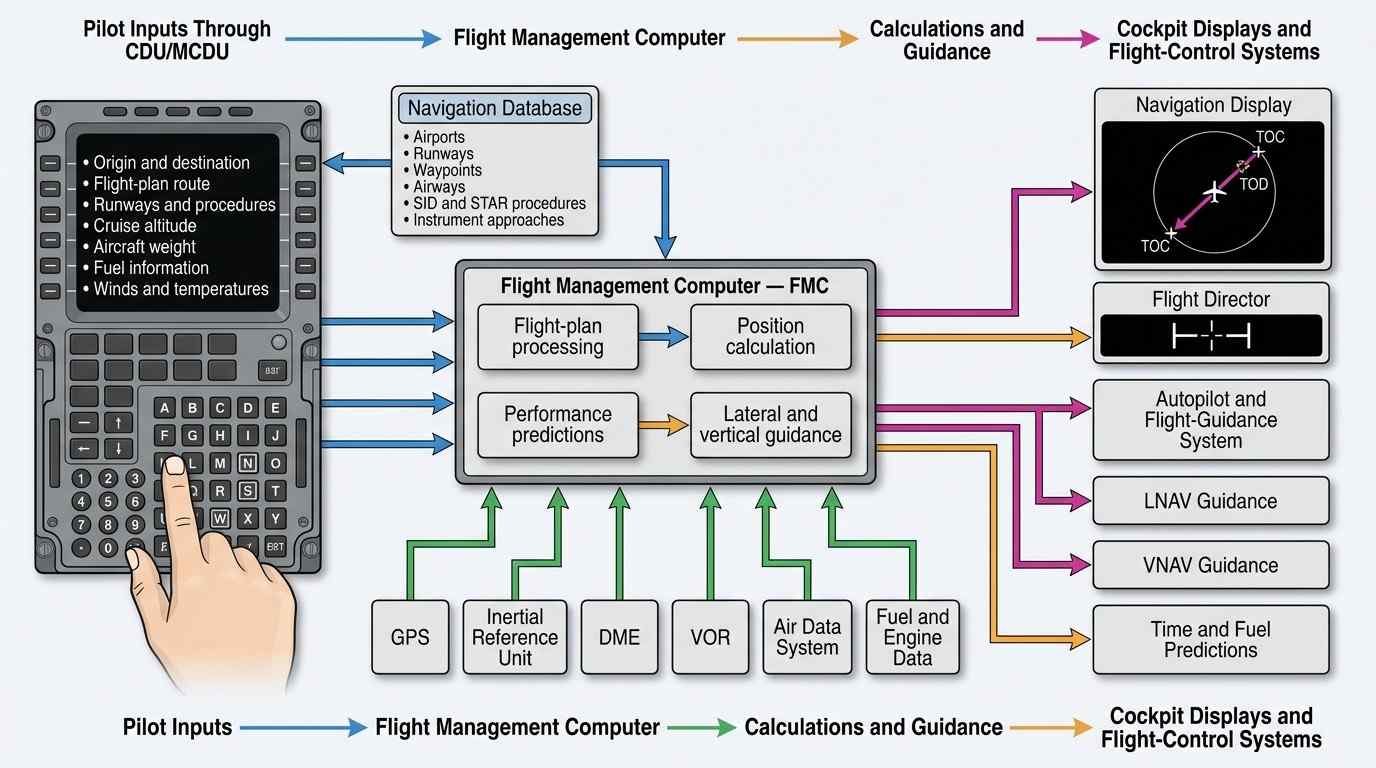
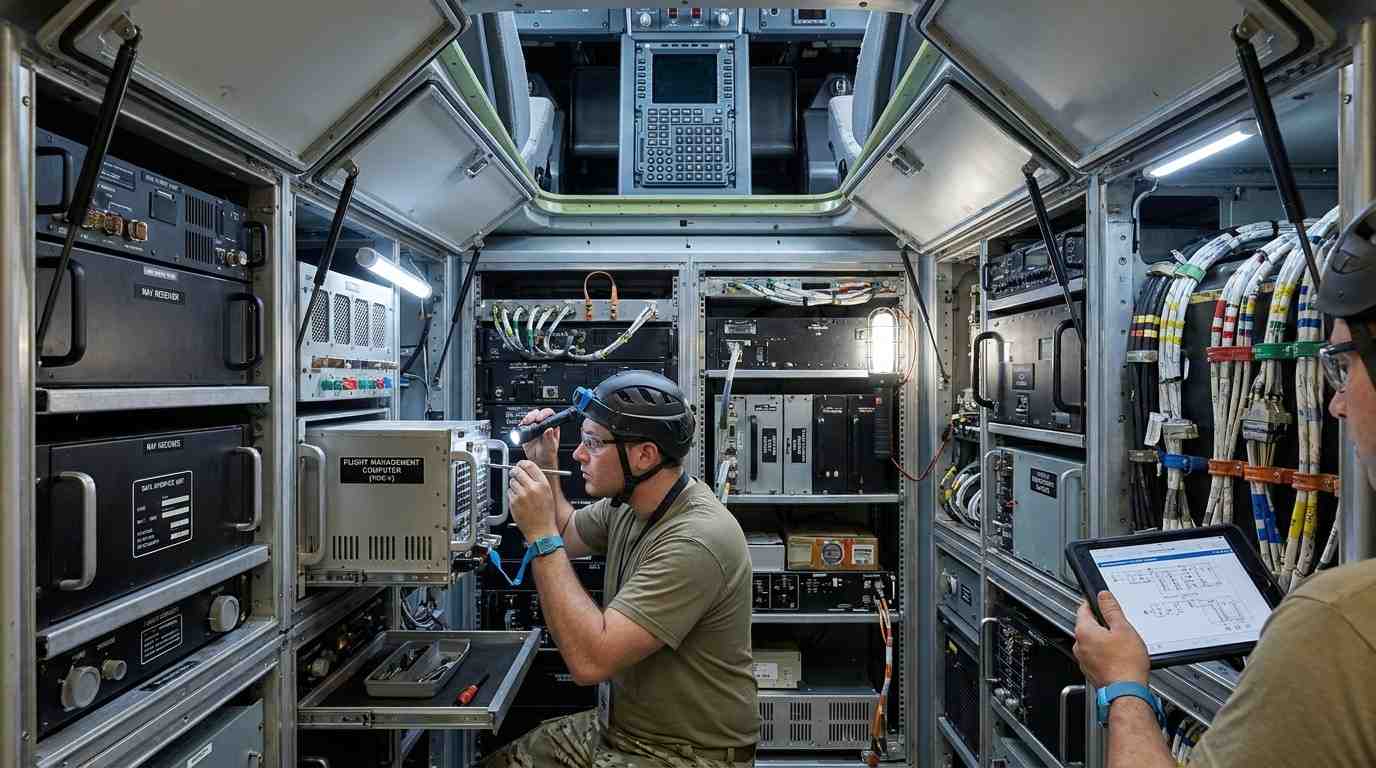
One CDU, one flight-management computer, a navigation database and a few sensor inputs connected by clean arrows to the cockpit displays and flight-guidance system.
The real FMS is distributed across CDU or MCDU panels, flight-management computers, GPS and inertial-reference equipment, radio-navigation receivers, display computers, autoflight systems, data buses, circuit breakers, connectors and extensive wiring installed throughout the cockpit and avionics compartments.
The diagram explains how flight-plan data, navigation inputs, calculations and guidance move through the FMS. The aircraft shows where the individual units, interfaces and wiring are physically installed. Effective troubleshooting requires technicians to understand both the information flow and the real avionics architecture.
FAQ: Flight Management System
What’s the difference between FMS and FMC? The FMC is the computer itself — one component. The FMS is the complete system: the FMC plus the CDU, the navigation database, and the sensor inputs all working together.
Is the FMS the same as the autopilot? No — they’re partners. The FMS is the brain that decides what to fly (route, speeds, altitudes); the autopilot is the hands that physically fly it. Engage LNAV and VNAV, and the autopilot follows the FMS’s plan.
What do LNAV and VNAV mean? LNAV (lateral navigation) steers the aircraft along the route — left and right. VNAV (vertical navigation) manages the profile — climb, cruise, and descent, including the Top of Descent point.
Do pilots still navigate manually? They can, and they’re trained to. In daily operations the FMS handles routine navigation with far greater precision, while pilots manage, monitor, and cross-check the system — and take over whenever needed.
How often is the navigation database updated? Every 28 days, on the worldwide AIRAC cycle. Airports, airways, and procedures change constantly, so the FMS’s map is refreshed on a fixed schedule to stay accurate.
Next time you fly, remember — there’s a smart system working behind the scenes the whole way, quietly making thousands of decisions to keep the flight safe, smooth, and efficient. Save the chart to your aviation board for revision, and if you want to see what’s pushing the aircraft while the FMS does the thinking, read our guide on [how a jet engine works — internal link when live].