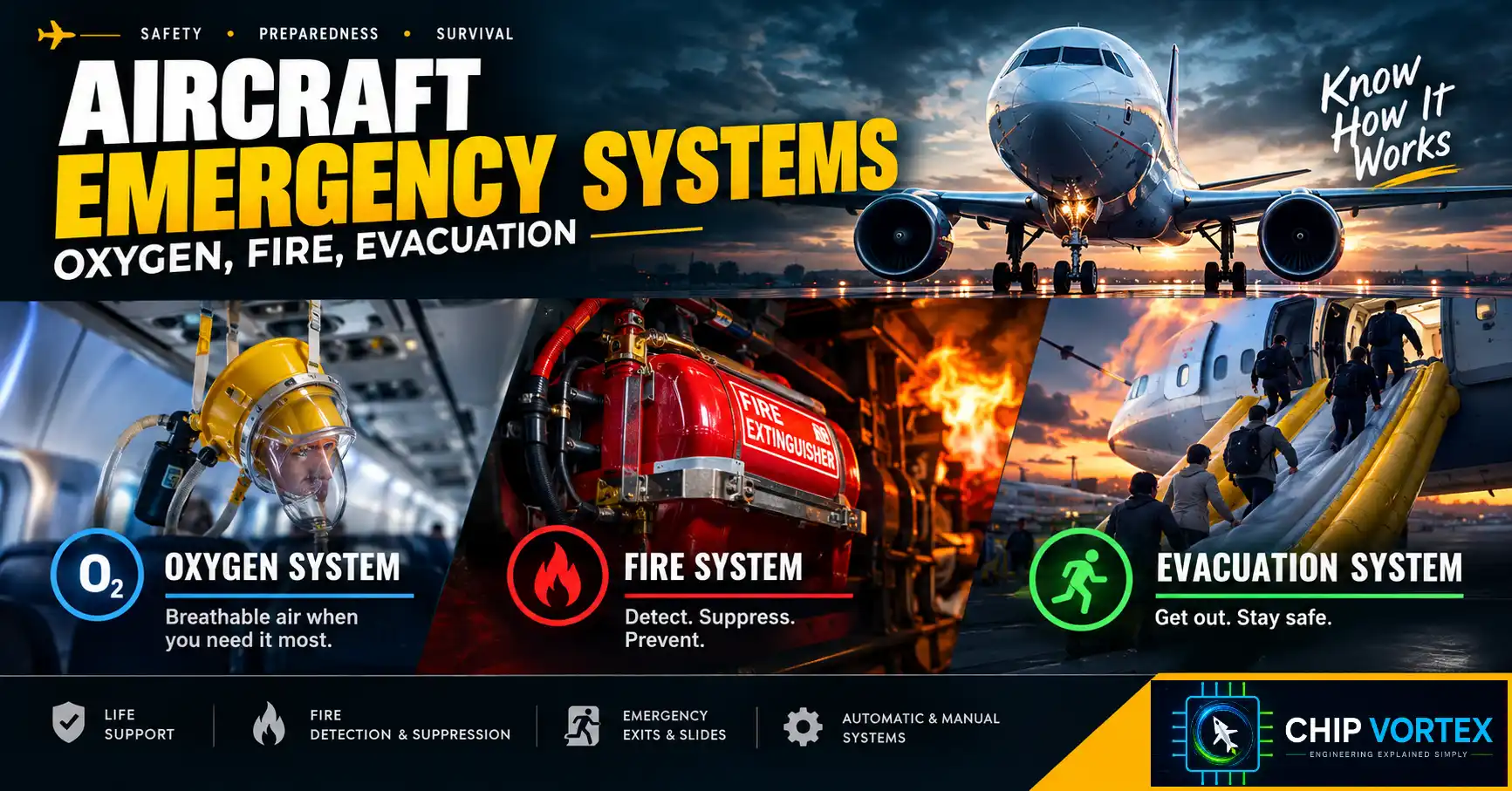
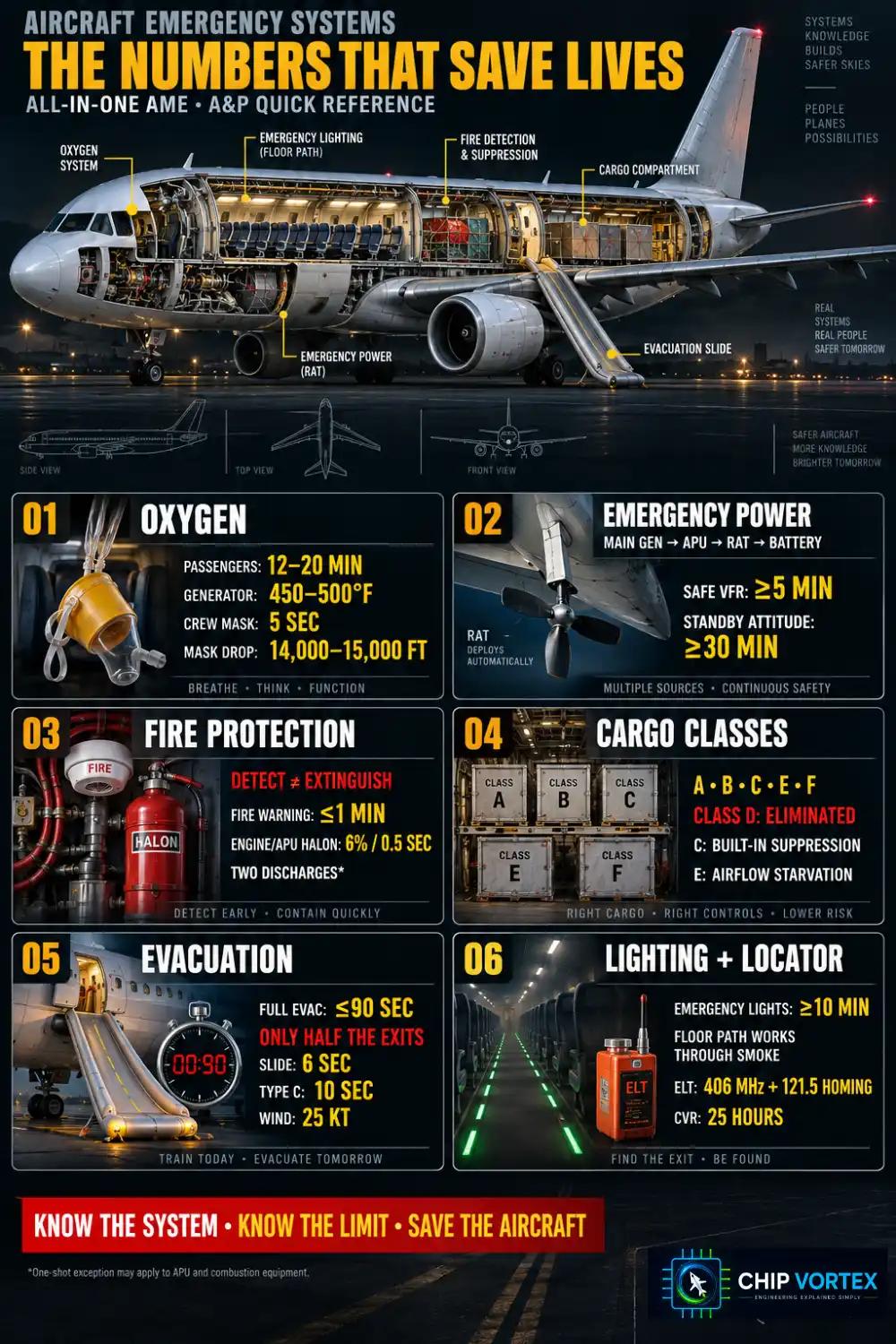
Aircraft emergency systems are the equipment and procedures that keep an aircraft survivable when something has already gone wrong — oxygen when the cabin fails, power when the generators quit, detection and suppression when something burns, and a way out when the aircraft is on the ground. This guide covers each in turn, with the regulatory numbers AME and A&P students are expected to know.
Emergency Oxygen
Passengers: chemical generators
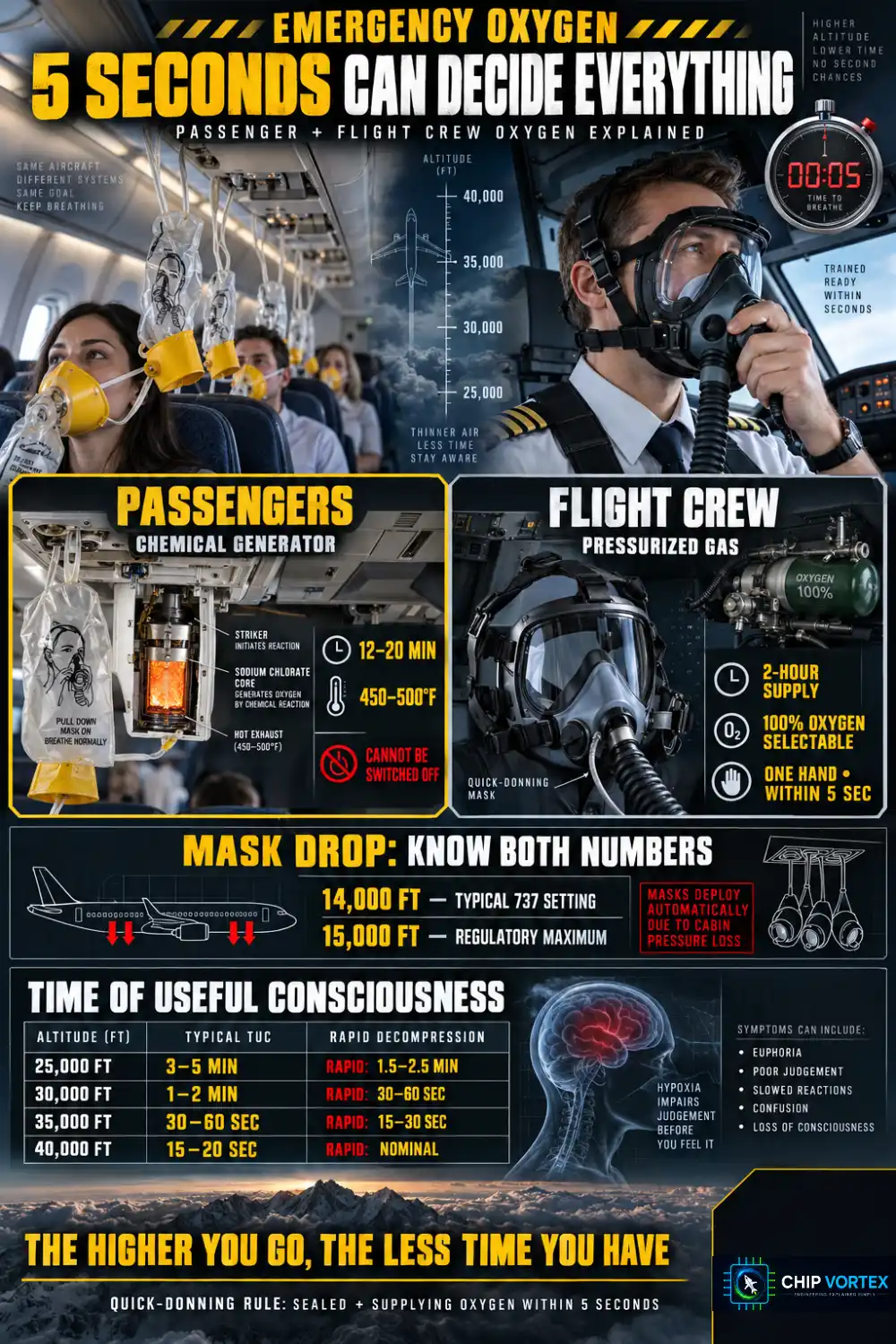
Passenger masks are fed by chemical oxygen generators, not stored gas. Pulling the mask releases a spring-powered striker that ignites a small charge, starting an exothermic reaction in a sodium chlorate core.
Two consequences follow, and both matter:
- It cannot be switched off. Once started, the reaction runs to completion — on the order of 12 to 20 minutes depending on type.
- It gets hot. The NTSB records maximum shell temperatures typically reaching 450–500 °F.
That heat is why generators are dangerous cargo. In the ValuJet 592 accident of 11 May 1996, a DC-9 crashed into the Everglades with 110 fatalities, after a fire in the Class D cargo compartment initiated by the actuation of oxygen generators improperly carried as cargo — required shipping safety caps had not been installed.
The NTSB’s probable cause has three limbs, and the third is the one that changed the rules: the failure of SabreTech to properly prepare, package and identify the generators; the failure of ValuJet to oversee its contract maintenance programme; and the failure of the FAA to require smoke detection and fire suppression systems in Class D cargo compartments. Class D was eliminated by Amendment 25-93, effective 19 March 1998, with in-service retrofit to Class C or E required by 19 March 2001.
Flight crew: gaseous, and five seconds
Crew oxygen is a separate pressurised gaseous system, because the crew requirement is duration plus regulator control plus 100% selection — none of which a fixed-output chemical core can deliver. Under 14 CFR 121.333(b) the supply must last two hours per flight crew member, and “two hours” is itself a defined quantity: descent from maximum certificated operating altitude to 10,000 ft in ten minutes, then 110 minutes at 10,000 ft.
The famous number is the quick-donning requirement (25.1447(c)(2)(i) for certification, 121.333(c) operationally): the mask must be capable of being placed on the face, secured, sealed and supplying oxygen on demand with one hand and within five seconds.
When do the masks drop?
Two different numbers, and students mix them up. 15,000 ft cabin altitude is the regulatory maximum under 14 CFR 25.1447(c)(1) for aircraft certificated above 30,000 ft. 14,000 ft is the typical manufacturer setting on the 737 — comfortably below the limit.
Time of useful consciousness
| Cabin altitude | TUC | After rapid decompression |
|---|---|---|
| 25,000 ft | 3–5 min | 1.5–2.5 min |
| 30,000 ft | 1–2 min | 30 s – 1 min |
| 35,000 ft | 30 s – 1 min | 15–30 s |
| 40,000 ft | 15–20 s | Nominal |
Those right-hand figures are why the five-second mask rule exists.
Emergency Electrical Power
The hierarchy runs: engine-driven main generators → APU generator → ram air turbine or emergency generator → battery with static inverter for essential AC.
One correction worth making, because it is widely repeated: there is no general 30-minute battery requirement in Part 25. What 25.1351(d) requires is safe VFR operation for not less than five minutes with normal electrical power inoperative. The genuine 30-minute rule is 121.305(k) — the standby attitude indicator must run for a minimum of 30 minutes after total failure of the electrical generating system. Actual battery endurance is type-specific AFM data, not regulation.
Fire Protection: Detection and Extinguishing
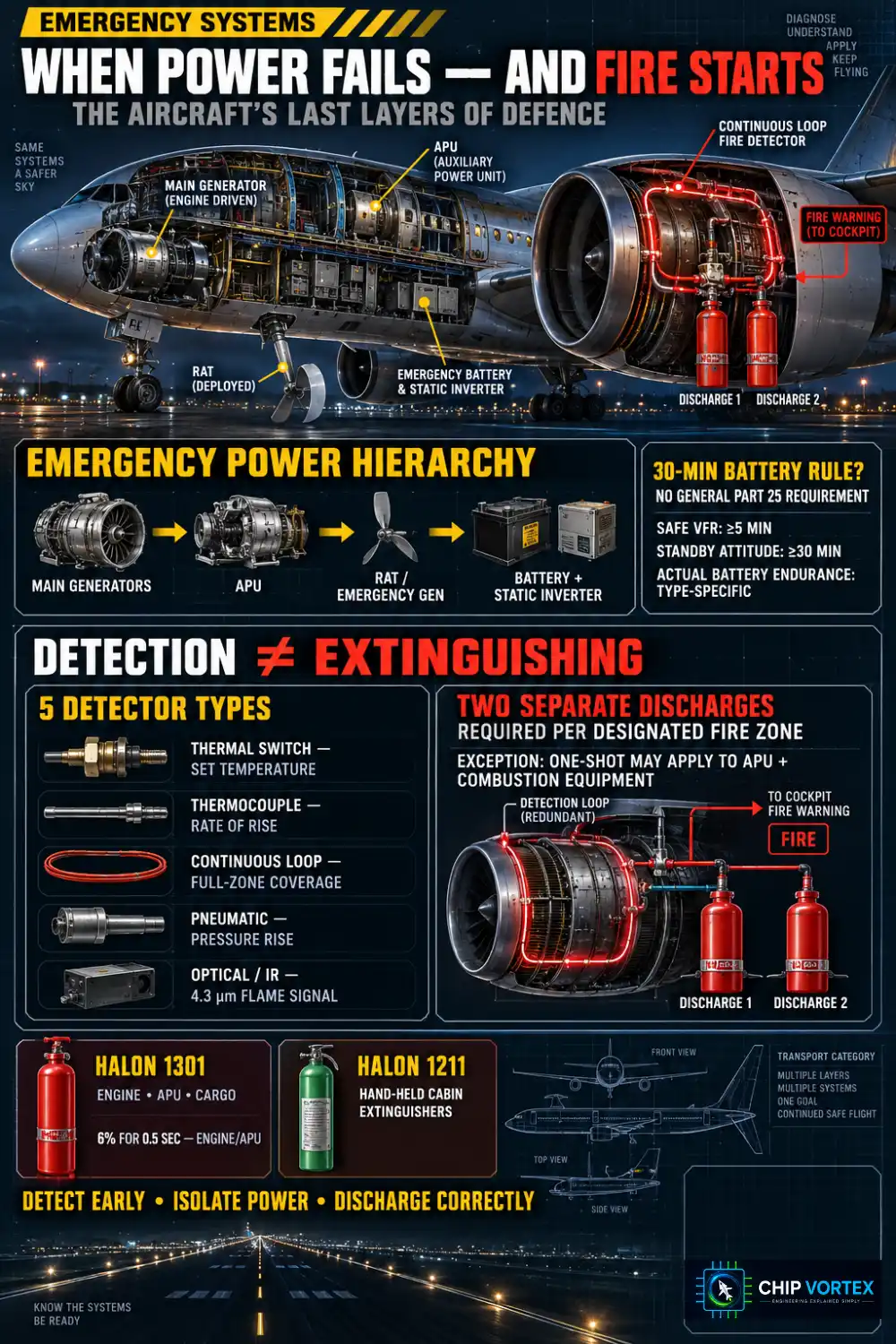
These are two separate systems, tested independently. Detection senses and annunciates; extinguishing discharges agent.
Detector types
- Thermal switch — heat-sensitive units completing a circuit at a set temperature; wired in parallel with each other, in series with the indicator.
- Thermocouple — responds to rate of temperature rise, which means it gives no warning when an engine overheats slowly.
- Continuous loop — Fenwal (eutectic salt with a nickel conductor) and Kidde (two wires in a thermistor core) types running the length of the zone.
- Pneumatic — a helium-filled tube whose pressure rises with heat, with a separate integrity switch to flag leaks.
- Optical / infrared — detects hydrocarbon flame radiation centred near 4.3 micrometres.
Transport-category aircraft must have two separate discharges available for each designated fire zone under 25.1195 — with an exception students routinely miss: an individual “one-shot” system is permitted for APUs, fuel burning heaters and other combustion equipment.
Agents and the halon problem
Halon 1301 is the total-flood agent for engine nacelles, APUs and cargo compartments. Note the concentrations differ by application: the engine/APU performance standard is 6% by volume for 0.5 second, while cargo compartments require about 5% initial knockdown then not below 3% for the remainder of the flight. Halon 1211 is the streaming agent in hand-held cabin extinguishers.
Halon is being phased out, and the deadlines are examinable — note the two different triggers:
| Application | ICAO cut-off | Trigger |
|---|---|---|
| Lavatories | After 31 Dec 2011 | Individual C of A first issued (Annex 6) |
| Hand-held extinguishers | After 31 Dec 2018 | Individual C of A first issued (Annex 6) |
| Engine / APU | On/after 31 Dec 2014 | Type certificate application (Annex 8) |
| Cargo compartments | On/after 28 Nov 2024 | Type certificate application (Annex 8) |
The EU runs its own timetable under Regulation (EU) 2024/590, with cut-off dates and separate end-of-service dates: halon portable extinguishers reached end of service on 31 December 2025, while engine, APU and cargo halon runs to 31 December 2040. There is no equivalent FAA end-of-service mandate — the point most likely to confuse a North American student.
The current reality is messier than the timetable suggests. ICAO’s own 2025 working paper describes the cargo cut-off as “technically unattainable for new aircraft type certifications” — the two candidate replacements add either 100–500 kg of agent mass or are five to six times heavier than halon. And 2-BTP, one of the leading substitutes, may itself fall within regulatory definitions of PFAS.
Cargo Compartment Classes
| Class | Detection | Suppression |
|---|---|---|
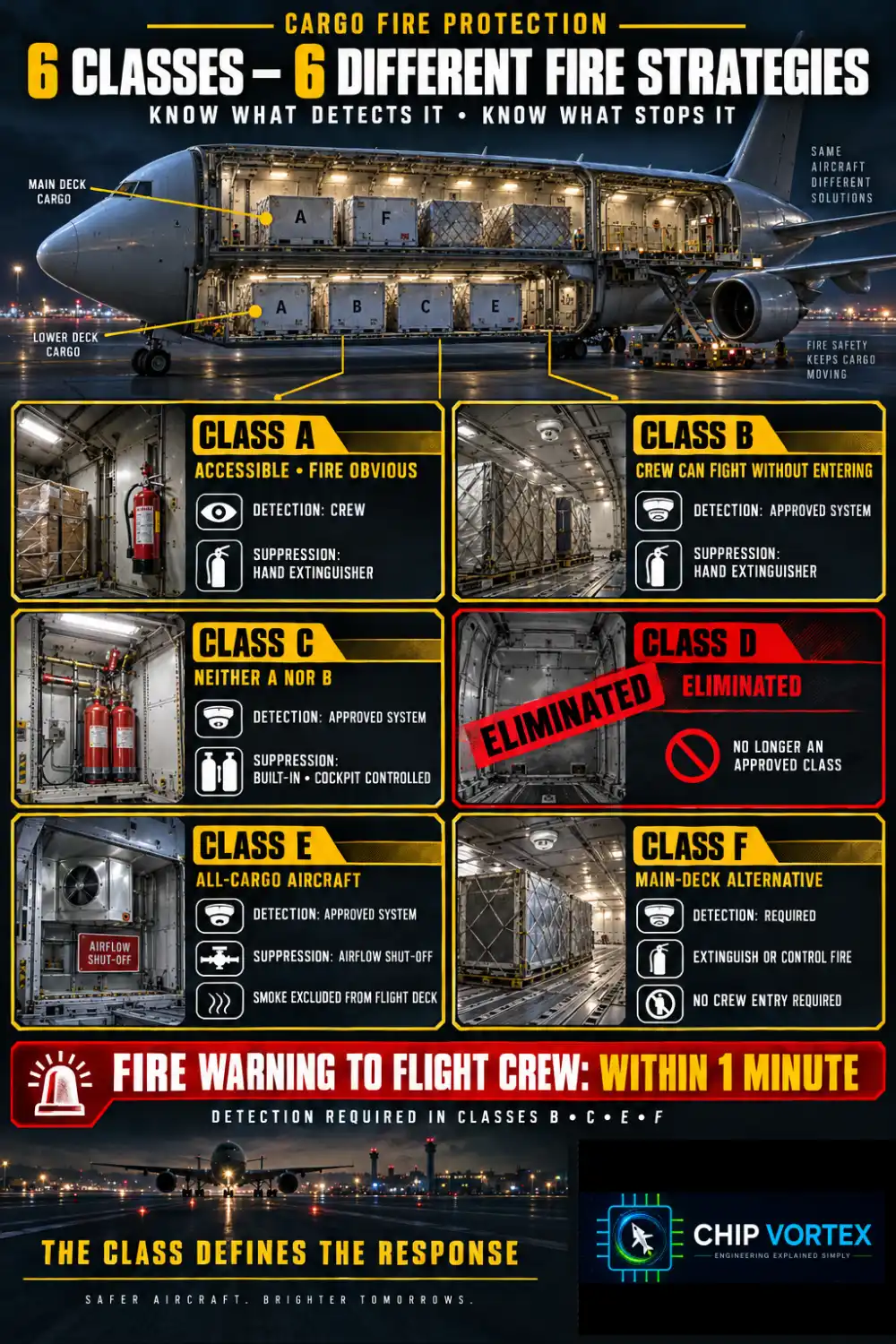
| A — accessible, fire obvious to crew | Crew | Hand extinguisher |
| B — crew can fight it without entering | Separate approved system | Hand extinguisher |
| C — neither A nor B | Separate approved system | Built-in, cockpit-controlled |
| D — eliminated | — | — |
| E — all-cargo aeroplanes | Separate approved system | No agent system — airflow shut-off (starvation) plus smoke exclusion from the flight deck |
| F — main deck alternative | Yes | Means to extinguish or control a fire without a crewmember entering the compartment |
Where a detection system is required (Classes B, C, E and F), 25.858 requires a visual indication to the flight crew within one minute of a fire starting.
Evacuation: The 90-Second Rule
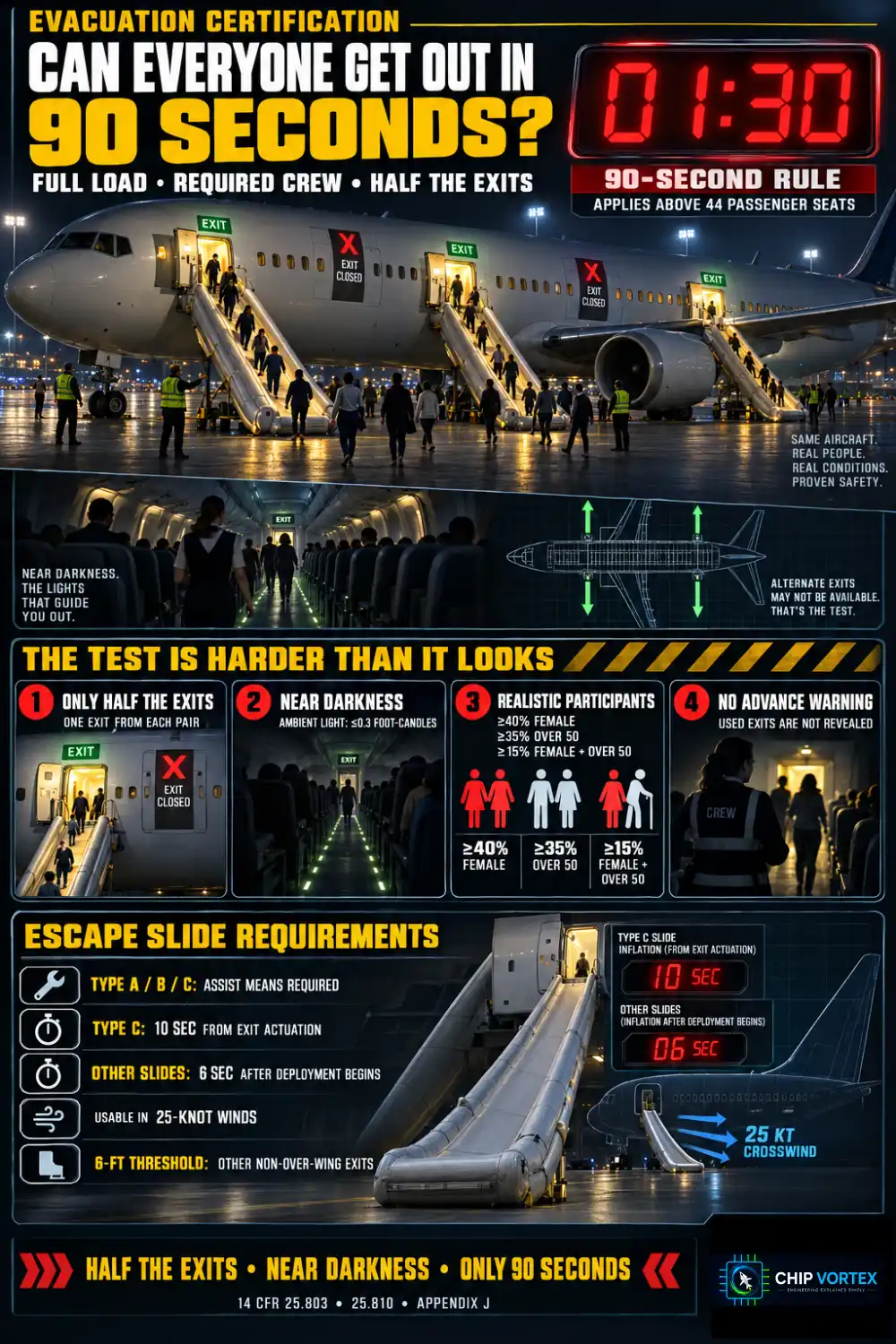
Under 14 CFR 25.803, aircraft seating more than 44 passengers must show that a full load plus required crew can evacuate within 90 seconds. It is a certification demonstration, and the rule permits a combination of analysis and testing where the Administrator finds it equivalent to an actual demonstration. The conditions in Appendix J are what make it demanding:
- Only one exit from each exit pair may be used — effectively half the exits.
- Ambient light no greater than 0.3 foot-candles; only the aircraft’s own emergency lighting may illuminate.
- At least 40% of participants female, at least 35% over 50, at least 15% female and over 50.
- No prior indication to anyone of which exits will be used.
Escape slides
Under 25.810, every non-over-wing Type A, B or C exit requires an assist means regardless of sill height. The familiar 6-foot threshold applies to other non-over-wing emergency exits.
The erection times also split differently from how they are usually taught. Type C exits get 10 seconds from the time the exit opening means is actuated. Everything else must erect within 6 seconds after deployment is begun — including Types A and B. The slide must remain usable in 25-knot winds from the most critical angle, with the assistance of only one person.
Emergency Lighting
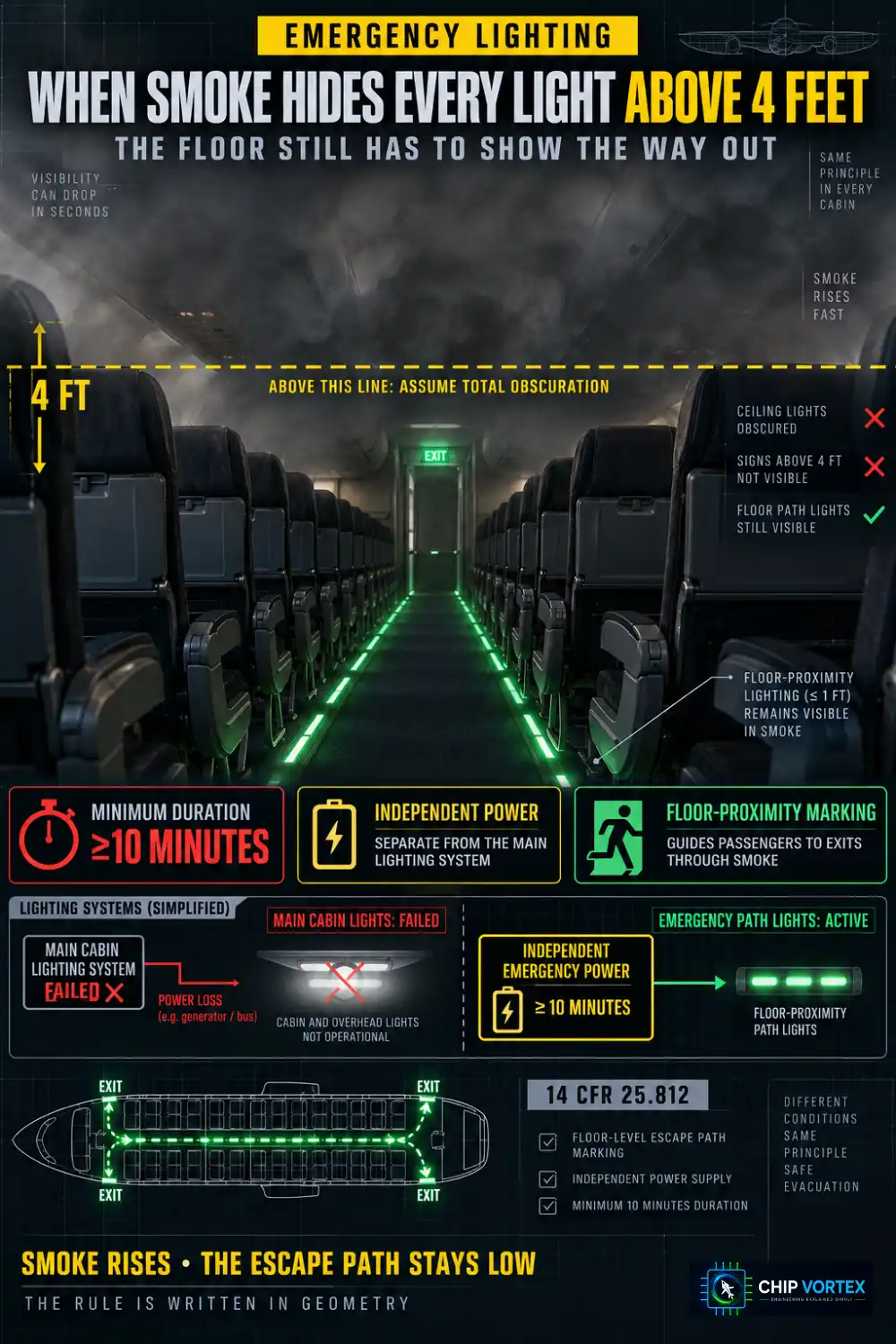
Under 25.812, emergency lighting must be independently powered from the main lighting system and provide the required illumination for at least 10 minutes.
The most important provision is floor proximity escape path marking: it must guide passengers “when all sources of illumination more than 4 feet above the cabin aisle floor are totally obscured.” That is a smoke rule written in the language of geometry.
Locator and Recorder Systems
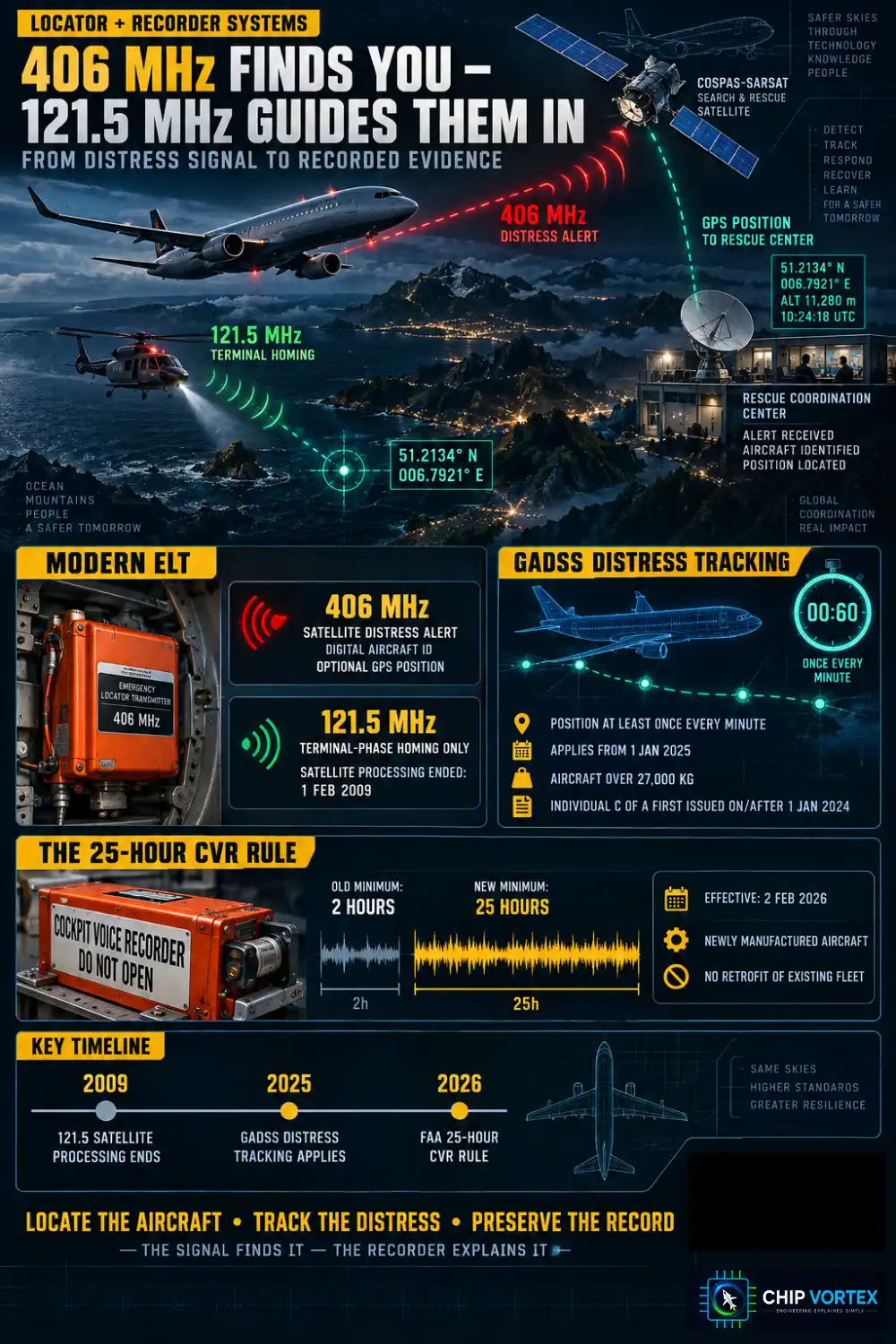
ELT. Cospas-Sarsat terminated satellite processing of 121.5 MHz on 1 February 2009. Modern ELTs transmit on 406 MHz with digital aircraft identification and optional GPS position, and retain a 121.5 MHz signal purely for terminal-phase homing. Separately, ICAO’s GADSS autonomous distress tracking requirement — position at least once every minute when in distress — applies from 1 January 2025 to aeroplanes over 27,000 kg maximum certificated take-off mass whose individual certificate of airworthiness was first issued on or after 1 January 2024.
Flight recorders. The big recent change: the FAA’s 25-hour CVR rule, published and effective 2 February 2026, raises the minimum cockpit voice recording duration from 2 hours to 25 for newly manufactured aircraft, under Section 366 of the FAA Reauthorization Act of 2024. Note two things: compliance is staggered by aircraft category rather than immediate, and the rule mandates no retrofit of the existing fleet.
Frequently Asked Questions
Why can’t a passenger oxygen generator be turned off?▾
Because it is a chemical reaction, not a valve. Once ignited it runs to completion at shell temperatures typically reaching 450–500 °F.
What made Class D cargo compartments illegal?▾
ValuJet 592. The FAA’s failure to require smoke detection and fire suppression in Class D compartments was the third limb of the NTSB’s probable cause — not merely a contributing factor. Class D was eliminated by Amendment 25-93.
Is the 90-second evacuation test done in the dark?▾
Effectively yes — ambient light no greater than 0.3 foot-candles, with only the aircraft’s emergency lighting permitted.
Related reading: the ram air turbine, the aircraft fuel system, and the aircraft autopilot system.