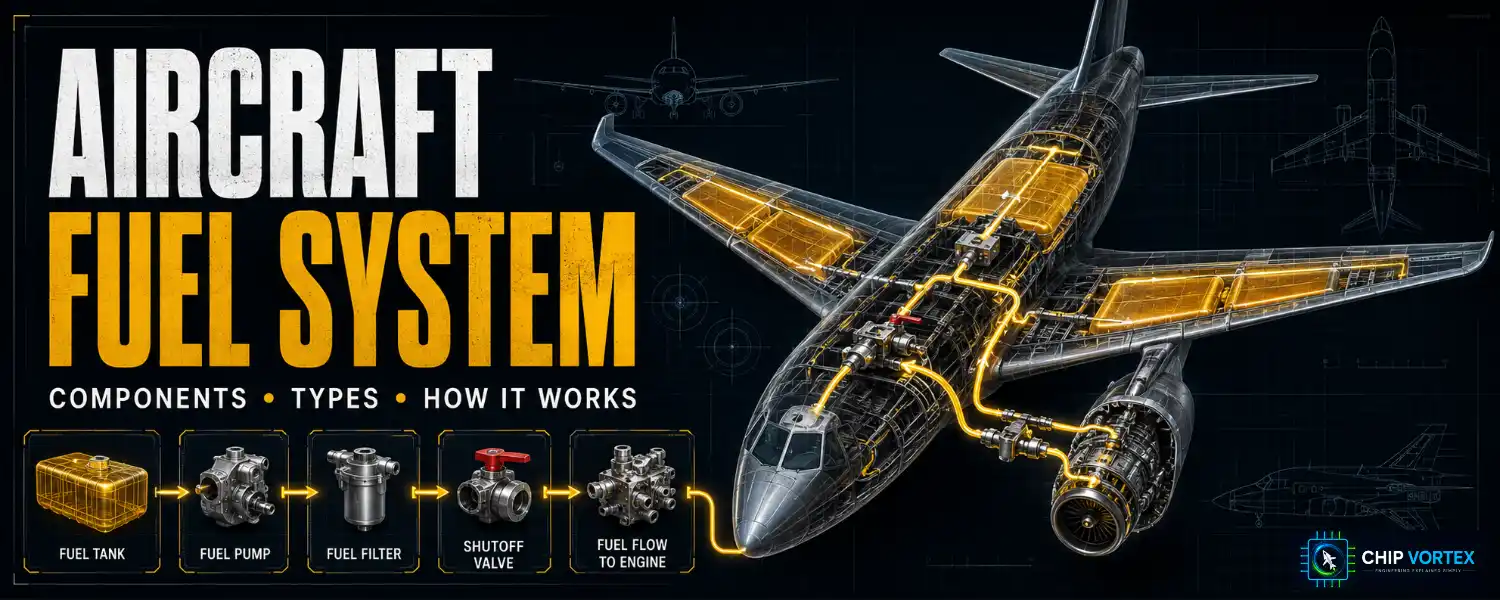
The aircraft fuel system is the network of tanks, pumps, valves, lines and gauges that stores fuel and delivers it to the engine at the right pressure and flow rate, in every attitude the aircraft is certified to fly. For an AME or A&P student, it is one of the highest-yield systems to master: it appears in written exams, in oral and practical assessments, and in almost every line-maintenance task you will ever perform.
What Does an Aircraft Fuel System Actually Do?
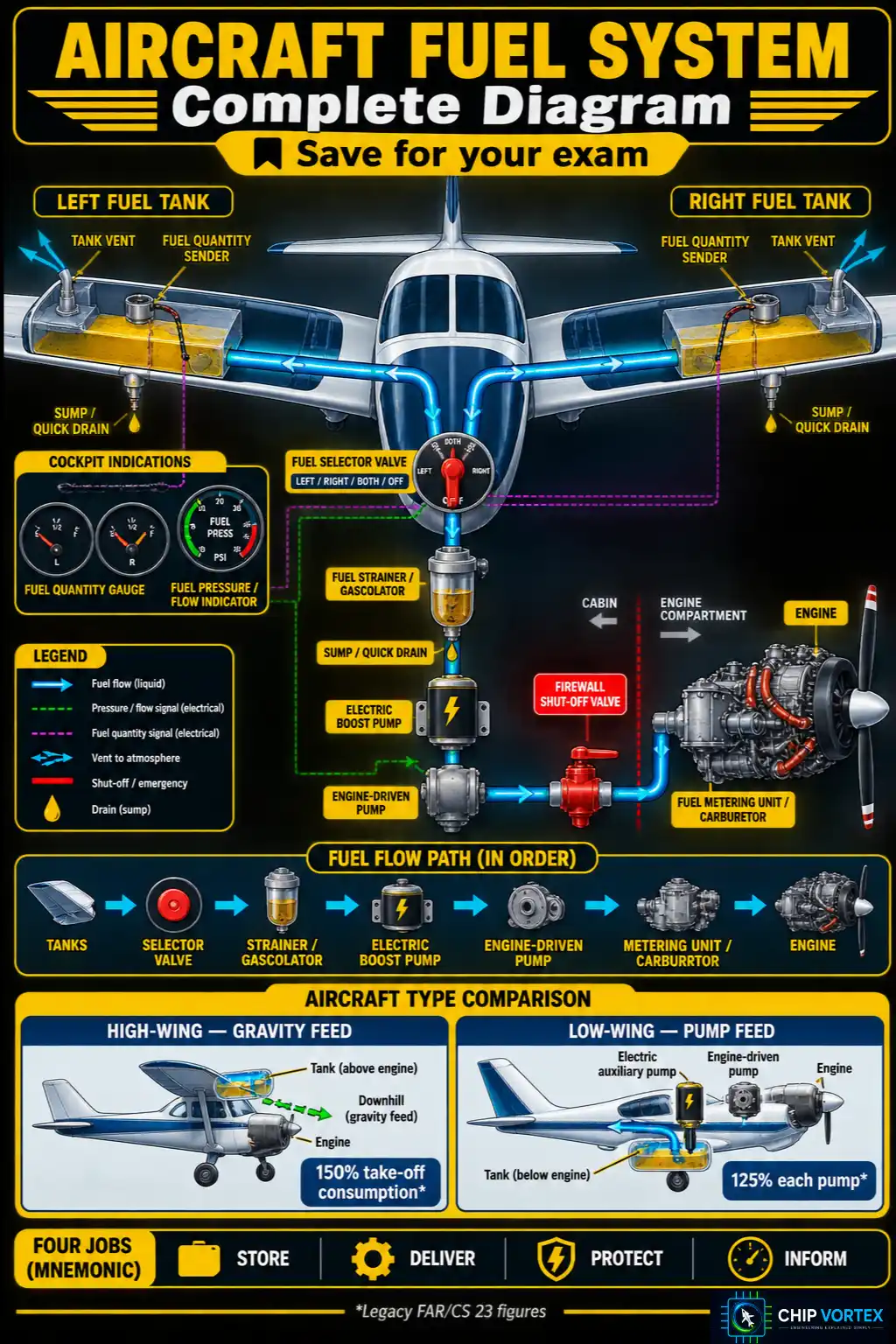
A certified fuel system has to do four things reliably:
- Store fuel safely, without leaks, and vent the tanks so pressure stays balanced as fuel is consumed and as temperature changes.
- Deliver uninterrupted fuel to the engine at the required pressure and flow through the full certified flight envelope.
- Protect the engine by filtering out water, sediment and microbial contamination.
- Inform the crew, through quantity, pressure and flow indication, so fuel can be managed and the aircraft kept in balance.
Every component below serves one of those four jobs. Place a part in the right category and you already understand half of what it does.
Aircraft Fuel System Components
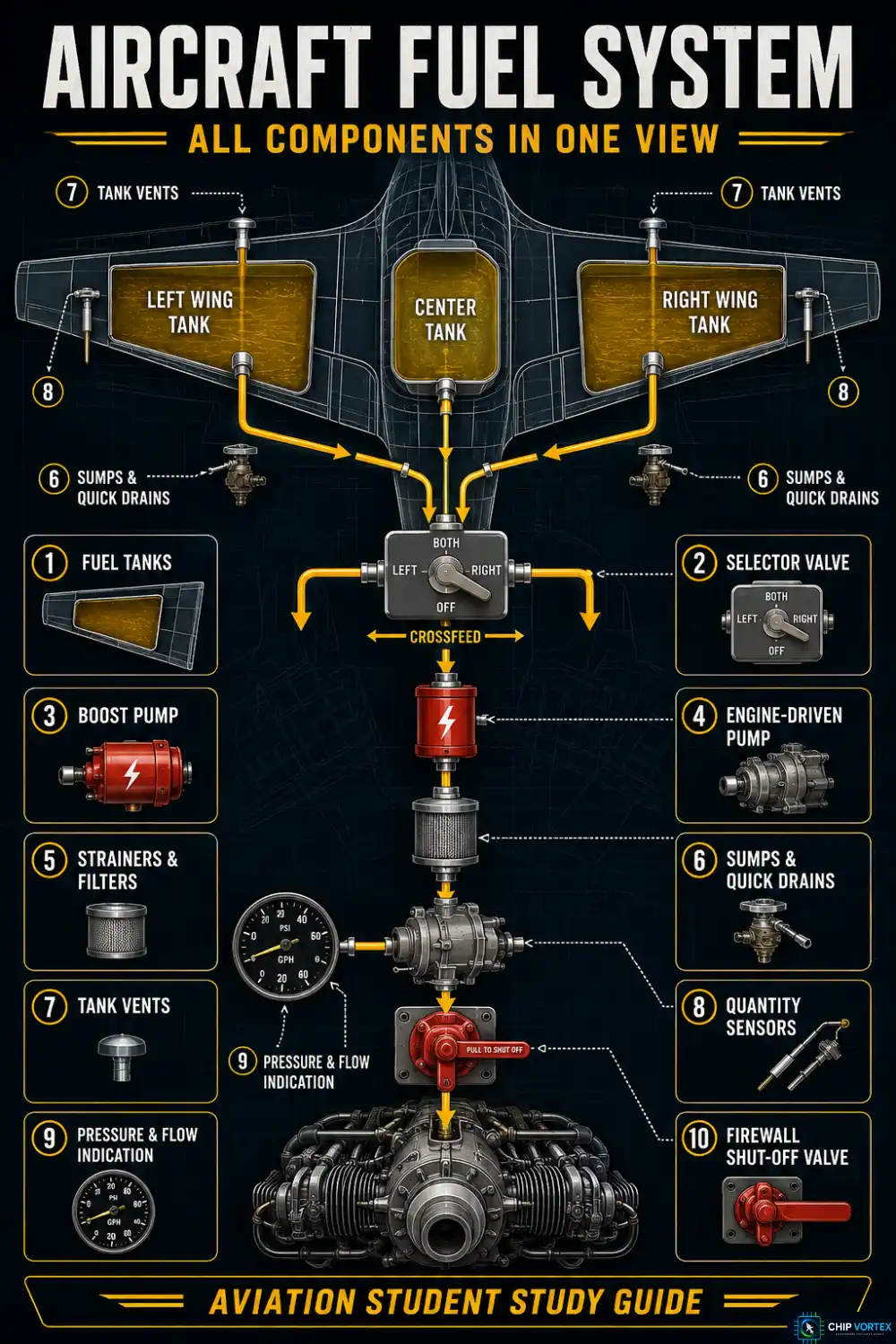
These are the core aircraft fuel system components you will find on nearly every airframe, from a Cessna 172 to a widebody:
- Fuel tanks — store the fuel; usually one or more per wing, sometimes a centre tank.
- Fuel selector valve — lets the crew choose the source: LEFT, RIGHT, BOTH or OFF. On multi-engine aircraft it also enables crossfeed.
- Boost (auxiliary) pump — an electric pump used for engine start, take-off, landing, high-altitude operation, and as a backup if the engine-driven pump fails.
- Engine-driven pump — the mechanical primary pump that supplies fuel during normal operation.
- Strainers and filters — trap contaminants. A coarse strainer (the gascolator) sits upstream of the pump to protect it from debris; finer filters often sit downstream, ahead of the fuel metering unit. Note the trap: a clogged upstream strainer starves the pump inlet and is itself a cause of cavitation.
- Sumps and quick-drain valves — the lowest points of the system, where water and sediment collect and are drained during preflight.
- Vents — keep tank pressure near atmospheric, allow fuel to expand, and prevent a vacuum forming as fuel is drawn out.
- Fuel quantity sensors and gauges — measure the fuel on board and display it in gallons, litres or pounds.
- Fuel pressure and flow indication — confirms the pump is delivering and lets the crew monitor consumption.
- Firewall shut-off valve — isolates fuel from the engine compartment in an emergency.
Fuel Tank Types: Integral, Rigid and Bladder
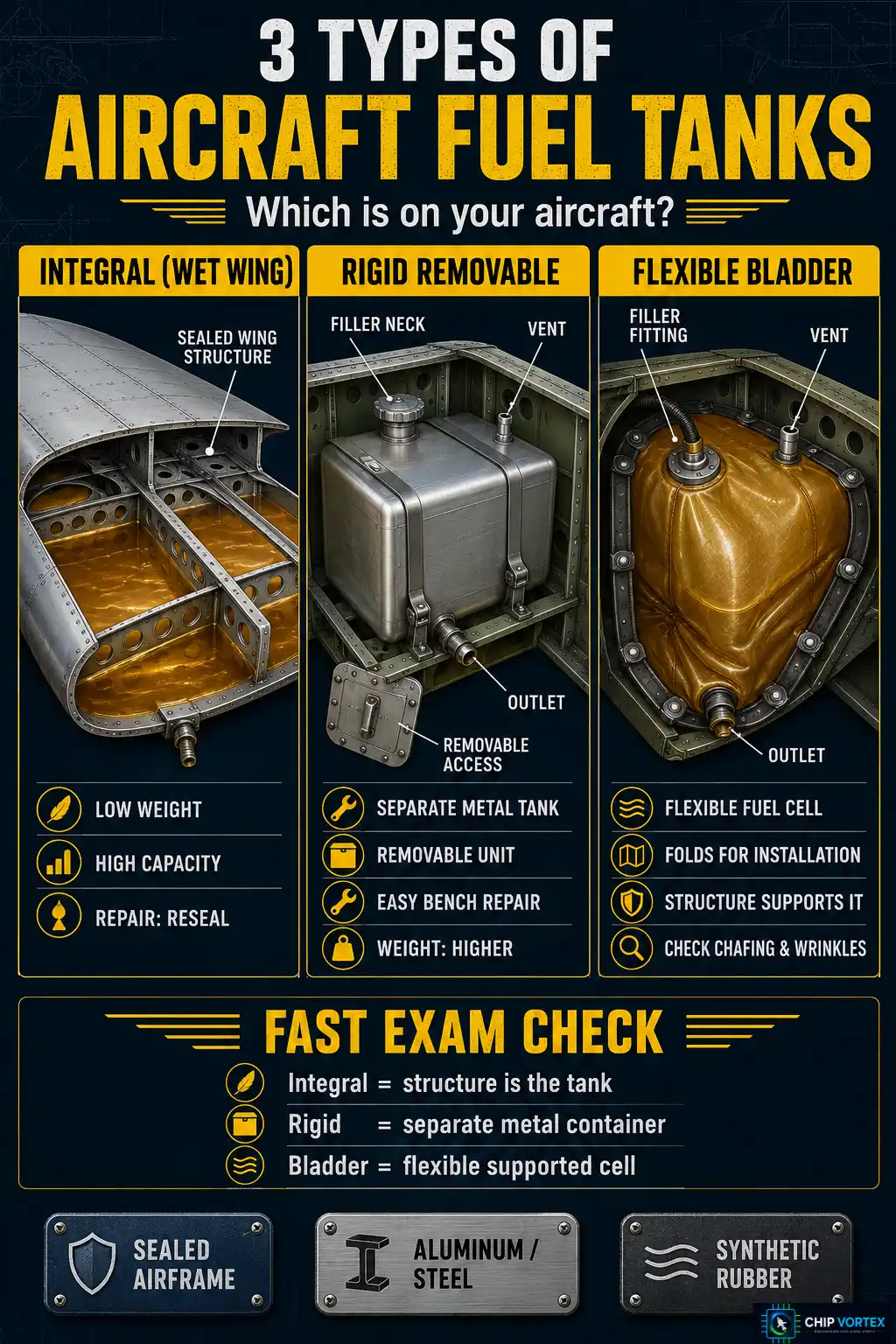
Three tank designs dominate aviation, and knowing which is which is a common exam question.
Integral tanks (“wet wing”)
The wing structure itself is sealed and used as the tank. Aluminium alloy suits this because it is compatible with the fuel itself — though water settling at the tank bottom still drives microbially influenced corrosion, which is why wet wings get close attention at inspection. Internal baffles limit sloshing during manoeuvres. Integral tanks save weight and maximise volume, but repairing a leak means entering and resealing the structure.
Rigid removable tanks
Self-contained tanks, typically riveted and seam-welded from 3003 or 5052 aluminium alloy or stainless steel, installed into a dedicated fuel bay. Older aircraft used terneplate — a favourite exam distractor. Their advantage is maintainability: the tank comes out and is repaired on the bench.
Bladder tanks
Flexible cells made from reinforced synthetic rubber. Because the bladder is folded during installation, it can be fitted through a normal inspection opening without cutting large access panels into the structure.
Gravity Feed vs Pump Feed: The Two Fuel Delivery Designs
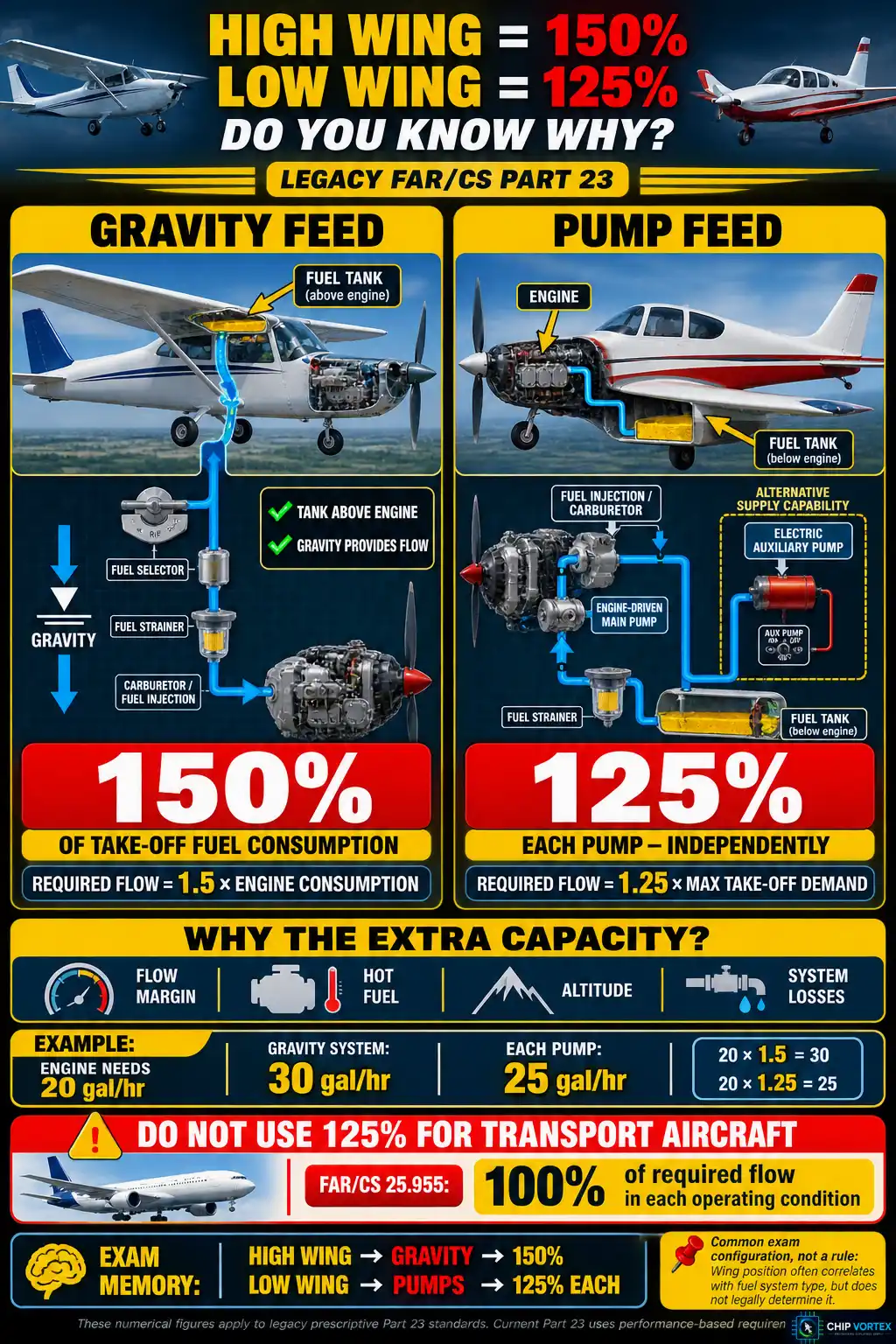
How fuel gets from tank to engine depends almost entirely on where the wing sits.
Gravity feed systems are used on high-wing aircraft, where the tanks sit above the engine and fuel simply flows downhill. There is no pump in the primary path, which makes the design beautifully simple. Under the pre-2017 FAR/CS 23.955 standard that certifies essentially the entire legacy piston fleet, a gravity system had to supply 150% of the engine’s take-off fuel consumption.
Pump feed systems are required on low-wing aircraft, where the tanks sit below the engine and gravity works against you. These use an engine-driven mechanical pump plus an electrically driven auxiliary pump. Under the same rule, each main and each emergency pump had to independently supply 125% of the fuel flow required at maximum take-off power — that redundancy is the whole point.
Two caveats examiners like. Amendment 23-64 rewrote Part 23 in 2017 into performance-based wording (§ 23.2430), so those numbers no longer appear in the rule for a new type certificate — but they still govern the legacy fleet and are still what the handbooks test. And they are Part 23 figures only: transport-category aircraft under 25.955 require 100% of the flow needed in each operating condition. Do not carry 125% into a widebody answer.
Remember the pairing: high wing, gravity, 150% — low wing, pumps, 125% each.
Aviation Fuel Types and Colour Codes
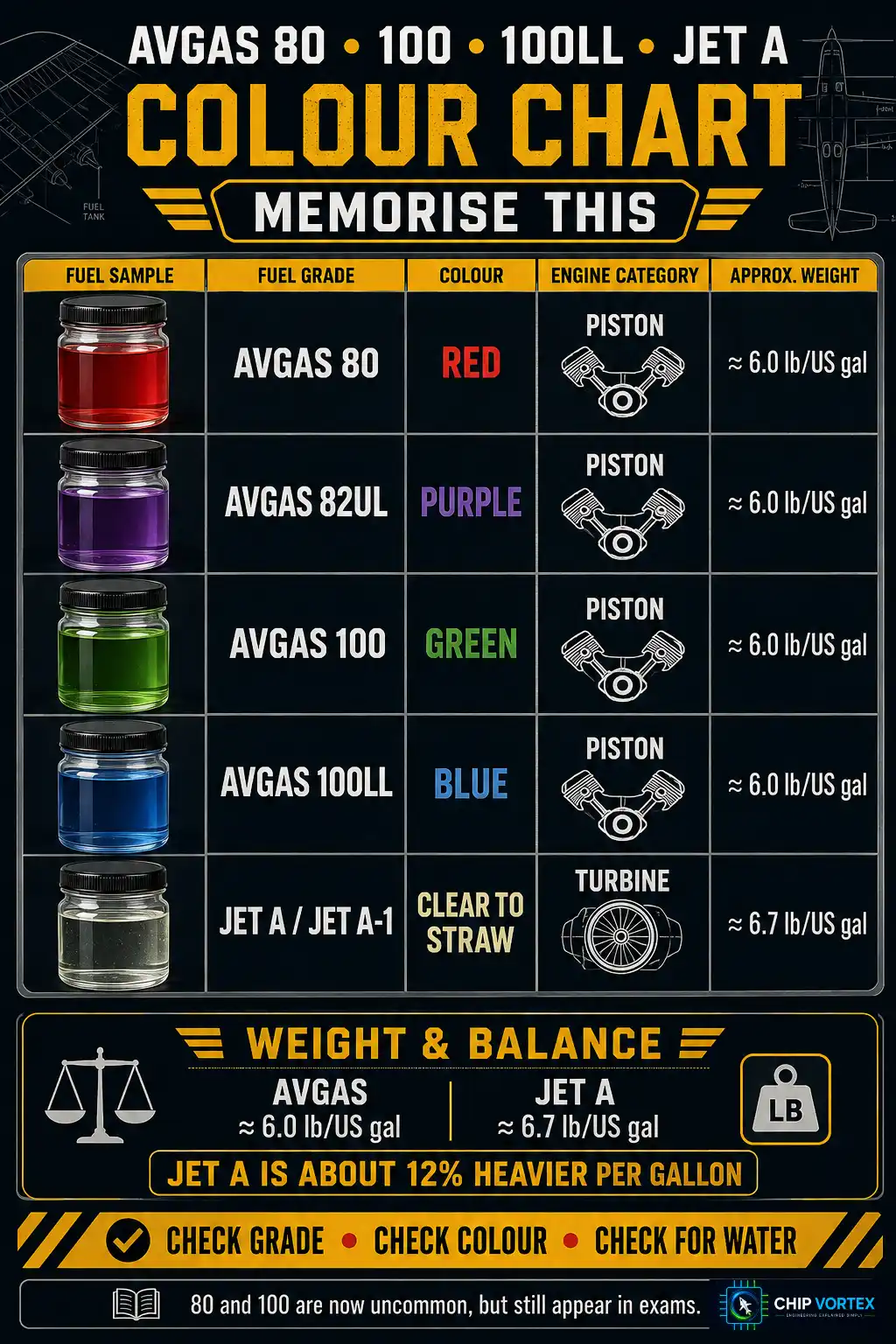
Fuel is dyed so that contamination or misfuelling can be spotted in a drained sample. This table is worth memorising:
| Fuel Grade | Colour | Engine Type | Approx. Weight |
|---|---|---|---|
| Avgas 80 (obsolete) | Red | Piston | ~6.0 lb/US gal |
| Avgas 82UL | Purple | Piston | ~6.0 lb/US gal |
| Avgas 100 (scarce) | Green | Piston | ~6.0 lb/US gal |
| Avgas 100LL | Blue | Piston | ~6.0 lb/US gal |
| Jet A / Jet A-1 | Clear to straw | Turbine | ~6.7 lb/US gal |
In practice 100LL is the only grade widely available today; 80 and 100 remain on exam papers more than on fuel trucks. The weights matter for weight-and-balance: Jet A is about 12% heavier per gallon than Avgas. Jet A density varies with temperature, so 6.7–6.8 lb/gal is the honest working range.
One current change worth knowing: the FAA’s EAGLE initiative aims to eliminate leaded aviation fuel from piston aircraft by the end of 2030. GAMI’s G100UL took its first STC in July 2021 and a fleetwide approval in September 2022; Swift Fuels’ 100R received a narrow first STC in September 2024 and has been expanding its approved model list since; UL100E is progressing through the PAFI fleet-authorisation pathway. Expect unleaded avgas questions to start appearing in exams.
Contamination and Vapor Lock: The Two Classic Failures
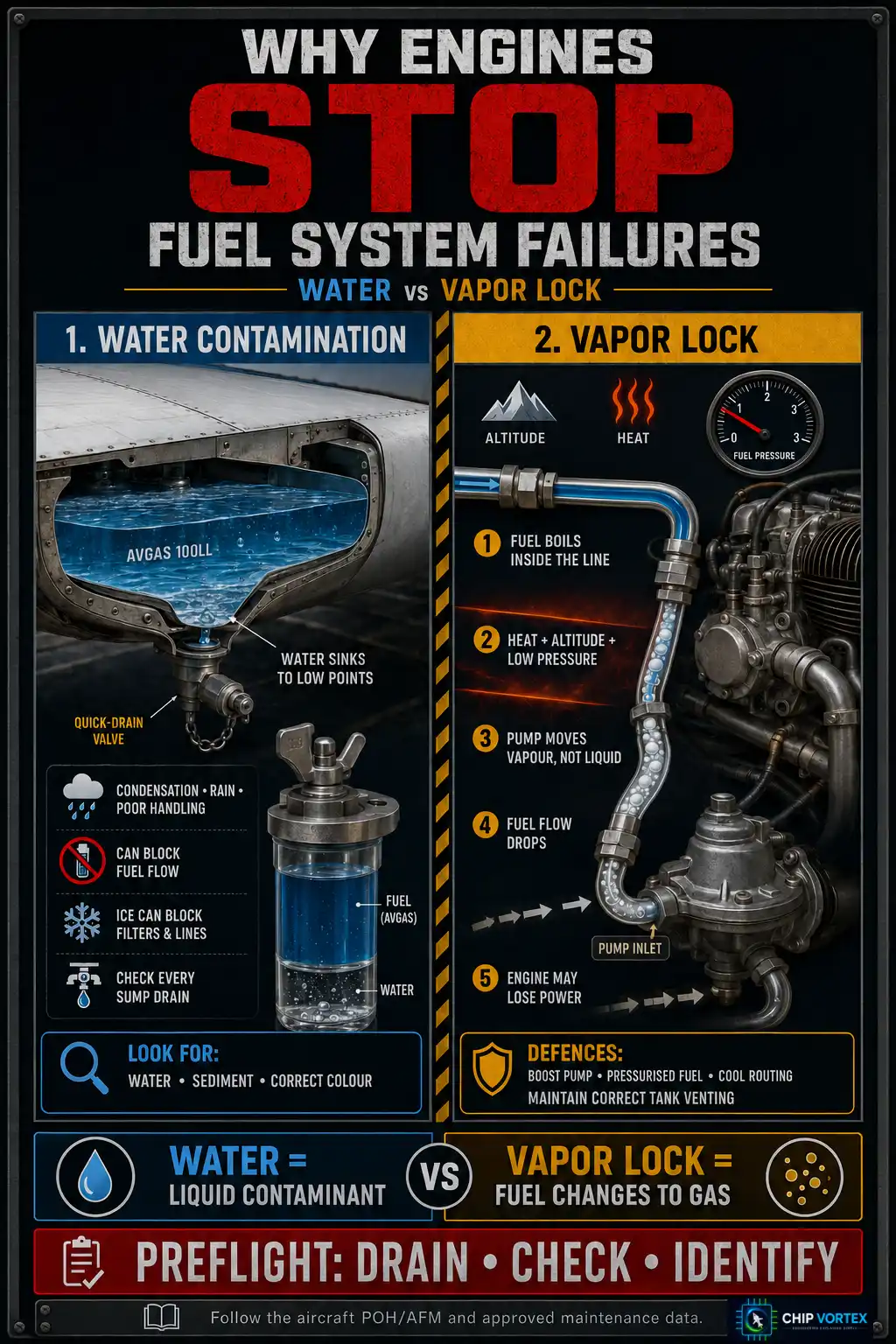
Water is the number one contaminant, entering through condensation in partially filled tanks and through poor ground handling. In cold conditions it freezes and blocks filters and lines; in warm conditions it reaches the engine and stops combustion. Hence the preflight sump drain: you are checking each sample for water droplets, sediment and correct colour.
Vapor lock occurs when fuel vaporises inside the line, so the pump moves vapour instead of liquid. It is more likely at altitude, because the boiling point of fuel falls as atmospheric pressure falls, and on hot fuel-injected engines. Boost pumps and correctly designed vents are the defences — keeping fuel pressurised keeps it liquid.
Frequently Asked Questions
Why do high-wing aircraft not need a fuel pump?▾
Because the tanks are above the engine, gravity alone can deliver the required flow. Many high-wing aircraft still carry an auxiliary pump for redundancy, but the primary path does not depend on one.
What is fuel crossfeed?▾
Crossfeed lets fuel from one wing’s tank feed the opposite engine on a multi-engine aircraft. It is used to correct lateral imbalance and to use remaining fuel after an engine failure.
Why are fuel tanks vented?▾
As fuel is consumed, the space above it must be replaced with air. Without a vent, a partial vacuum forms and fuel flow stops. Vents also allow fuel to expand safely as temperature rises.
Where is the fuel strainer located, and why?▾
The main strainer sits at a low point upstream of the pump, so debris and water are caught before they reach it. Do not treat “upstream” as an absolute rule, though: boost pumps carry their own inlet screens, and fine filters are commonly fitted downstream of the pump ahead of the metering unit. Turbine systems typically use both — a low-pressure filter before the pump and a high-pressure filter after it.
Study Takeaway
If you remember nothing else about the aircraft fuel system, remember the four jobs — store, deliver, protect, inform — and the high-wing/low-wing split between gravity feed and pump feed. Every component and certification number hangs off that framework.