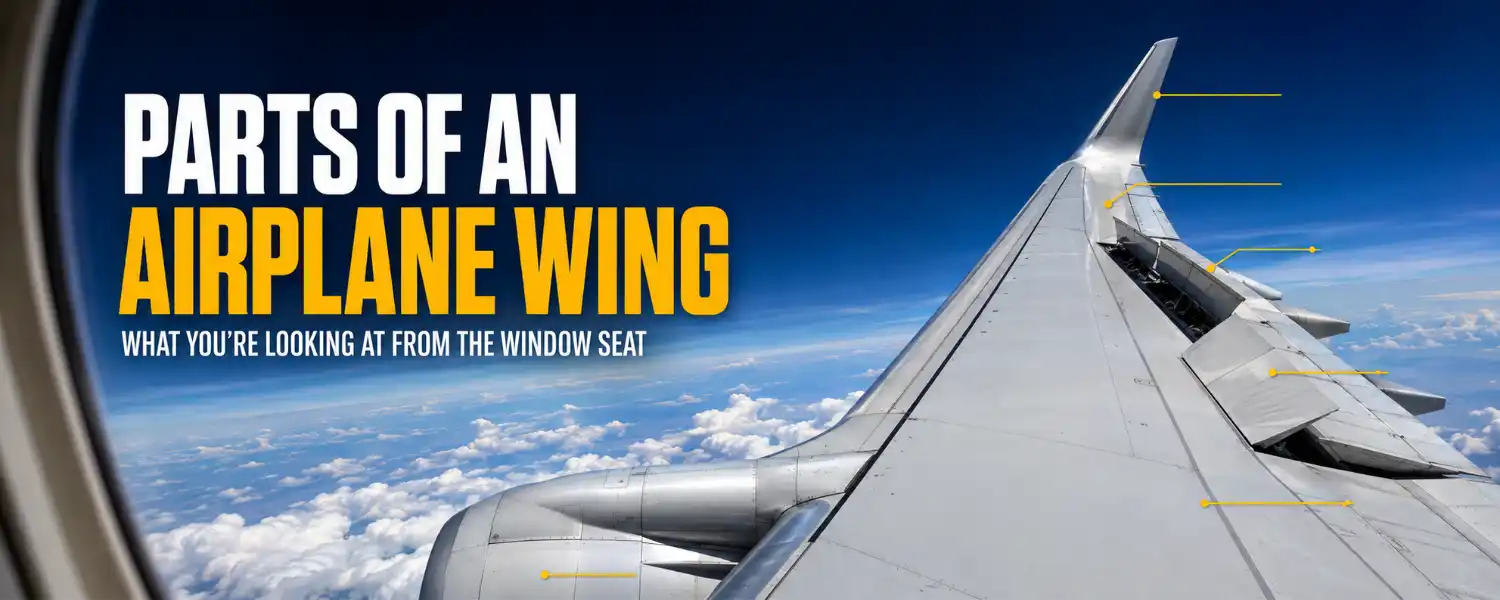
You’re in the seat over the wing. On approach, the whole thing seems to come apart — panels slide backward, surfaces droop down, and the moment the wheels touch, a row of plates snaps upright like the wing is applying the brakes. It is. Everything you just watched has a name and a job, and by the end of this guide you’ll know all of them.
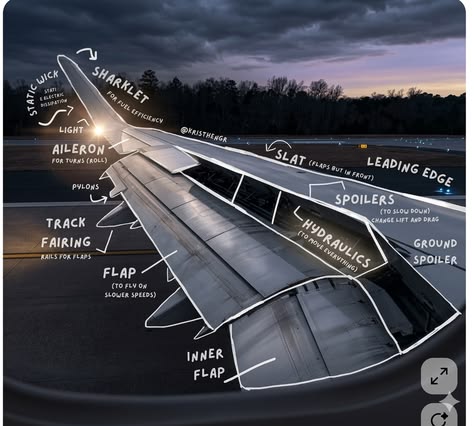
Save the labeled photo for your next flight, then let’s take the tour — from the wingtip inward.
The Wingtip Zone
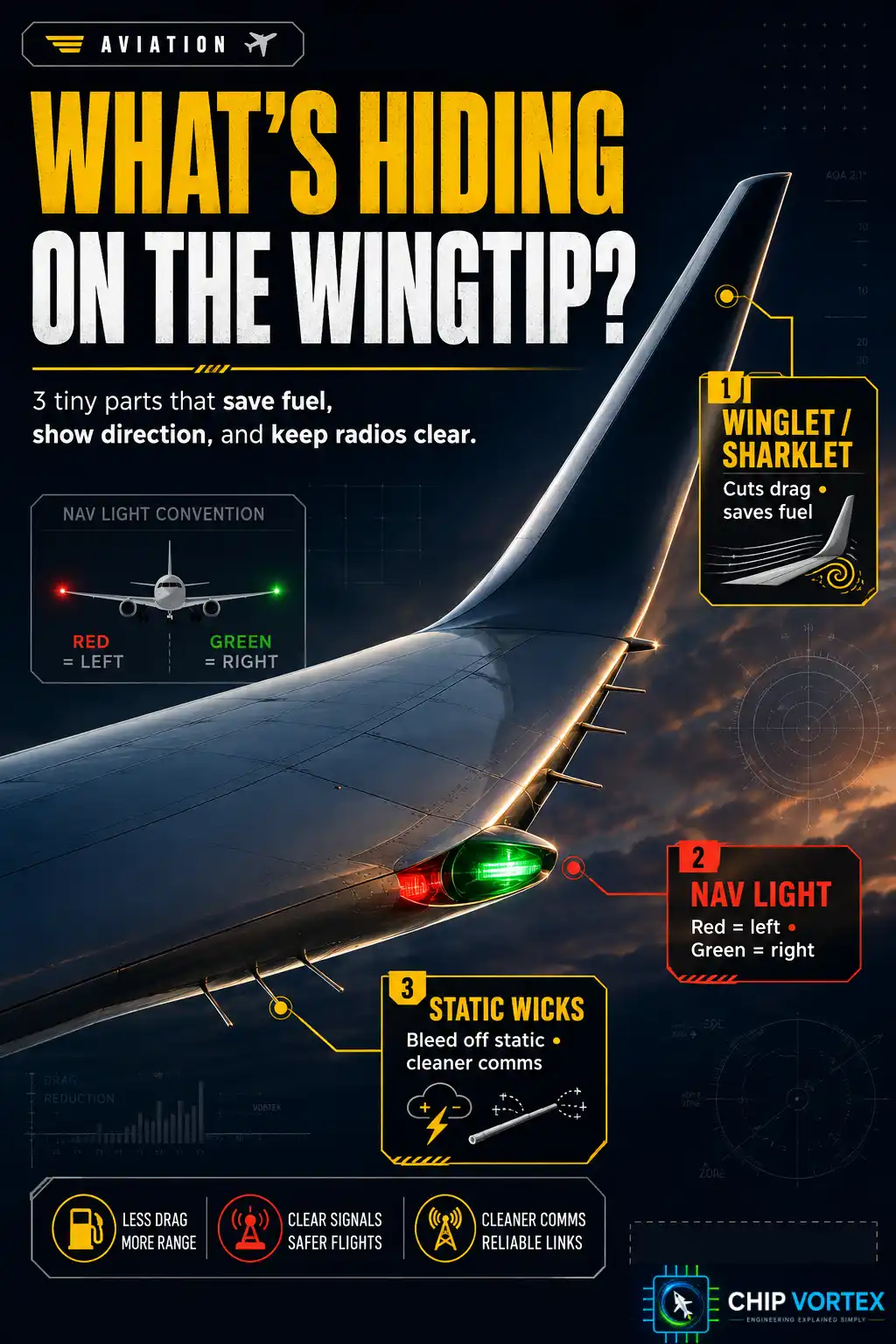
Winglet / Sharklet. That upturned fin at the tip isn’t decoration. As a wing makes lift, high-pressure air below curls around the tip toward the low pressure above, forming a swirling vortex that drags the aircraft backward. The winglet blocks and weakens that swirl, cutting induced drag and saving a meaningful percentage of fuel on every flight. Spotting tip: “Sharklet” is Airbus’s name for theirs; Boeing calls them winglets — same physics, different branding.
Navigation light. The wingtip light — red on the left tip, green on the right — tells other aircraft which way you’re pointing at night. Sailors will recognize the convention; aviation borrowed it from the sea.
Static wicks. Those thin rods trailing off the wingtip and rear edges are static dischargers. An aircraft rubbing through air and precipitation builds static charge, and that charge crackles into the radios. The wicks bleed it quietly overboard, keeping communication clean. Count them next flight — they’re everywhere once you notice.
The Leading Edge
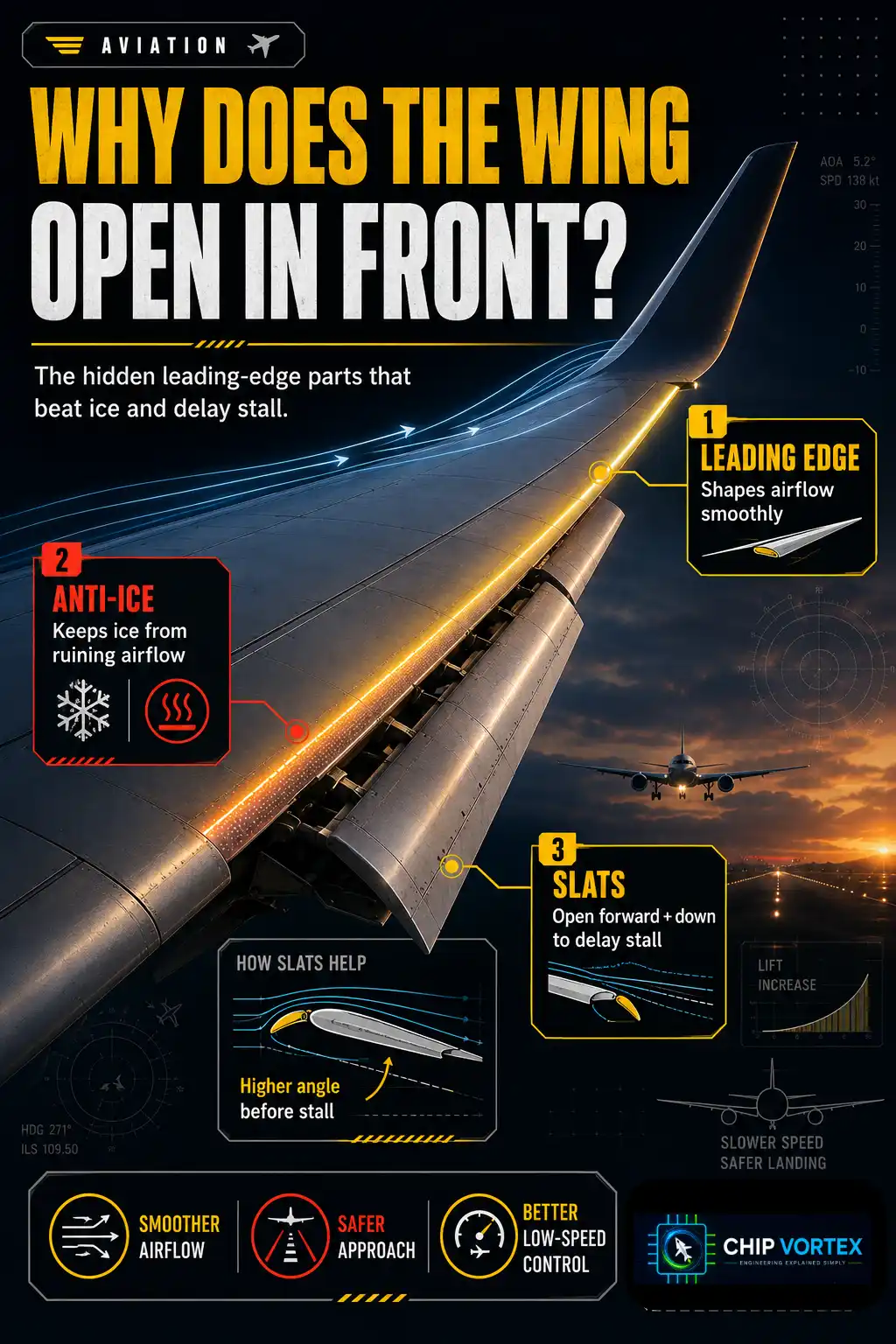
The leading edge itself is the wing’s front door — shaped to meet the air smoothly, and on many aircraft heated or protected against ice, because ice on this edge ruins the airflow everything else depends on.
Slats — “flaps, but in front.” The casual definition is honestly not bad. Slats are panels that slide forward and down from the leading edge, opening the wing’s shape so it can reach a higher angle of attack before the airflow gives up and the wing stalls. As we covered in our air data systems guide, a wing always stalls at its critical angle of attack — slats push that limit further out, which is what lets a 70-ton jet fly slowly and safely on approach.
The Trailing Edge
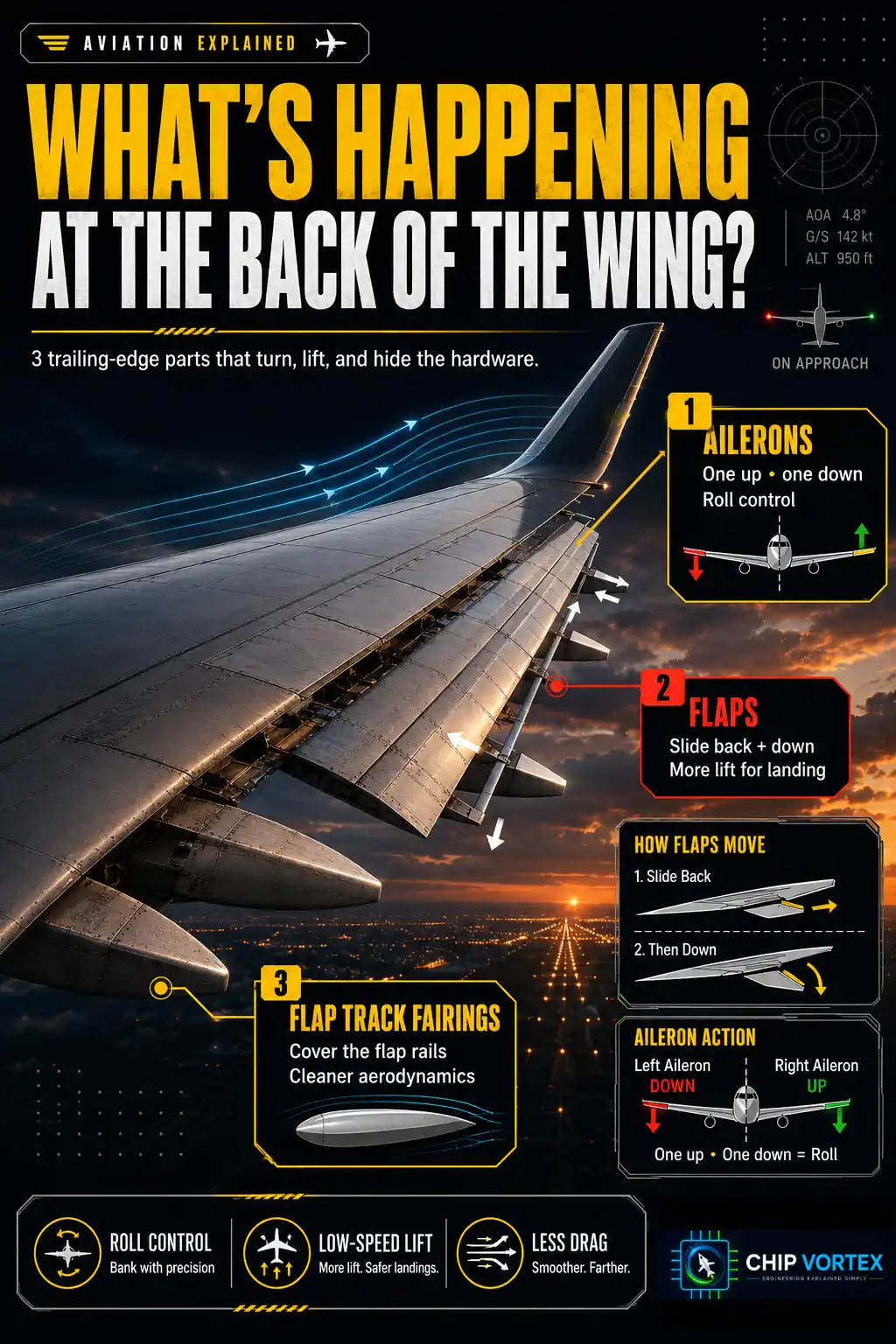
Ailerons. Out near the tip, these small panels move in opposition — one up, one down — rolling the aircraft into and out of turns. When your side of the wing dips as the aircraft banks, the aileron did that.
Flaps (inner and outer). The stars of the landing show. Modern airliner flaps don’t just hinge downward — they slide backward and then down, growing the wing’s area and deepening its curve at the same time. More area plus more camber equals lift at low speed, which is exactly what takeoff and landing demand. They extend in stages, which is why you hear and feel several distinct clunks on approach rather than one.
Flap track fairings. Those canoe-shaped pods hanging under the wing puzzle more passengers than any other part. They’re aerodynamic covers over the rails and carriages the flaps ride on — the machinery has to live somewhere, and a smooth canoe drags far less than exposed mechanism. Mystery solved: they’re the flap system’s garages.
The Top Surface
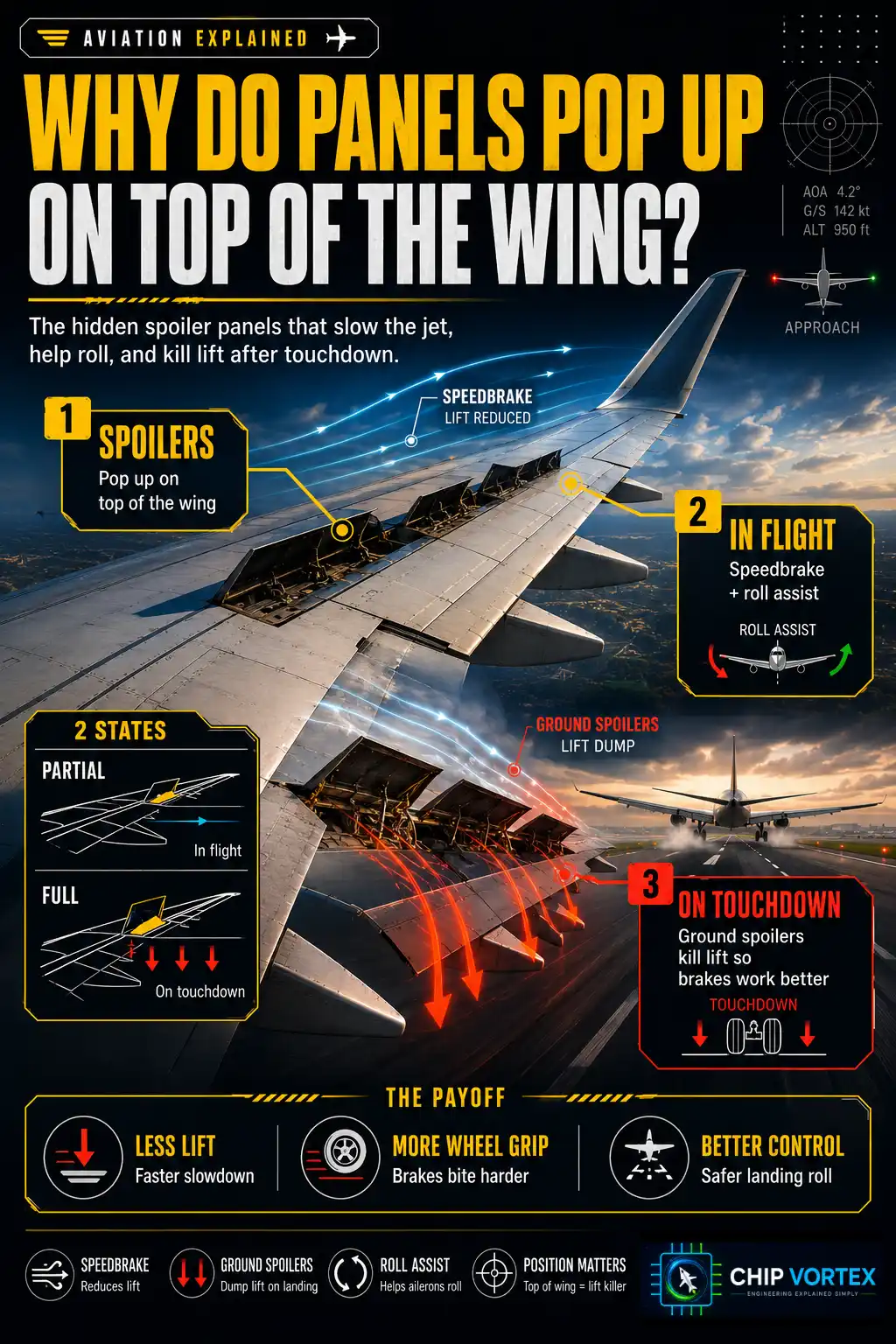
Spoilers. The rectangular panels laid flat on top of the wing are the multi-tools of flight. Raised partially in flight, they act as speedbrakes and help the ailerons roll the aircraft. Raised fully on touchdown — that dramatic snap you see the instant the wheels hit — they become ground spoilers, destroying the wing’s lift on purpose. That’s not the plane braking with the wing; it’s the wing dumping the aircraft’s weight onto the wheels so the brakes can actually work. Lift is wonderful right up until you want to stop.
The Movers Behind It All
Hydraulics. Slats, flaps, spoilers, landing gear, brakes — nearly everything that moves is driven by hydraulic pressure, delivered by multiple independent systems so no single failure freezes the wing. When the flaps deploy and you glimpse the exposed actuators and plumbing inside, you’re looking at the muscle of the aircraft. (It deserves its own deep dive — coming soon in our Aircraft Systems Series.)
Pylons. The structures that hang the engines beneath the wing. A pylon is far more than a bracket — it carries the engine’s thrust into the wing structure, feeds fuel across, and is engineered to behave predictably even in extreme failure cases. The wing lifts; the pylon delivers the push.
Watch the Wing on Your Next Flight
Now turn the knowledge into a show. On takeoff: slats and flaps are already out before the roll begins; after liftoff, listen for the whirs as they retract in stages while the aircraft accelerates — the wing literally changing shape for cruise. On landing: the sequence runs in reverse — slats first, flaps stepping out stage by stage, maybe the spoilers rising partially as speedbrakes on descent — and then the finale, ground spoilers snapping full upright at touchdown. Window seat, just behind the wing, is the best seat in science.
FAQ: Airplane Wing Parts
What are the panels that rise up when a plane lands?▾
Ground spoilers. They deploy the instant the wheels touch to destroy the wing’s lift, planting the aircraft’s weight on the wheels so the brakes can grip effectively.
Why do airplane wingtips curve upward?▾
Those are winglets (Airbus calls theirs Sharklets). They weaken the drag-producing vortex that spills around the wingtip, cutting fuel burn on every flight.
What are the canoe-shaped pods under the wing?▾
Flap track fairings — streamlined covers over the rails and rollers the flaps slide on. Machinery inside, aerodynamics outside.
What’s the difference between flaps and slats?▾
Both help the wing fly slowly, from opposite ends: flaps extend from the trailing edge (more area and curve), slats from the leading edge (more usable angle of attack before stall). On approach, they work as a team.
Is it normal for the wing to flex and bounce in flight?▾
Completely — it’s designed to. A flexing wing is absorbing turbulence like a spring instead of fighting it rigidly; test aircraft wings are bent to extraordinary angles before certification. Flex is what strength looks like.
Next flight, take the window seat just behind the wing and watch the whole performance with new eyes — then come back and tell us in the comments which part you spotted first. Save the labeled photo for the flight, and continue into the machinery with our Aircraft Systems Series: the Navigation System and Air Data Systems.