
Compressed air is the workshop’s third utility — after electricity and water — and it’s the only one most people plumb themselves. Every pneumatic system, from a garage compressor line to a factory’s air network, is built from a small vocabulary of fittings; choose them well and the system runs silent and tight, choose them wrong and you get the hiss that quietly runs your compressor all night. This guide covers all 24 fittings — what each one does, when to reach for it, and the thread trap that causes most leaks.

Save the chart, then let’s decode the system behind it.
First: How Push-to-Connect Actually Works

Almost every fitting in this chart has that blue ring — the collet. Push a cleanly cut tube in, and spring-loaded teeth inside grip it while an O-ring seals around it: done, no tools. To release, press the collet flat against the fitting body and pull the tube out. That’s the entire trick behind “push-in,” “push-to-connect,” and “one-touch” — three names for the same technology. Every fitting then has up to two kinds of ends: a thread side (screws into equipment) and a tube side (the collet). Read any fitting as what threads in, what pushes in, and which way the air turns — and the whole chart opens up.
Quick Reference: The Six Families
| Family | Fittings | Job |
|---|---|---|
| Straights | Union male/female, push-in, bulkhead, reducer | Connect in a line |
| Elbows | Male/female, extended, hex compact, union L | Turn corners, relieve strain |
| Tees & Ys | Branch/run tees, Y types, reducer versions | Split or join flow |
| Multi-way | Cross 4-way, triple-branch 5-way | Feed many lines from one |
| Flow control | Speed controllers, hand valve | Manage speed and isolation |
| Silencers | Brass, plastic | Quiet the exhaust |
Straight Connectors
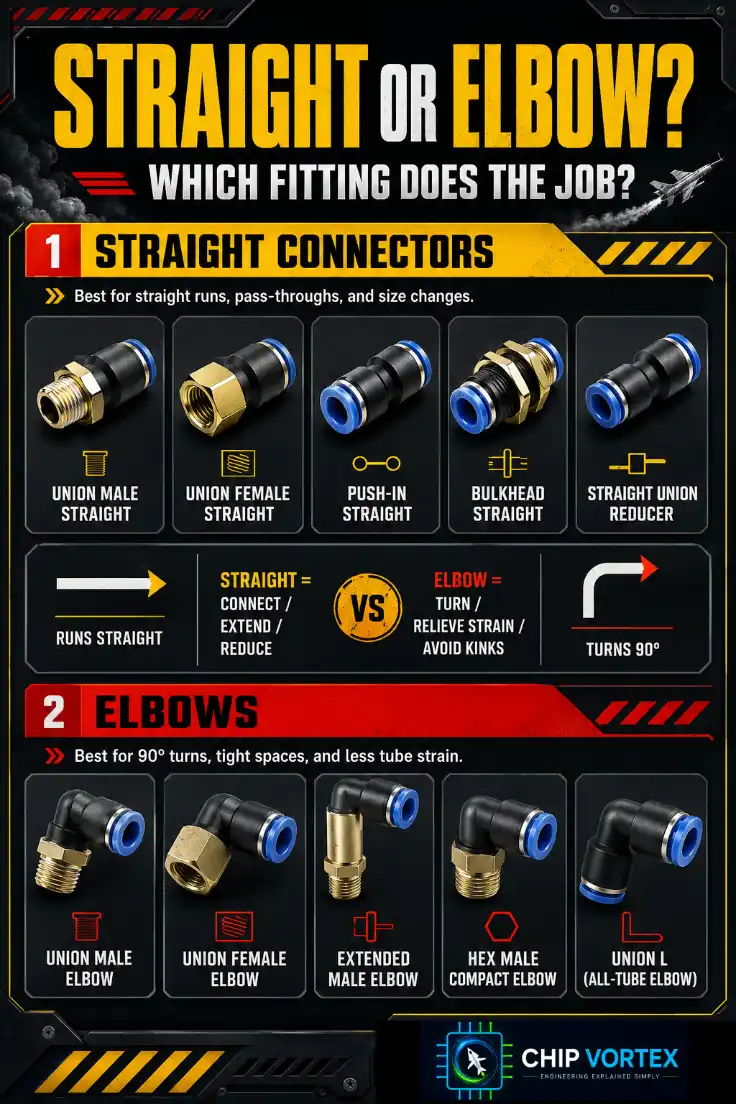
Union Male Straight — male thread on one end, collet on the other: the workhorse that connects tube to any threaded port (compressor outlets, valve bodies, cylinder ports). Union Female Straight — the same idea with a female thread, for mating onto male-threaded equipment. Push-In Straight — collets on both ends: pure tube-to-tube union, the fitting that rescues a cut or extends a run in seconds. Bulkhead Straight — the through-the-wall specialist: it mounts through a panel with a locknut, so air can pass cleanly through an enclosure, cabinet, or workbench top. Straight Union Reducer — collets of two different sizes, stepping a main line down to a smaller branch line without adapters.
Elbows
Elbows aren’t just for corners — they relieve strain, letting tubing exit a port at 90° instead of bending tightly and kinking. Union Male Elbow and Union Female Elbow put a swiveling collet at right angles to a thread. The Extended Male Elbow (the pin’s “lengthen” fitting) adds body length to reach past obstructions — recessed ports, crowded manifolds. The Hex Male Compact Elbow trades reach for a wrench-friendly hex body in tight spots. And the Union L (all-tube elbow) turns a corner between two tubes with no threads at all.
Tees and Ys — and the Difference the Labels Hide

Here’s a distinction worth learning properly, because the chart’s two “tee male 3-way” cells are actually two different fittings. A Male Branch Tee has its thread on the branch — the perpendicular leg — with tube runs passing straight through: air tees off sideways from a line into a port. A Male Run Tee has its thread on the run — one end of the straight-through path — so the line ends at a port while a tube branches off sideways. Same three openings, opposite flow logic; pick by where the equipment sits. Their all-tube sibling, the Push-In Tee, splits tube to two more tubes.
The Y fittings — Y-Type Male, Y One-Touch (all-tube), and their reducer versions (as with the Tee Reducer, mixing collet sizes) — do the same splitting job with a gentler geometry: air divides along a smooth fork instead of slamming into a 90° wall, which means less turbulence and less pressure drop. Rule of thumb: T when geometry demands it, Y when flow matters.
Multi-Way Manifolds
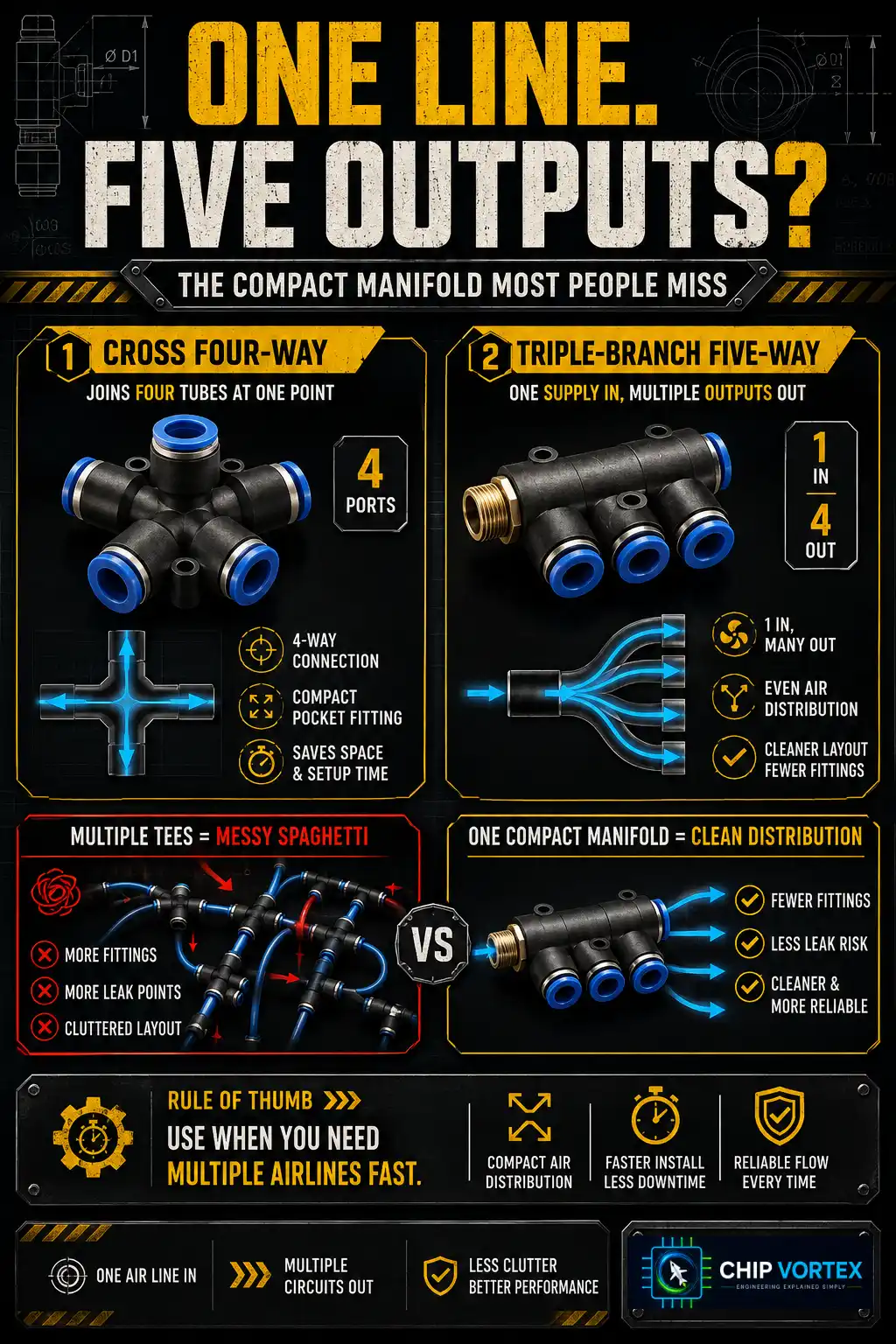
The Cross Four-Way joins four tubes at one point; the Triple-Branch Five-Way takes one supply and fans it out to multiple outputs in a single body. These are pocket manifolds — one airline in, several circuits out — and they keep a multi-tool bench or a multi-cylinder machine from becoming a spaghetti of separate tees.
Flow Control: Where Air Gets Manners
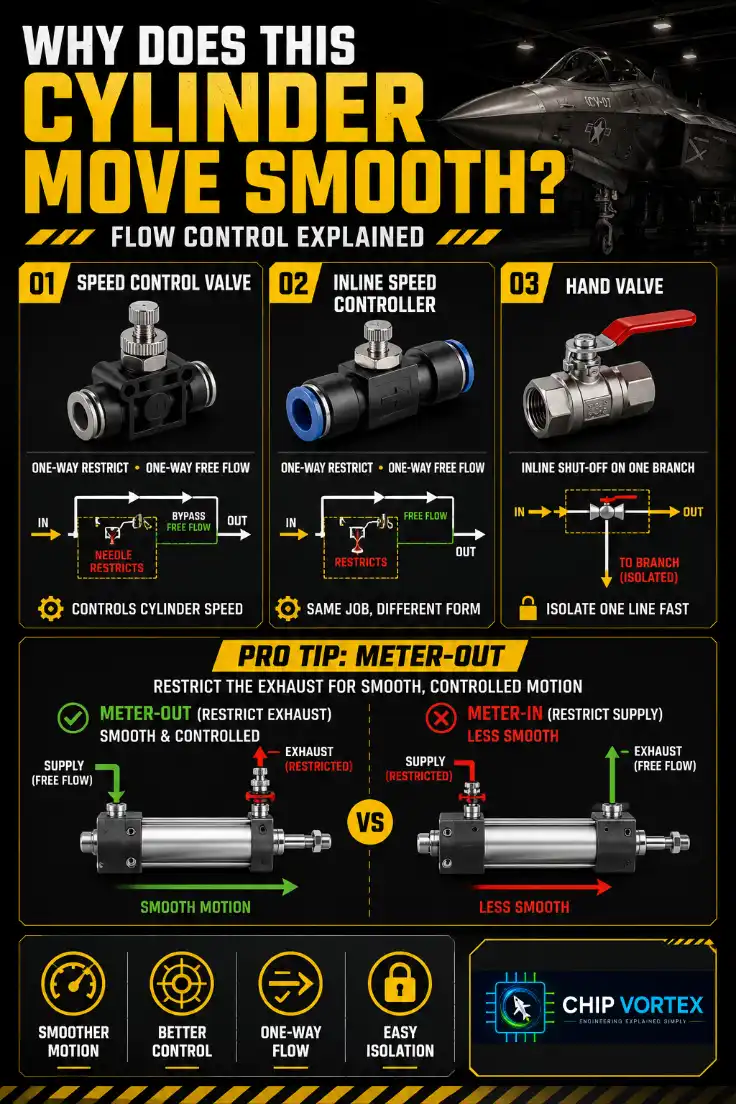
The Speed Control Valve (cylinder-mount style) and the Inline Push-In Speed Controller do the same beautiful thing: a needle valve restricts flow in one direction while a bypass lets it flow free the other way — which is how you control how fast a pneumatic cylinder strokes. The professional trick is meter-out: restrict the exhaust air leaving the cylinder rather than the supply entering it, and the motion becomes smooth and controlled instead of jerky, because the cylinder always works against a cushion. The Hand Valve is simpler manners: an inline shut-off that isolates one branch so you can work on it without draining the whole system.
Silencers: The Courtesy Fittings

Every time a valve exhausts, compressed air escapes at a scream. Thread a Brass Sintered Silencer or a Plastic Silencer into the exhaust port and that blast diffuses through thousands of tiny passages into a hiss. Brass sintered versions take more heat and abuse; plastic ones are cheap and light. One maintenance truth for both: those tiny passages clog with oil and dust over time, and a clogged silencer back-pressures the valve — if a machine slows down mysteriously, check the silencer first.
The Thread Trap: NPT vs BSPT vs BSPP
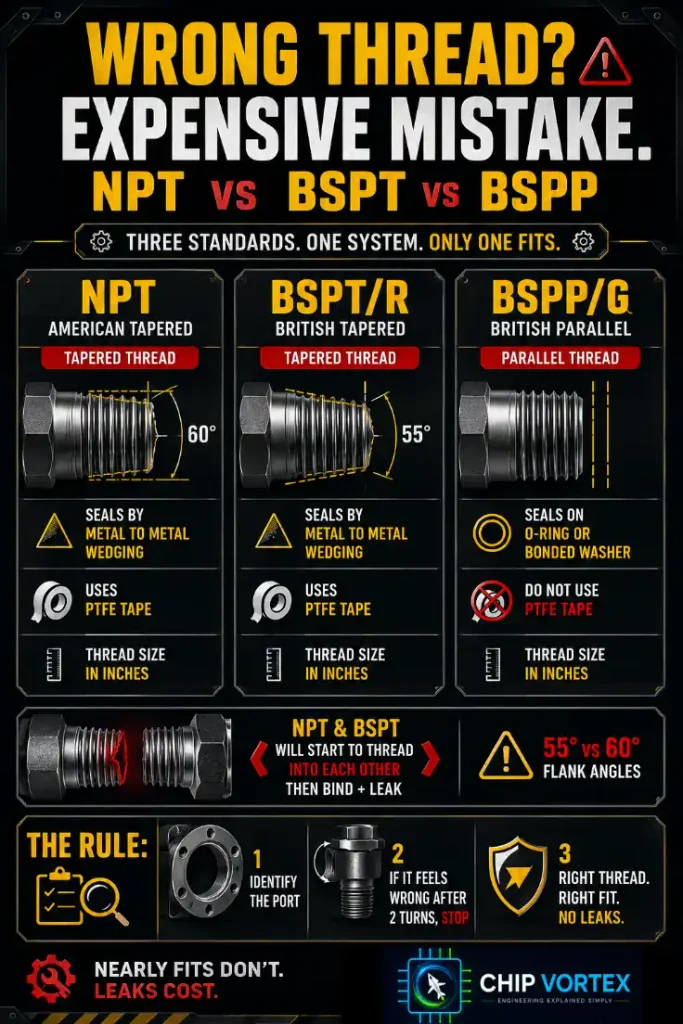
More pneumatic leaks come from threads than from tubes — because there are three standards pretending to be each other. NPT (American, tapered — threads marked in inches), BSPT/R (British tapered), and BSPP/G (British parallel). Tapered threads seal by wedging metal against metal — that’s what PTFE tape is for. Parallel (G) threads never seal on the threads at all; they seal on a bonded washer or O-ring at the shoulder, and no amount of tape will fix one forced into the wrong port. NPT and BSPT will even start threading into each other — 55° vs 60° flank angles — before binding and leaking forever. The rule: identify the port before buying the fitting, and if it feels wrong after two turns, stop. Nothing in a pneumatic system wastes more money than a “nearly fits.”
The Aviation Corner
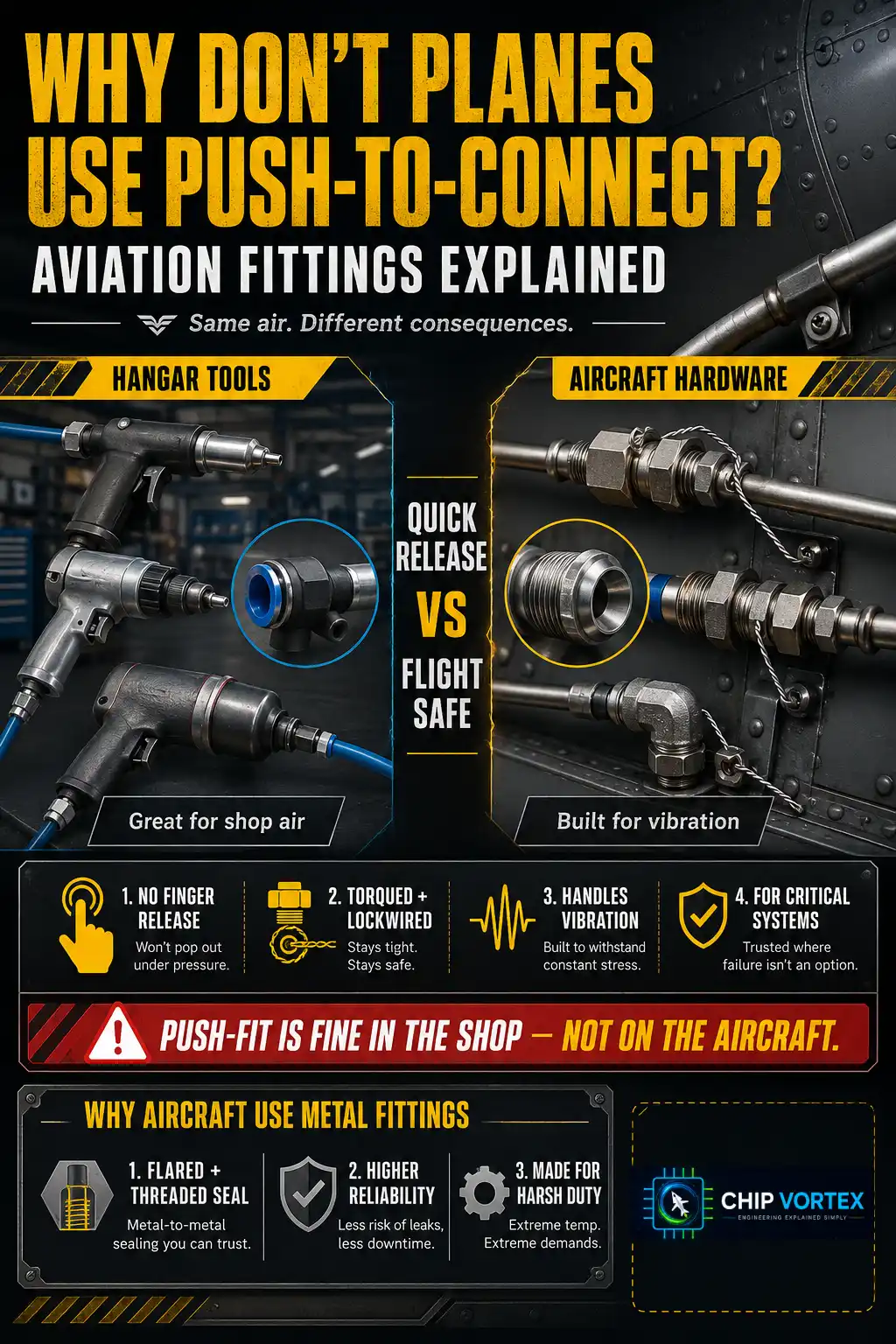
Walk into any hangar and pneumatics is the sound of work: rivet guns, pneumatic drills, impact wrenches — an AME’s hands run on shop air, plumbed through exactly the fittings above. But look at the aircraft itself and the push-fit collet vanishes: airframe plumbing uses flared and threaded metal fittings (AN/MS standards), torqued and lockwired, because a fitting that releases with a finger-press has no business on a machine that vibrates for 60,000 flight hours. It’s a perfect lesson in engineering context — the same physics, two different consequence levels, two different connection philosophies. And the aircraft’s own giant pneumatic network — bleed air at 200°C — plays by rules we covered in the aircraft pneumatic system guide.
FAQ: Pneumatic Fittings
How do I release a tube from a push-to-connect fitting?▾
Press the blue collet flat against the fitting body and hold it there while pulling the tube straight out. Pulling without pressing only makes the teeth grip harder.
What’s the difference between a branch tee and a run tee?▾
Location of the thread. Branch tee: thread on the perpendicular leg, tube passes straight through. Run tee: thread on one end of the straight path, tube branches sideways. Choose by where the threaded port physically sits.
Why use a Y fitting instead of a tee?▾
Flow. A Y divides air along a smooth fork; a tee forces it into a 90° turn, creating turbulence and pressure drop. Where cylinder speed or flow balance matters, the Y wins.
Can I mix NPT and BSPT fittings?▾
No. They’ll start threading together — then bind, cross-thread, and leak permanently. The flank angles differ (60° vs 55°). Identify your port standard first; tape can’t rescue a mismatch.
Why is my fitting hissing?▾
The usual suspects, in order: tube not cut square, a scratched or ovaled tube end, a worn collet O-ring, or the wrong thread standard forced in. Re-cut the tube square with a proper tube cutter before blaming the fitting — and remember every small hiss is your compressor’s duty cycle, on your electricity bill.
What’s the one fitting your workshop couldn’t run without — and what’s the leak that took you longest to find? Tell us in the comments. Save the chart for your next air-line build, and keep exploring: how an aircraft’s pneumatic system does all this at 200°C, and why every thread in this guide traces back to the fastener logic that holds machines together.