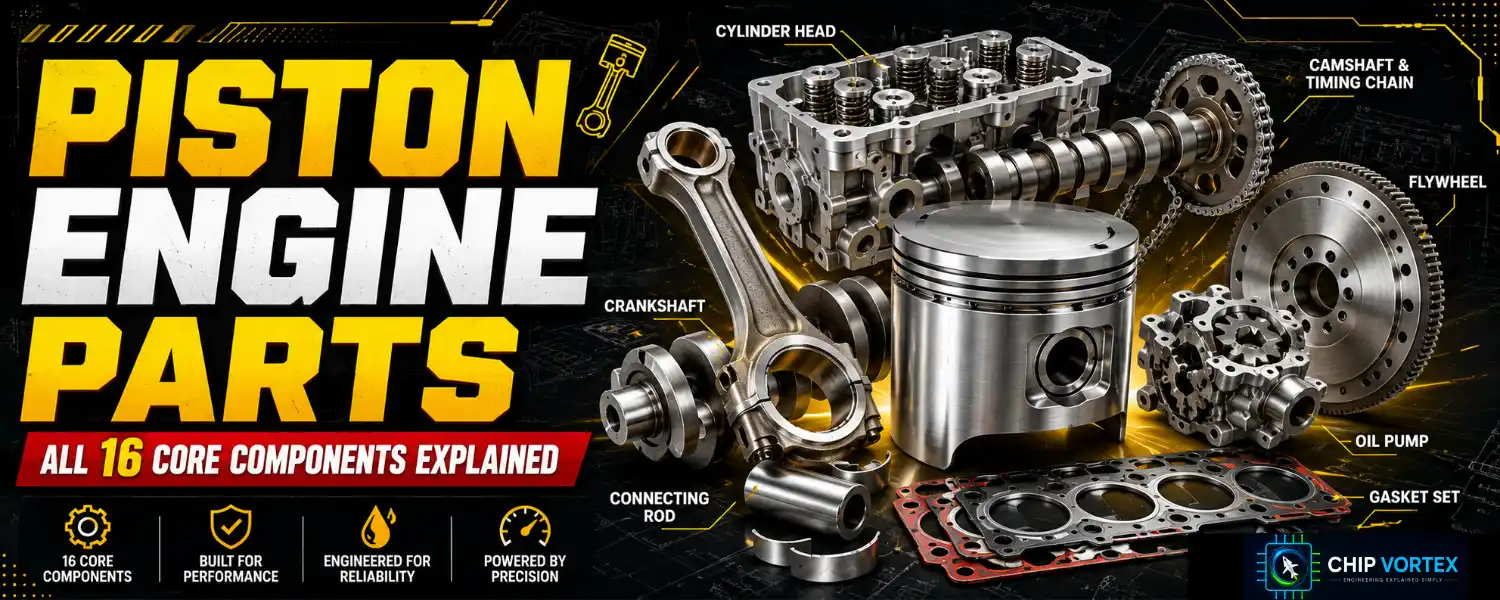
Know your engine, power your knowledge. A piston engine — whether it’s in your car or bolted to the nose of a training aircraft — is a few dozen simple parts, each with exactly one job, choreographed so precisely that together they turn thousands of explosions a minute into smooth, usable power. Here are the 16 core components: what each one looks like, what it does, and then the dance they all perform together.
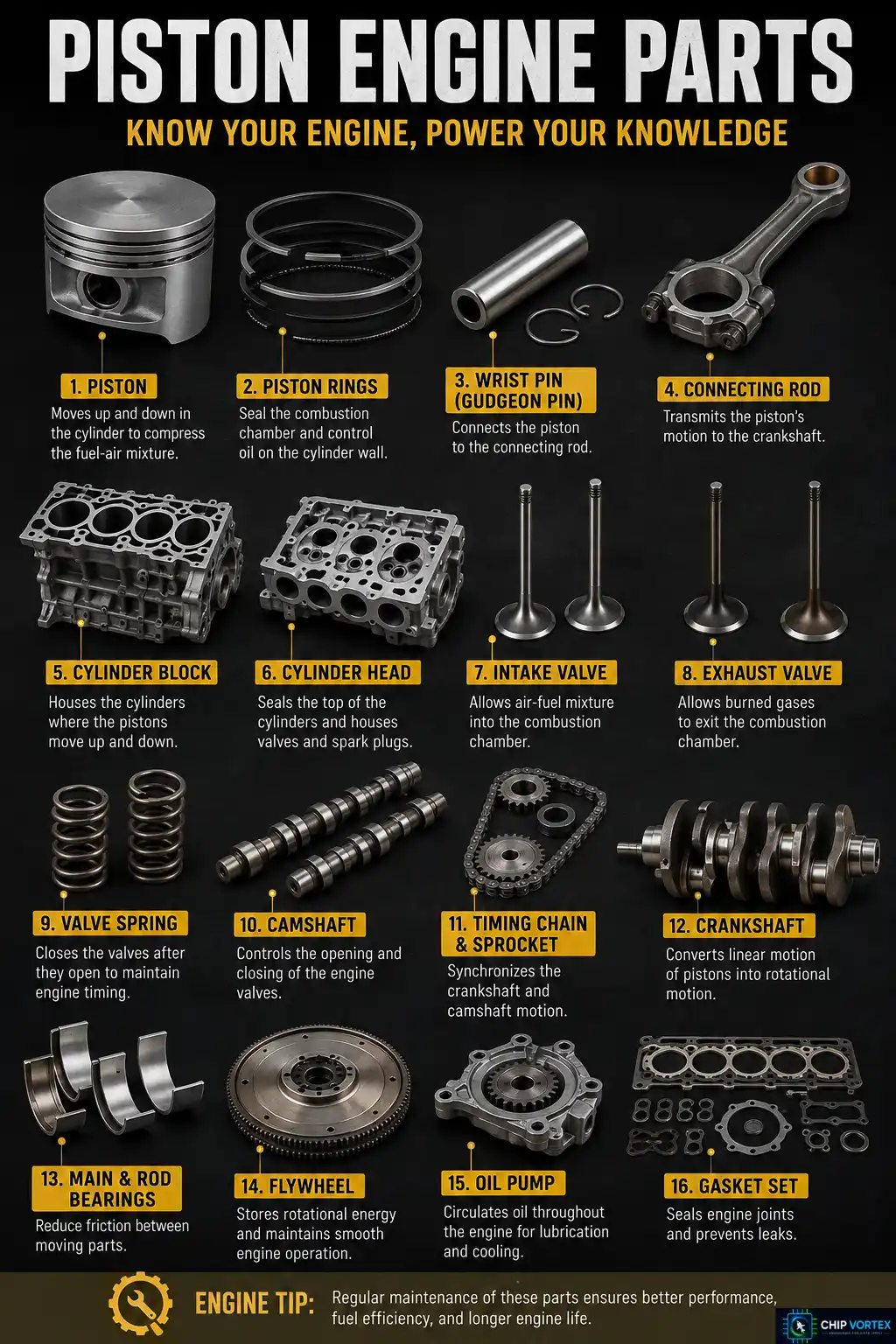
Save the chart for the workshop, then let’s meet the cast in order.
The Piston Assembly (1–4)
1. Piston
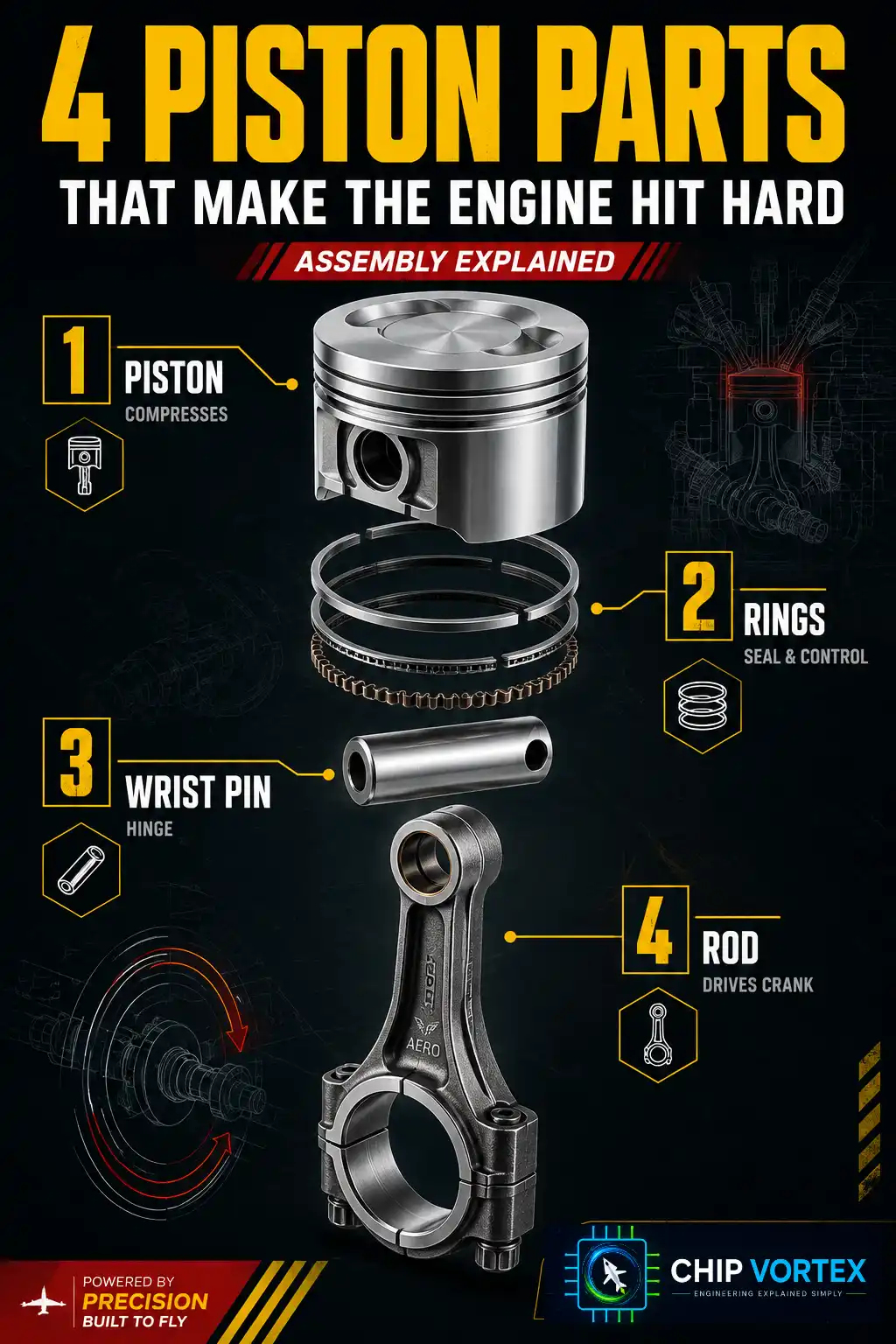
The fist of the engine. The piston slides up and down its cylinder, compressing the fuel-air mixture on the way up and taking the full force of combustion on the way down — thousands of times per minute, at temperatures and pressures that would destroy most machines. Everything else in the engine exists either to feed this punch or to catch it.
2. Piston Rings
The piston never actually touches the cylinder wall — its rings do. Two or three springy metal rings sit in grooves around each piston: the upper compression rings seal combustion pressure above the piston, and the lower oil control ring scrapes the cylinder wall so oil lubricates without burning. When rings wear, both jobs fail at once — compression leaks past (blow-by) and oil sneaks up into the chamber, which is exactly the story a wet, oil-fouled plug tells in our spark plug reading guide.
3. Wrist Pin (Gudgeon Pin)
The hinge of the whole assembly: a short, hardened steel tube joining the piston to its connecting rod, secured by circlips. It looks trivial and carries brutal loads through every single stroke. Two names, one part — “wrist pin” in American workshops, “gudgeon pin” in British and aviation maintenance manuals, so an aircraft engineer meets both on day one.
4. Connecting Rod
The translator. The rod’s small end holds the wrist pin; its big end clamps around a crankshaft journal — and between them it converts the piston’s straight-line punches into the crankshaft’s rotation. Rods live in a violent world of reversing loads, which is why a failed one doesn’t just stop an engine; it usually exits through the side of it.
The Structure & The Doors (5–8)
5. Cylinder Block
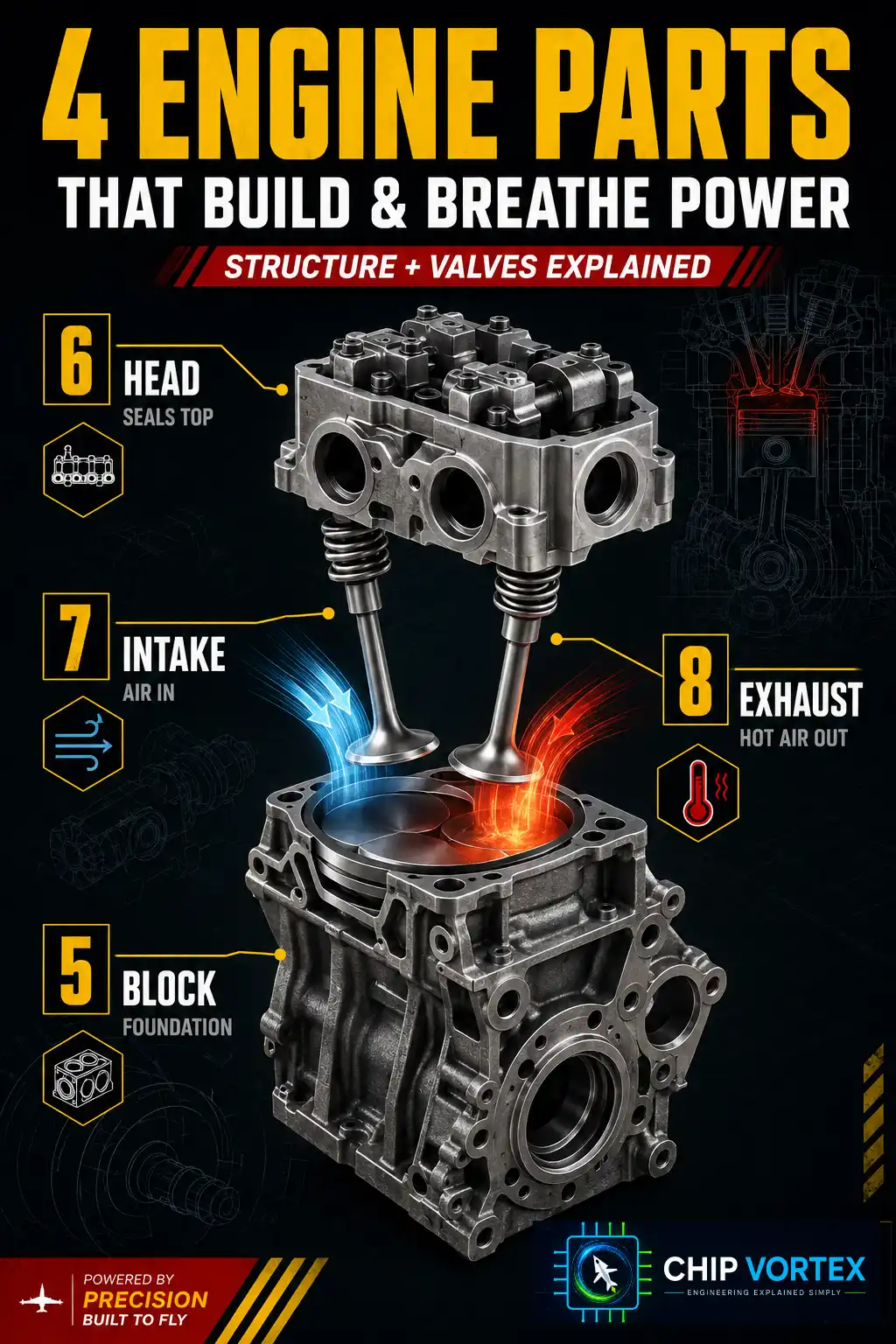
The foundation — the massive casting that houses the cylinders where the pistons run, carries the crankshaft along its bottom, and routes coolant and oil through its internal passages. Every other component on this chart bolts to, into, or onto the block.
6. Cylinder Head
The engine’s intricate upper half: it seals the tops of the cylinders to form the combustion chambers and houses the valves, their springs, the camshafts — and the spark plugs, whose deposits record everything that happens inside those chambers. Air arrives here (through the intake manifold — where a turbocharger’s boost is delivered on forced-induction engines) and leaves here as exhaust.
7. Intake Valve
One of the engine’s two doors. The intake valve opens to admit the fuel-air mixture into the combustion chamber, then seals shut against full combustion pressure. Intake valves get a constant cool wash of incoming charge — the easy job, relatively speaking.
8. Exhaust Valve
The other door — and the one with the hard life. It opens into a blast of freshly burned gases and runs far hotter than its intake sibling, glowing dull red in normal operation. It’s why exhaust valves get exotic materials and clever cooling — including, in many aircraft engines, hollow stems filled with sodium that sloshes heat away from the valve head. A part the size of a flower, engineered like a turbine blade.
The Timekeepers & The Spine (9–12)
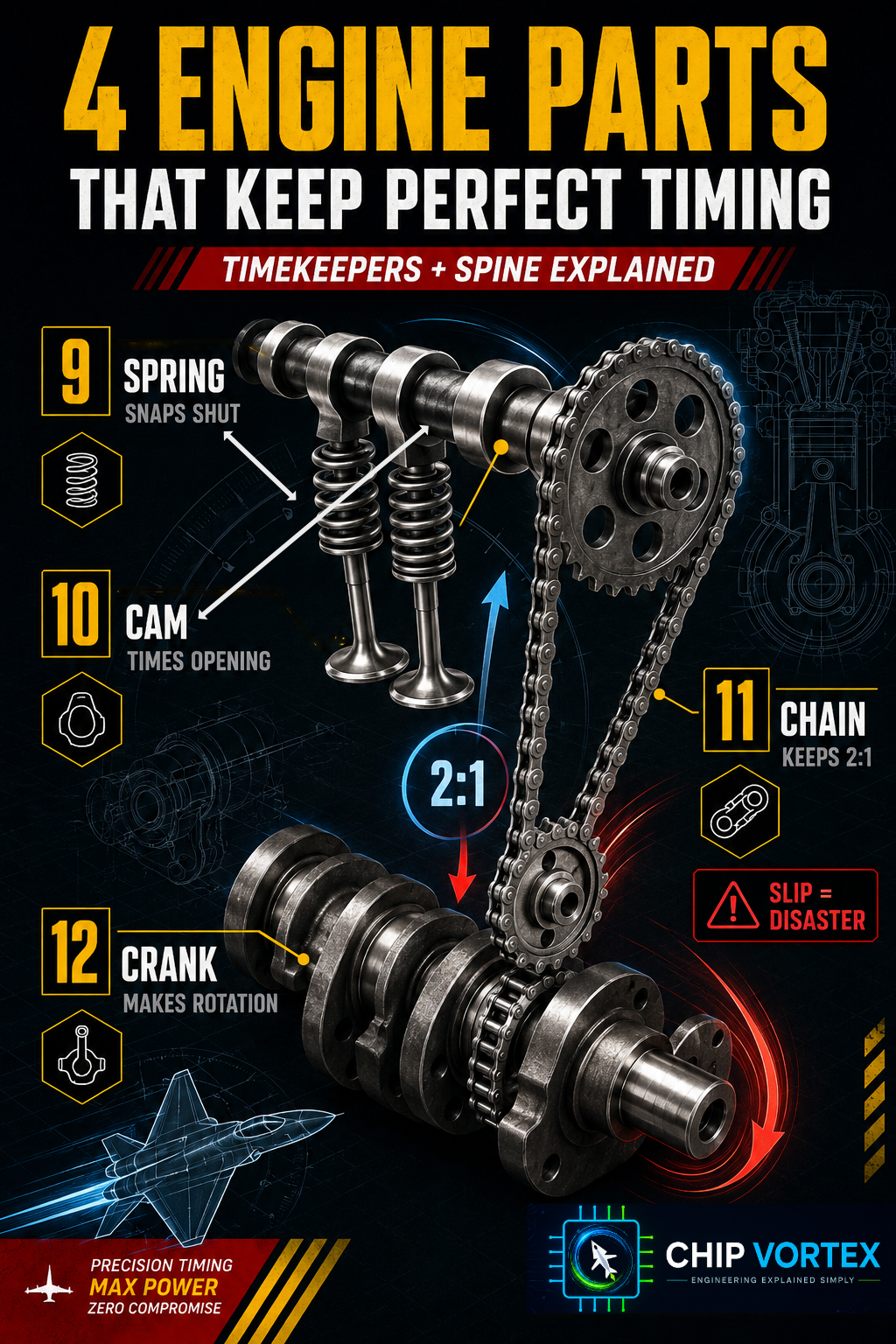
9. Valve Spring
The springs snap the valves shut the instant their cam lobes release them, and hold them sealed against combustion pressure. At high rpm they fight a resonance called spring surge — the reason performance and aircraft engines use the variable-pitch and dual-spring designs we covered in the types of springs guide. A valve that closes late meets a rising piston; the spring’s whole job is making sure that never happens.
10. Camshaft
The choreographer. Egg-shaped lobes along the camshaft press each valve open at exactly the right moment and hold it open exactly long enough. The lobe profiles literally are the engine’s personality — mild lobes for smooth economy, aggressive lobes for top-end power.
11. Timing Chain & Sprocket
The link between the crankshaft and camshaft, and keeper of the engine’s most sacred ratio: the cam sprocket has twice the teeth of the crank sprocket, so the camshaft turns at exactly half crankshaft speed — because each valve opens once per two crank revolutions in a four-stroke engine. If this chain ever slips a tooth, valves and pistons stop taking turns and start colliding. The tensioner exists so it never does.
12. Crankshaft
The spine and the output. Its offset journals catch every connecting rod’s downward blow and convert the assault into rotation — the one spinning shaft through which everything the engine produces must leave. Forged, balanced, and counterweighted, it’s usually the single most expensive part on this chart.
The Support Crew (13–16)
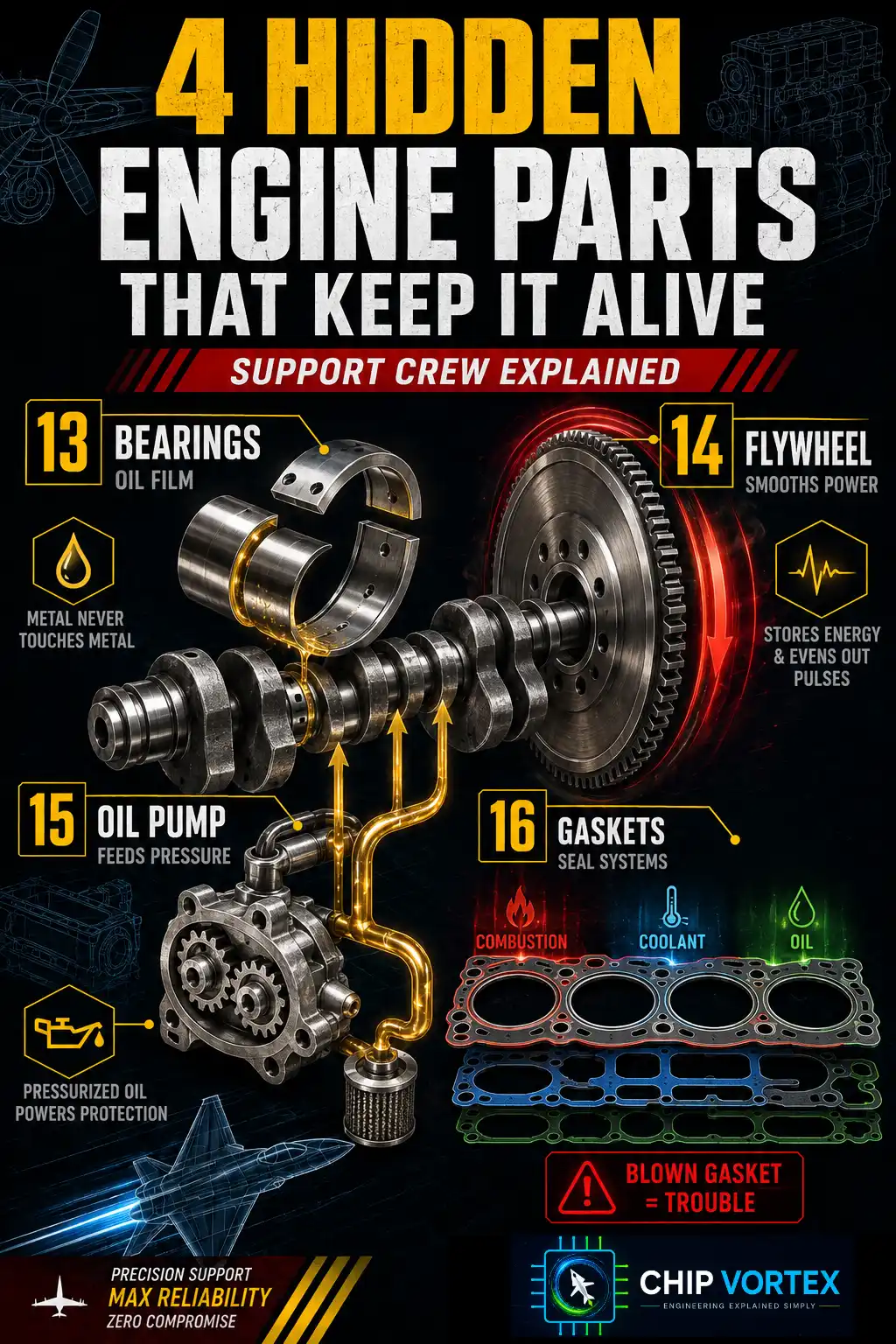
13. Main & Rod Bearings
The quiet heroes. These soft-alloy shell bearings cradle the crankshaft in the block (mains) and connect the rods to its journals (rod bearings) — and here’s the secret: metal never touches metal. The bearings ride on a pressurized film of oil thinner than a human hair, and the “reading” of worn bearing shells at teardown tells engineers about the bottom end the way plug reading tells them about the top. A starved bearing that grabs its journal — the dreaded spun bearing — is an engine’s death sentence.
14. Flywheel
A heavy, precisely balanced disc on the crankshaft’s tail. Combustion arrives as separate pulses; the flywheel’s inertia banks each pulse and pays it back smoothly, turning a series of explosions into even rotation. Its ring gear is also what the starter motor grabs to wake the engine — and on manual cars, its face is where the clutch does its handshake with the gearbox.
15. Oil Pump
The heart of the bloodstream. Drawing oil from the pan below, the pump forces it under pressure through the block’s galleries to every bearing, journal, and cam lobe — building the microscopic films that make 16 metal components coexist at full fury. It cools as it lubricates. Lose oil pressure, and an engine’s life expectancy collapses from decades to minutes.
16. Gasket Set
The seals between every mating surface — valve cover, oil pan, manifolds, and the star of the set: the head gasket, which single-handedly keeps combustion pressure, coolant, and oil sealed away from each other in one thin layer between block and head. Unglamorous parts, catastrophic when they fail — which is why “blown head gasket” is the phrase no owner wants to hear.
How They Dance Together: The Four Strokes
Now run the machine. Intake: the piston slides down as the cam opens the intake valve and the mixture rushes in. Compression: both valves sealed by their springs, the piston rises, the rings hold the pressure, the head gasket holds the line. Power: the spark plug fires, combustion slams the piston down, the wrist pin and rod deliver the blow through the rings’ seal to the crankshaft, the bearings’ oil film takes the shock, and the flywheel banks the energy. Exhaust: the piston rises as the exhaust valve opens and the spent gases leave — while the timing chain has already cued everyone for the next cycle. Four strokes, two crank turns, one valve event each — repeated flawlessly, millions of times.
Same Parts, 10,000 Feet Up
Open a piston aircraft engine and you’ll recognize this entire chart: pistons, rings, gudgeon pins, valves, cams, crankshaft — the identical anatomy, doing the identical dance. What changes are the priorities: aircraft engines are typically air-cooled and horizontally opposed, drive the propeller directly, carry two independent ignition systems with two spark plugs per cylinder, and use touches like those sodium-cooled exhaust valves — because at altitude, “pull over and check it” isn’t on the menu. The engine in your car and the engine in a trainer are the same brilliant machine, tuned for two different promises.
FAQ: Piston Engine Parts
What does the head gasket actually do — and why is a blown one so feared?▾
It seals combustion pressure, coolant, and oil away from each other in one thin layer. When it fails, the three mix — which is why the symptoms are dramatic and the repair means lifting the head off the engine.
Why do engines burn oil?▾
Usually the rings or valve seals. A worn oil control ring stops scraping the cylinder wall clean, so oil rides up into the chamber and burns — announcing itself with blue-tinged smoke and wet, oil-fouled spark plugs.
What’s the difference between the crankshaft and the camshaft?▾
The crankshaft is the output — it converts piston punches into rotation. The camshaft is the scheduler — it opens and closes the valves. The timing chain locks them at exactly 2:1: the cam turns once for every two crank revolutions.
What does VTEC actually do?▾
It’s Honda’s system for switching between two cam lobe profiles — mild for efficiency at low rpm, aggressive for power up high — using an oil-pressure solenoid to make the swap mid-drive. One engine, two personalities.
Which engine parts wear out first?▾
The friction workers: piston rings and bearings over the long haul, valve gear and the timing chain with age — and the components protected by oil last exactly as long as the oil system keeps protecting them. Regular maintenance isn’t a suggestion; it’s the whole deal.
Ever had one of these apart in your hands — or is this the first time you’ve met the full cast? Tell us in the comments which part earned your respect. Save the chart, then follow the parts into their own stories: how to read spark plugs, types of springs, and the turbochargers that feed the whole show.