Every machine that spins has the same enemy: friction. Left alone, a steel shaft turning in a steel hole grinds itself to death in minutes. Bearings are engineering’s twelve different answers to that one problem — some roll, some slide, some float on oil, and one levitates on pure magnetism. Here’s every type: how it works, which loads it handles, and where it’s hiding in the machines around you.
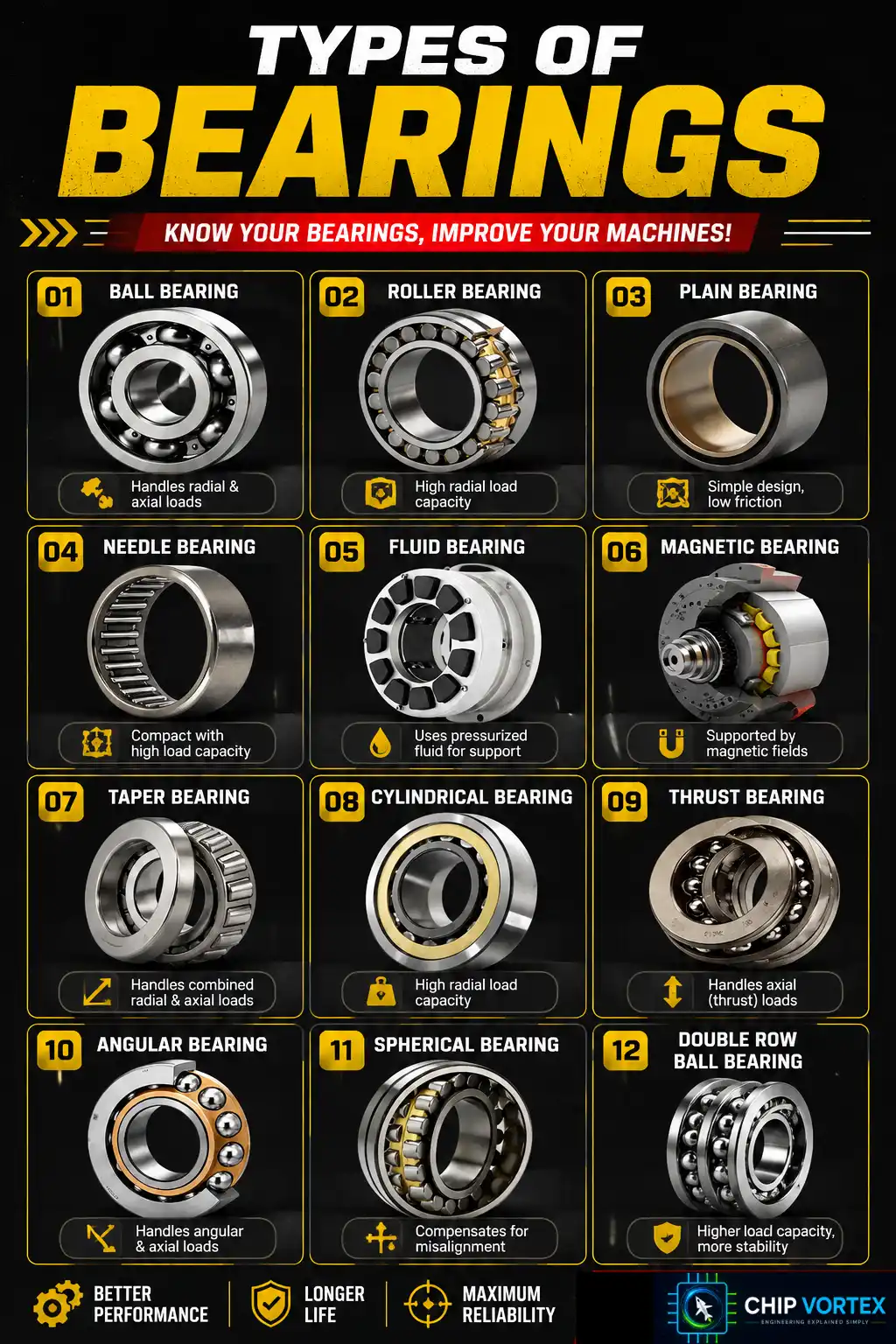
Save the chart, then let’s meet all twelve — starting with the one you’ve definitely held.
Quick Reference: All 12 Types of Bearings
| # | Bearing Type | How It Works | Best For |
|---|---|---|---|
| 1 | Ball | Balls roll between races | All-round radial + axial loads |
| 2 | Roller (family) | Rollers instead of balls — line contact | Heavier radial loads |
| 3 | Plain | Surfaces slide on a lubricant film | Simplicity, huge loads, tight budgets |
| 4 | Needle | Ultra-thin rollers | High load in minimal radial space |
| 5 | Fluid | Shaft floats on pressurized fluid | Extreme speed, zero contact |
| 6 | Magnetic | Shaft levitates in magnetic fields | No contact, no lubricant at all |
| 7 | Taper | Cone-shaped rollers | Combined radial + axial (wheels!) |
| 8 | Cylindrical | The standard roller member | Maximum radial capacity |
| 9 | Thrust | Elements arranged for axial push | Pure thrust loads |
| 10 | Angular Contact | Races offset at an angle | Radial + one-direction axial, precision |
| 11 | Spherical | Self-aligning curved outer race | Misaligned or flexing shafts |
| 12 | Double Row Ball | Two rows share the work | More capacity and stiffness |
1. Ball Bearing
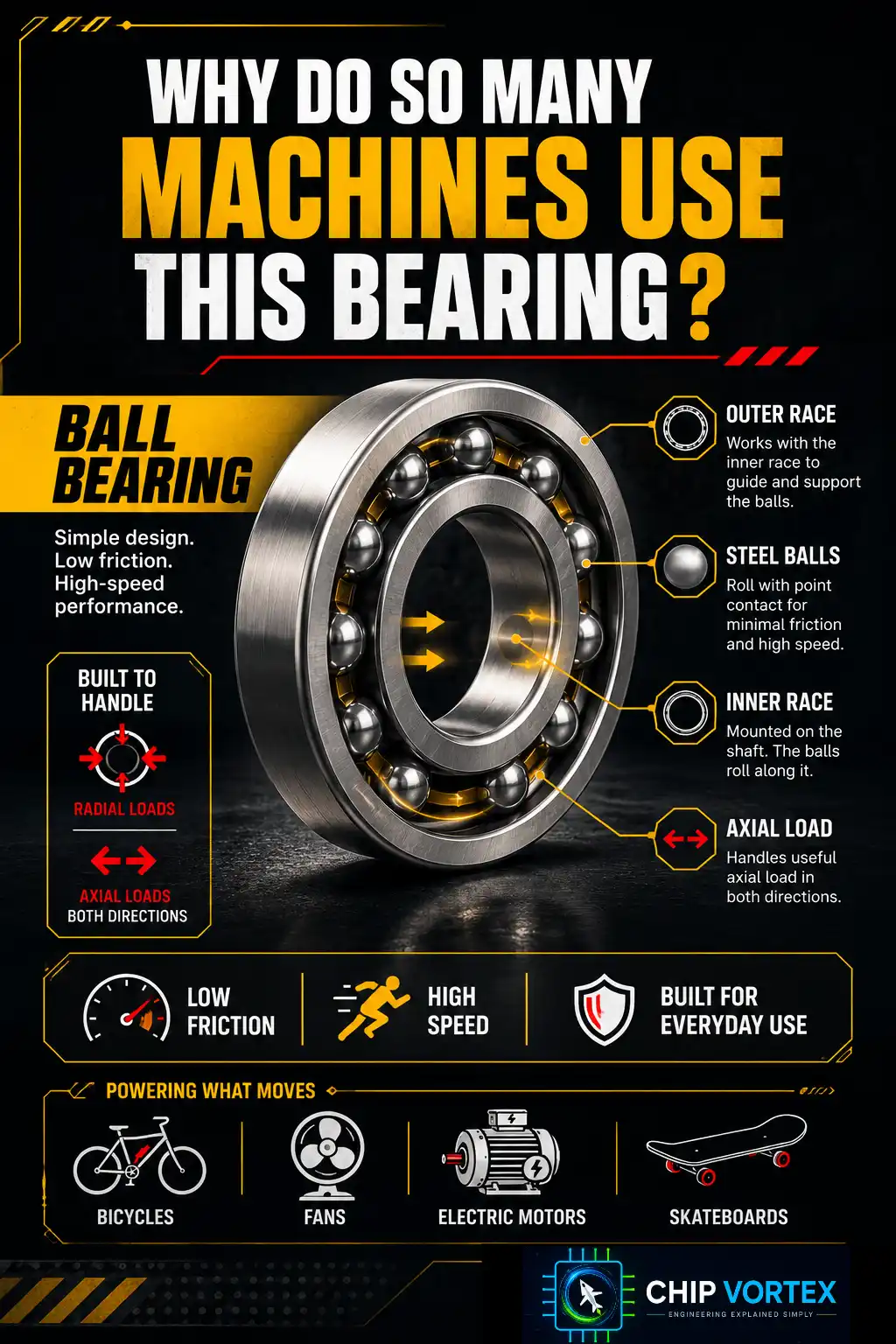
The one everybody knows — hardened steel balls rolling between an inner and outer race. Because each ball touches the races at a single point, friction is beautifully low and speeds can be high; the trade-off is that point contact limits how much load each ball can carry. Balls handle radial loads and a useful amount of axial load in both directions, which makes this the default bearing of the world: skateboards, fans, electric motors, bicycles — and, in premium form, the main shafts of jet engines.
2. Roller Bearing — Meet the Family
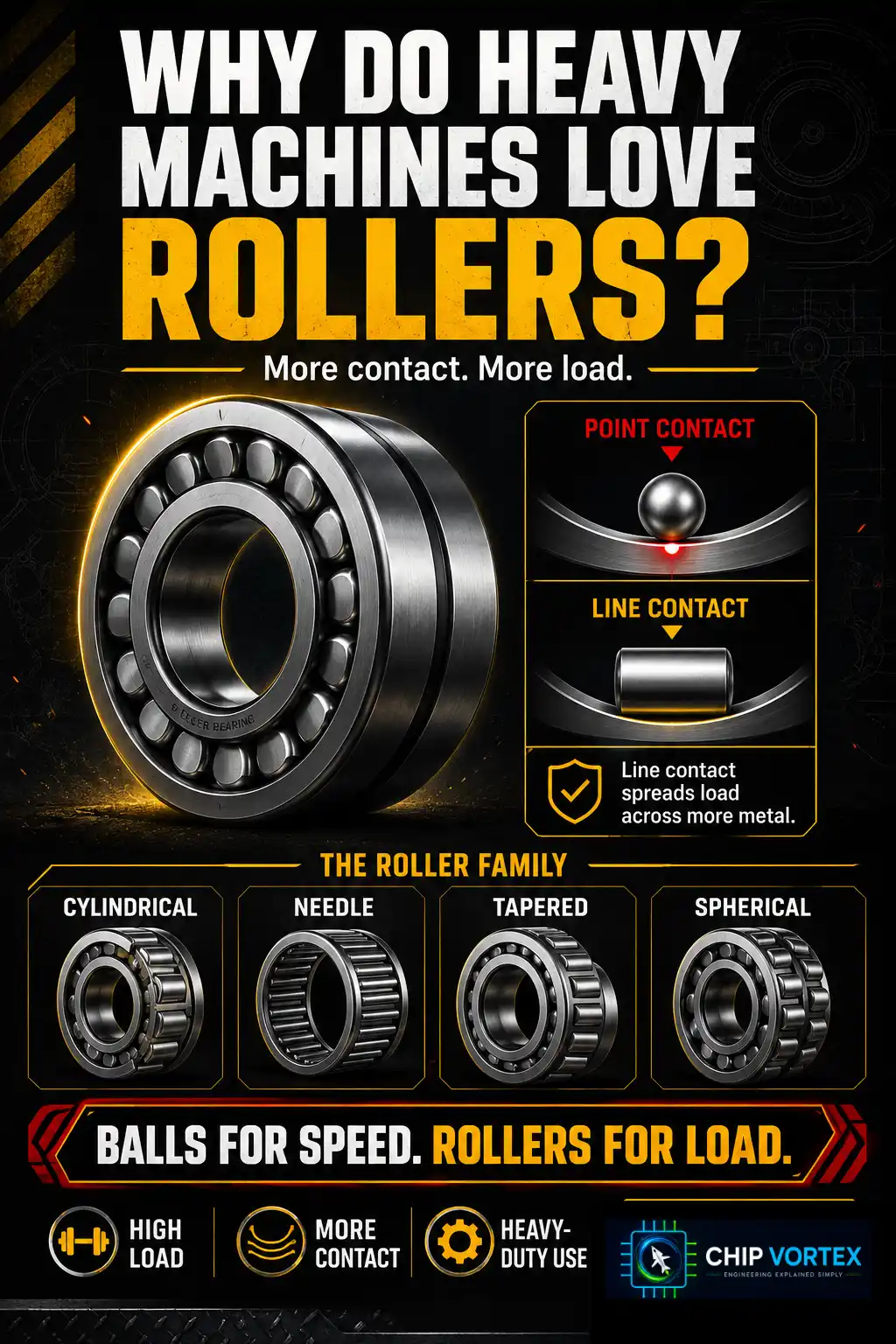
Swap the balls for rollers and everything changes: a roller touches the race along a line, not a point, spreading the load across far more metal. That’s the whole roller idea — more contact, more capacity, slightly less speed. “Roller bearing” is really a family name, and four of its members have their own cells on this chart: the cylindrical (#8), the needle (#4), the taper (#7), and the spherical (#11). Remember the family rule and the rest of the chart organizes itself: balls for speed, rollers for load.
3. Plain Bearing
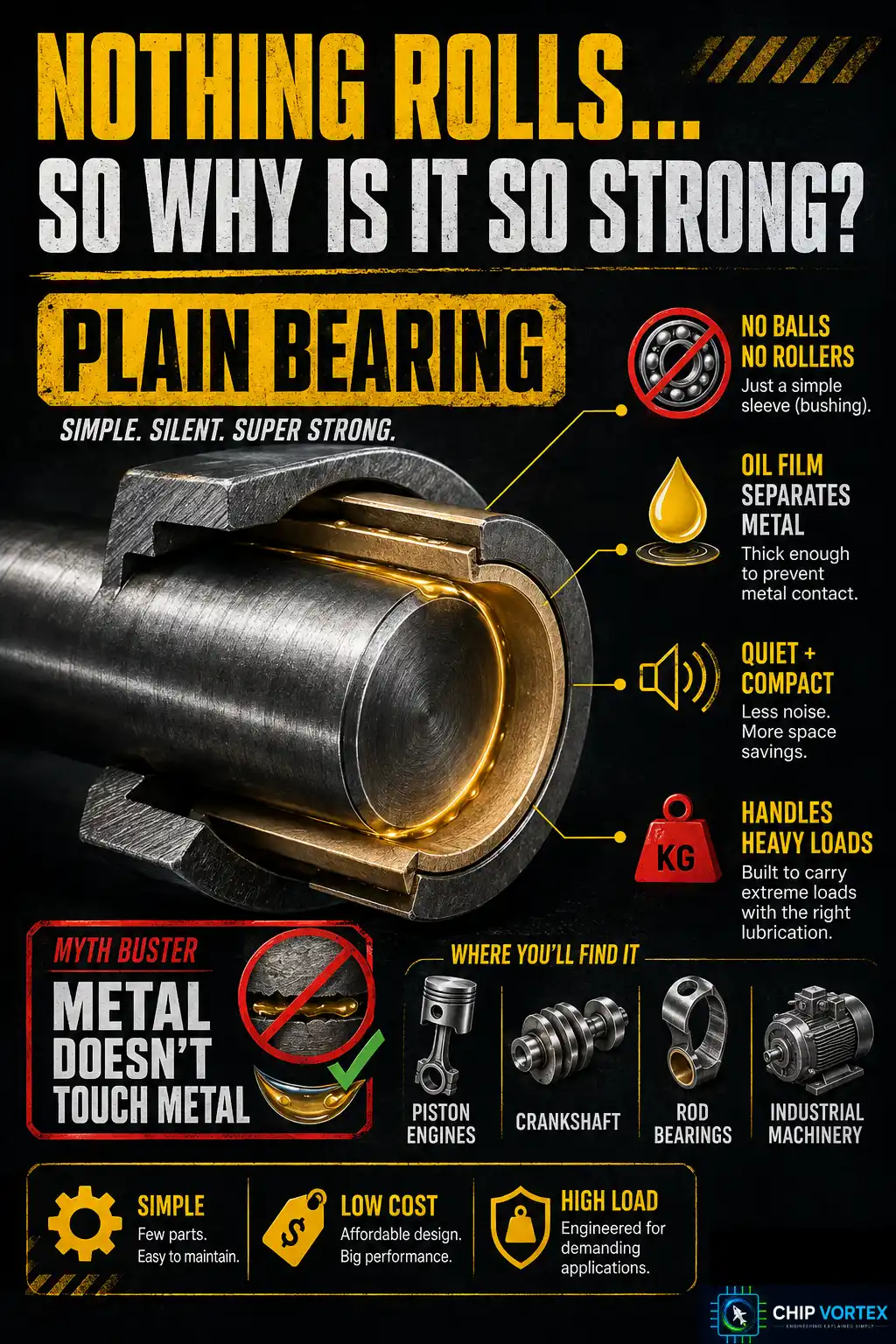
No balls, no rollers — nothing rolls at all. A plain bearing (bushing) is simply a precisely made sleeve of friendly material in which the shaft slides on a thin film of lubricant. It’s the oldest, simplest, cheapest bearing — and far from primitive: the main and rod bearings inside every piston engine are plain bearings riding on pressurized oil, where — as we said in that post — metal never actually touches metal. Quiet, compact, and capable of carrying enormous loads, as long as the lubrication never stops.
4. Needle Bearing
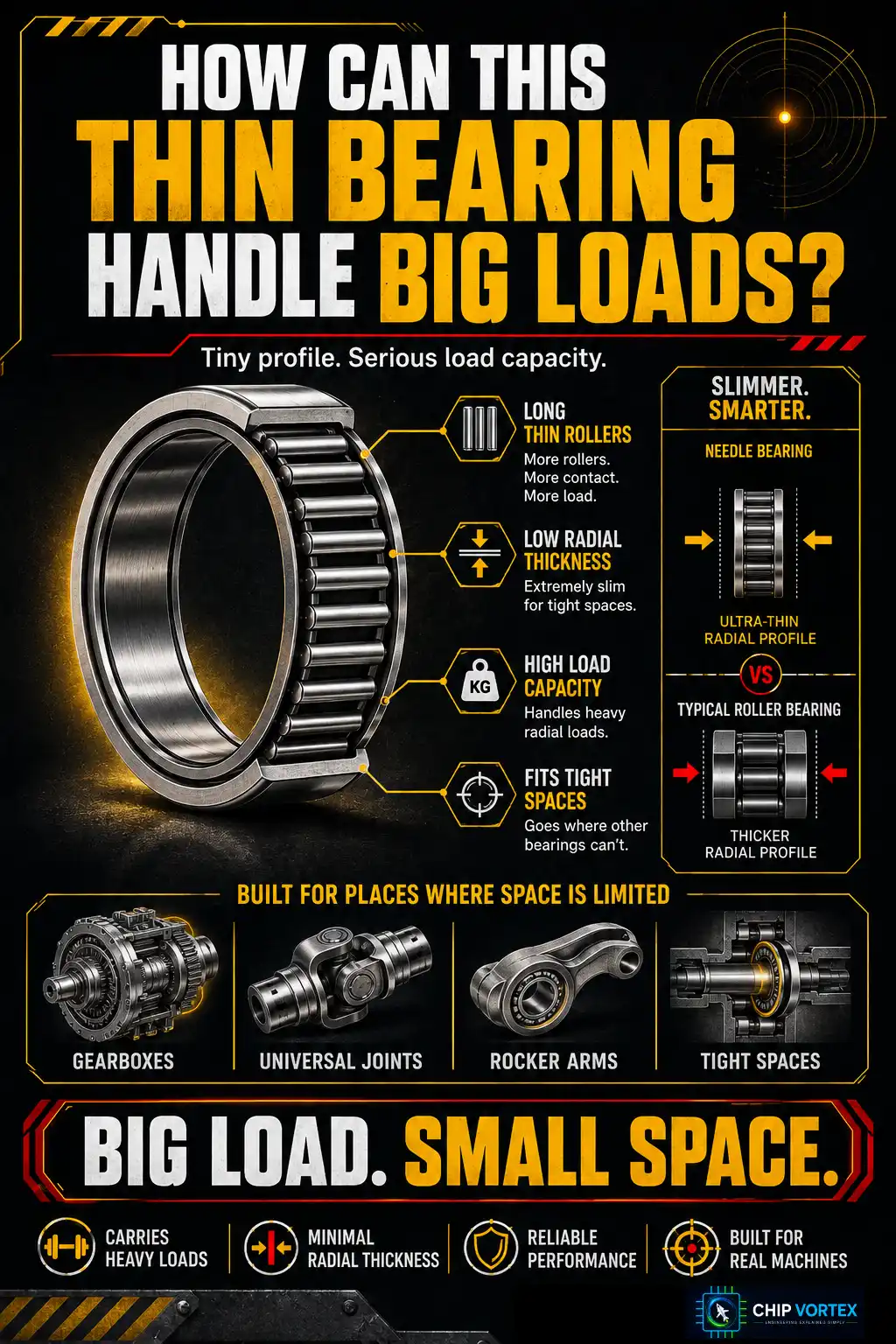
A roller bearing on a diet: the rollers are so long and thin they look like needles, which shrinks the bearing’s radial thickness to almost nothing while keeping the roller family’s load capacity. When designers have a big load and no room — inside gearboxes, universal joints, rocker arms — the needle bearing squeezes in where nothing else fits.
5. Fluid Bearing
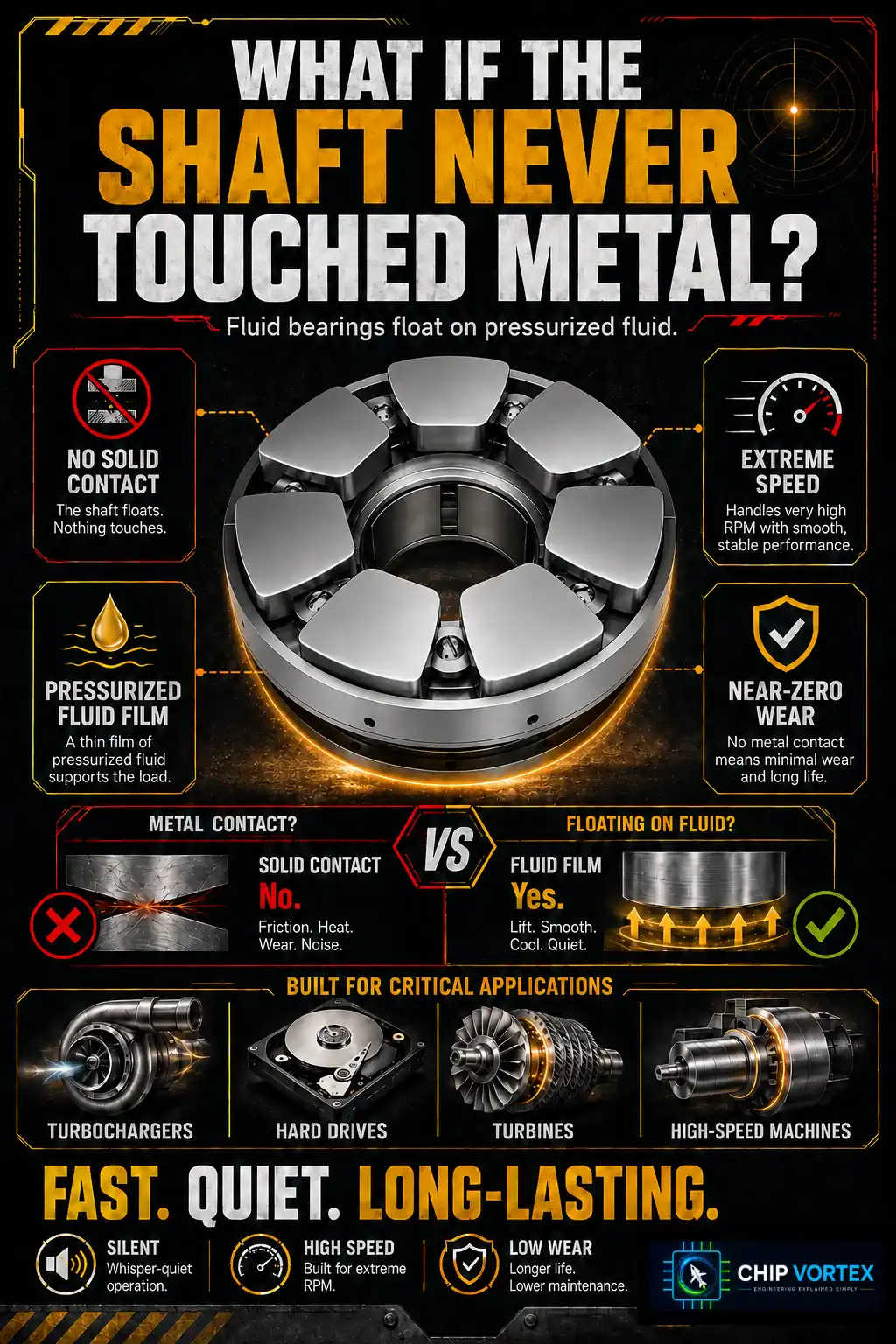
Now we leave contact behind entirely. In a fluid bearing, the shaft floats on a film of pressurized fluid — either self-generated by the shaft’s own rotation (hydrodynamic) or supplied by an external pump (hydrostatic). Nothing solid touches anything solid, so wear approaches zero and speeds can go extreme. This is how turbochargers’ journal bearings survive 200,000 rpm in hot oil, how hard drive spindles spin in silence, and how giant power-station turbines ride for decades.
6. Magnetic Bearing
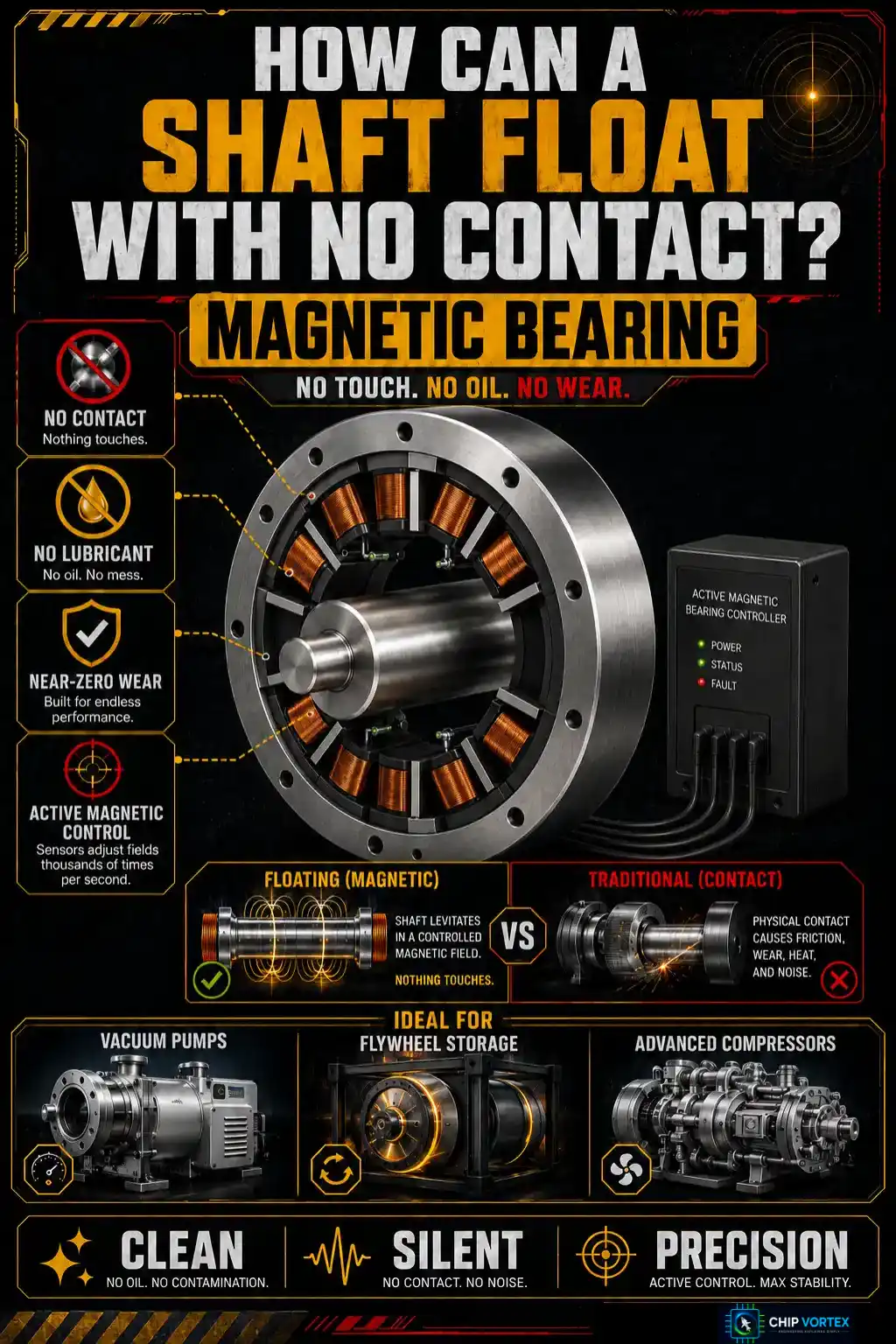
The science-fiction one that quietly went industrial: the shaft levitates, held centered by actively controlled magnetic fields, with sensors and electronics adjusting the field thousands of times a second. No contact, no wear, no lubricant at all — which is exactly why magnetic bearings run vacuum pumps, flywheel energy storage, and advanced compressors where oil would be contamination and maintenance access is a luxury. The bearing you can’t hear, because nothing is touching.
7. Taper Bearing
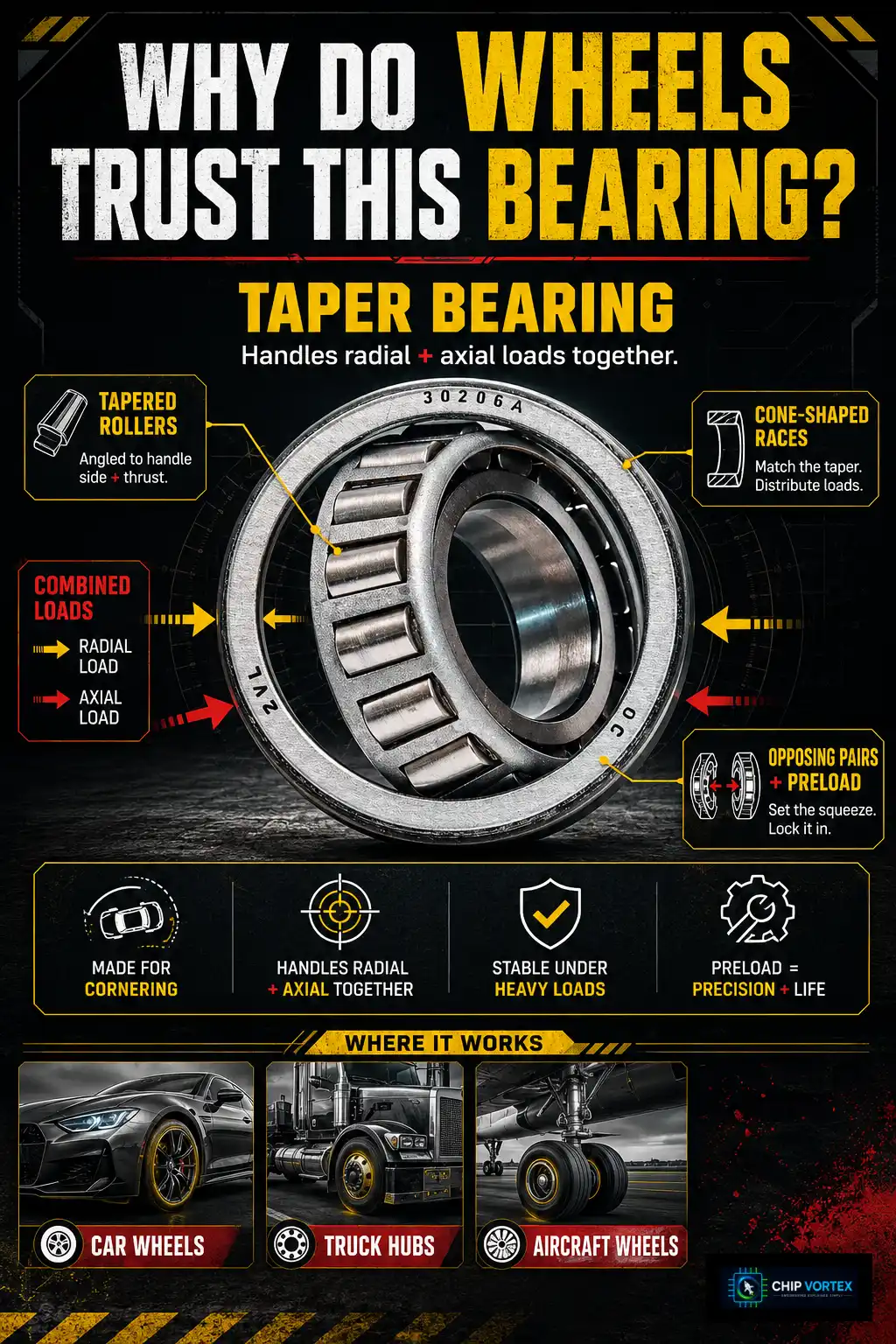
The tapered roller bearing’s cone-shaped rollers run between cone-shaped races, so the geometry itself handles radial and axial loads together — exactly the mixed loading a wheel produces when a vehicle corners. Car wheels, truck hubs, and aircraft wheels all ride on tapers, always mounted in opposing pairs with an adjustable squeeze called preload — and setting that preload by feel while packing wheel bearings is a rite of passage for every mechanic and AME.
8. Cylindrical Bearing
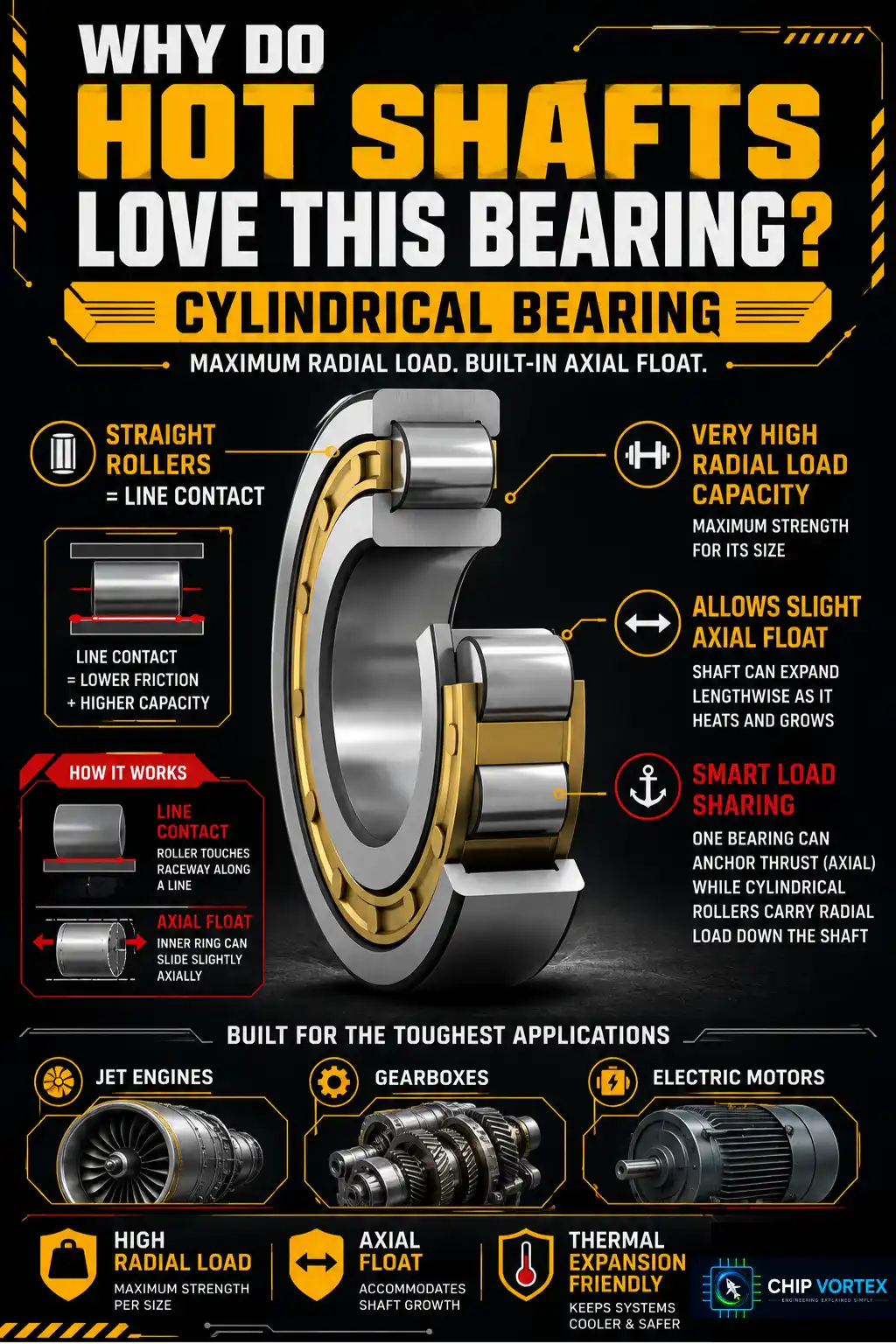
The standard-bearer of the roller family: straight rollers, straight races, maximum line contact — the highest radial capacity per size on this chart. The elegant subtlety: cylindricals allow slight axial float, letting a shaft slide lengthwise as it heats and grows. Jet engines exploit exactly that — a ball bearing anchors the shaft and takes the thrust, while cylindrical rollers down the shaft carry radial load and let the metal expand freely. Gearboxes and electric motors lean on them for the same reasons.
9. Thrust Bearing
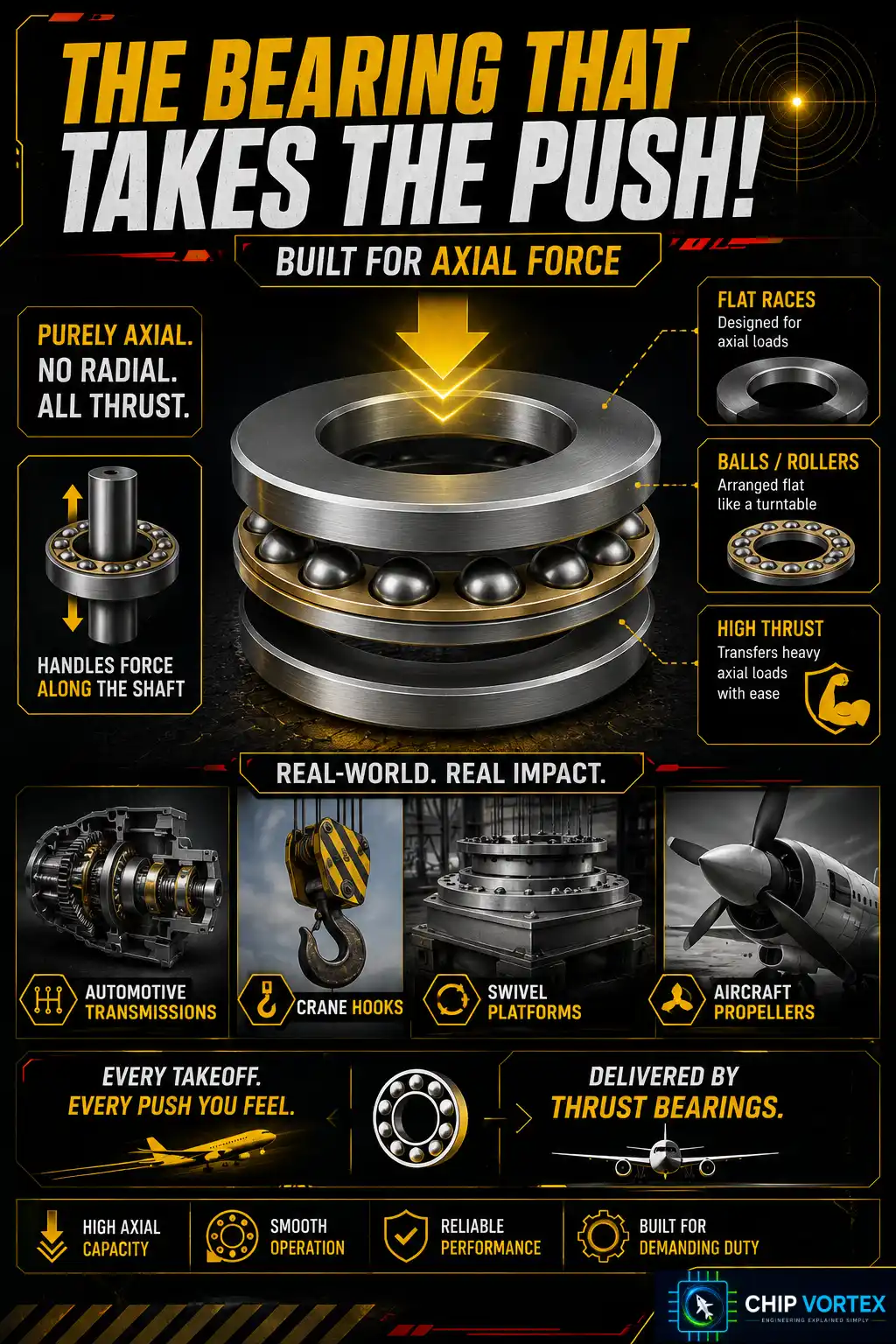
Built purely for axial loads — force along the shaft, not around it — with its balls or rollers arranged flat like a turntable. Thrust bearings live wherever something pushes lengthwise: automotive transmissions, crane hooks, swivel platforms — and in aviation, it’s a thrust bearing that transfers the propeller’s entire pull into the airframe. Every takeoff, that push you feel arrived through one of these.
10. Angular Contact Bearing
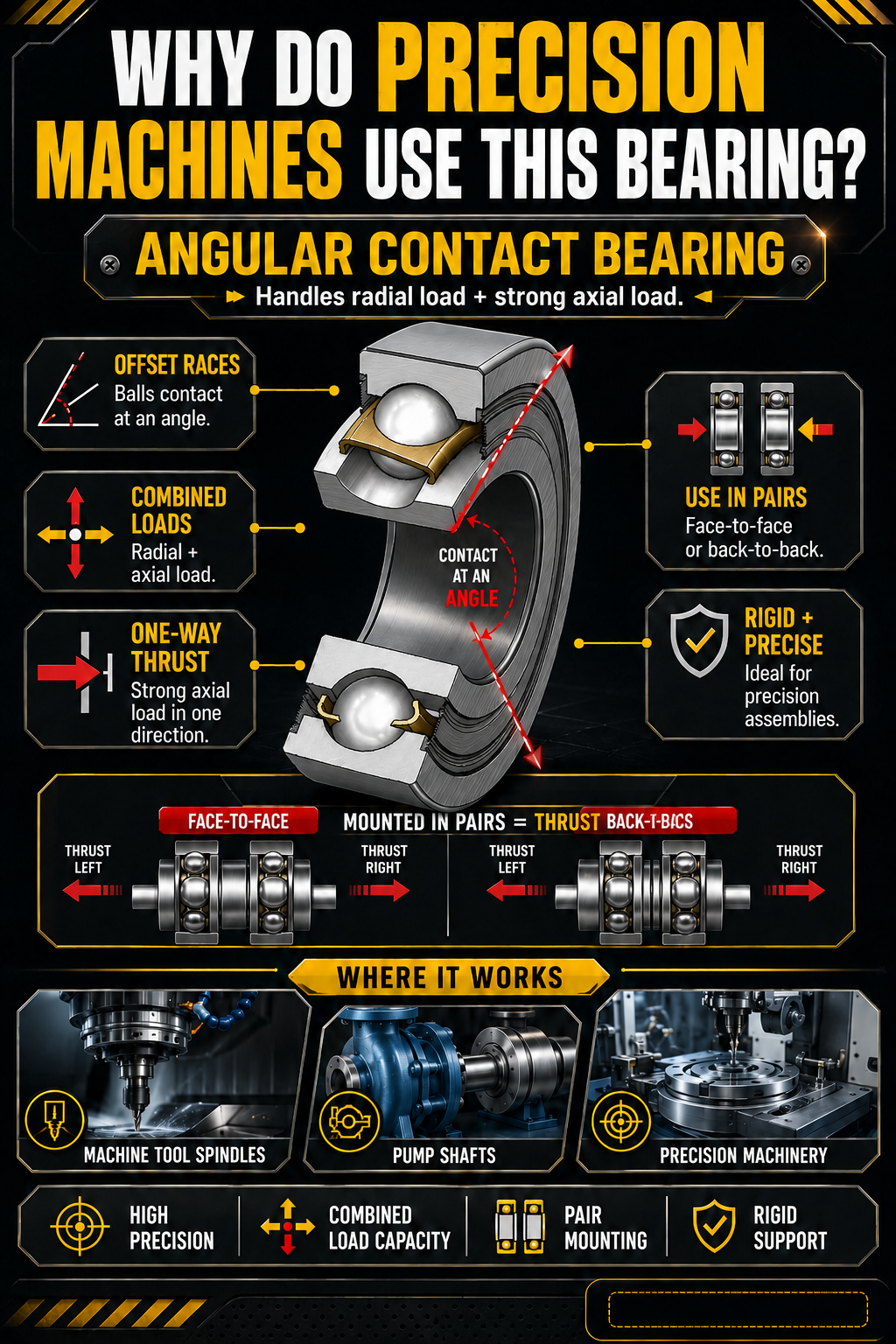
A ball bearing with attitude: its races are offset so the balls contact at an angle, letting the bearing carry radial load plus strong axial load in one direction. Mount two face-to-face or back-to-back and you’ve built a rigid, precise assembly that handles thrust both ways — which is why machine-tool spindles, pump shafts, and anything needing precision under combined loads reaches for angular contacts in pairs.
11. Spherical Bearing
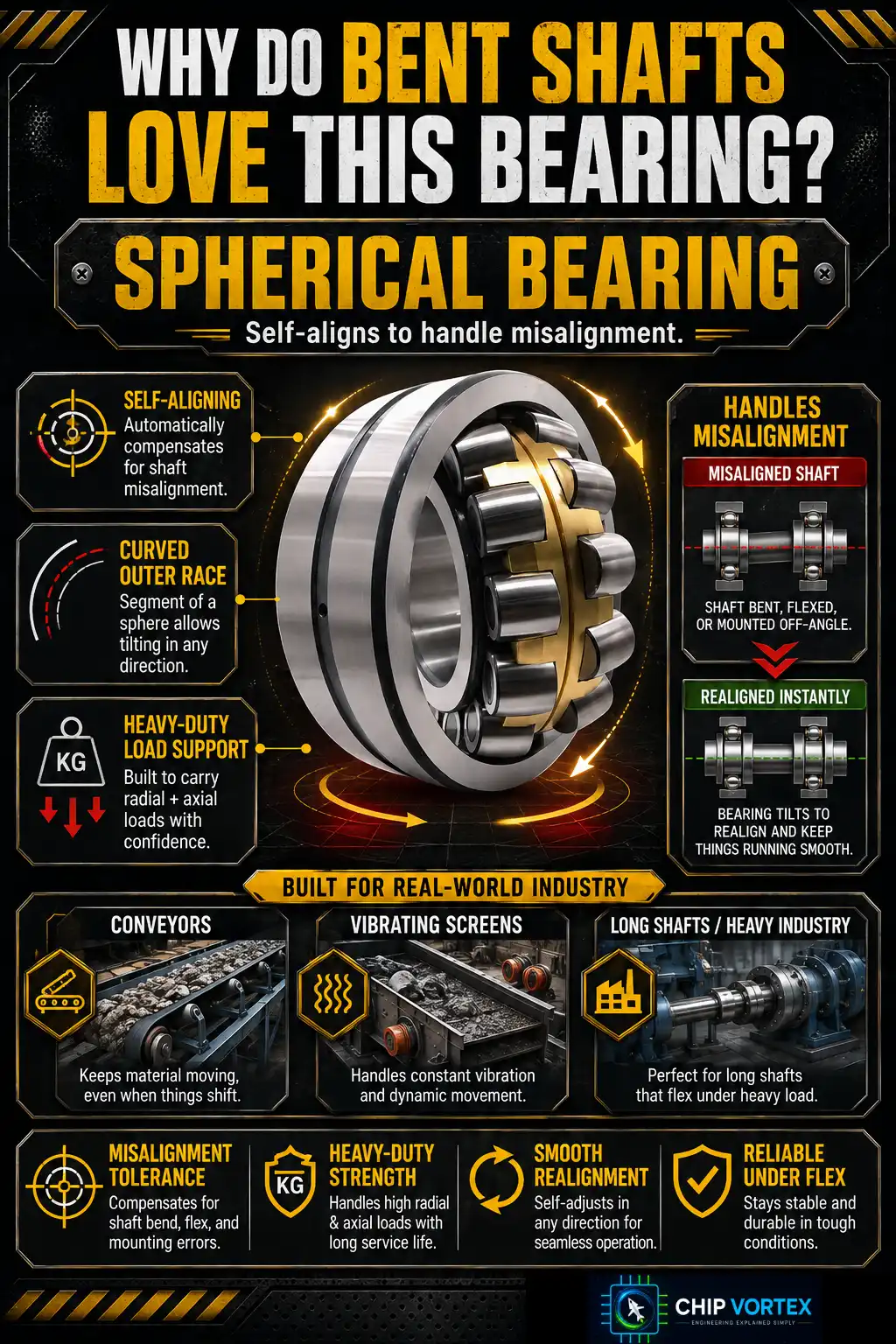
The forgiving one. Its outer race is curved like a segment of a sphere, so the whole bearing can tilt within its housing — automatically compensating for shaft misalignment, flex, or mounting error. Heavy industry loves it: conveyors, vibrating screens, and long shafts that bend under load all run on spherical bearings that simply shrug and realign.
12. Double Row Ball Bearing
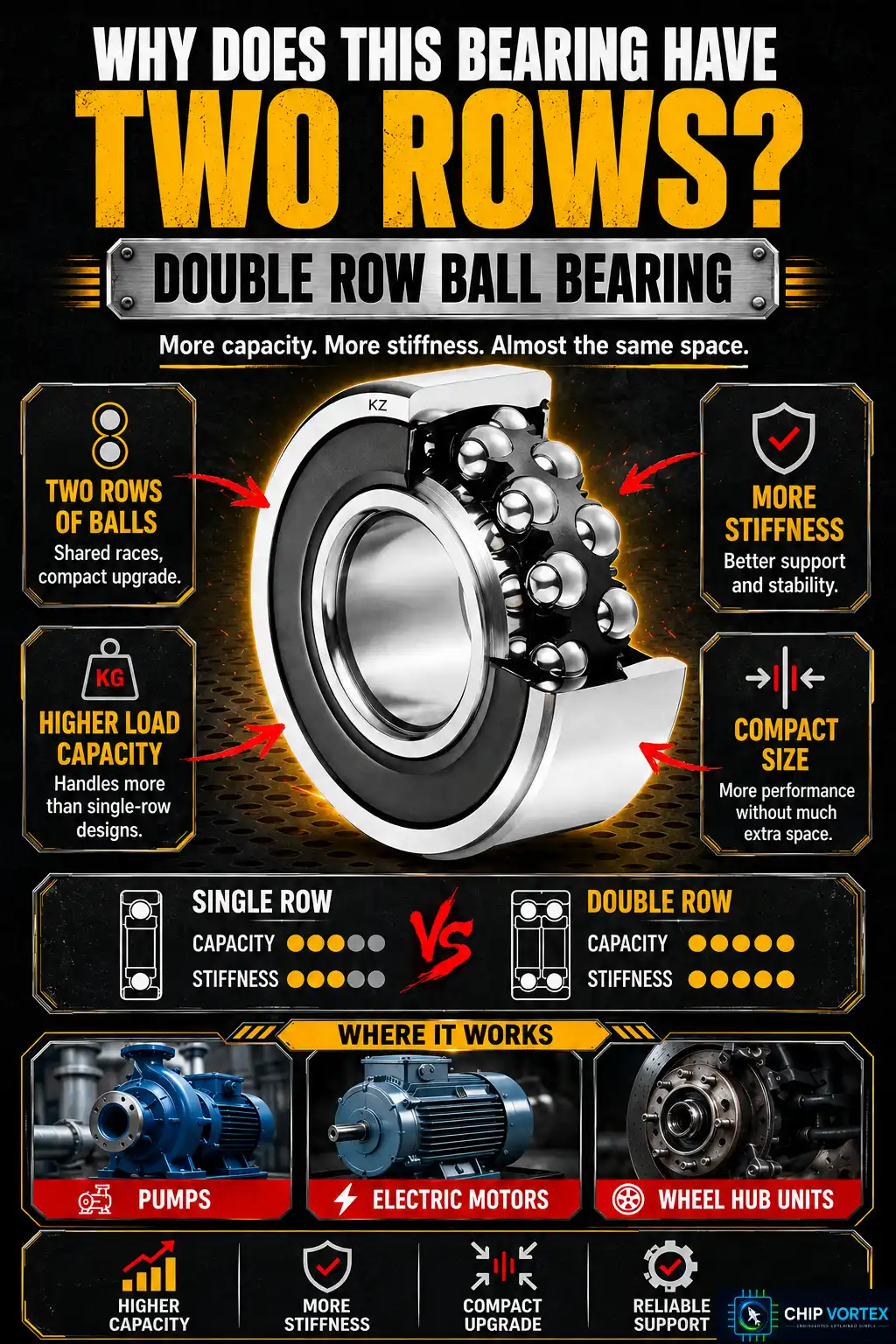
Two rows of balls sharing one set of races: nearly double the capacity and noticeably more stiffness in barely more space than a single row. When a single-row ball bearing is almost enough, the double row is the tidy answer — common in pumps, electric motors, and wheel hub units.
How to Choose: The 30-Second Logic
Start with load direction: pure radial points to cylindrical or ball; pure axial to thrust; combined to taper or angular contact. Then load size: balls for lighter and faster, rollers for heavier. Then the constraints: no radial space → needle; misalignment → spherical; extreme speed or zero-wear demands → fluid or magnetic; simplicity and budget with guaranteed lubrication → plain. Twelve types, one question repeated: what is the load, and which way is it pushing?
FAQ: Types of Bearings
What’s the difference between ball and roller bearings?▾
Contact shape. Balls touch at a point — less friction, more speed, less load. Rollers touch along a line — more load capacity, slightly lower speed. Balls for speed, rollers for load.
Journal bearing vs ball bearing turbo — what’s the debate about?▾
Journal (fluid/plain) bearings are cheap, durable, and love oil; ball-bearing turbos spool faster because rolling friction is lower from the first instant. Enthusiasts pay for the response; fleets buy the durability.
What bearings are in a car’s wheels?▾
Tapered roller bearings (or sealed hub units built from them) — because a cornering wheel loads the bearing radially and axially at once, and the taper’s geometry handles both together.
What is bearing preload?▾
A deliberate, controlled squeeze applied to a bearing pair that removes internal play and stiffens the assembly. Too loose and things wander; too tight and the bearing cooks — which is why setting preload correctly is a genuine skill.
Why do bearings fail?▾
Rarely from honest old age. The real killers are contamination (dirt in the races), lubrication failure, misalignment, incorrect preload — and over-greasing, which churns and overheats a bearing as surely as no grease at all. Most bearing deaths are murders, not natural causes.
Look around you right now — the fan, the hard drive, the car outside — and count the bearings quietly doing their jobs. Which type surprised you most: the one that floats on oil, or the one that touches nothing at all? Tell us in the comments. Save the chart, and follow the bearings into the machines: the piston engine’s plain bearings, the turbocharger’s journal bearings, and the wave springs that preload them.