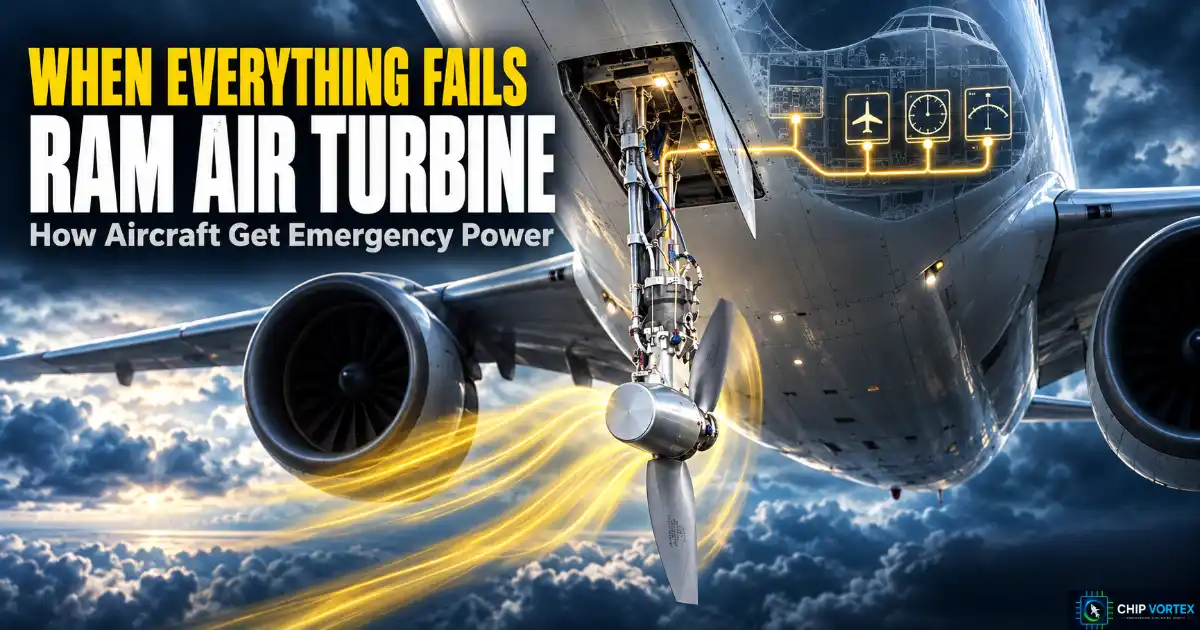
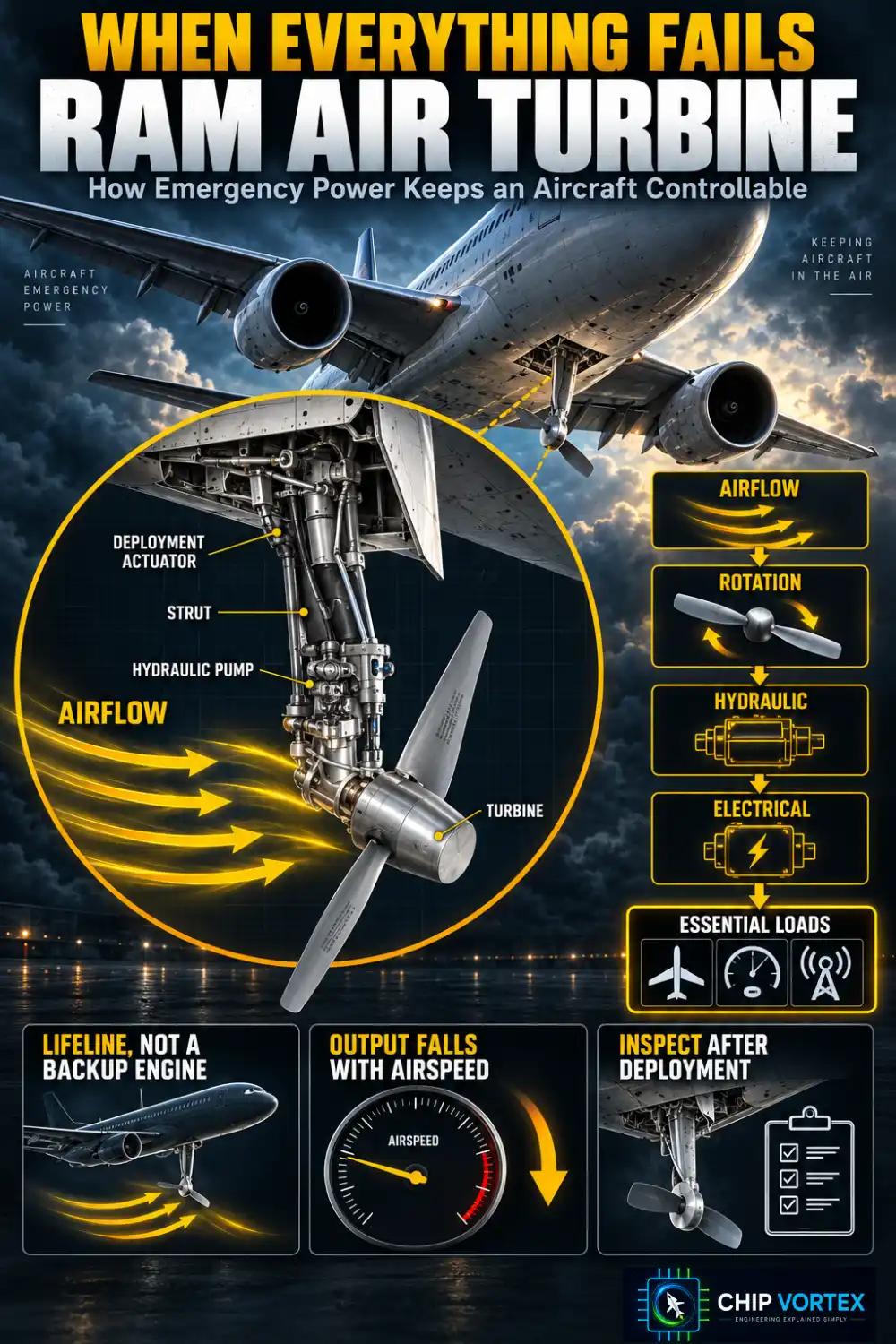
A ram air turbine is a small propeller that drops into the airstream when an aircraft loses its normal power sources, using the aircraft’s own forward motion to generate emergency hydraulic pressure, electrical power, or both. Collins Aerospace credits its RATs with saving approximately 1,700 lives across 16 documented events — a manufacturer figure with no published event list behind it, but an indication of scale.
It is also one of the most misunderstood components on the aircraft — because what it cannot do matters as much as what it can.
How a Ram Air Turbine Works
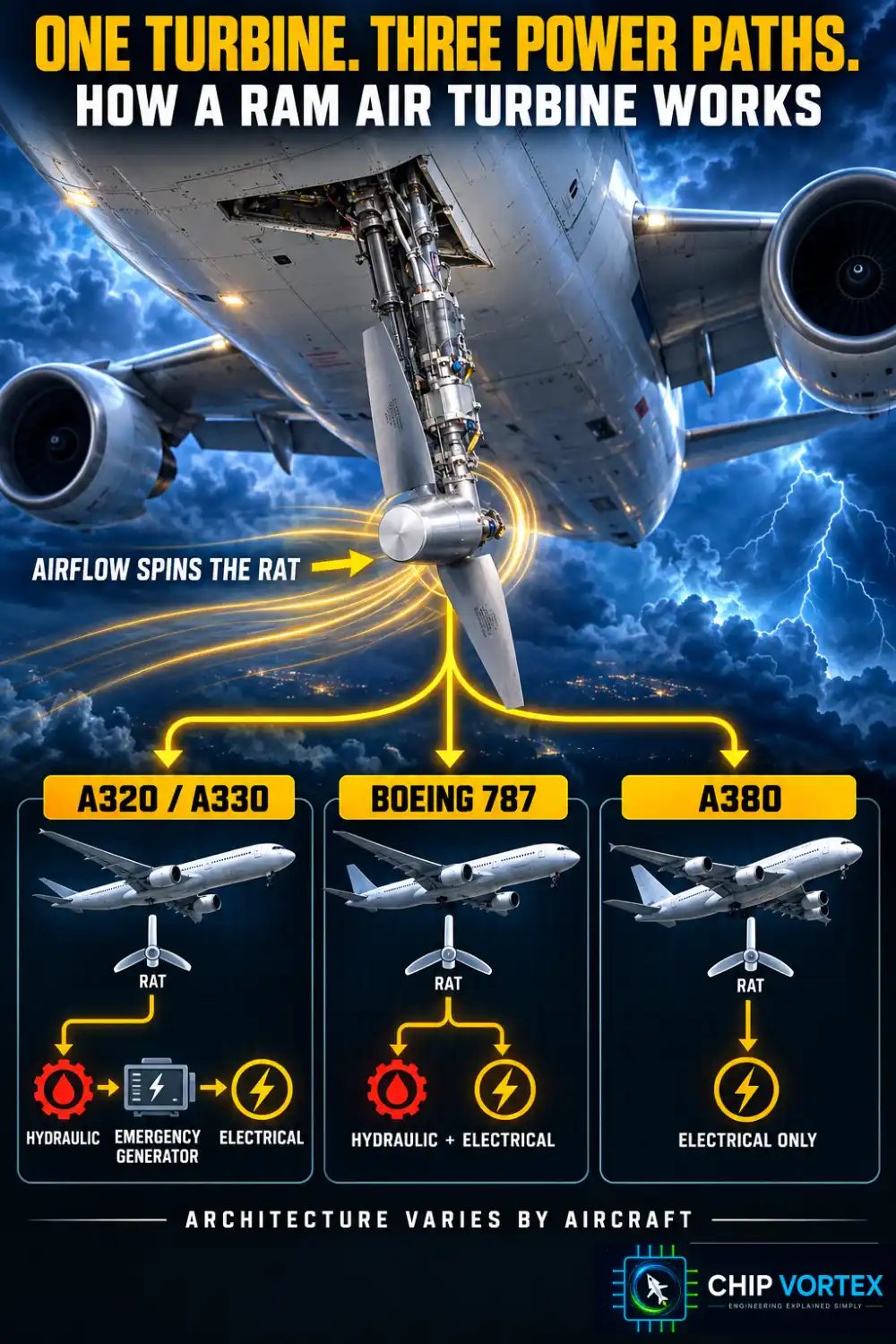
Safran, one of the two main manufacturers, defines the RAT as a system “used to provide electrical power and/or hydraulic pressure to the critical systems on the aircraft in case of a failure of the main generation systems.” Three parts: the turbine with its speed regulator, the generator and its control unit, and the extension and retraction actuation system.
Note the “and/or” — the architecture varies by type:
- A320 and A330 — the RAT drives hydraulics, and the hydraulic power then drives the emergency generator. The NTSB describes the A320 RAT as supplying “hydraulic power to the controlled-speed motor generator, which then provides electrical power to the airplane.”
- Boeing 787 — supplies both hydraulic and electrical power. The AAIB India report on AI171 refers explicitly to “the RAT hydraulic pump.”
- A380 — the outlier: it generates electrical power only, driving an electrical emergency generator.
What Triggers Deployment
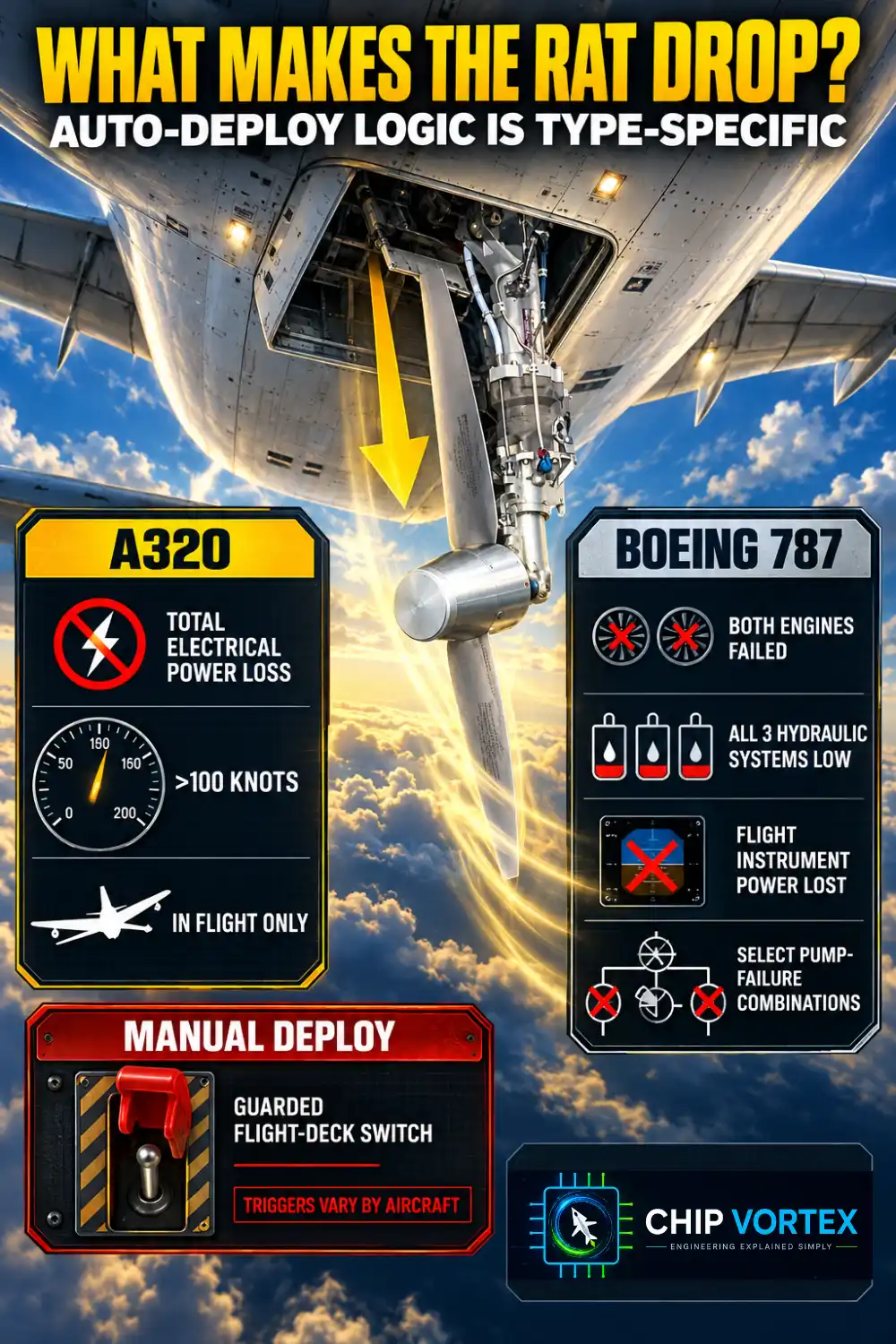
Triggers are type-specific, and it is worth knowing at least two real examples rather than a generic list.
On the A320, the NTSB’s US Airways 1549 report states it plainly: “When all of the airplane’s electrical power is lost and the airplane has an airspeed greater than 100 knots (kts), the RAT will automatically deploy and begin providing electrical power.” That airspeed interlock is deliberate — it prevents deployment on the ground.
On the 787, auto-deploy logic includes both engines failed, all three hydraulic systems low, loss of all electrical power to flight instruments, and certain combinations of electric motor pump failures during takeoff, approach or landing.
Every type also has a guarded manual deployment switch on the flight deck.
How Much Power Does a RAT Produce?
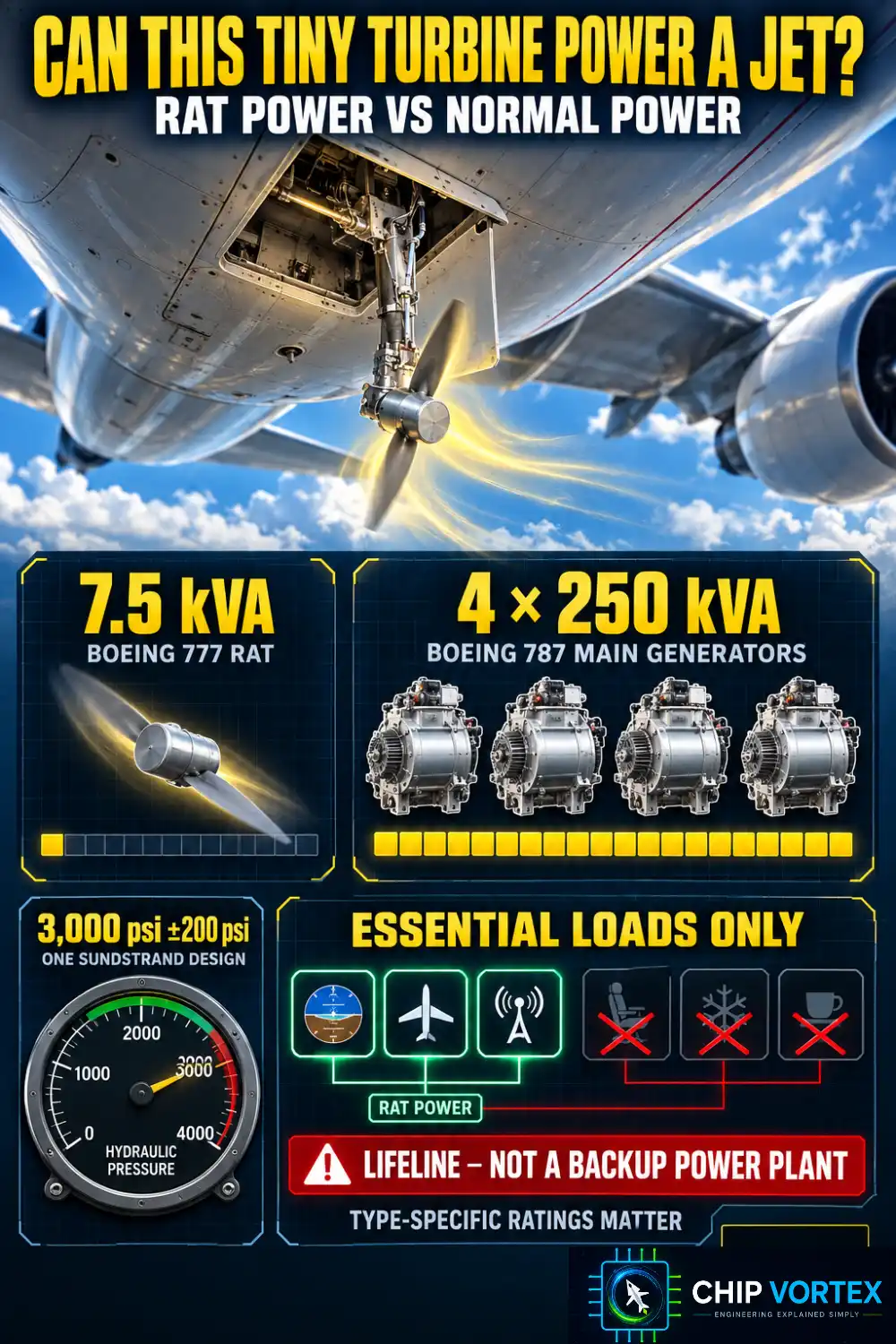
Be careful with numbers here. Most per-type kVA figures circulating online are uncited, and Safran and Collins publish no ratings at all. Exact figures live in type-specific maintenance manuals. Two that are traceable:
- Boeing’s own published architecture material lists one 7.5 kVA RAT for the 777.
- Hydraulic output on one Sundstrand design is regulated to 3,000 psi ±200 psi.
Put 7.5 kVA against the 787’s four main generators of 250 kVA each and the real lesson lands. The RAT is not a backup power plant. It is a lifeline sized for essential loads only.
Speed and RPM
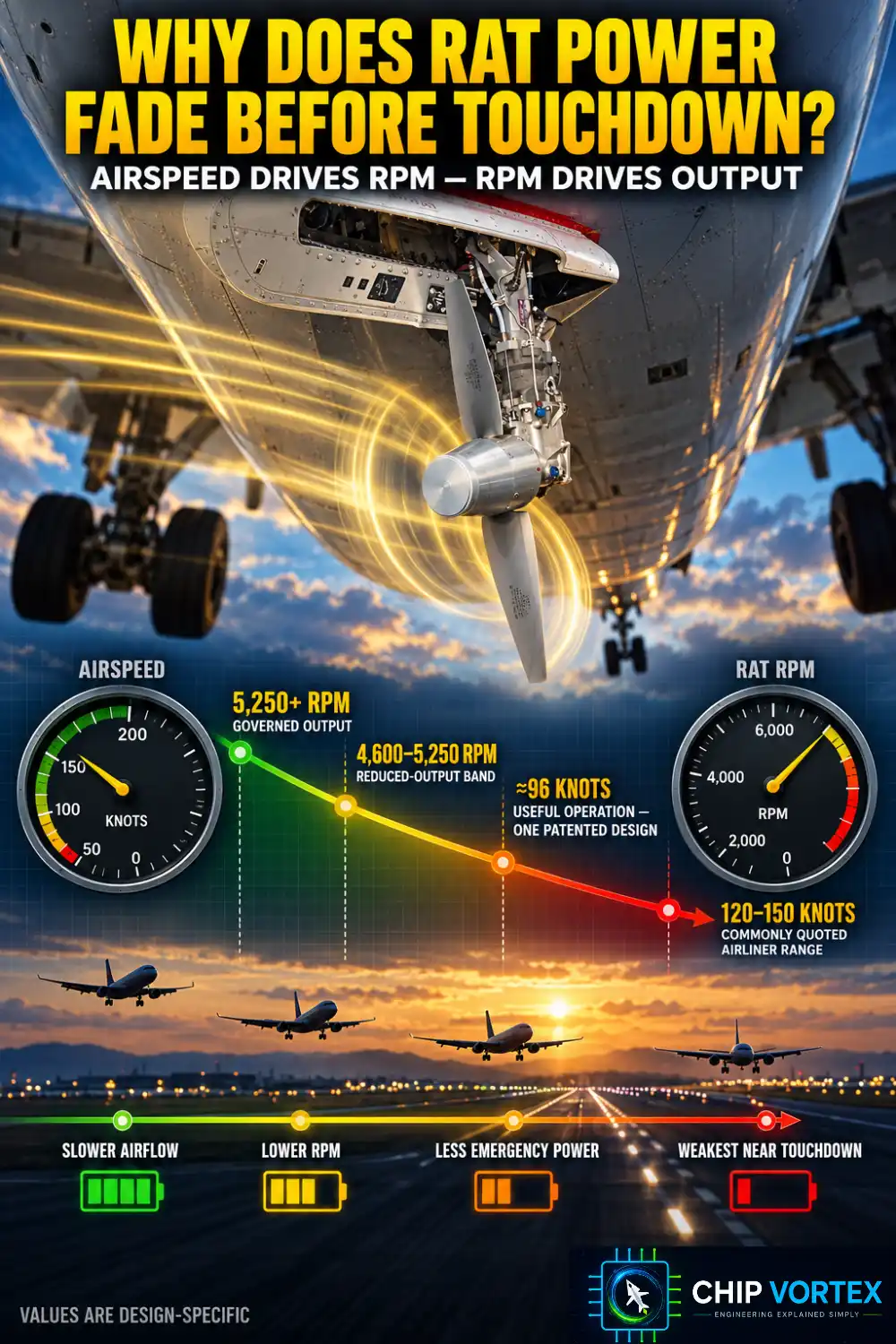
From the Sundstrand design patent: the governor holds the turbine above 5,250 rpm, a power controller manages the reduced-output band from 4,600 to 5,250 rpm, and that controller extends useful operation down to approximately 96 knots equivalent airspeed — against roughly 125 KEAS for earlier designs that simply stalled.
In operational terms, airliner RAT minimum speeds are commonly quoted in the 120–150 knot range. Below that, output falls away — which is exactly why a RAT is least helpful at the moment of touchdown.
What a RAT Does Not Power
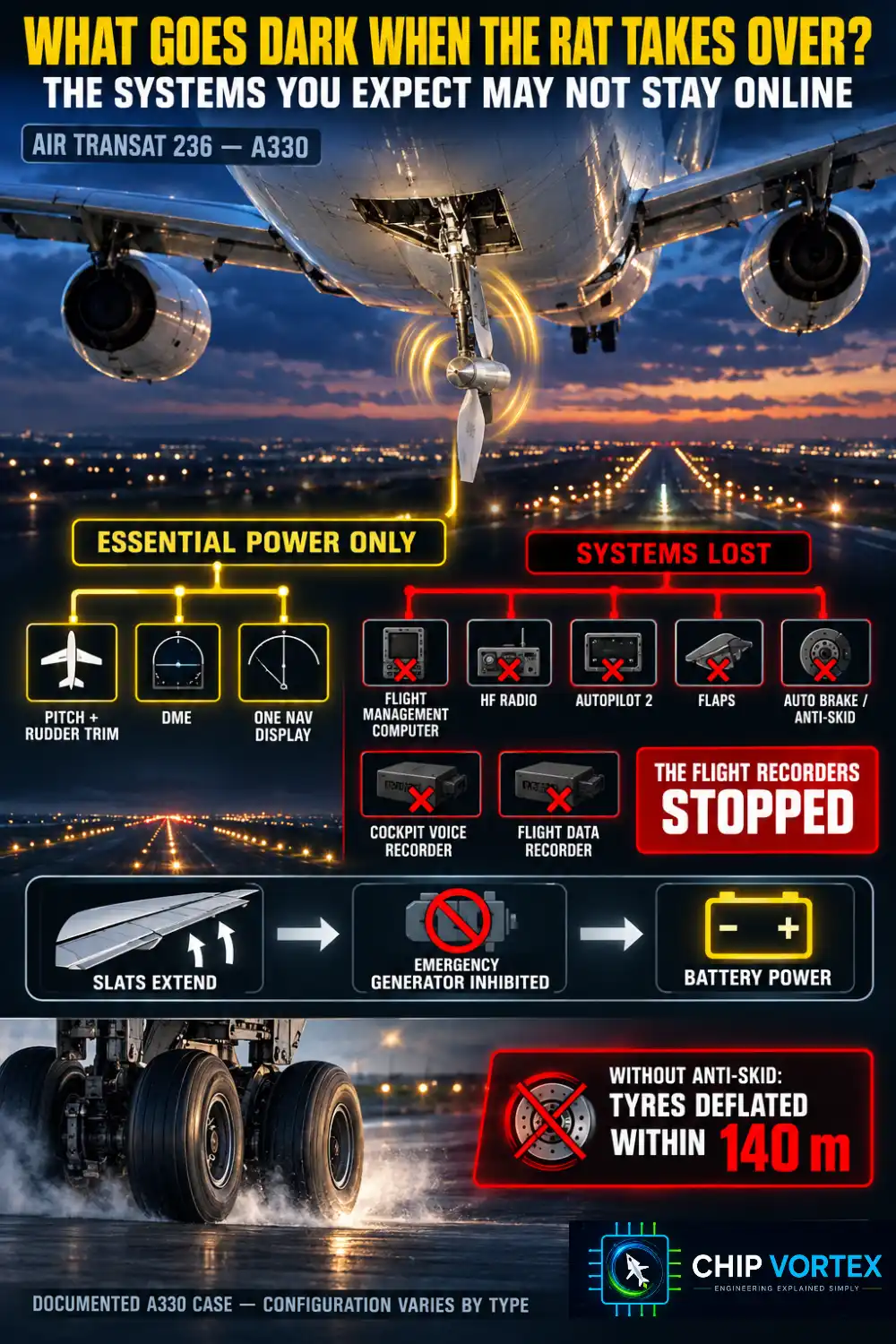
Generic lists here are unsatisfying. Air Transat 236 gives something better: a documented account of what an A330 actually loses the moment it goes onto emergency power. Among the systems that went down were the flight management computer, HF radio, autopilot 2, pitch and rudder trim, DME, one navigation display — and, most striking of all, the cockpit voice recorder, the flight data recorder, the flaps and the auto brake / anti-skid.
Read that again. The flight recorders themselves stop. There is a further step down too: on the A330 the emergency generator is inhibited on slat extension, so as the crew configured for landing the supply transferred to batteries.
The consequences were physical. Without anti-skid the tyres locked, abraded and fully deflated within 140 m of touchdown.
Two Case Studies Worth Knowing
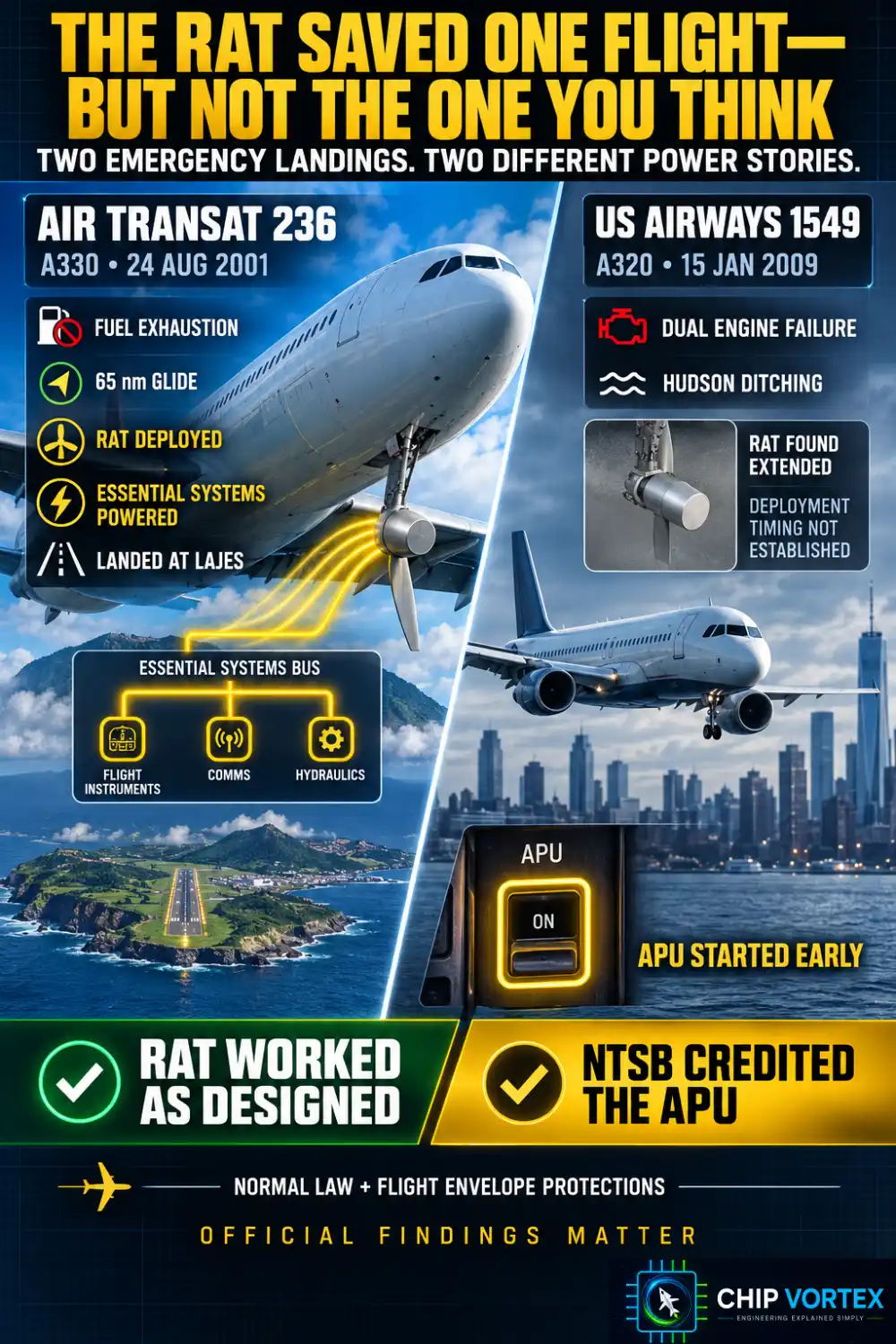
Air Transat 236 — the RAT working as designed
On 24 August 2001, A330 C-GITS suffered fuel exhaustion over the Atlantic after a fuel leak. The root cause was a mismatched build: a pre-modification hydraulic tube fitted alongside a post-modification hydraulic pump left inadequate clearance, the tubes came into contact in service, and the No. 2 engine fuel tube chafed and cracked. The second engine flamed out at about FL345, 65 nm from Lajes in the Azores. The RAT deployed and carried the aircraft’s essential systems through the glide to a landing on runway 33 at roughly 200 knots. Sixteen passengers and two cabin crew were injured during the evacuation.
US Airways 1549 — the RAT was not the hero
This is the more instructive case, because the official record does not say what most people assume.
The NTSB recorded that on recovery from the Hudson “the RAT was found in the extended position… both RAT blades were present, and no major deformation of the blades was observed.” Note what the report does not do: it documents the A320’s auto-deploy logic in one section and the RAT’s recovered position in another, but it does not narrate when or how the RAT deployed.
And no NTSB finding credits the RAT with improving the outcome. Finding 14 credits the APU:
“Despite being unable to complete the Engine Dual Failure checklist, the captain started the auxiliary power unit, which improved the outcome of the ditching by ensuring that a primary source of electrical power was available to the airplane and that the airplane remained in normal law and maintained the flight envelope protections, one of which protects against a stall.”
The captain started the APU out of checklist sequence. That decision, not the RAT, is what the investigation identified as consequential.
Air India 171: What the Official Report Actually Says
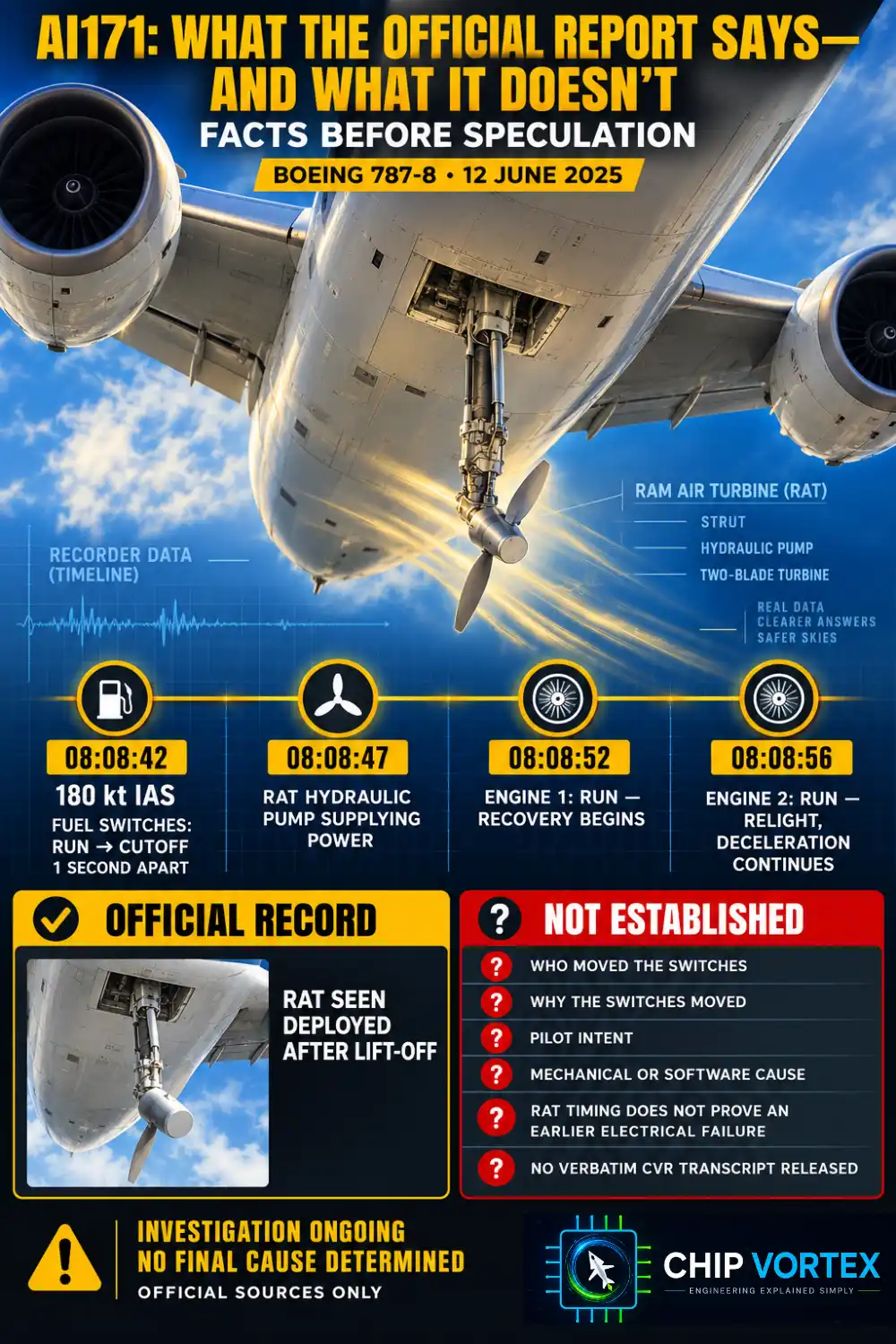
The RAT deployment on AI171 (Boeing 787-8 VT-ANB, Ahmedabad, 12 June 2025) drove a great deal of public interest in this component. Because the investigation is ongoing, only the official record belongs in a technical article.
From the AAIB India preliminary report of 12 July 2025, the RAT is documented twice. Airport CCTV “showed Ram Air Turbine (RAT) getting deployed during the initial climb immediately after lift-off.” And in the recorder data: “Engine 1 and Engine 2 N2 values passed below minimum idle speed, and the RAT hydraulic pump began supplying hydraulic power at about 08:08:47 UTC.”
On the sequence: the report puts maximum recorded airspeed of 180 kt IAS at 08:08:42 UTC and says that immediately thereafter the two engine fuel cutoff switches transitioned from RUN to CUTOFF, “one after another with a time gap of 01 sec.” Both switches were moved back to RUN — Engine 1 at 08:08:52, Engine 2 at 08:08:56 — and Engine 1’s core deceleration stopped and began to recover, while Engine 2 relit but could not arrest its deceleration.
The report also summarises a cockpit exchange: “one of the pilots is heard asking the other why did he cutoff. The other pilot responded that he did not do so.” Two things about that line. The report does not identify which pilot said which, and it is the investigators’ paraphrase — no verbatim CVR transcript has been released.
The report’s own closing position is the most important sentence for anyone writing about it: “At this stage of investigation, there are no recommended actions to B787-8 and/or GE GEnx-1B engine operators and manufacturers.”
Status as of August 2026: no final report has been published. AAIB issued a 12-month interim statement on 12 June 2026 reporting progress but no new findings. A draft final report was expected in October 2026, after which ICAO Annex 13 consultation must occur before public release.
What is not established
None of the following appears in any official document:
- That either pilot acted deliberately, or any conclusion about intent.
- How or why the switches moved at all — deliberate, inadvertent or induced. The mechanism is simply undetermined.
- Any mechanical or software defect as cause. The report found no defect in the fuel control switches, though it does record the FAA’s advisory-only SAIB NM-18-33 on the switch locking feature.
- Any verbatim CVR transcript.
- That the RAT deployment timing proves an electrical or systems failure preceded the fuel cutoff. This inference circulates widely. The report supports it nowhere — the RAT came up roughly five seconds after the switch transitions, which is what you would expect from the switch transitions alone.
AAIB has publicly asked media to refrain from spreading premature narratives. For a technical audience, that is not a limitation — the documented facts are more instructive than the speculation.
Maintenance: What Happens After Deployment
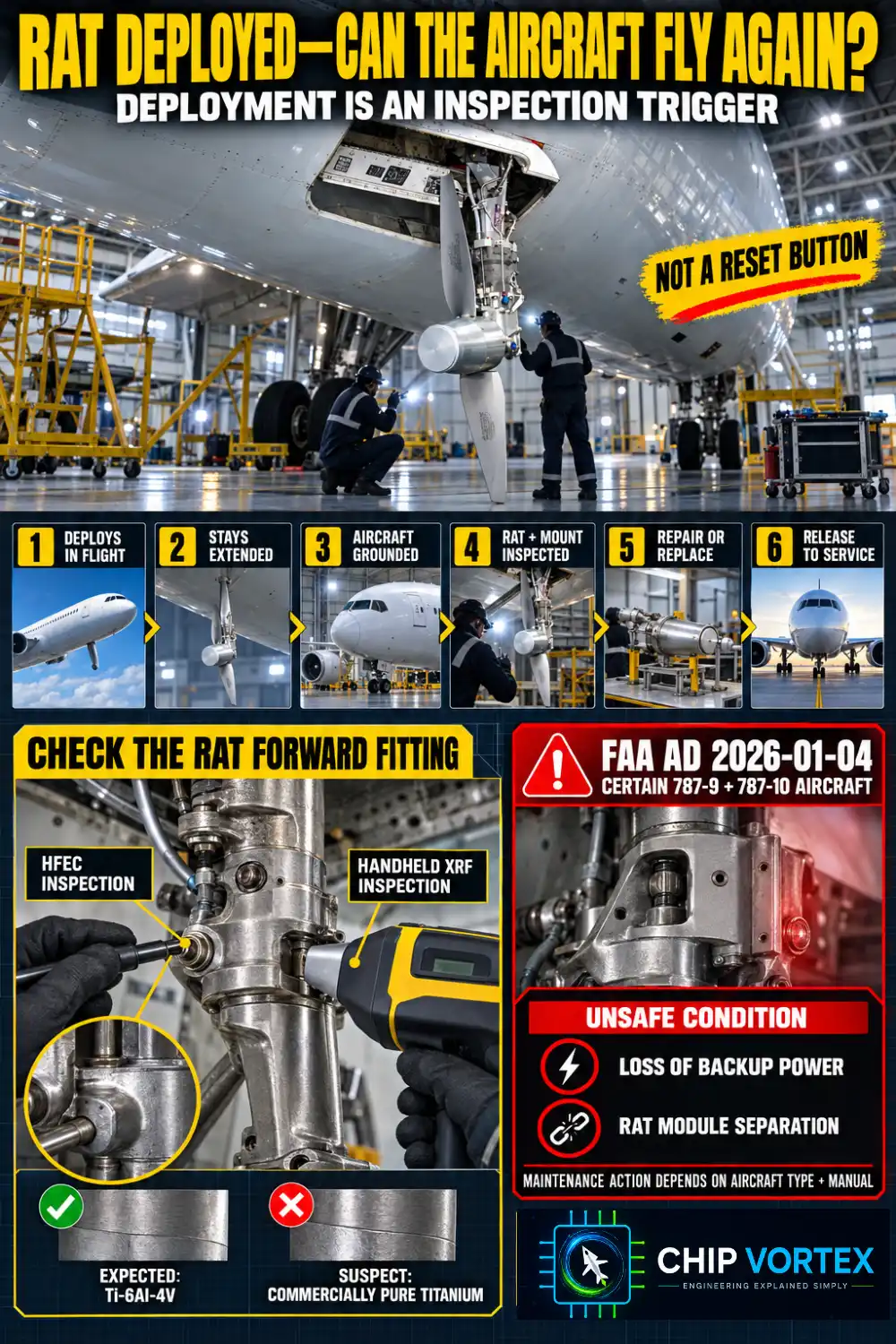
A RAT deployment is not a resettable event. Once automatically deployed in flight, it generally cannot be retracted until the aircraft is on the ground.
Deployment can also trigger mandatory maintenance action. An early example of the principle: EASA AD 93-057-041(B) R2, applicable to certain A320 variants, required RAT ball bearing inspection “after each functional ground check of the Ram Air Turbine, or after each flight Ram Air Turbine deployment,” with replacement if necessary before the next flight. That AD has long since been terminated by modification, but the logic it embodies persists across types — a deployment is an inspection trigger, not a reset button.
In practice that is what happens. When Air India flight AI117, a 787-8, experienced an uncommanded RAT deployment on approach to Birmingham on 4 October 2025 at around 400 ft, the aircraft was grounded for detailed inspection and the return flight cancelled. India’s DGCA ordered fleet-wide reinspection of emergency power systems on affected 787s. Air India subsequently stated the deployment was “neither due to a system fault nor pilot action” — a reminder that the investigation of such events often ends somewhere other than where it starts.
Current airworthiness action
FAA AD 2026-01-04, effective 20 February 2026, addresses 787-9 and 787-10 RAT forward fittings “possibly manufactured with an incorrect titanium alloy material” — commercially pure titanium instead of Ti-6Al-4V. The stated unsafe condition is stark: “loss of backup hydraulic and/or electrical power as well as the RAT module departing from the airplane.” It mandates eddy current or handheld XRF inspection to identify the alloy.
Frequently Asked Questions
Can a ram air turbine be retracted in flight?▾
Generally no. Once deployed in flight it stays out until the aircraft is on the ground, and deployment triggers a mandatory inspection before further flight.
Does the RAT power the flight recorders?▾
Not necessarily. On Air Transat 236 both the CVR and FDR were among the systems lost when the aircraft went onto emergency power.
Why does the RAT have a minimum airspeed?▾
Because it extracts energy from the airstream. Below roughly 120–150 knots on airliners, output falls away — which is precisely why it is weakest at the end of a glide.
Related reading: aircraft emergency systems, the gas turbine engine, and the aircraft fuel system.