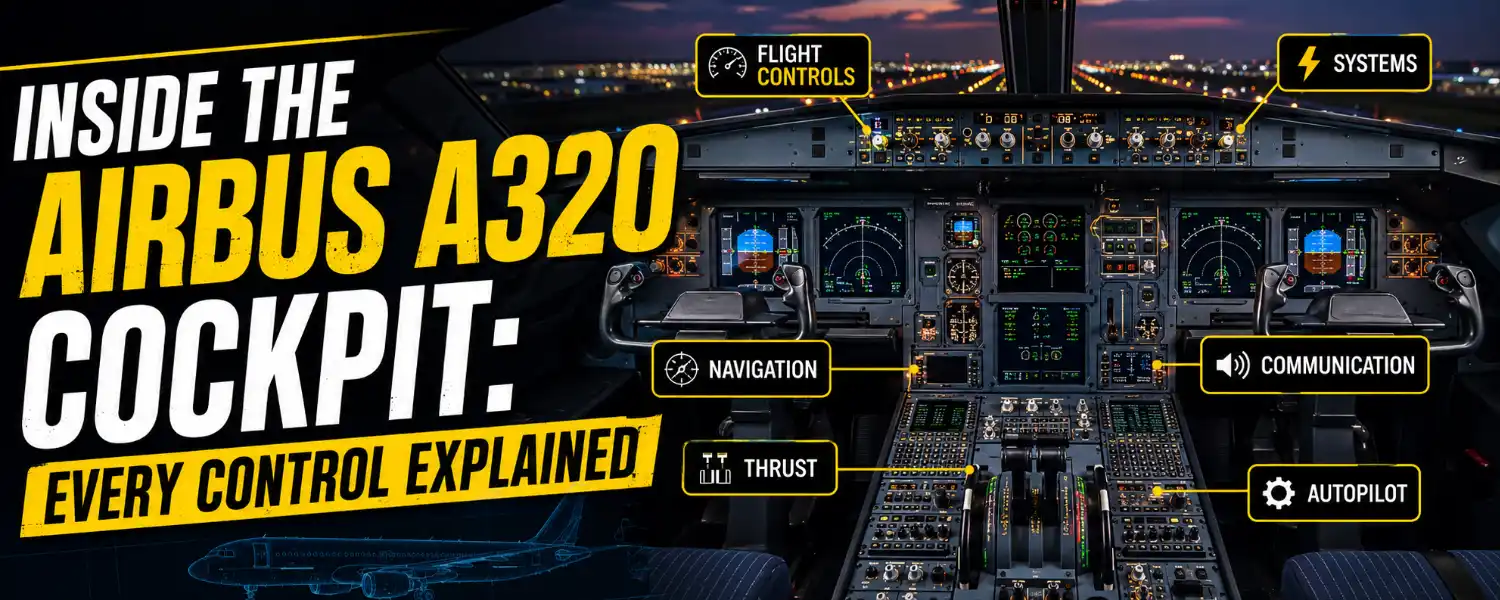
Sit in an A320 and the first thing you notice is what’s missing: no yoke. In its place, a small stick by the window, a proper table where the control column should be, and a design philosophy that changed airline cockpits forever. The A320 flight deck is the most common jet cockpit on Earth — and the most opinion-starting. Here’s the full tour.
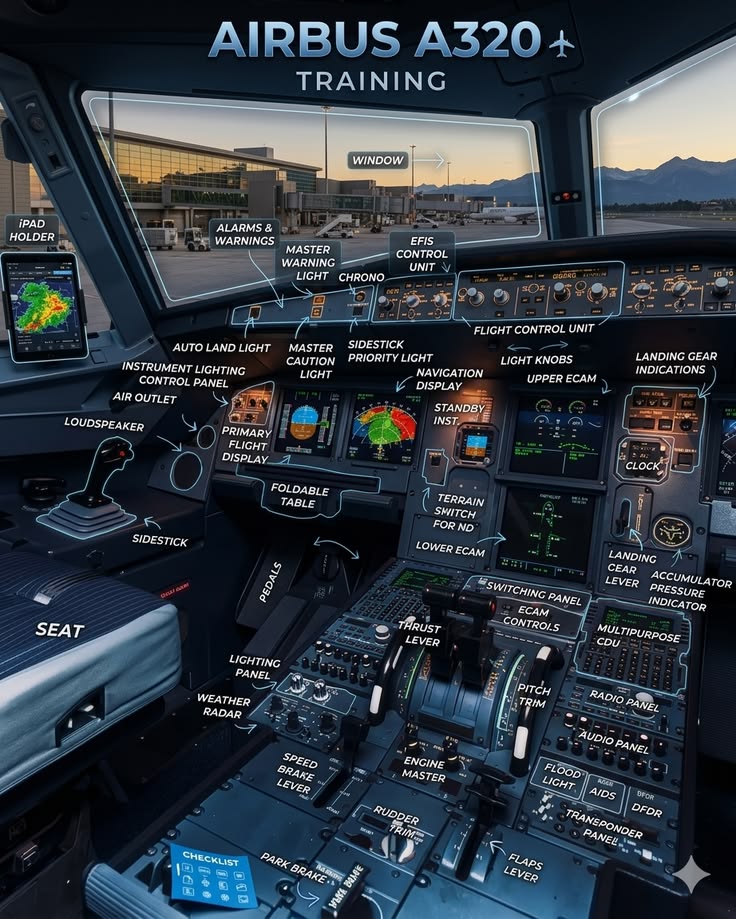
Save the labeled photo, then let’s start with the thing everyone argues about.
The Airbus Difference: The Sidestick (and the Table It Paid For)
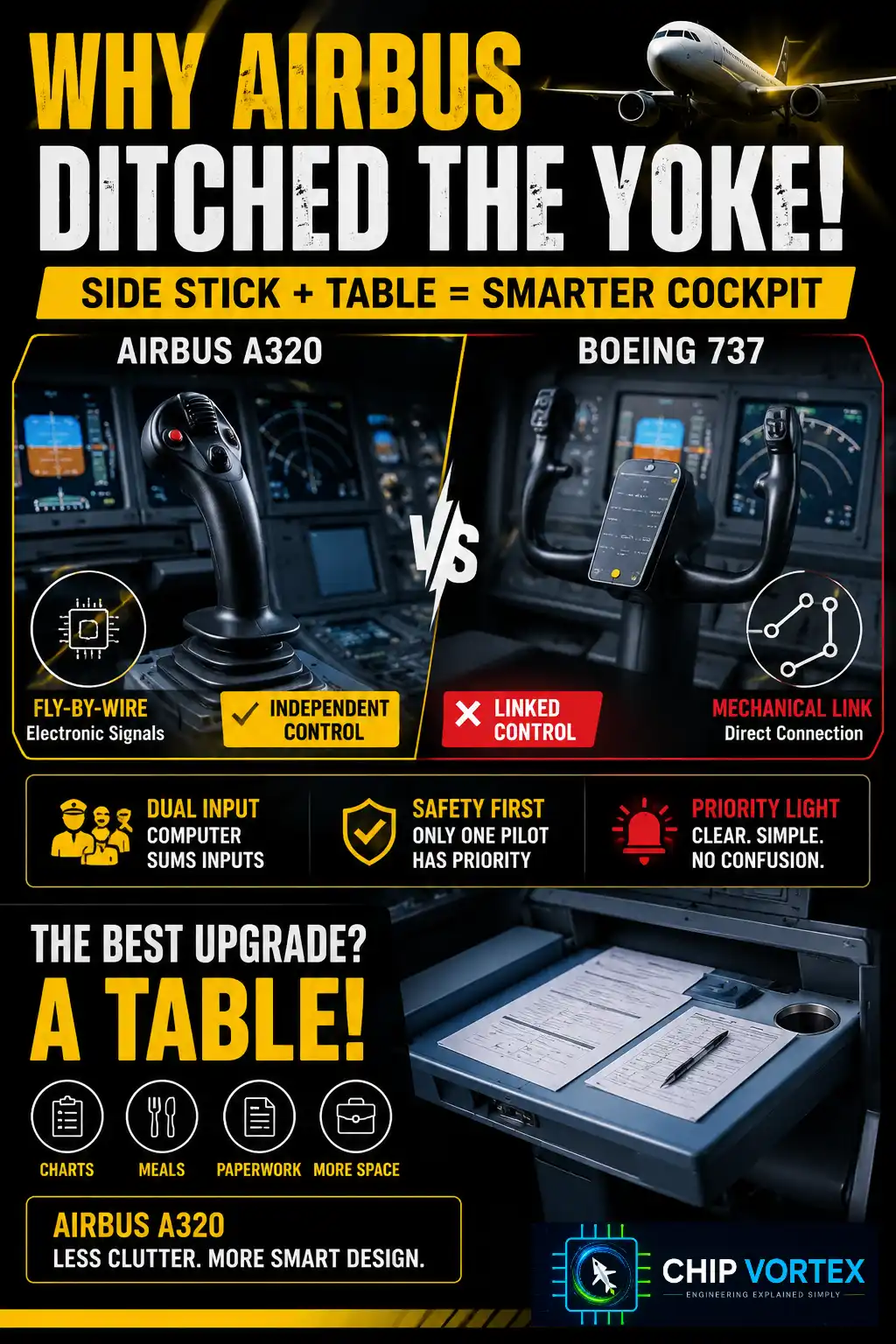
The sidestick is the A320’s signature. Instead of a yoke, each pilot flies with a compact stick at their outboard side — and it isn’t a mechanical linkage to anything. It’s fly-by-wire: the stick sends electrical signals to flight control computers, which move the surfaces while quietly keeping the aircraft inside its safe flight envelope.
Here’s the detail that surprises everyone: unlike the mechanically linked control columns we toured in the turboprop cockpit — where one pilot’s inputs physically move both columns — A320 sidesticks move independently. One pilot cannot feel what the other is doing. If both make inputs at once, the aircraft sums them and announces “DUAL INPUT.” And when one pilot needs unambiguous control, the sidestick priority button takes it — lighting the sidestick priority light on the glareshield (yes, the one labeled on the photo) so there’s never doubt about whose aircraft it is. Different philosophy, same rule as always: exactly one pilot flying.
And the famous consolation prize: with no yoke in the way, each pilot gets a foldable table — the tray table Boeing pilots joke about and secretly envy. Charts, meals, paperwork: the A320 turned the space a yoke would occupy into a desk.
Zone 1: The Glareshield
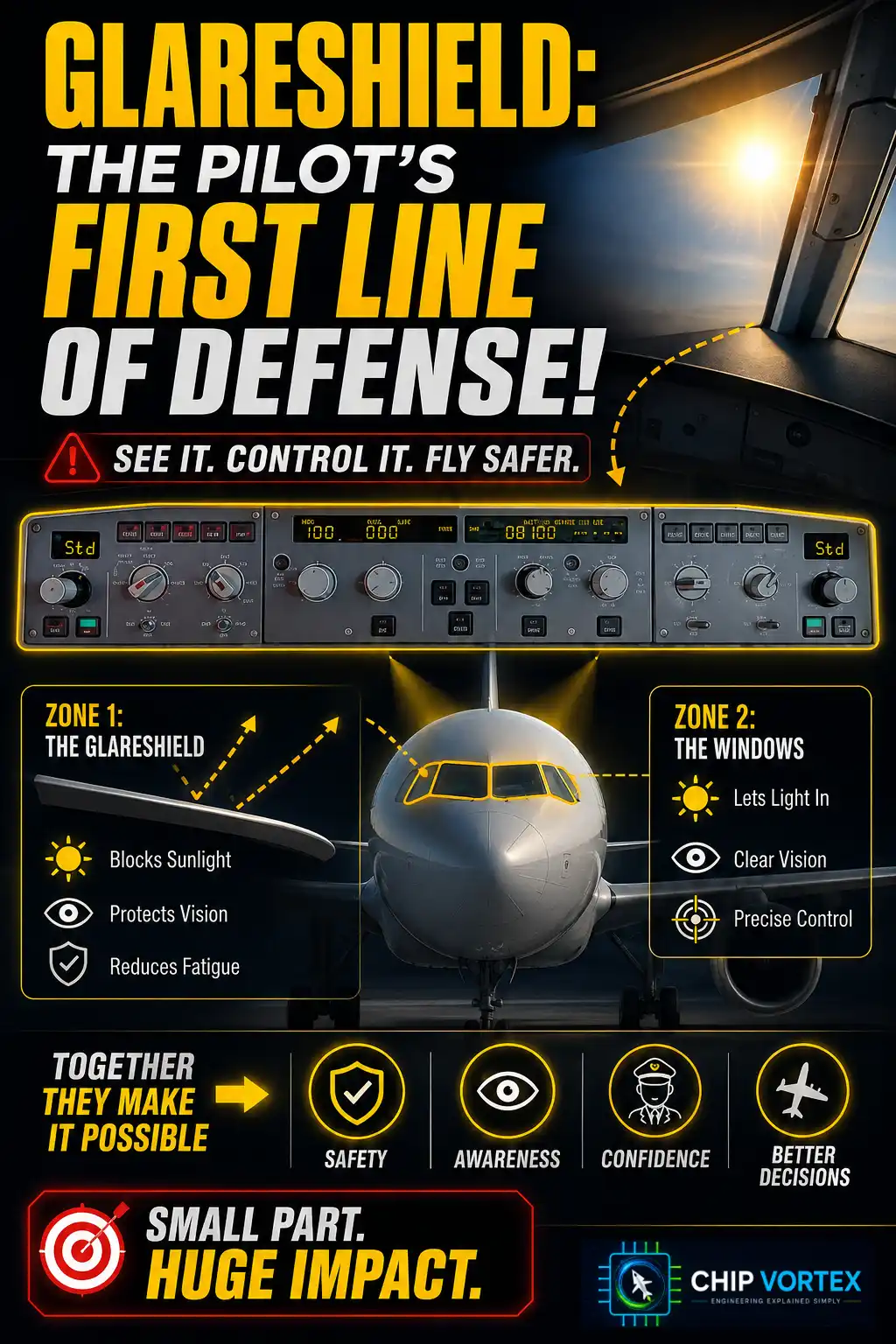
FCU (Flight Control Unit) — the wide panel of knobs across the glareshield: speed, heading, altitude, vertical speed. This is where pilots dial their intentions for the autopilot. EFIS Control Units at each end let each pilot configure their own displays — map range, weather overlay, navigation aids. Between them sit the attention-getters we met in the EICAS vs ECAM post: master warning and master caution lights, plus the autoland light — the indicator that stands guard during the automatic landings we covered in the ILS deep dive. Add the chrono button (flight timing at a thumb’s reach) and the sidestick priority lights, and the glareshield is complete: the aircraft’s intentions on the left-to-right, its objections in red and amber.
Zone 2: The Main Instrument Panel
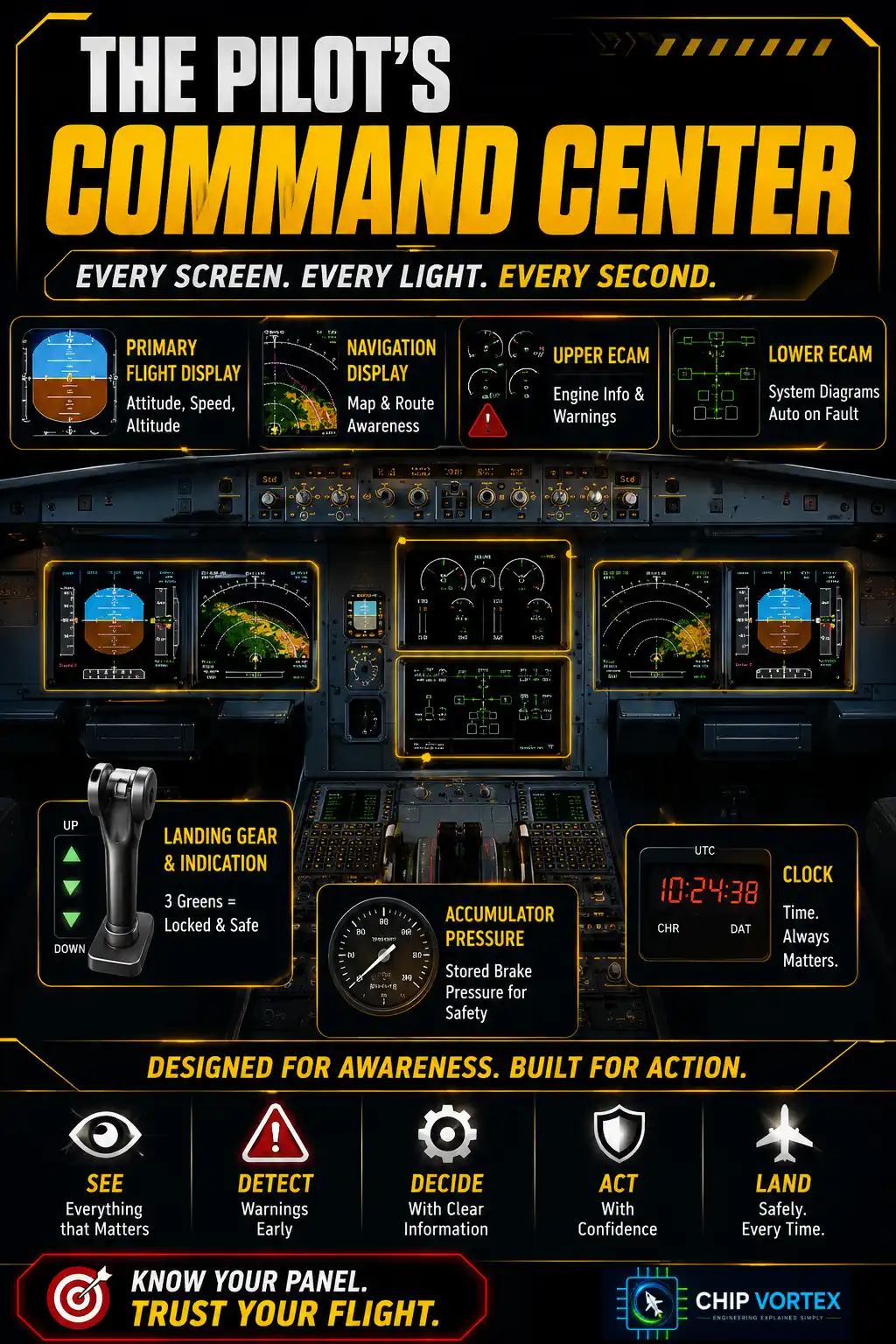
Each pilot faces a Primary Flight Display (attitude, speed, altitude — the air-data picture) and a Navigation Display beside it, with a terrain switch to overlay terrain awareness on the map. Center stage belongs to the two screens that define Airbus monitoring: the Upper ECAM (engine parameters and any active warnings with their corrective actions) and the Lower ECAM (system diagrams — the page that auto-appears when something faults, exactly as we saw in the ECAM post). The standby instrument waits between them for the day the main screens don’t. To the right: the landing gear lever with its gear indication lights (three greens — the phrase every aviation film borrows), the accumulator pressure indicator showing stored brake pressure for parking and emergencies, and a clock — because some things never leave the panel.
Zone 3: The Pedestal
The shared territory between the seats, and home to two more famous Airbus opinions.
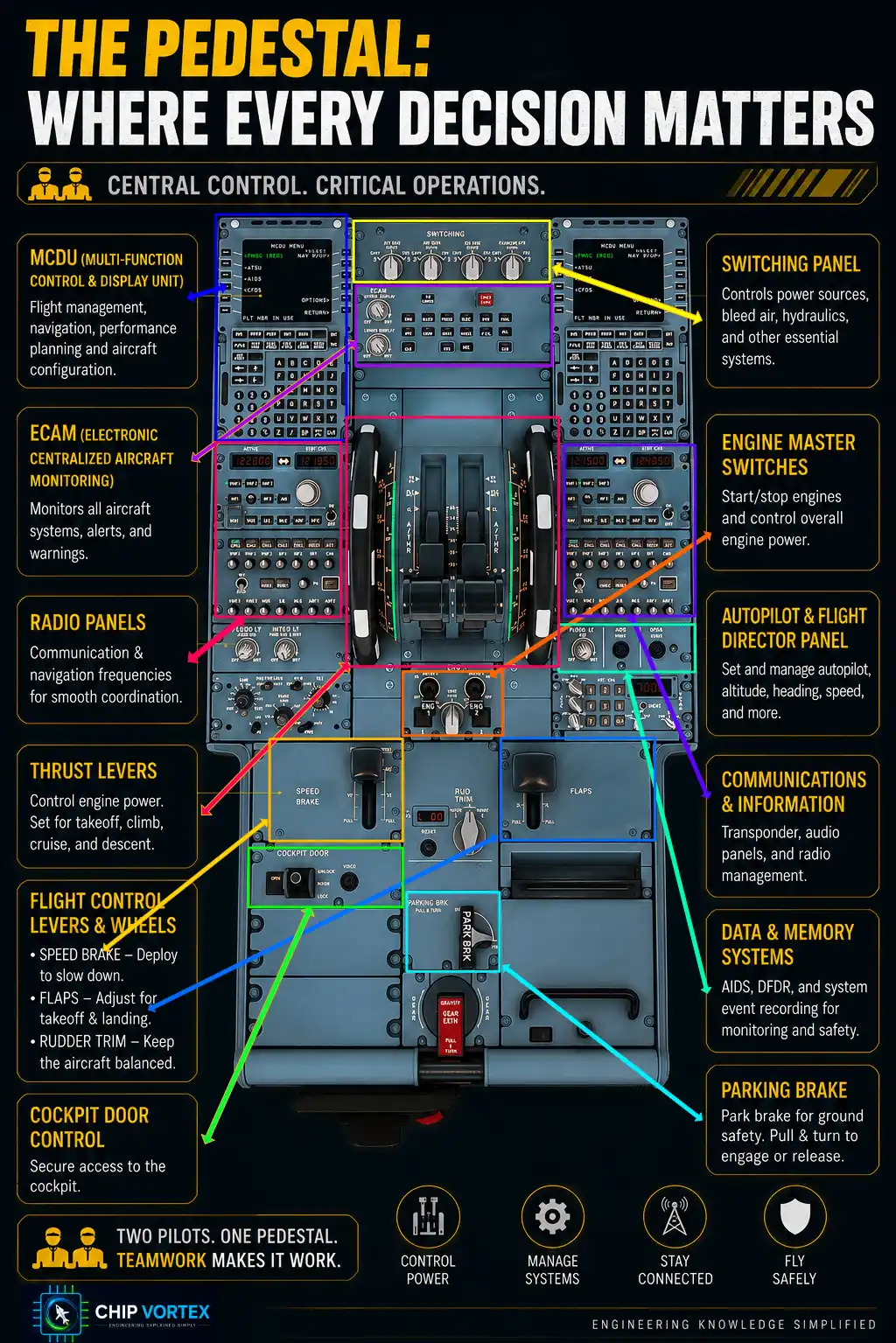
Thrust levers — and here’s surprise number two: in normal A320 operation, they don’t move on their own. The pilots set them into a detent (like CLB for climb), and the autothrust varies engine power without back-driving the levers. Boeing’s throttles physically move as thrust changes; Airbus’s stay put and let the displays tell the story. Two valid philosophies, one endless debate.
Engine Master switches — the A320 starts and stops its engines with two guarded switches, not levers. Flip ENG 1 MASTER to ON with the mode selector in ignition, and the aircraft runs the start sequence itself.
MCDU (Multipurpose Control & Display Unit) — the keyboard-and-screen interface to the Flight Management System: route, weights, performance. Two of them, one per pilot, exactly where both can reach.
Around them: the speed brake lever (spoilers on demand), the flaps lever with its gated positions, the pitch trim wheels (the large wheels flanking the pedestal — one of the few controls still mechanically connected), rudder trim, and the park brake. Aft on the pedestal live the radio panels, audio control panels, and transponder — the communication suite from our comms systems tour — plus the weather radar controller, the ECAM control panel (for calling up system pages manually), the display switching panel, the lighting panels, and two small buttons with big jobs: AIDS (the Aircraft Integrated Data System, for capturing data snapshots) and the DFDR event button, which bookmarks this moment in the flight data recorder — a story for a future post about the black boxes.
Zone 4: The Human Corners
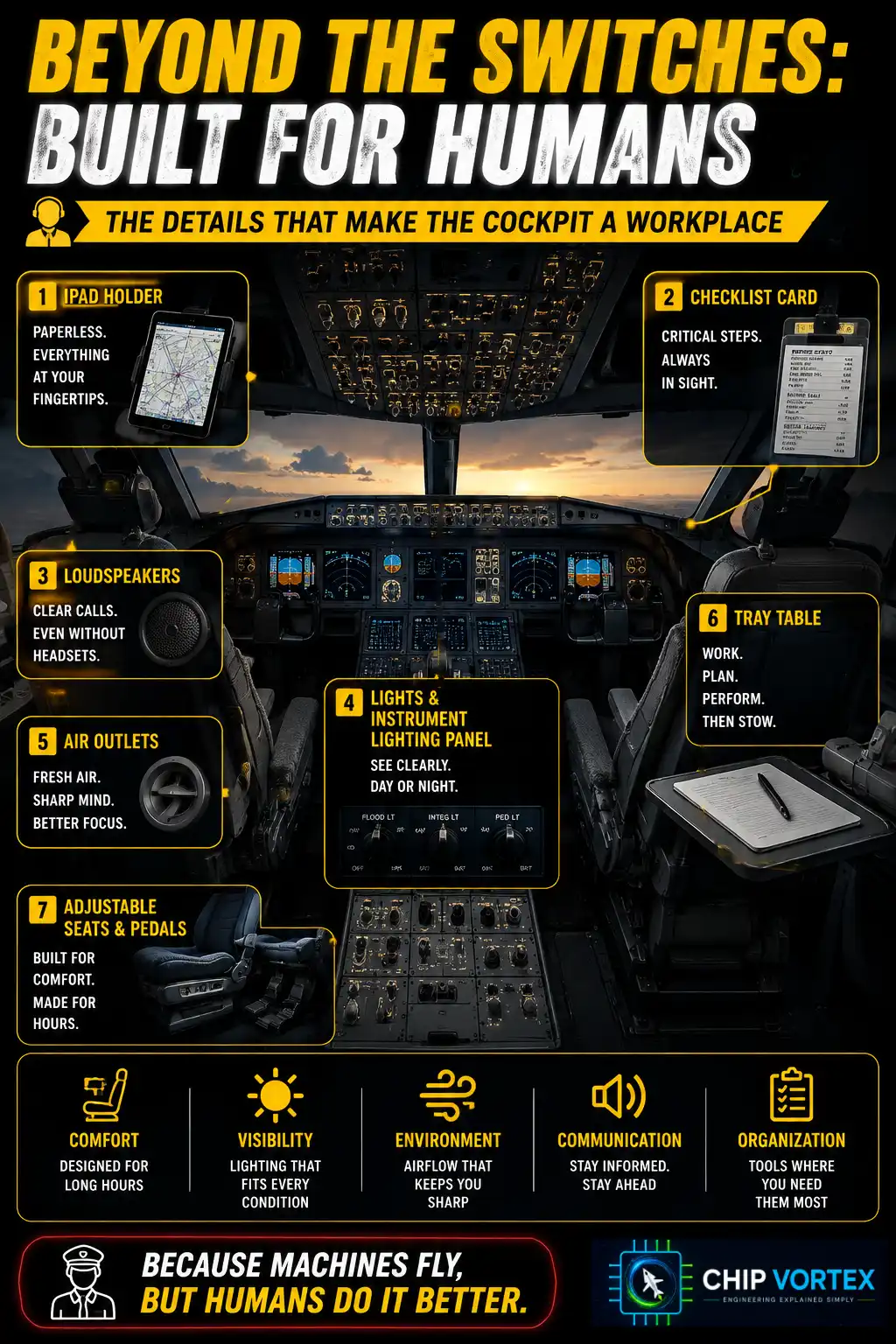
The details that make it a workplace: the iPad holder (the electronic flight bag era — charts and manuals went paperless), the checklist card within reach, loudspeakers for when headsets are off, flood lights and the instrument lighting control panel for night operations, air outlets, adjustable seats and pedals — and that tray table, folded away until cruise. Airliners are flown by people for hours at a time; the cockpit quietly admits it.
FAQ: A320 Cockpit
Why does the A320 have a sidestick instead of a yoke?▾
Fly-by-wire made the mechanical yoke unnecessary — the stick sends electrical signals to computers, which fly the surfaces and protect the flight envelope. The freed space became the pilots’ table.
Do the two sidesticks move together?▾
No — they’re independent, with no mechanical link. Simultaneous inputs are summed and trigger a “DUAL INPUT” alert, and the priority button gives one pilot unambiguous control, lit on the glareshield for both to see.
Why don’t A320 thrust levers move by themselves?▾
By design. Pilots park the levers in detents and the autothrust adjusts power electronically without moving them — Airbus trusts the displays to show thrust, where Boeing moves the levers. Same outcome, different philosophy.
What are the upper and lower ECAM screens?▾
The upper ECAM shows engine data and active warnings with corrective actions; the lower ECAM shows system diagrams and auto-displays the affected system when a fault occurs — the Airbus monitoring approach in two screens.
Is the cockpit the same across the A320 family?▾
Essentially yes — the A318 through A321, including the neo generation, share a common cockpit and a single type rating. Learn this flight deck once, and an airline can move you across the whole family — a huge reason for its popularity.
So — sidestick or yoke? Moving throttles or silent detents? Pick your side in the comments; this debate has outlasted careers. Save the labeled photo, then compare it with the turboprop cockpit to see how differently two aircraft solve the same jobs — and go deeper into the screens with EICAS vs ECAM.