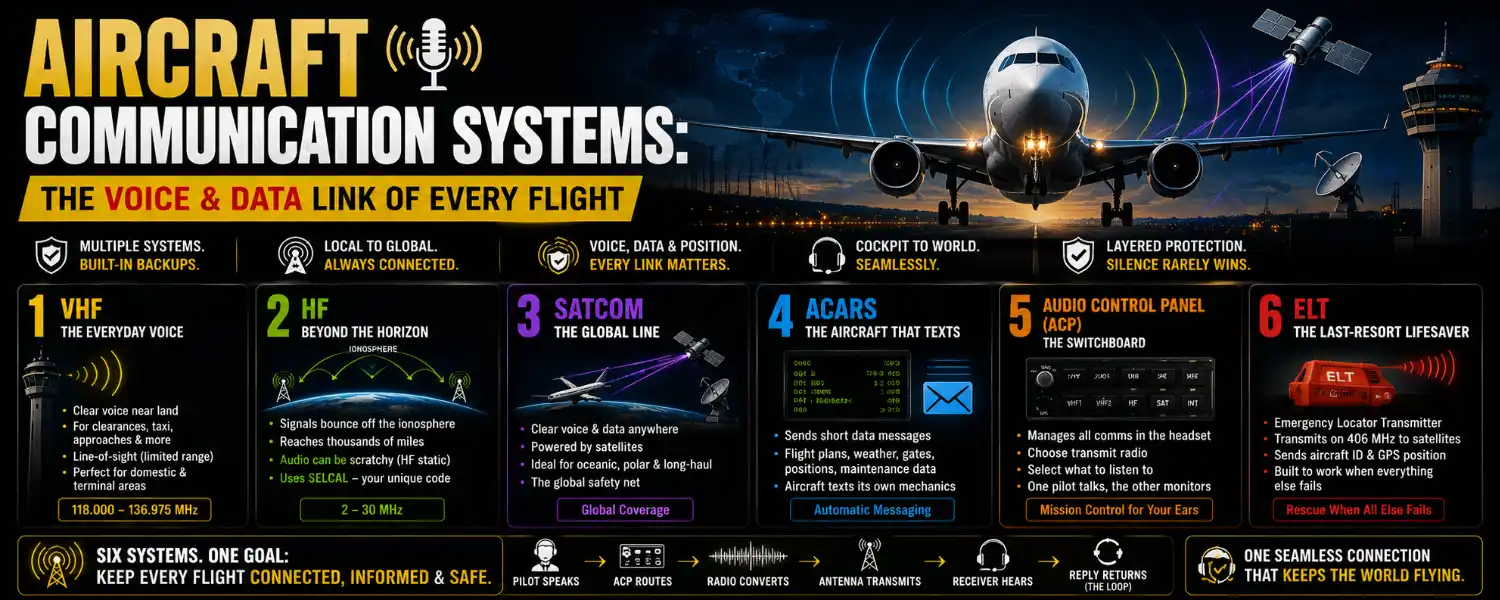
The communication system keeps pilots connected with air traffic control, other aircraft, and their airline’s operations center — anytime, anywhere in the world — through a layered set of radios and data links: VHF for everyday voice, HF and SATCOM for the oceans, ACARS for digital messages, and the ELT for the day everything else has failed.
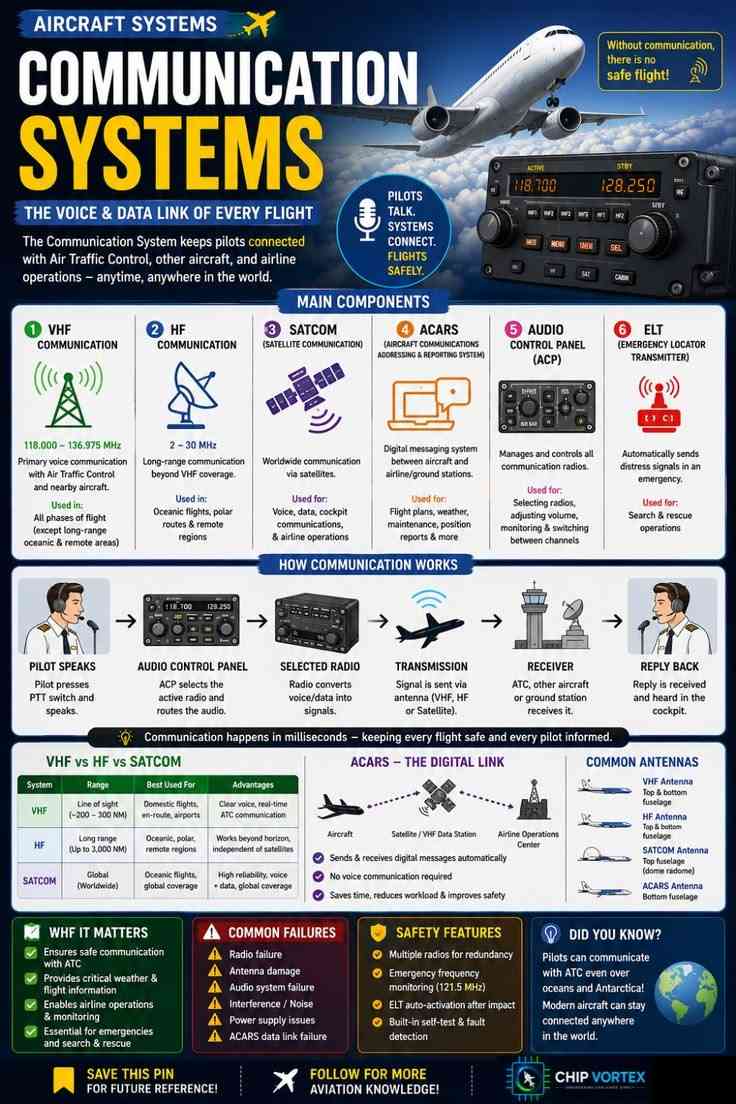
Save the chart, then let’s go through the six components — from the everyday workhorse to the last-resort lifesaver.
[🔧 Try It Yourself: Interactive Aircraft communication Simulator]
The 6 Main Components
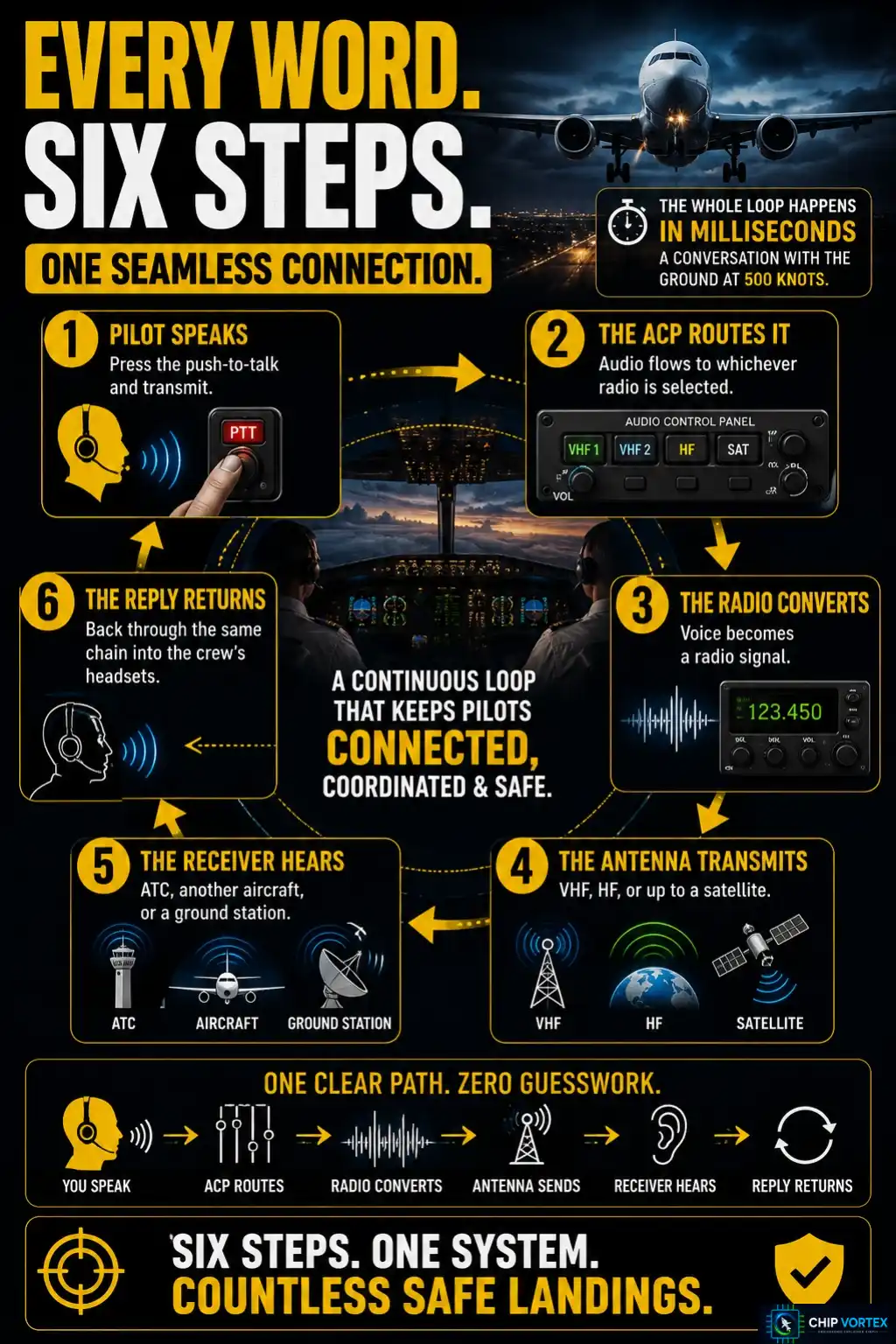
1. VHF Communication — The Everyday Voice
The workhorse. VHF radios (118.000–136.975 MHz) carry nearly every word spoken between pilots and controllers — clearances, taxi instructions, approach vectors, the lot. The catch is physics: VHF travels in straight lines, so range is limited to the radio horizon — a couple of hundred nautical miles at cruise altitude, far less on the ground. Perfect for domestic flying and terminal areas; useless in the middle of an ocean. Which is why the next two components exist.
2. HF Communication — Beyond the Horizon
HF radio (2–30 MHz) performs the trick VHF can’t: its signals bounce off the ionosphere — the charged upper layer of the atmosphere — and skip back down thousands of miles away, curving communication around the planet with no satellite involved. The price is audio quality (oceanic HF has a famously scratchy, whistling character), and the clever fix is SELCAL: crews don’t sit listening to static for hours — the ground station transmits the aircraft’s unique code, a chime sounds in the cockpit, and only then does anyone put the volume up. One spotting detail: on modern jets the HF antenna hides inside the tail fin’s leading edge.
3. SATCOM — The Global Line
Satellite communication closes the remaining gaps: clear voice and data anywhere on Earth, relayed through satellite constellations via the dome-shaped radome on the upper fuselage. Oceanic crossings, polar routes, airline operational calls, and modern datalink services all ride on it. Where HF is the resourceful old-timer, SATCOM is the reliable global network — and airliners carry both, because layers are the whole philosophy here.
4. ACARS — The Aircraft That Texts
The digital housekeeper: ACARS (Aircraft Communications Addressing and Reporting System) exchanges short data messages between the aircraft and the ground automatically over VHF or satellite — flight plans, weather updates, gate assignments, position reports. And here’s the part maintenance people love: the aircraft texts its own mechanics. Engine health snapshots and fault reports transmit automatically in flight, so by the time the aircraft parks, engineering may already know what it needs. No voice, no workload — just the aircraft quietly doing its own paperwork.
5. Audio Control Panel (ACP) — The Switchboard
Each pilot’s ACP is the traffic junction for every sound in their headset: which radio transmits when the push-to-talk is pressed, which channels are monitored, at what volume. It’s how one pilot can talk to ATC while the other checks weather on a second radio — and how both keep a permanent ear on the frequencies that matter. We saw these panels on the pedestal in our cockpit tour; this is what they were doing.
6. ELT — The Last-Resort Lifesaver
The Emergency Locator Transmitter speaks only when everything else has gone silent. Triggered automatically by impact forces (or manually by the crew), a modern ELT transmits a distress signal on 406 MHz to the international COSPAS-SARSAT satellite network — complete with the aircraft’s identity and GPS position — while also broadcasting a homing signal rescuers can track on scene. It’s the one radio on board designed for a flight nobody plans.
How Communication Works: 6 Steps
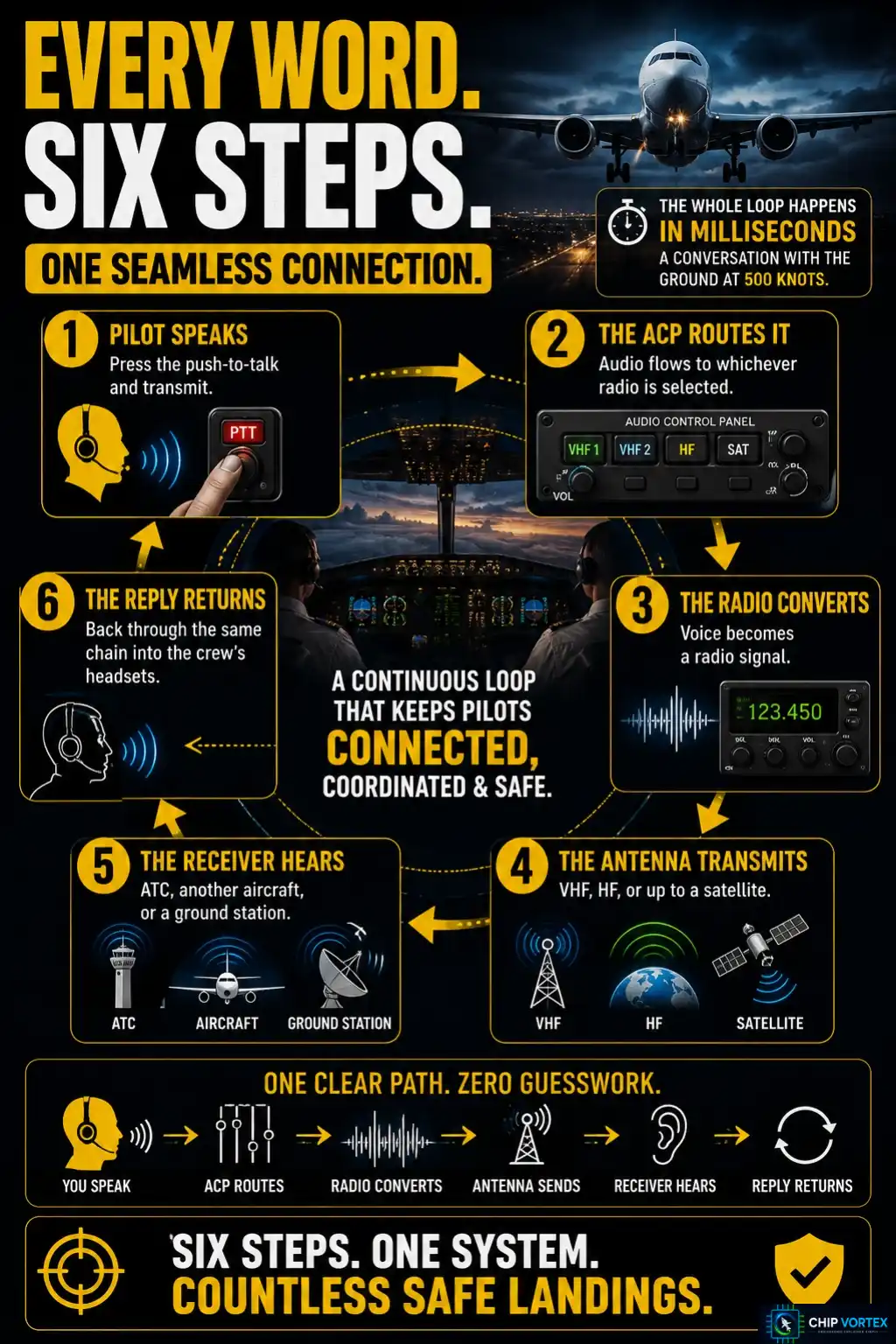
Pilot speaks — press the push-to-talk, transmit. The ACP routes it — audio flows to whichever radio is selected. The radio converts — voice becomes a radio signal. The antenna transmits — VHF, HF, or up to a satellite. The receiver hears — ATC, another aircraft, or a ground station. The reply returns — back through the same chain into the crew’s headsets. The whole loop happens in milliseconds — a conversation with the ground at 500 knots.
VHF vs HF vs SATCOM: The Three Ranges
| System | Range | Best For | Advantage |
|---|---|---|---|
| VHF | Line of sight (~200–300 NM) | Domestic flights, en-route, airports | Clear voice, real-time ATC |
| HF | Long range (up to ~3,000 NM per hop) | Oceanic, polar, remote regions | Works beyond the horizon, no satellite needed |
| SATCOM | Global | Oceanic flights, worldwide coverage | High reliability, voice and data anywhere |
Three technologies, one design principle: overlap. Wherever one layer thins out, another is already covering it.
From Voice to Text: ACARS and CPDLC
ACARS opened the digital door; CPDLC (Controller–Pilot Data Link Communications) walked ATC through it. On oceanic routes and increasingly over land, routine clearances now arrive as text messages on a cockpit screen — “CLIMB TO FL370” — which the crew reads and accepts with a button press. No congested frequency, no accent misheard through static, a written record of every instruction. Voice remains for anything urgent or unusual; the routine traffic moves to data. It’s the same evolution your own life went through — and it happened at 35,000 feet too.
The Human Layer: Why Pilots Repeat Everything
Listen to any ATC frequency and you’ll hear the ritual: the controller issues a clearance, and the pilot says it back word for word. That’s the readback/hearback loop — the pilot’s readback proves the message arrived intact, and the controller’s listening catches any error before it flies. Combine that with standardized phraseology (why it’s “climb flight level three seven zero,” never “go on up”), and voice communication becomes engineered against misunderstanding. And underneath it all sits aviation’s priority mantra — aviate, navigate, communicate — a deliberate reminder that talking comes third: fly the aircraft first, know where you’re going second, then tell someone about it.
Why It Matters
Communication is how a flight stays inside the system: safe coordination with ATC, weather and operational updates flowing in, the airline monitoring its aircraft across the globe — and in an emergency, the fastest possible path from “something’s wrong” to “help is coming.” A silent aircraft is an aircraft the world can’t help.
Common Failures — and the Layers That Catch Them
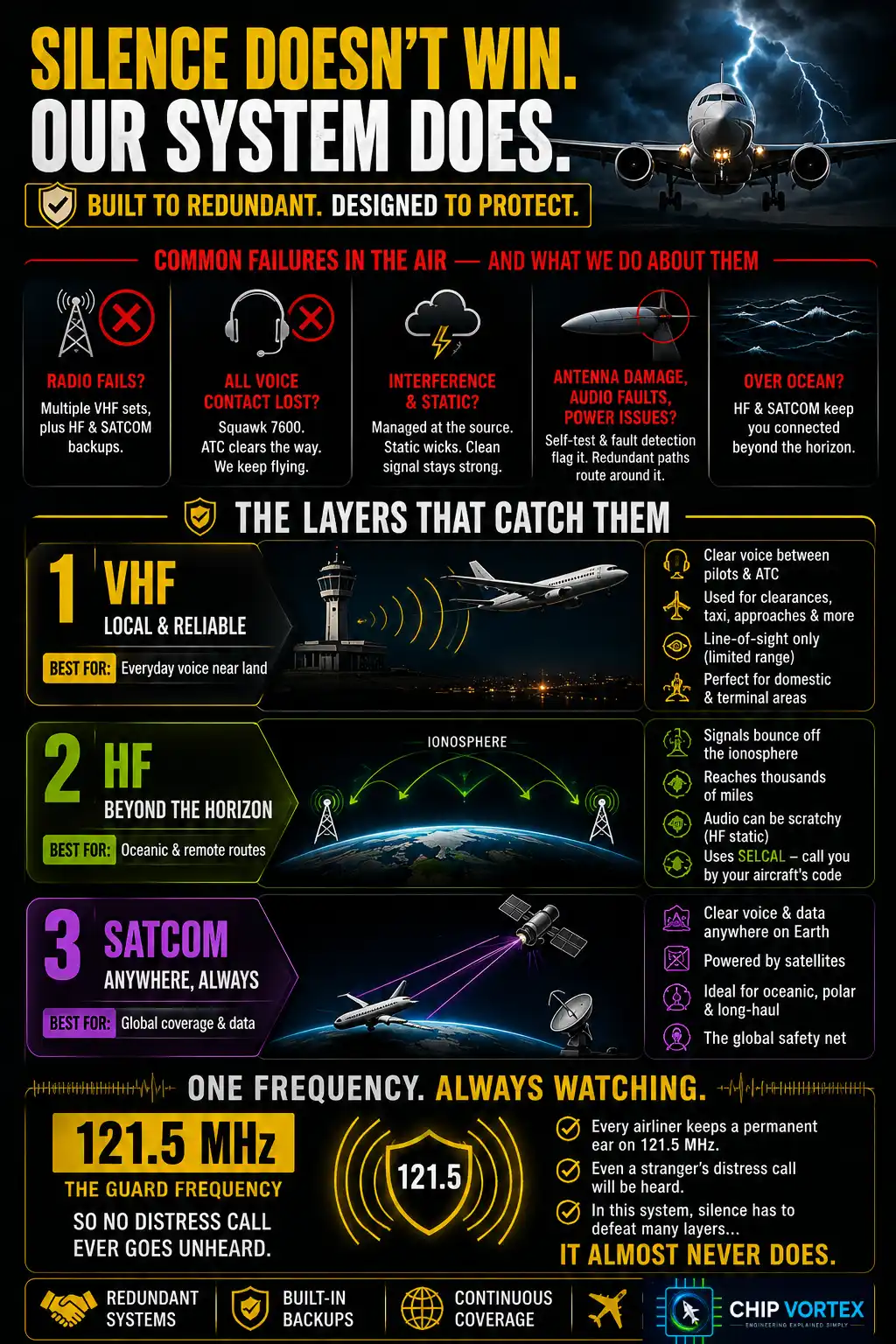
A radio fails? There are multiple — airliners carry several independent VHF sets, plus HF and SATCOM behind them. All voice contact lost? The transponder speaks instead: the crew squawks 7600, the universal radio-failure code, and ATC clears the way while the crew follows published lost-communication procedures — the flight continues safely, just more quietly. Interference and static? Managed at the source — remember the static wicks from our wing tour, bleeding away the charge that would otherwise crackle into the radios. Antenna damage, audio faults, power issues? Built-in self-test and fault detection flag them, and redundant paths route around them. And through it all, every airliner keeps a permanent ear on 121.5 MHz — the guard frequency — so that even a stranger’s distress call never goes unheard. In this system, silence has to defeat many layers before it wins; it almost never does.
Did You Know?
Pilots can communicate with ATC over the open ocean and even Antarctica — between HF’s ionospheric skip and SATCOM’s global constellations, a modern aircraft can stay connected literally anywhere on Earth. The middle of nowhere stopped being out of reach decades ago.
FAQ: Aircraft Communication Systems
What frequencies do pilots use to talk to ATC?▾
The VHF band from 118.000 to 136.975 MHz for everyday communication — and every airliner also monitors 121.5 MHz, the international emergency guard frequency.
How do pilots communicate over the ocean?▾
Through layers: HF radio that bounces signals off the ionosphere far beyond the horizon, SATCOM for clear global voice and data, and CPDLC data link for routine clearances as text. VHF simply can’t reach — so three other systems do.
What happens if a plane loses all radio contact?▾
The crew squawks 7600 on the transponder — the universal radio-failure code — and ATC immediately knows, clearing surrounding traffic. The flight continues under published lost-communication procedures. It’s an inconvenience, not an emergency.
What is ACARS?▾
A digital messaging system that automatically exchanges short data messages between the aircraft and the ground — flight plans, weather, position reports, and even engine health data sent straight to the maintenance team.
Why do pilots repeat everything ATC says?▾
It’s the readback/hearback safety loop: repeating the clearance proves it was received correctly, and the controller listening to the readback catches any error before it becomes a flight path.
Next time you hear that calm radio chatter in a cockpit video, you’ll know the machinery and the discipline behind every word. Which surprised you more — the aircraft that texts its mechanics, or squawk 7600? Tell us in the comments. Save the chart, and keep the series going: Inside the Cockpit, the Navigation System, and the ILS.