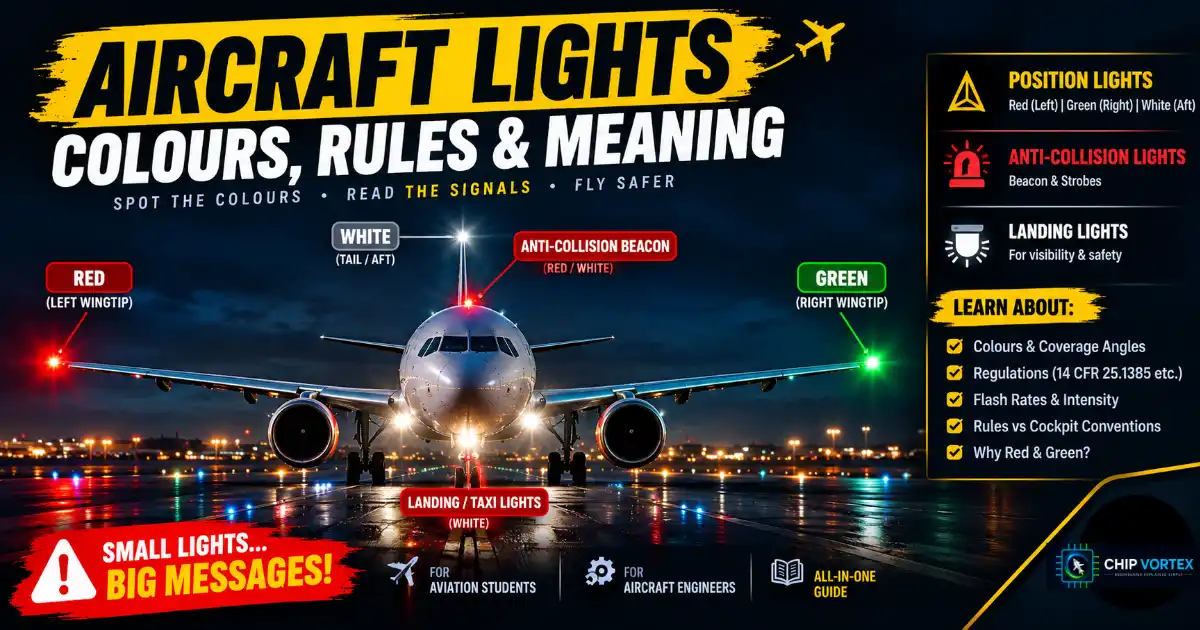
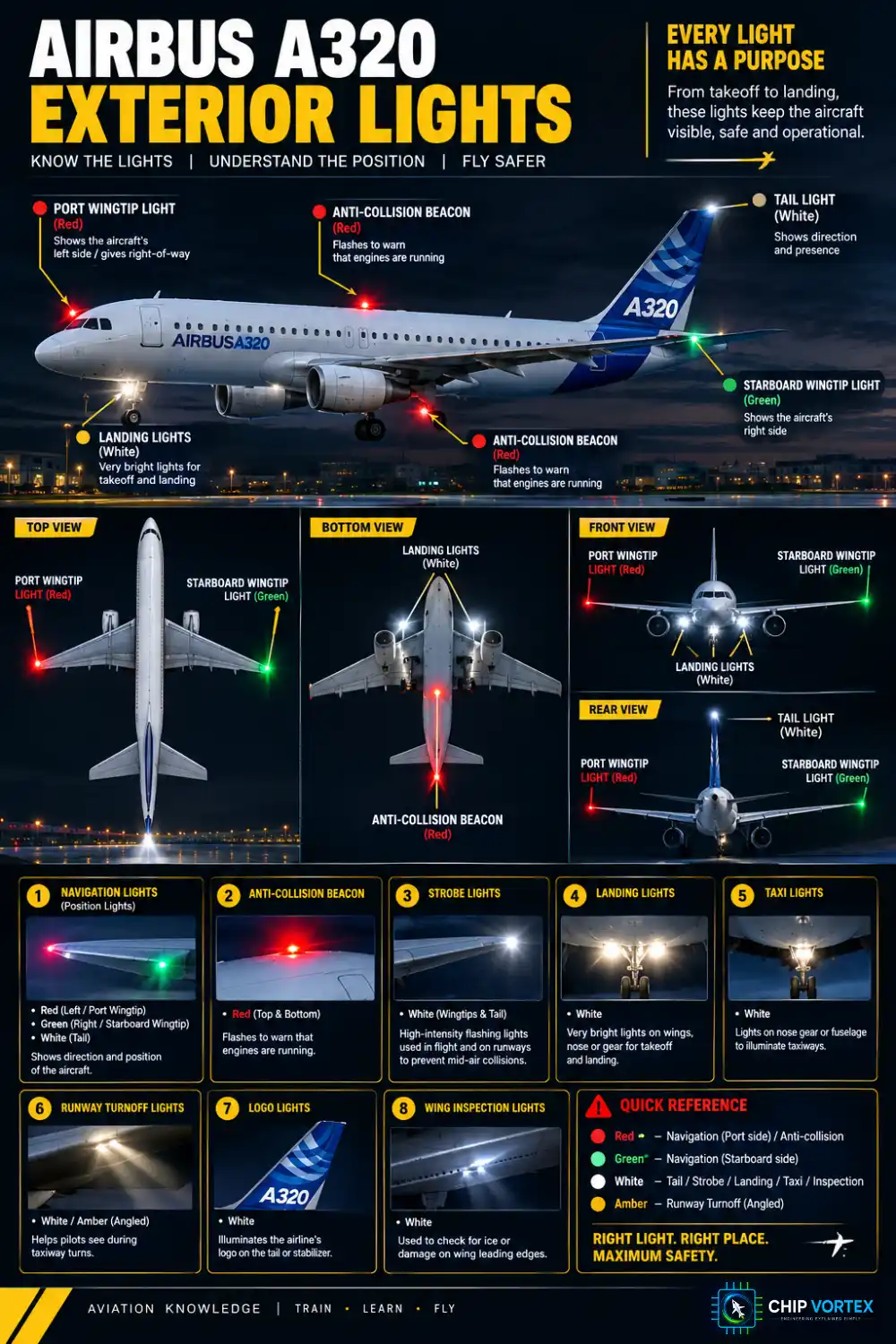
Look up at a night sky and you can read an aircraft’s direction before you can see its shape. That is the entire design intent behind aircraft lights: a system of colours, arcs and flash rates that tells an observer where an aircraft is, which way it is pointing, and whether it is dangerous to approach.
Here is what each of the airplane lights does, which ones the regulations actually require, and where the rules end and cockpit convention begins.
Position Lights (Navigation Lights): Red, Green and White
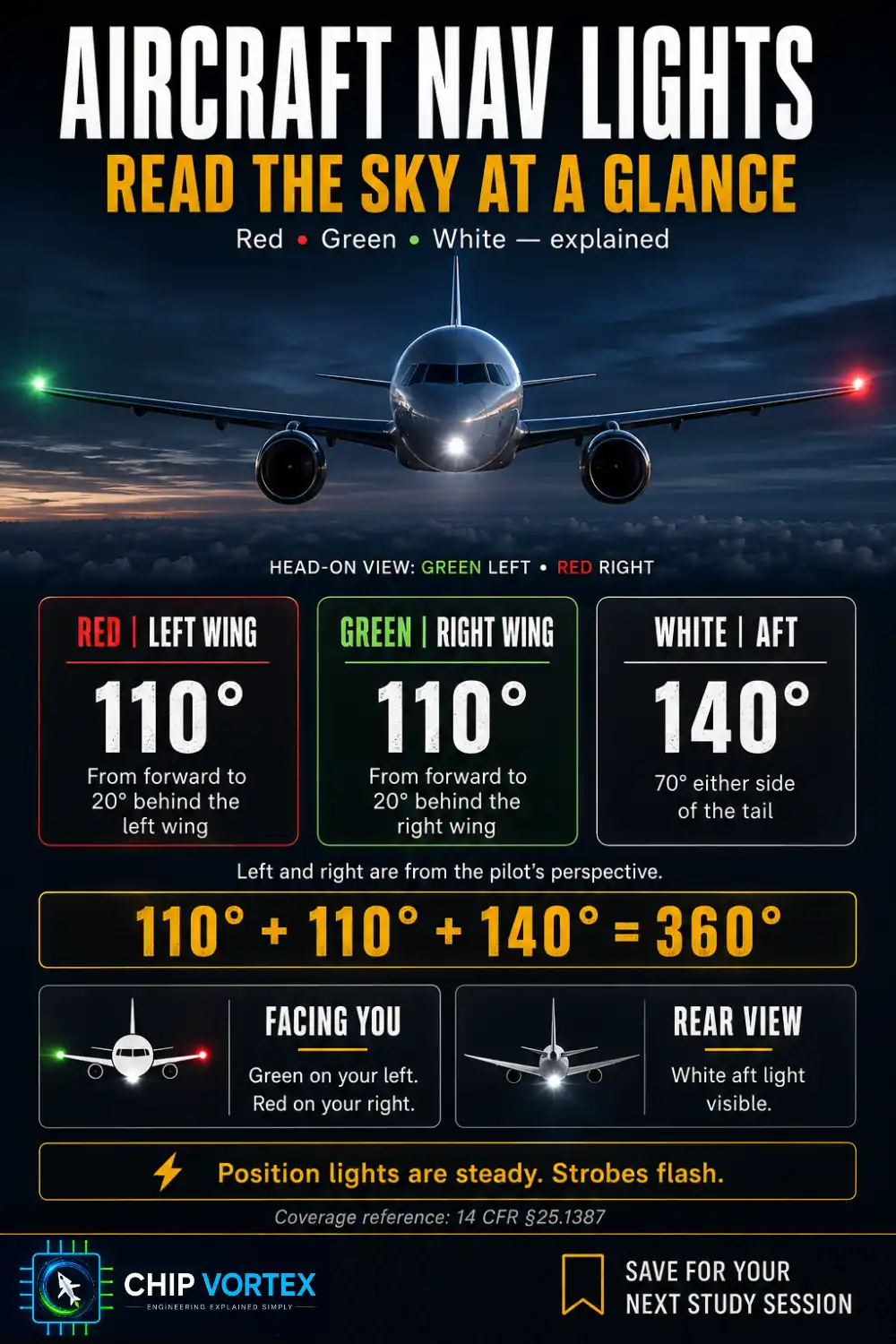
Position lights and navigation lights are the same thing — the regulations say “position,” pilots usually say “nav.” Under 14 CFR 25.1385 the arrangement is fixed: a red light on the left wingtip, a green light on the right, spaced as far apart as practicable, and a white light as far aft as possible on the tail or on each wingtip.
The clever part is the coverage. Section 25.1387 defines them as dihedral angles rather than beams:
| Light | Dihedral angle | Coverage |
|---|---|---|
| Red (left) | Angle L | 110° to the left of the nose |
| Green (right) | Angle R | 110° to the right of the nose |
| White (aft) | Angle A | 70° each side of the tail — 140° total |
110 + 110 + 140 = 360°. There is no direction from which an aircraft shows nothing.
And the colours you see tell you the geometry — but get the direction right, because it is easy to reason backwards. An aircraft flying towards you presents its left wing on your right. So:
- Green on your left, red on your right — it is coming towards you.
- Red on your left, green on your right — it is heading away.
- One colour alone — you are seeing it side-on.
- A steady white — you are behind it.
The pilots’ mnemonic for the head-on case reads left to right: “green then red, turn right or you’re dead.” It matches the maritime rule too — two vessels meeting head-on each see the other’s red light to starboard, and both turn right to pass port to port.
How bright is bright enough?
Section 25.1391 sets minimum intensities in candles, and they are lowest where they matter least:
- Red and green, within 10° of dead ahead: 40 candles
- 10° to 20°: 30 candles
- 20° out to 110°: 5 candles
- Rear white, 110° to 180°: 20 candles
Note the qualifier in 25.1389: these intensities must be provided by new equipment with covers and filters in place. Real lenses fade, pit and craze in service. The FAA’s guidance on that degradation, AC 43-217, is scoped to anti-collision lights rather than position lights — but its point generalises, and it is where you will find the instruction that a photometer, not an eyeball, is the standard tool for measuring intensity.
Why Red and Green?
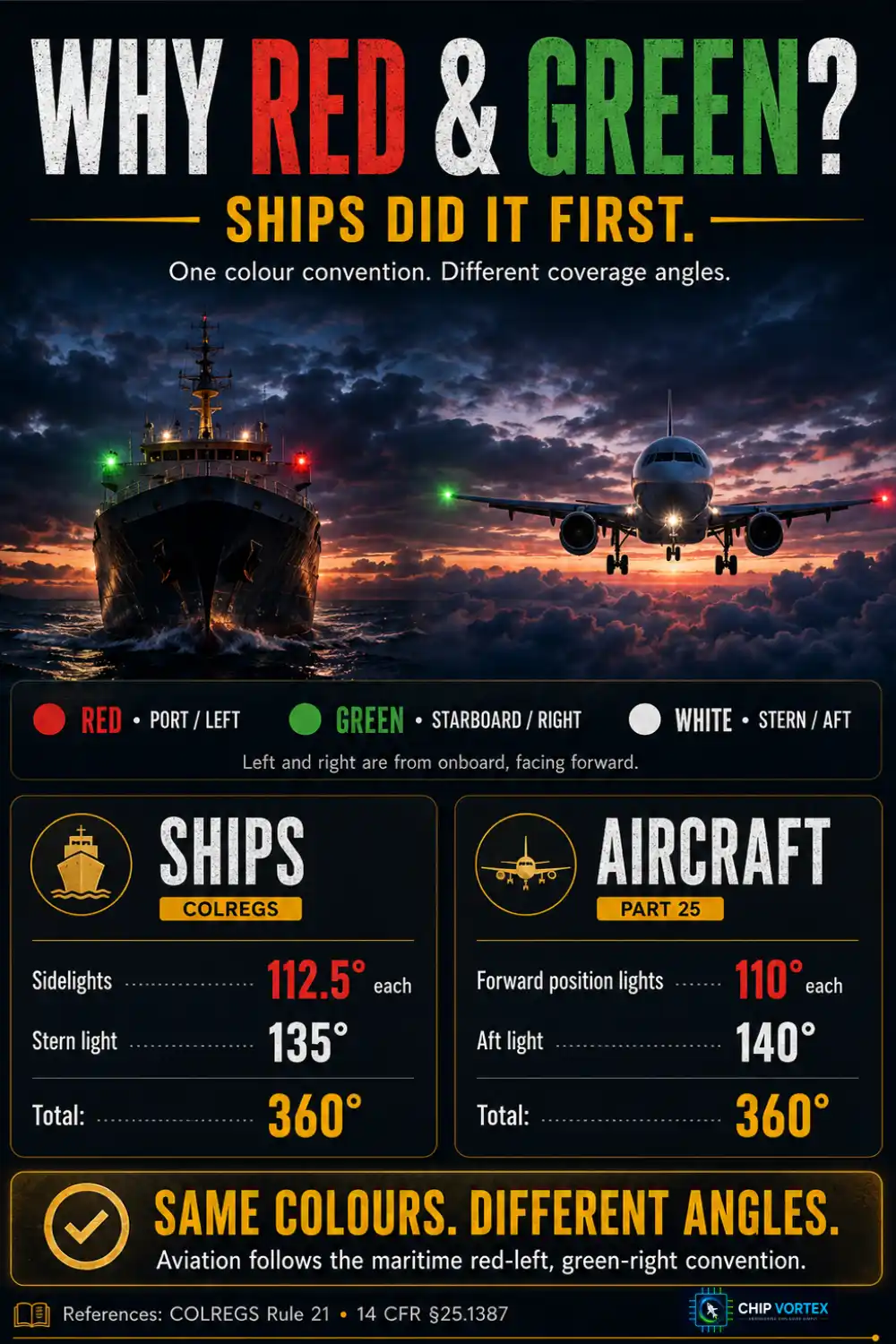
Because ships did it first. Under the international collision regulations a vessel shows a green sidelight to starboard, a red sidelight to port, and a white sternlight — the same red-left, green-right, white-aft pattern.
What is genuinely interesting is that aviation kept the pattern and changed the numbers:
| Ships (COLREGS) | Aircraft (Part 25) | |
|---|---|---|
| Sidelights | 112.5° each | 110° each |
| Stern / aft light | 135° | 140° |
| Total | 360° | 360° |
Both sum to a full circle; the split just moved. Be wary of the folklore explanations you will find online — there is no sourced basis for stories about red marking “the more dangerous side.” The honest answer is that aviation inherited a working maritime convention from nineteenth-century steam navigation practice.
Anti-Collision Lights: Beacon and Strobes
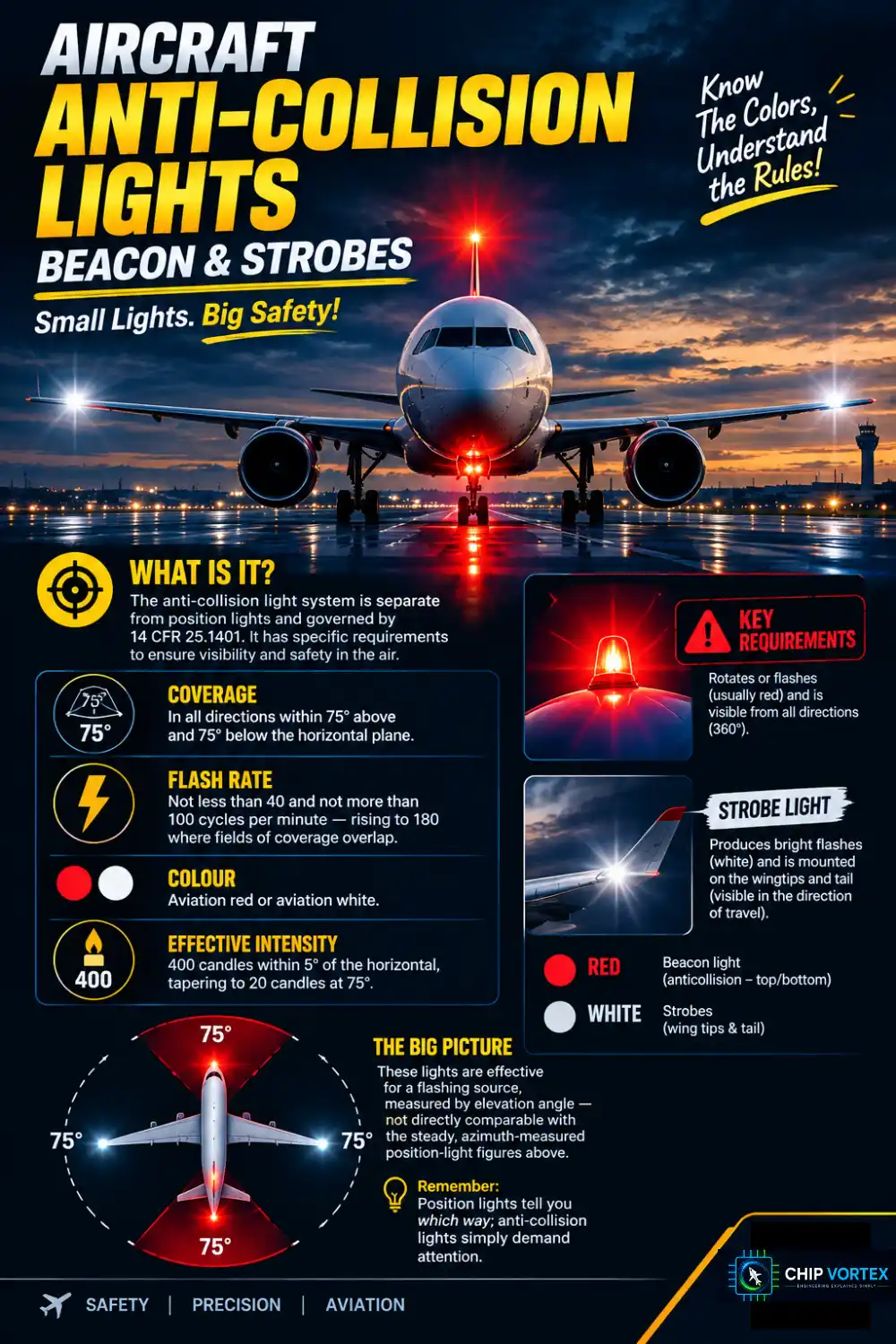
The anti-collision light system is separate from position lights and governed by 14 CFR 25.1401. Its requirements are more demanding:
- Coverage in all directions within 75° above and 75° below the horizontal plane.
- Flash rate of not less than 40 and not more than 100 cycles per minute — rising to 180 where fields of coverage overlap.
- Colour: aviation red or aviation white.
- Effective intensity of 400 candles within 5° of the horizontal, tapering to 20 candles at 75°.
Those are effective intensities for a flashing source, measured by elevation angle — not directly comparable with the steady, azimuth-measured position-light figures above. But the order of magnitude tells the story: position lights tell you which way; anti-collision lights simply demand attention.
The AIM is permissive about the hardware: an anti-collision system “can use one or more rotating beacons and/or strobe lights, be colored either red or white.” Which specific lights make up the approved system is set by each aircraft’s type certificate — so on many airliners the red beacons and the white strobes are elements of one certificated system rather than two independent ones.
The Rule vs the Convention
This is where most explanations go wrong, so it is worth being precise.
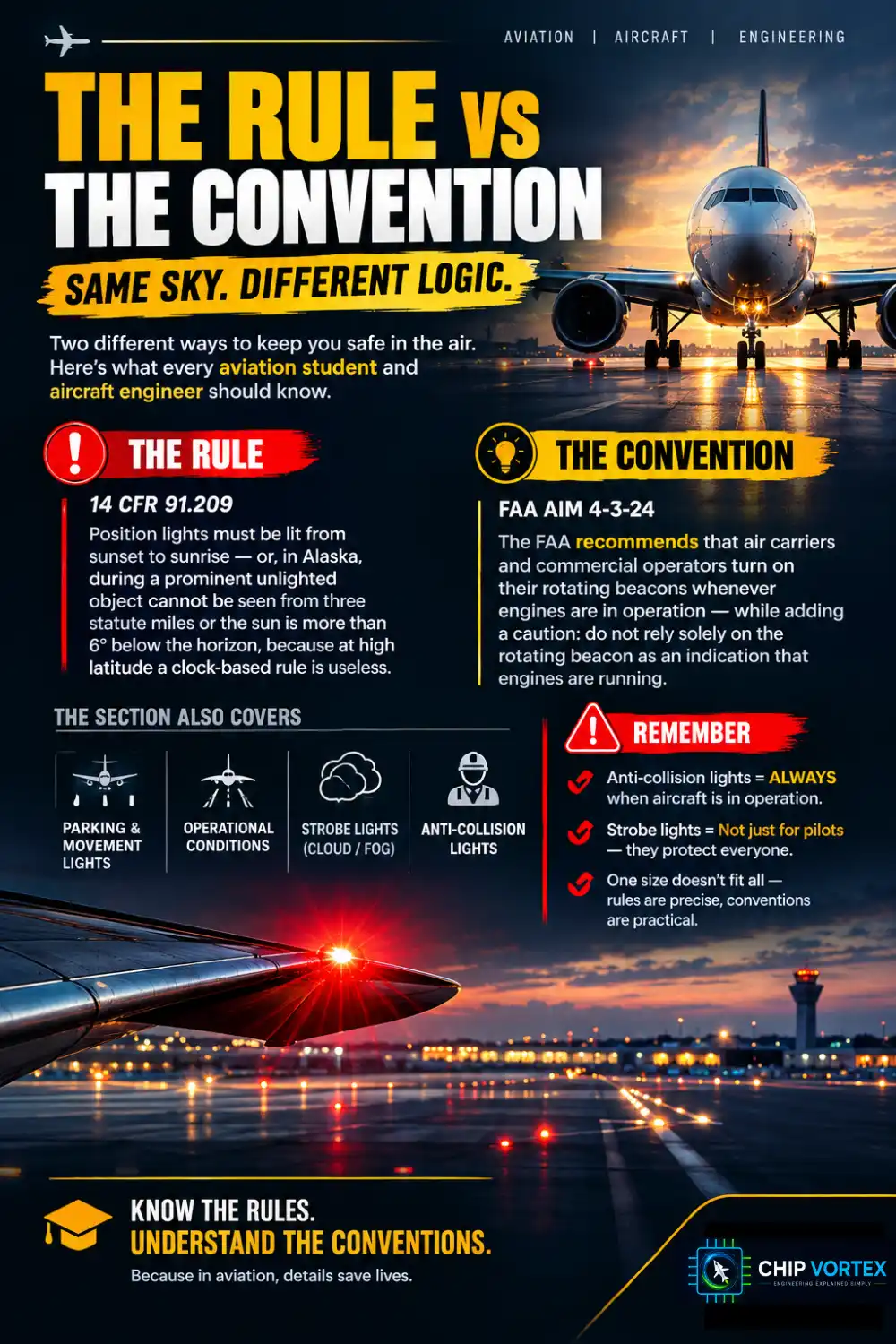
The rule is 14 CFR 91.209. Position lights must be lit from sunset to sunrise — or, in Alaska, during the period when a prominent unlighted object cannot be seen from three statute miles or the sun is more than 6° below the horizon, because at high latitude a clock-based rule is useless. The section also covers parking and moving aircraft near a night operations area, though there it allows alternatives to lit position lights. Anti-collision lights must be lit whenever an aircraft so equipped is operated, day or night, with one exception, quoted in full:
“However, the anticollision lights need not be lighted when the pilot-in-command determines that, because of operating conditions, it would be in the interest of safety to turn the lights off.”
That covers strobes reflecting off cloud or fog, or dazzling ground crew.
The convention is AIM 4-3-24, and it is written in the language of advice. The FAA recommends that air carriers and commercial operators turn on their rotating beacons whenever engines are in operation — while adding a caution people forget: do not rely solely on the rotating beacon as an indication that engines are running. Before taxi it recommends turning on navigation, position, anti-collision and logo lights, while warning that strobes should not be used during taxi if they would affect the vision of other pilots or ground crew. Illuminating all exterior lights when taxiing on or across a runway is a recommendation too — and explicitly at the pilot in command’s discretion.
So “beacon before start, strobes on the runway” is real and near-universal practice, but it is operator SOP and FAA advice, not a regulation.
Two rules that surprise people
- Under Part 91, a landing light is required only if the aircraft is operated for hire (91.205(c)(4)). A privately flown light aircraft can legally fly at night without one — though the AFM, or Part 121 and 135 rules, may say otherwise.
- Small Part 23 aeroplanes certificated after 11 March 1996 need an approved anti-collision system for day VFR, not just night.
One myth to retire while we are here: the daytime anti-collision requirement is not a Europe-only rule. Both 91.209(b) and Europe’s SERA.3215 require equipped aircraft to display anti-collision lights by day, and both allow the pilot to switch them off in the interest of safety. The real transatlantic difference is in which aircraft must be fitted with a system in the first place.
The Working Lights
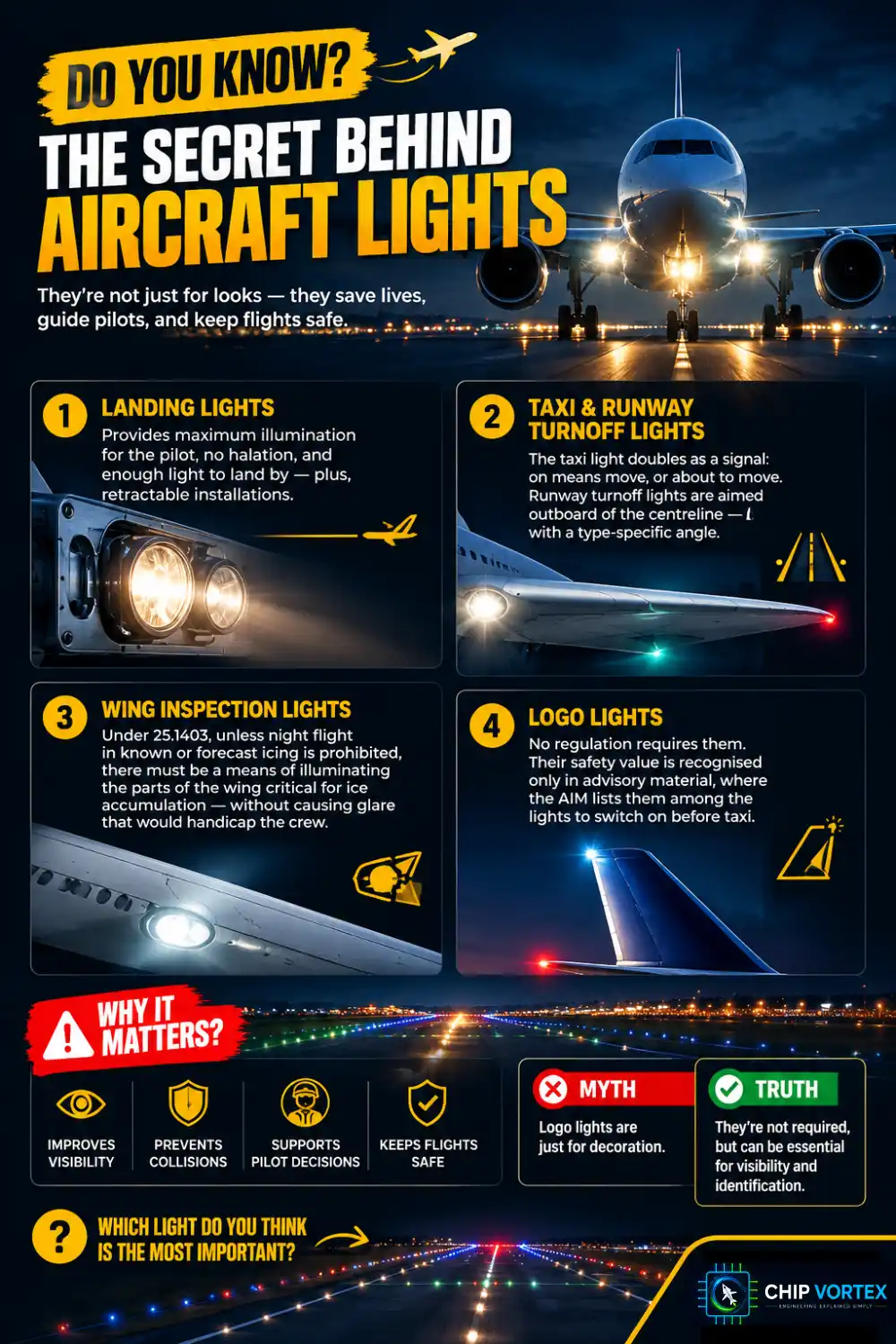
Landing lights. Section 25.1383 requires no objectionable glare visible to the pilot, no halation, and enough light to land by — plus, on retractable installations, a means of indicating to the crew when they are extended.
Taxi and runway turnoff lights. The taxi light doubles as a signal: on means moving or about to move. Runway turnoff lights are aimed well outboard of the centreline — the exact angle is type-specific — because the landing light beam is too narrow and aimed too far ahead to show you a taxiway exit.
Wing inspection lights are regulatory. Under 25.1403, unless night flight in known or forecast icing is prohibited, there must be a means of illuminating the parts of the wing critical for ice accumulation — without causing glare that would handicap the crew.
Logo lights are not. No regulation requires them. Their safety value is recognised only in advisory material, where the AIM lists them among the lights to switch on before taxi.
Operation Lights On
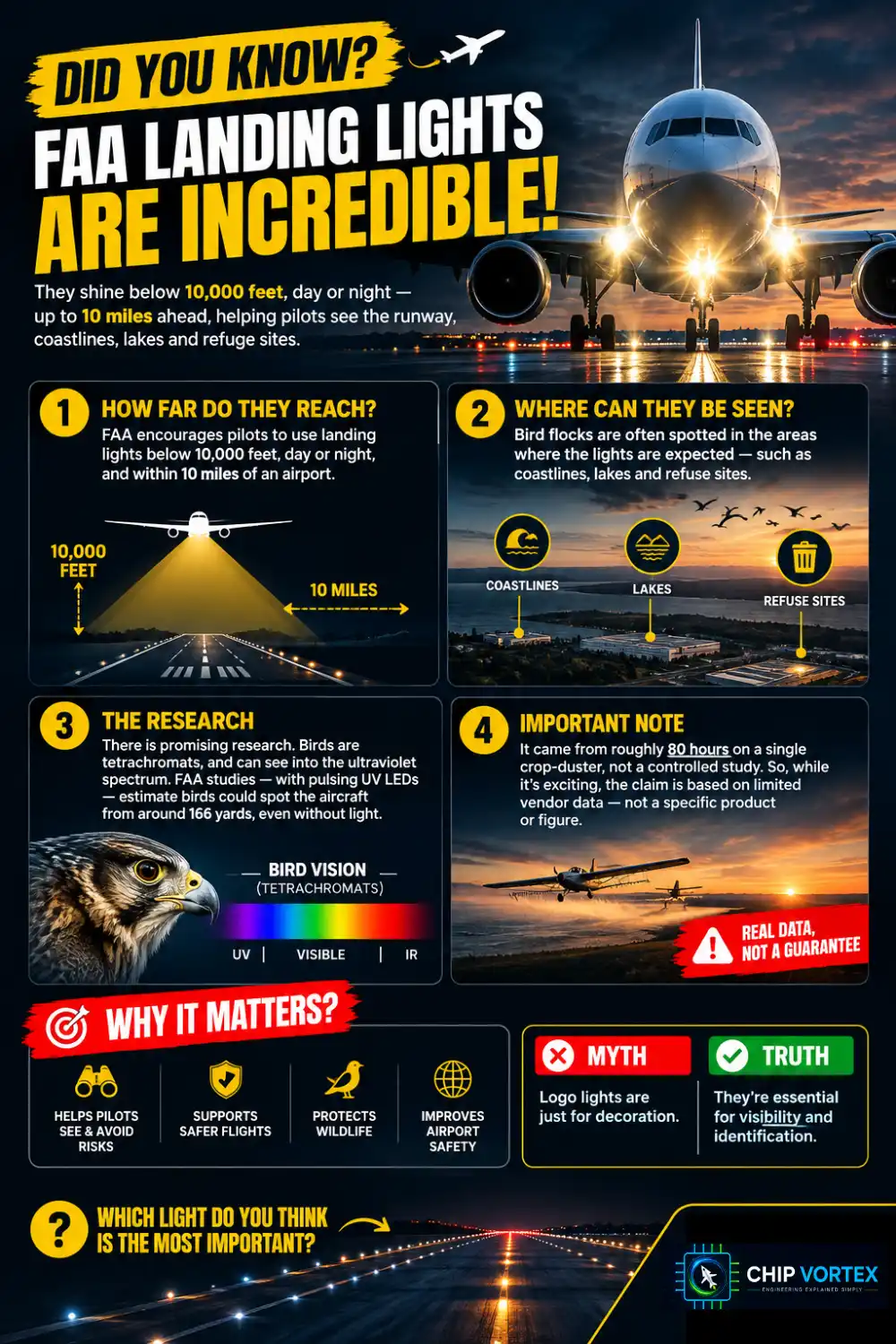
The FAA encourages pilots to use landing lights below 10,000 feet, day or night, and especially within 10 miles of an airport — and in areas where bird flocks are expected, such as coastlines, lakes and refuse sites.
There is promising research here too. Birds are tetrachromats and see into the ultraviolet, and FAA work with pulsing UV LEDs on landing gear produced an engineer’s estimate that birds spotted the aircraft from around 166 yards with the lights on, against 108 yards without. Treat that carefully: it came from roughly 80 hours on a single crop-duster, not a controlled study, and night, weather and other species remain future research. Be equally sceptical of vendor percentage claims for pulsed lighting — the FAA has endorsed no specific product or figure.
When Lights Are Not Enough
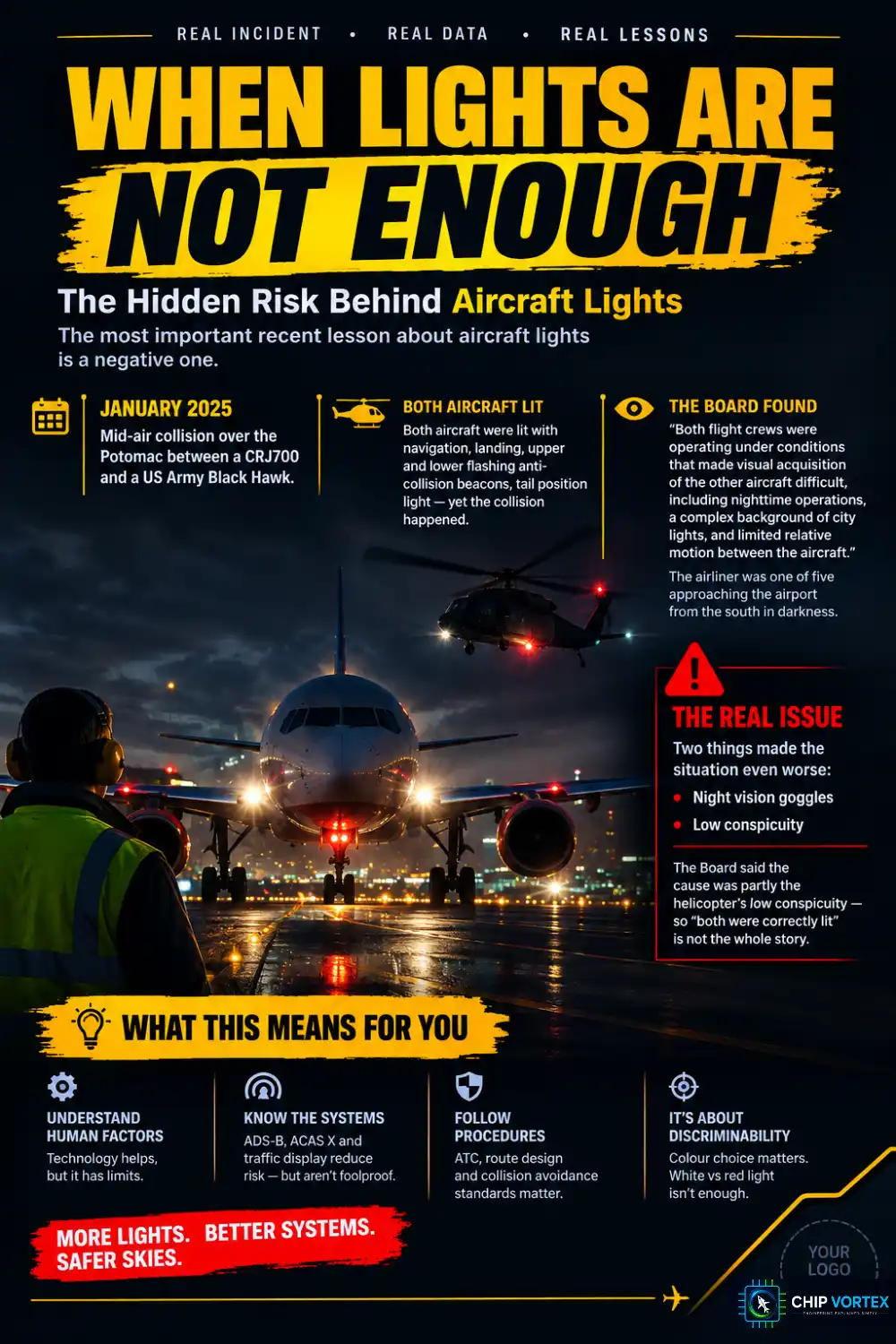
The most important recent lesson about aircraft lights is a negative one.
In the January 2025 mid-air collision over the Potomac between a CRJ700 and a US Army Black Hawk, both aircraft were lit. The NTSB documented the Black Hawk’s configuration in detail — landing light, navigation light, upper and lower flashing anti-collision beacons, tail position light. The Board found that “both flight crews were operating under conditions that made visual acquisition of the other aircraft difficult, including nighttime operations, a complex background of city lights, and limited relative motion between the aircraft.” The airliner was one of five approaching the airport from the south in darkness.
Two things complicate the picture and belong in any honest telling. The Black Hawk crew was flying with night vision goggles, and the NTSB devoted a section of the report to what the approaching traffic looked like through them. And the Board attributed causation partly to the helicopter’s low conspicuity — so “both were correctly lit” is not the whole story.
What is unambiguous is what the NTSB did next. Its recommendations addressed route design, ATC procedures, and traffic display and collision avoidance technology — ADS-B In, ACAS X. None addressed exterior lighting standards. The conclusion is uncomfortable but worth teaching: exterior lighting cannot guarantee detection against a cluttered urban background.
Japan’s JTSB made a related observation in its second interim report on the 2024 Haneda runway collision — all of the Coast Guard aircraft’s rearward-visible exterior lights were white, and it was stopped among white runway centreline and touchdown zone lights. The JTSB is running experiments with red lighting; the investigation is not concluded. But the principle already stands: colour choice is about discriminability against a background, not decoration.
Frequently Asked Questions
Which way is that aircraft flying?▾
Green on your left and red on your right means it is coming towards you — because its left wing, carrying the red light, is on your right. The reverse means it is going away. A steady white light means you are looking at its tail.
What is the difference between the beacon and the strobes?▾
Function and colour, not category. Both form part of the same certificated anti-collision system. The red beacon is conventionally used as an engines-running warning; the white strobes are far brighter and used in flight and on runways.
Can a pilot legally turn the strobes off?▾
Yes — 91.209(b) allows it whenever the pilot in command judges that operating conditions make it safer, such as strobes reflecting back off cloud.
Related reading: aircraft emergency systems, which covers the emergency escape path lighting, and the aircraft autopilot system.