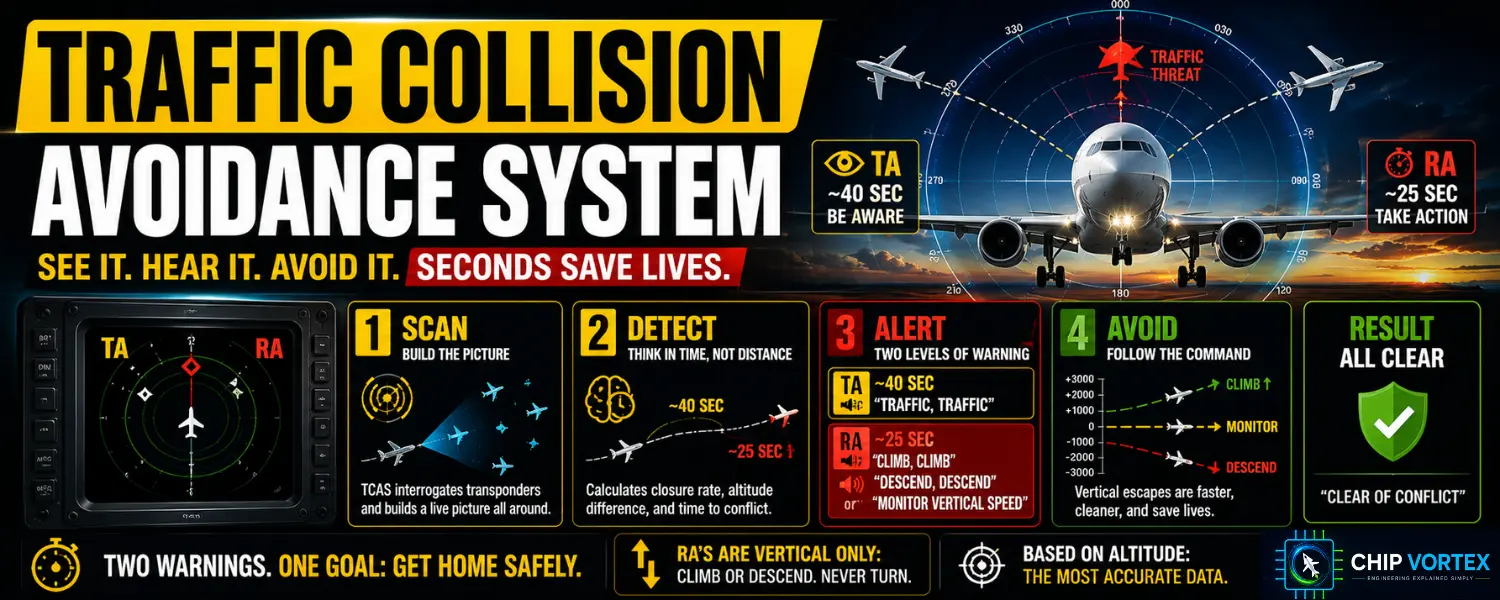
Two aircraft, converging at a combined closing speed of nearly a thousand knots. The pilots may never see each other — cloud, night, or simply the impossible geometry of spotting a dot that’s about to become an airplane. And yet, almost every time, nothing happens. Something on board saw it coming long before any human could.
TCAS — the Traffic Collision Avoidance System — is the silent guardian riding on every airliner. It continuously detects nearby traffic, warns the pilots when another aircraft gets too close, and, if a collision threat develops, commands the escape: climb or descend. It works independently of ground radar and air traffic control — a last line of defense that answers to no one but physics.
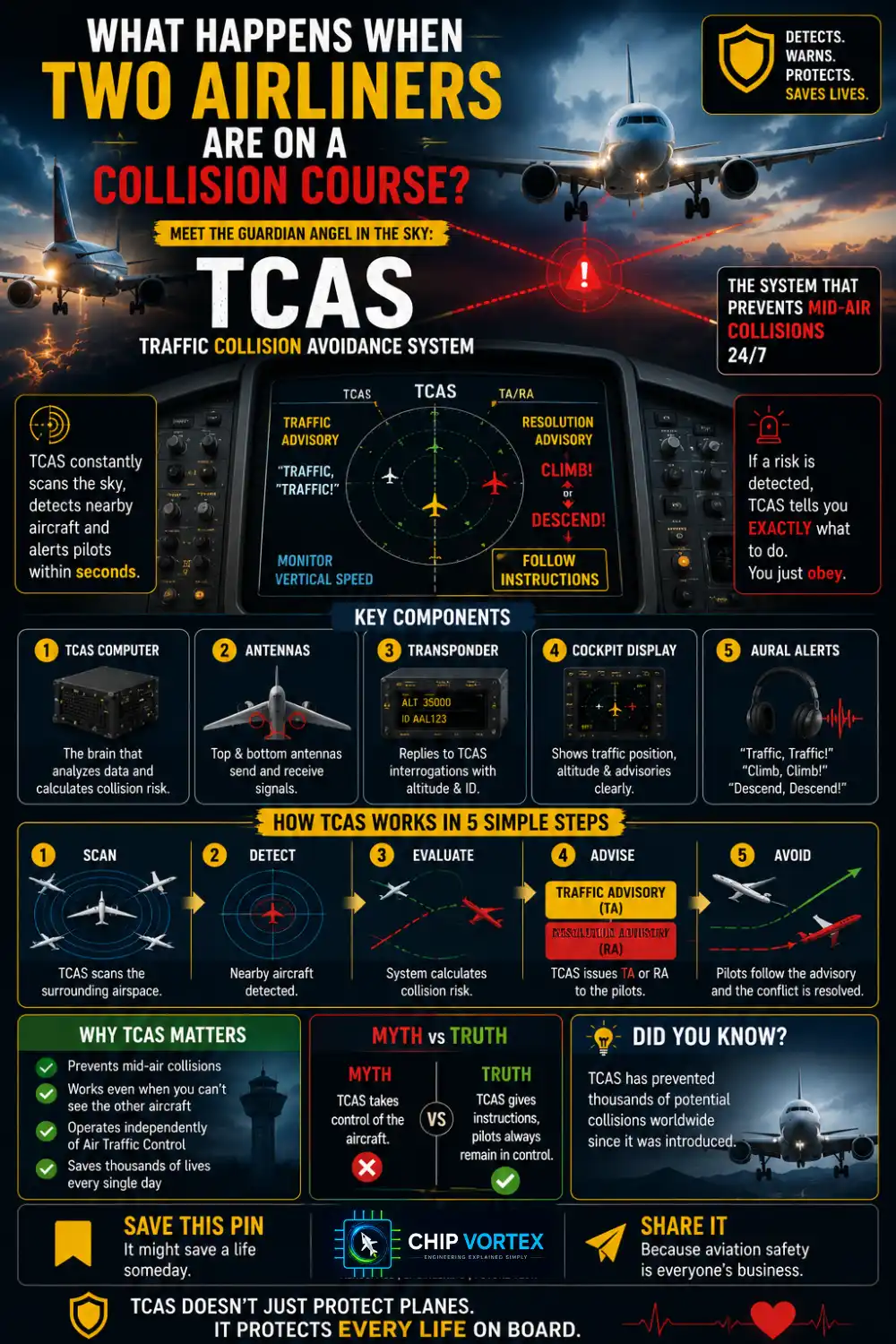
Save the chart, then let’s see how a computer wins a game of chicken at 500 knots — by refusing to play it.
What TCAS Is (and the Two Flavors It Comes In)
TCAS is an airborne system that finds other transponder-equipped aircraft, tracks them, and protects a volume of sky around its own aircraft. It comes in two levels: TCAS I issues traffic warnings only — common on smaller aircraft. TCAS II, mandatory on airliners, goes the full distance: it warns and commands avoidance maneuvers. Everything below is the full TCAS II story.
The 5 Key Components
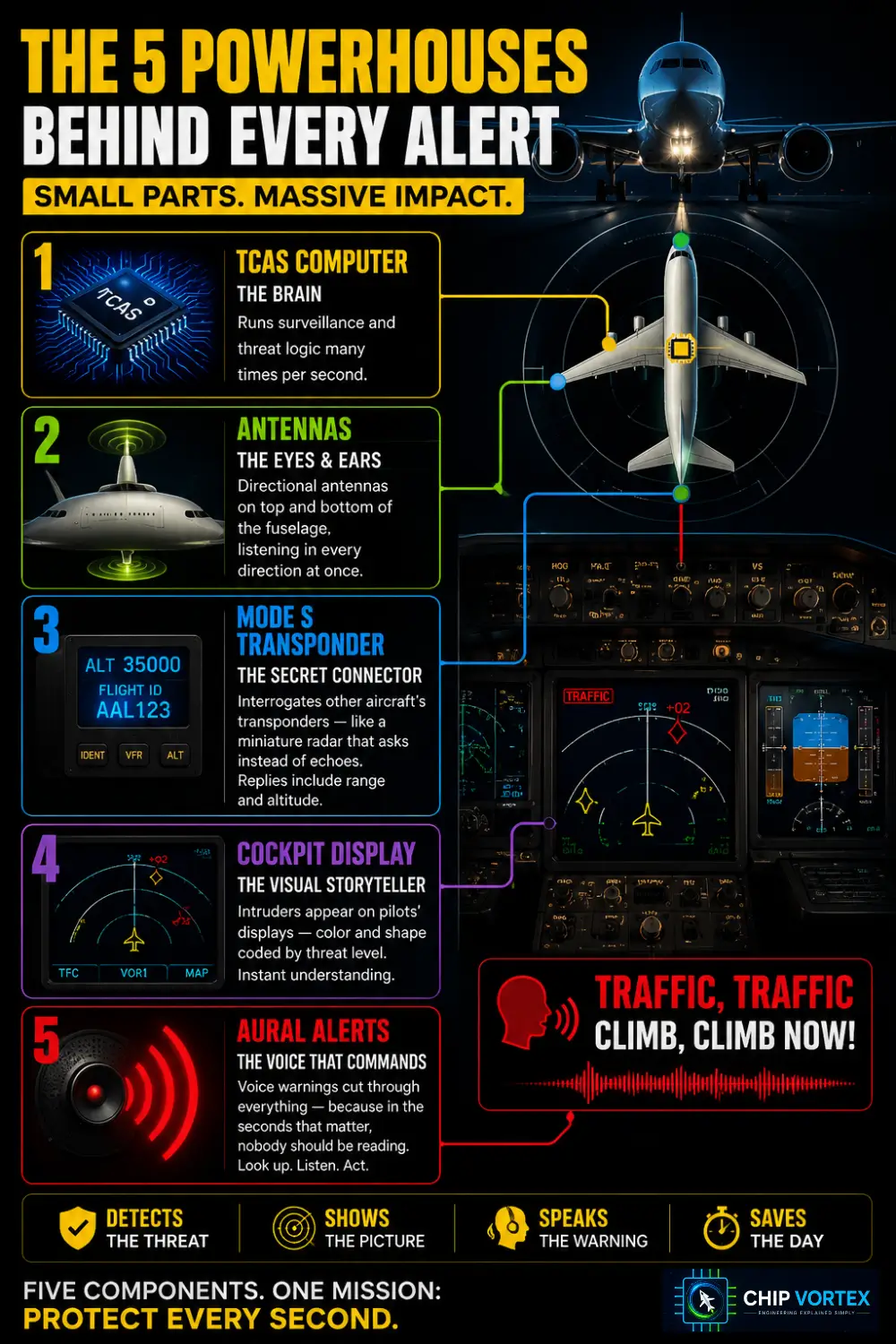
TCAS Computer — the brain, running the surveillance and threat logic many times per second.
Antennas — directional antennas on the top and bottom of the fuselage, listening in every direction at once.
Mode S Transponder — the secret to the whole system. TCAS works by interrogating other aircraft’s transponders — the same transponders we met in the communication systems post — like a miniature radar that asks instead of echoes. Every nearby transponder that replies hands over its range and altitude. No ground station required.
Cockpit Display — intruders appear on the pilots’ displays (the traffic symbols on the navigation display we mentioned in the Navigation System tour come from here), color- and shape-coded by threat level.
Aural Alerts — the voice. TCAS speaks its warnings out loud, because in the seconds that matter, nobody should be reading.
How TCAS Works: Scan, Detect, Alert, Avoid
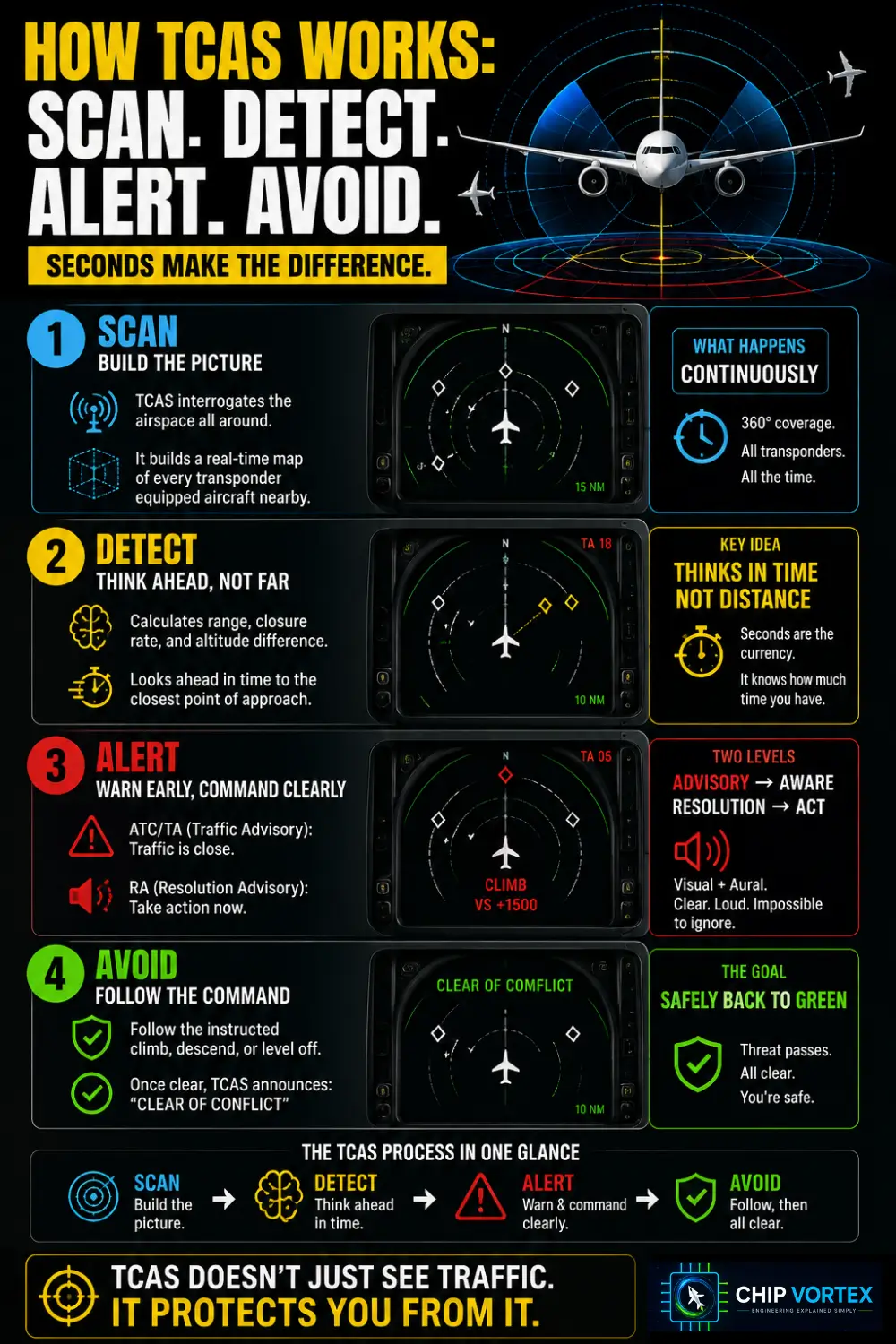
Scan. The system interrogates the surrounding airspace continuously, building a live picture of every transponder-equipped aircraft around it.
Detect. For each one, it computes range, closure rate, and altitude difference — and here’s the elegant part: TCAS thinks in time, not distance. Its threat logic is built on how many seconds remain until the closest point of approach. A slow aircraft nearby may be no threat; a fast one much farther out may already be urgent. Seconds are the only honest currency.
Alert. When the time-to-conflict shrinks past the first threshold, the pilots are warned. Past the second, they’re commanded.
Avoid. The crew flies the commanded escape, the threat passes, and TCAS announces the all-clear.
The Two-Level Ladder: TA, Then RA
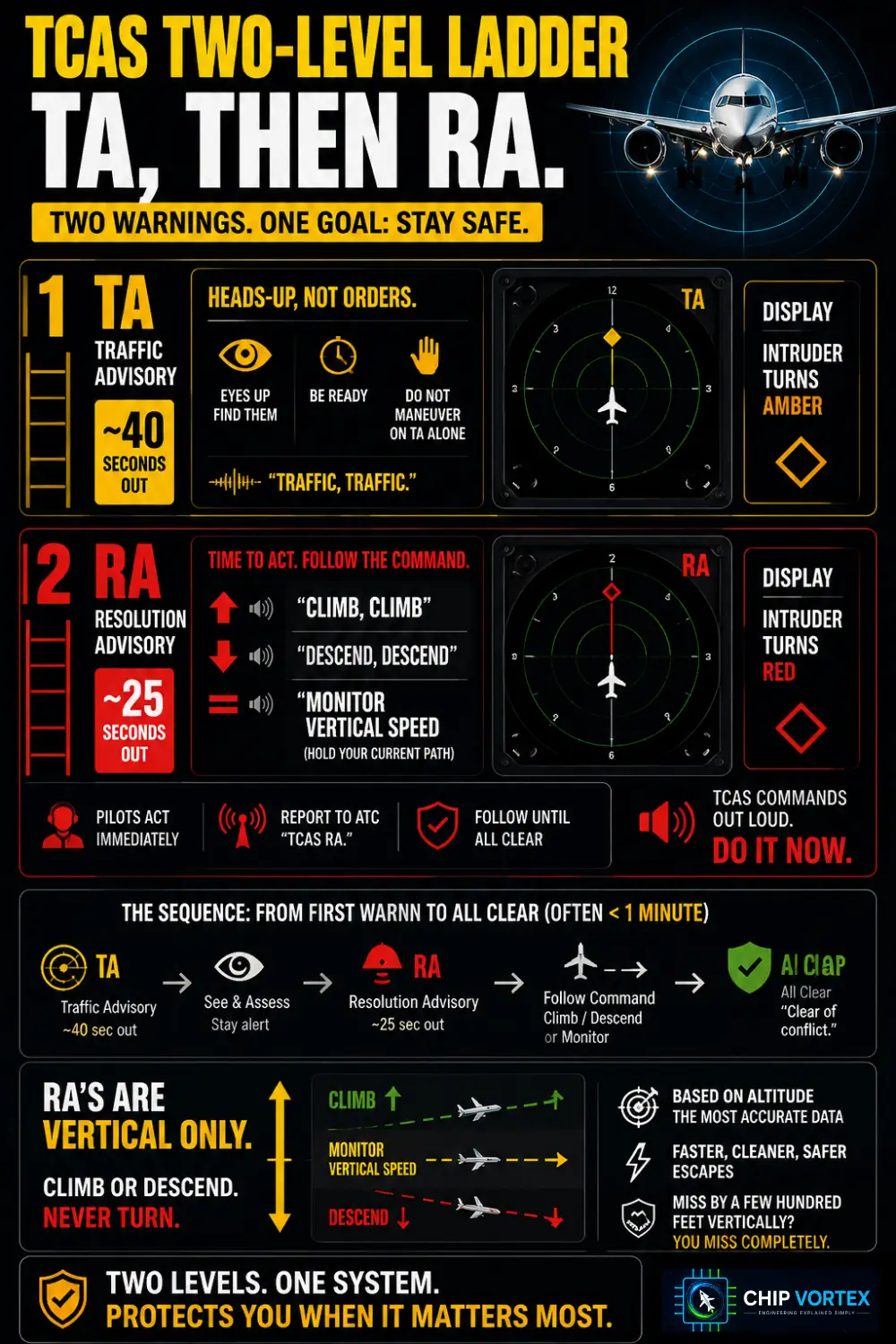
Traffic Advisory (TA) — roughly 40 seconds out. The intruder turns amber on the display and the cockpit hears “Traffic, traffic.” Meaning: eyes up, find them, be ready — but do not maneuver on a TA alone. It’s a heads-up, not an instruction.
Resolution Advisory (RA) — roughly 25 seconds out, if the threat keeps developing. The intruder turns red and TCAS commands the escape out loud: “Climb, climb” — “Descend, descend” — or “Monitor vertical speed” (meaning: your current vertical path is the safe one, hold it). The pilots fly the command immediately and tell ATC “TCAS RA.” When the geometry is resolved: “Clear of conflict.” The whole event, from first warning to all-clear, often lasts less than a minute.
One detail students love: RAs are vertical only — climb or descend, never turn. Vertical escapes are faster, cleaner to compute, and built on the most accurate data TCAS has: altitude. Two aircraft that miss by a few hundred feet vertically have missed completely.
The Coordination Handshake: Two Computers Negotiate
Here’s the part the chart couldn’t fit, and the most remarkable thing TCAS does. When both aircraft carry TCAS II — as all airliners do — the two systems talk to each other through their Mode S transponders and coordinate their escape maneuvers: one aircraft is commanded to climb, the other to descend. Never the same direction. Two computers, closing at a thousand knots, negotiate a contract in milliseconds and then hold each other to it. No ground station involved, no human in the loop — just two guardians agreeing who goes up and who goes down.
The Rule Written in History: The RA Outranks Everyone
TCAS carries one absolute rule, and aviation paid dearly to learn it. In 2002, the Überlingen mid-air collision occurred when one crew followed their air traffic controller’s instruction while the other followed their TCAS resolution advisory — the two aircraft were steered back into each other. The lesson was written into procedure worldwide, permanently: when an RA sounds, it is followed — immediately, precisely, and even over a conflicting ATC instruction. In that moment, the two coordinated computers have better information than anyone on the ground, and the entire system only works if both crews obey. It is one of the very few times in aviation a machine’s word outranks a human controller’s — by design, and by hard-won consensus.
Why It Matters
TCAS prevents mid-air collisions in exactly the situations where human eyes fail — cloud, darkness, and closure rates no lookout can beat. It works with zero dependence on ground radar, guarding aircraft over oceans and remote airspace just as well as over busy hubs. And since airliners began carrying it, it has been credited with defusing countless developing conflicts — most of which the passengers aboard never knew existed. The best save is the one nobody noticed.
Myth vs Truth
Myth: TCAS takes control of the aircraft. Truth: TCAS commands; pilots fly. The system issues the instruction and the crew executes it — pilots always remain in control. One modern refinement worth knowing: on newer Airbus aircraft, the autopilot can be coupled to fly the RA maneuver automatically with the crew supervising — the machine executing its own advisory, under human watch. The hierarchy stands either way: TCAS advises, and the humans remain responsible for the aircraft.
FAQ: TCAS
What’s the difference between a TA and an RA?▾
A Traffic Advisory (“Traffic, traffic”) is a heads-up — locate the aircraft, prepare, but don’t maneuver. A Resolution Advisory is a command — climb, descend, or hold vertical speed — flown immediately.
Does TCAS really override ATC?▾
Yes — when an RA sounds, crews follow it even against a conflicting ATC instruction, then report “TCAS RA.” That rule was written after the Überlingen accident and is absolute worldwide.
Why does TCAS only say climb or descend, never turn?▾
Vertical escapes are faster to execute, simpler to compute, and based on TCAS’s most accurate data — altitude. A few hundred feet of vertical separation ends the conflict completely.
Do both aircraft get told to move the same way?▾
Never. When both carry TCAS II, the two systems coordinate through their transponders — one is commanded up, the other down. The maneuvers are complementary by contract.
Do small planes have TCAS?▾
Light aircraft typically carry traffic-advisory systems or TCAS I — warnings without commands. Full TCAS II, with resolution advisories, is the airliner standard.
So — the pin asked: would you trust a system that saves lives every second? Now that you know it negotiates with its counterpart at closing speeds of a thousand knots, tell us in the comments. Save the chart, and keep the series going: Communication Systems (the transponders TCAS talks through), the Navigation System, and Inside the Cockpit.