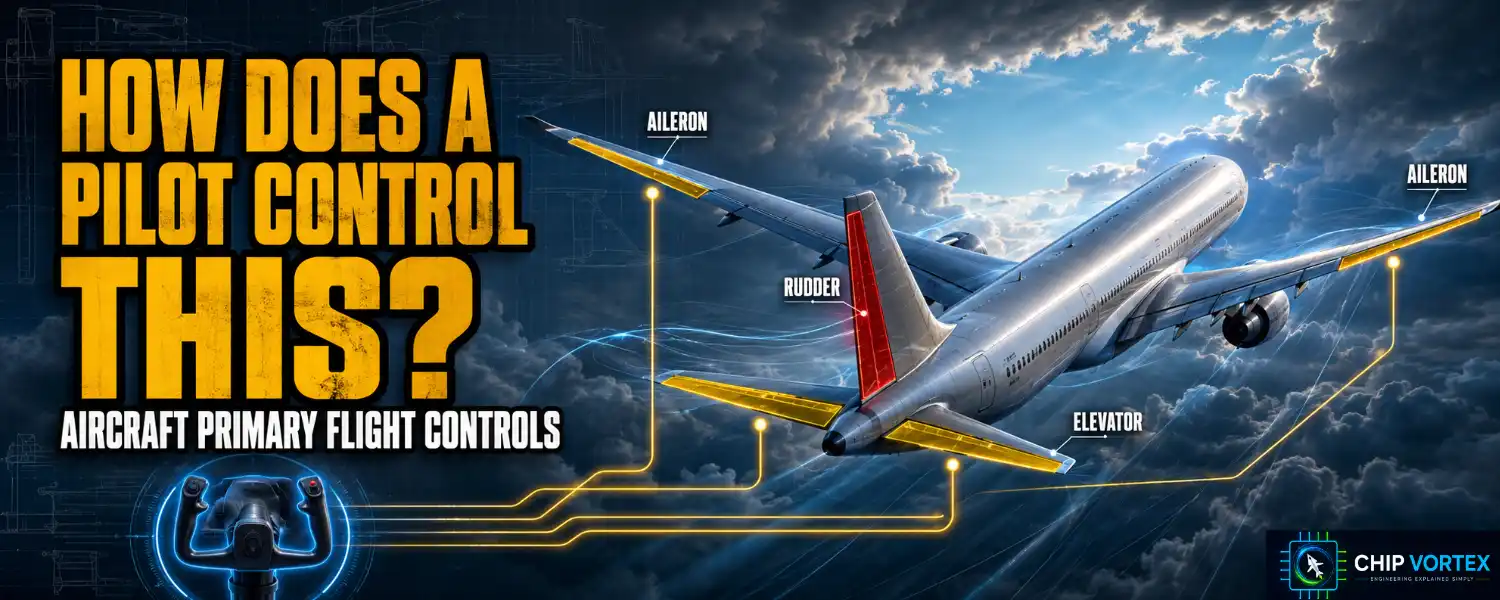
An aircraft has no road to steer against — it maneuvers by reshaping itself, bending the airflow with movable surfaces until the air pushes it exactly where the pilot wants. Three axes, three primary controls, one elegant chain from a pilot’s hand to a wing’s edge. This is the system every other system in this series ultimately serves: how pilots control the sky.
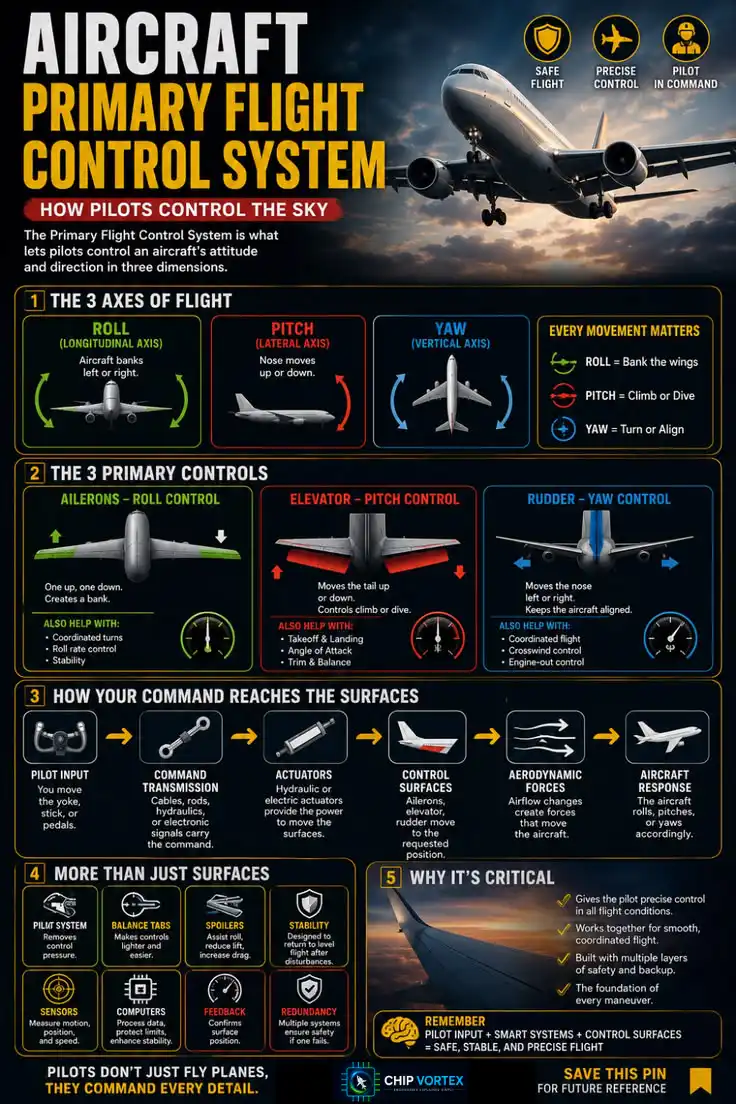
Save the guide, then let’s take the controls — starting with the geometry.
The Three Primary Flight Controls (Quick Answer)
The primary flight controls are the ailerons (roll), the elevator (pitch), and the rudder (yaw) — the three movable surfaces that command an aircraft’s attitude around its three axes. Everything else — flaps, spoilers, trim — is supporting cast.
The 3 Axes of Flight: Three Skewers Through One Point
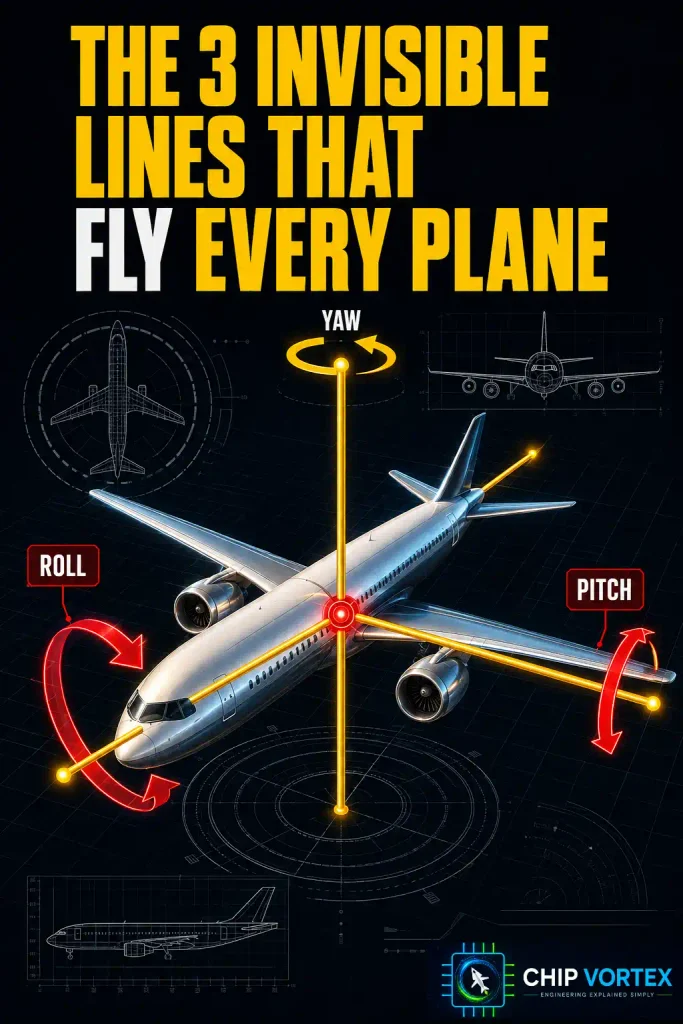
Picture three rods skewered through the aircraft, all crossing at its center of gravity. The longitudinal axis runs nose to tail — rotate around it and the wings bank: roll. The lateral axis runs wingtip to wingtip — rotate around it and the nose rises or falls: pitch. The vertical axis runs top to bottom — rotate around it and the nose swings left or right: yaw. Every maneuver ever flown, from a gentle turn to an airshow tumble, is just a recipe of these three rotations.
Ailerons: Roll — and the Trap the Wright Brothers Found
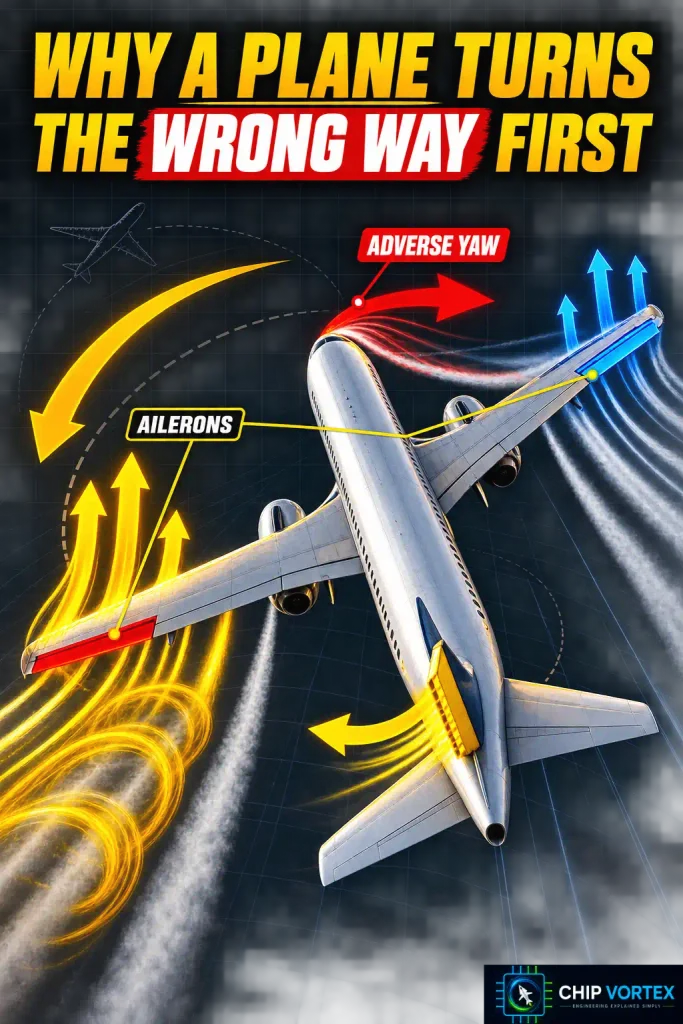
Out near each wingtip, the ailerons move in opposition — one rises, one drops. The dropped aileron increases that wing’s lift, the raised one reduces it, and the lift imbalance rolls the aircraft into a bank. Simple — except for the trap: the down-going aileron also creates more drag, tugging that wing backward so the nose swings away from the turn. This is adverse yaw, and the Wright brothers met it the hard way before anyone had named it: the fix is a touch of rudder in the same direction, which is why “stick and rudder” flying is called coordination. Modern designs soften the effect with clever aileron geometry — but the physics never left.
Elevator: Pitch — the Backwards Surface
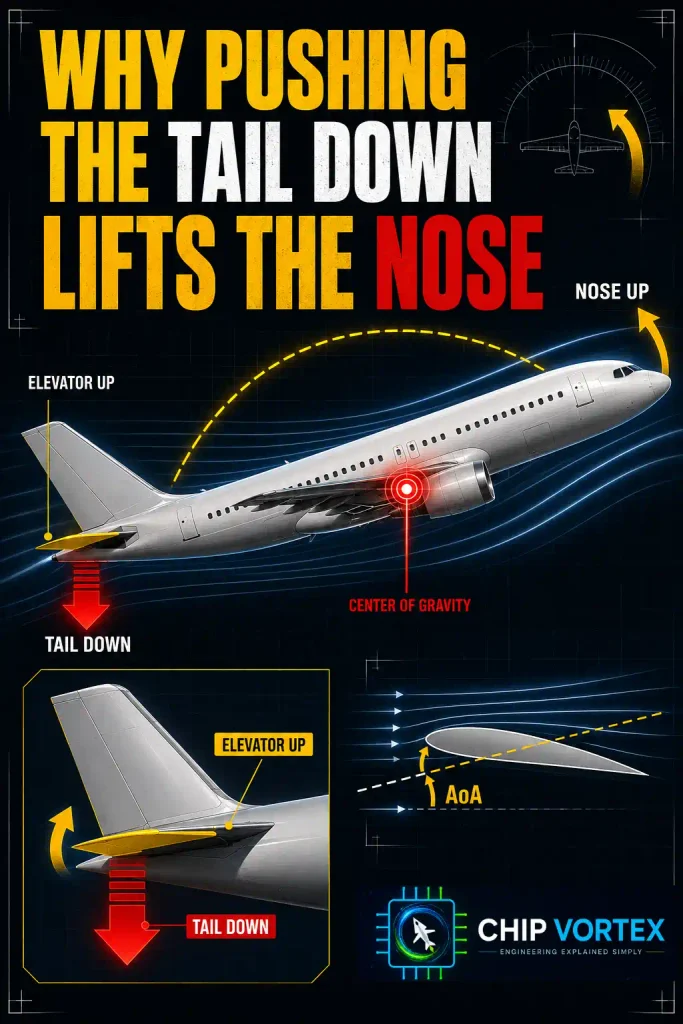
Here’s the counterintuitive gem of the whole system. On most aircraft, the horizontal tail lifts downward — a deliberate down-force that makes the aircraft stable, like an arrow’s fletching. So to raise the nose, the elevator deflects up, pushing the tail down harder, and the aircraft pivots nose-up around its center of gravity. What the elevator truly commands is angle of attack — the wing’s bite into the air — which is why it rules the moments where AoA is everything: takeoff rotation, the landing flare, and the instruments’ most-watched margins. Some aircraft move the entire tail surface as one piece — a stabilator — but the logic is identical.
Rudder: Yaw — Not the Steering Wheel
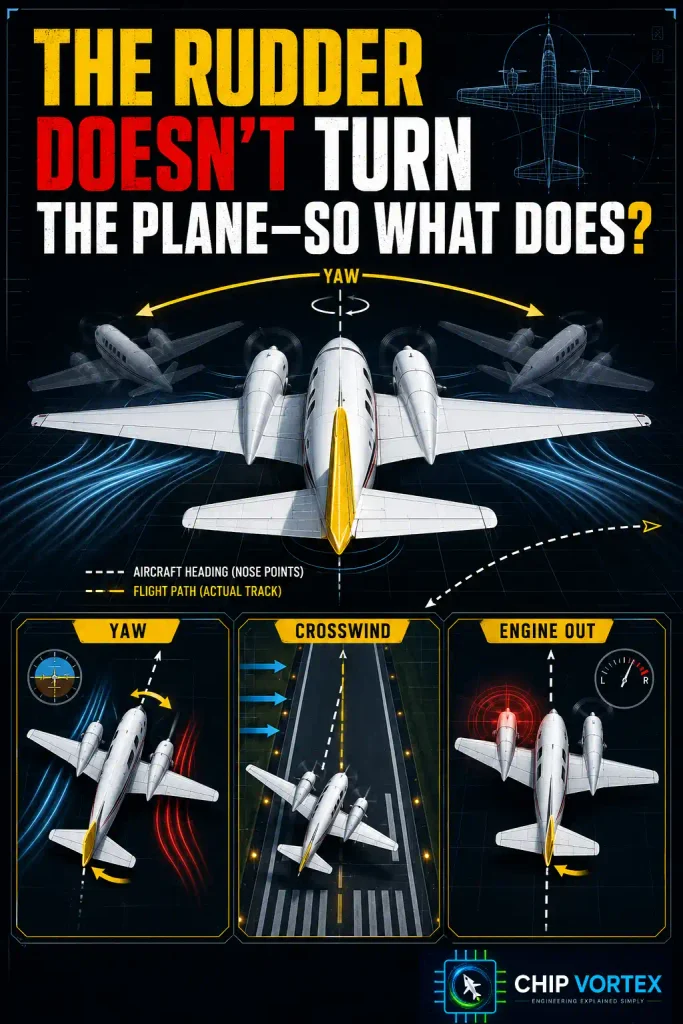
The biggest misconception in aviation, settled: the rudder does not turn the airplane. It swings the nose left or right, but pointed-somewhere isn’t going-somewhere in a fluid. The rudder’s real jobs are the pin’s own list: coordinating turns (killing adverse yaw), holding the aircraft straight in a crosswind — including the dramatic last-second “decrab” you’ve seen in landing videos — and, most critically, countering the huge asymmetric pull when an engine fails on one wing. The rudder is the aircraft’s discipline, not its steering.
So How Does a Plane Actually Turn?
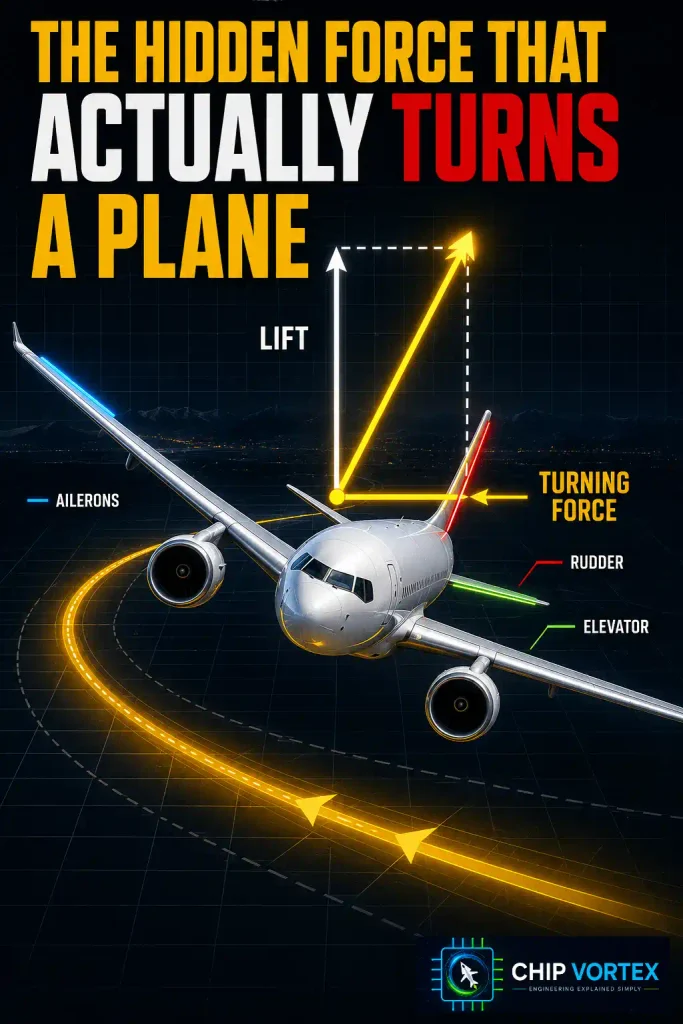
Bank the wings — and the lift force, which always pushes perpendicular to the wings, now tilts. Part of it still holds the aircraft up; the rest pulls it sideways, around the curve. That horizontal slice of lift is the turn. The ailerons set the bank, the rudder keeps it honest, and the elevator adds a little back-pressure because less lift is pointing “up.” Three surfaces, one coordinated arc — and not a steering wheel in sight.
From Hand to Sky: The Command Chain
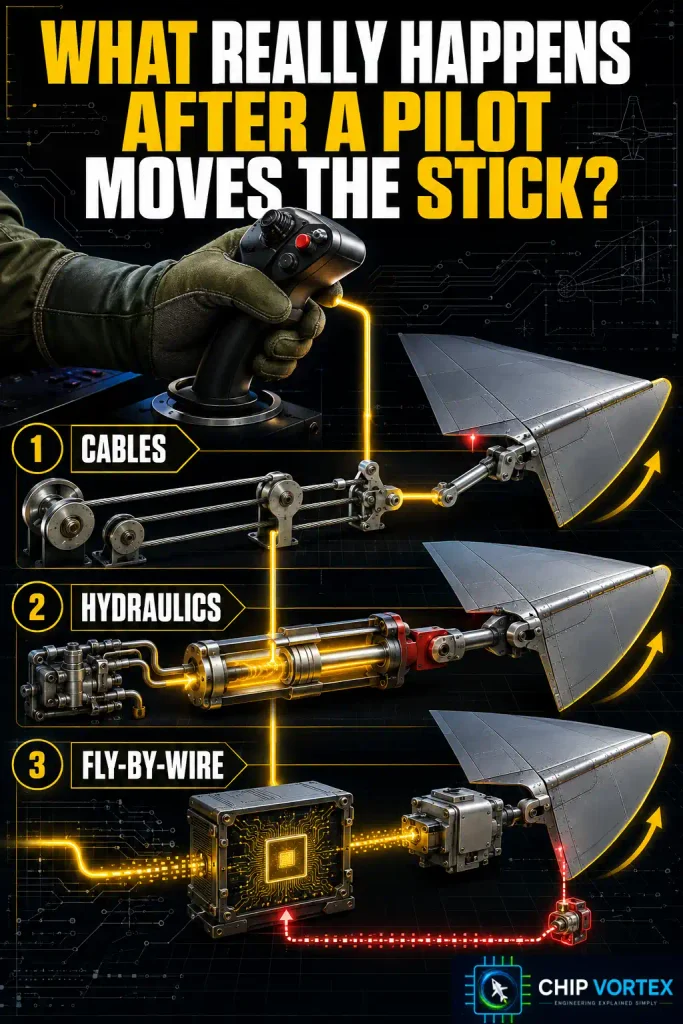
The pin’s chain deserves its own respect, because it spans a century of engineering. In early and light aircraft, cables and pushrods connect yoke to surface directly — you feel the air itself in your hands. Bigger, faster aircraft added hydraulic muscle, actuators doing the pushing while controls became requests. And modern airliners completed the transformation: fly-by-wire, where the A320’s sidestick sends electronic signals to computers that command the actuators — computers that also protect the envelope, refusing commands that would stall or overstress the aircraft. Sensors report surface positions back, closing the loop thousands of times a second. The pilot’s intent hasn’t changed since the Wrights; only the messengers have.
More Than Just Surfaces: The Supporting Cast
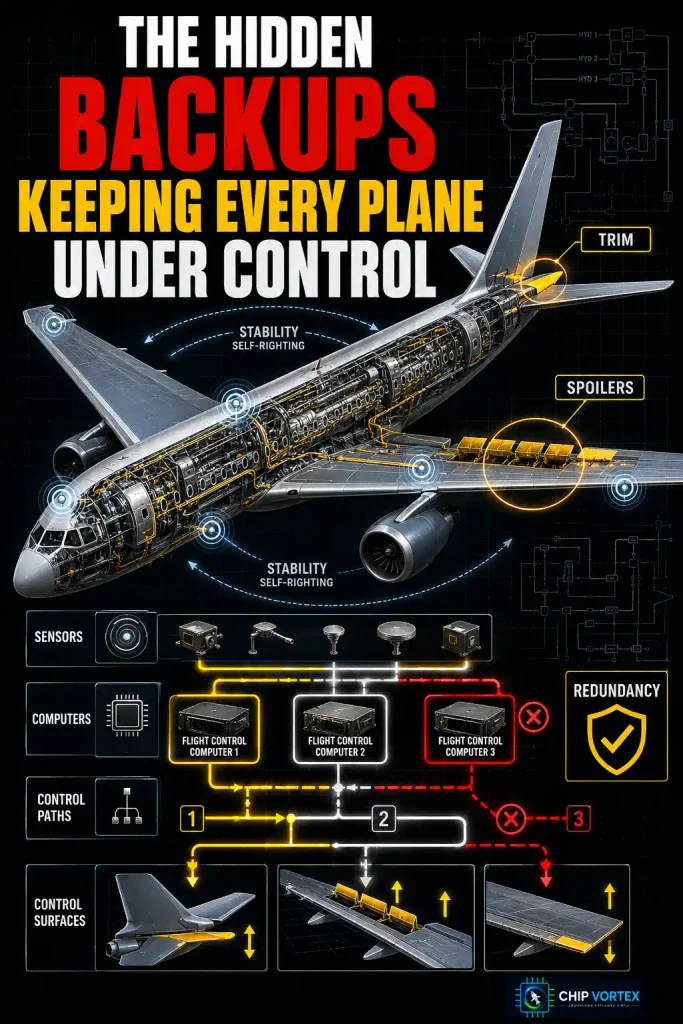
The pin’s fourth panel names the quiet enablers. Trim — the system that removes control pressure — lets the pilot set an attitude and relax, tiny adjustable surfaces (or a moving stabilizer) holding the load so human arms don’t have to. Balance tabs use aerodynamics to lighten the controls themselves. Spoilers rise from the wing to assist roll and dump lift — full story in the wing guide, where the secondary surfaces (flaps, slats, spoilers) live. Stability is designed-in: disturb a well-designed aircraft and it wants to return to level. And beneath it all: sensors, computers, feedback, and redundancy — multiple hydraulic systems, multiple computers, multiple paths from hand to surface. Aviation learned the value of those layers in the hardest ways; the 1989 Sioux City accident, where a crew steered a crippled airliner with engine thrust alone after all hydraulics were lost, remains the defining lesson in why no single path may ever be the only one.
Primary vs Secondary: The Clean Division
Worth one tidy paragraph: primary controls (ailerons, elevator, rudder) change where the aircraft points and banks — they’re flight-critical, instant, always active. Secondary controls (flaps, slats, spoilers, trim) change how the wing performs — lift, drag, workload. This post owns the first family; our wing anatomy guide owns the second. Between the two, you can now name everything that moves on an airliner.
FAQ: Primary Flight Controls
What are the three primary flight controls?▾
Ailerons (roll, at the wingtips), elevator (pitch, on the horizontal tail), and rudder (yaw, on the vertical tail) — commanding rotation around the aircraft’s three axes.
How does an airplane actually turn?▾
By banking. Ailerons tilt the wings, the lift force tilts with them, and its horizontal component pulls the aircraft around the curve — with rudder coordinating and elevator holding altitude. The rudder alone just skids the nose sideways.
What is the rudder for, if not turning?▾
Coordination (cancelling adverse yaw), crosswind alignment on takeoff and landing, and controlling the asymmetry when an engine fails. It keeps flight honest rather than steering it.
Why does the elevator push the tail down?▾
Because the tail normally lifts downward for stability. Deflecting the elevator up increases that downforce, pivoting the nose up around the center of gravity — the “backwards” logic that keeps aircraft naturally stable.
What happens if the flight controls fail?▾
Layers absorb the failure: multiple hydraulic circuits, independent computers, mechanical or electrical backup paths, and trim systems that can fly the aircraft coarsely. Total loss is vanishingly rare precisely because the system assumes any single part can fail.
“Pilots don’t just fly planes — they command every detail.” Next time you’re in a window seat, watch the wing: the little surfaces near the tip flickering constantly in cruise are the ailerons having a quiet conversation with the air. Which surprised you most — the rudder that doesn’t steer, or the tail that lifts down? Tell us in the comments, save the guide, and keep the tour going: the wing’s secondary surfaces, the sidestick that signals instead of pulls, and the air data that feeds the computers in between.