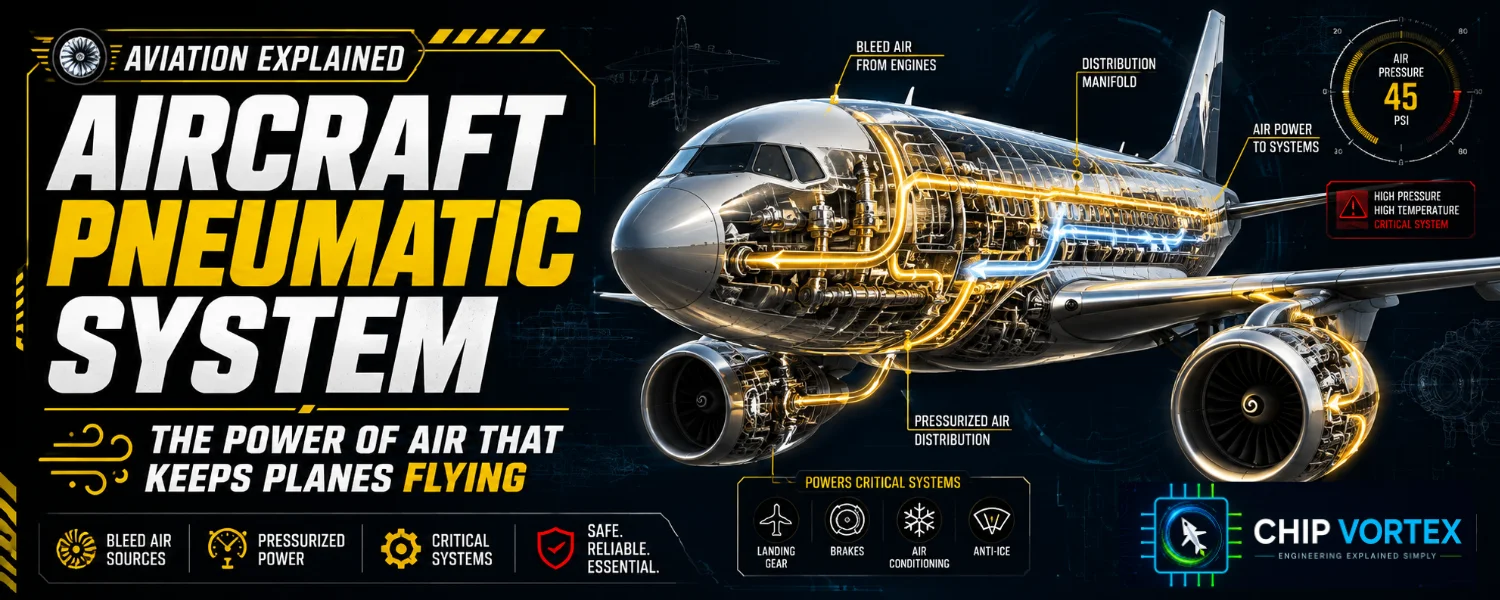
Jet engines don’t just make thrust — they make compressed air, and the aircraft quietly borrows some of it to run half the ship.
The pneumatic system takes high-pressure, high-temperature air — called bleed air — from the engines or the APU, then regulates it, cools it, and distributes it to power essential systems: engine starting, cabin pressurization and air conditioning, and the anti-ice protection that keeps wings and engines clear.
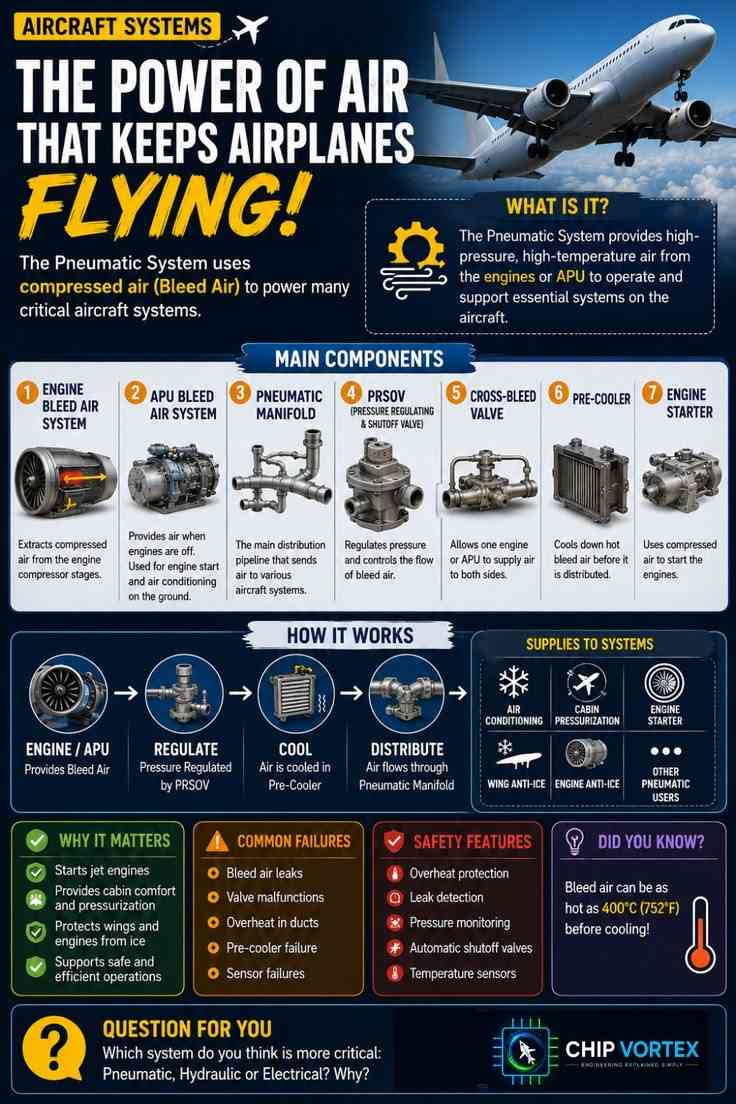
Save the chart for revision, then let’s follow the air from the compressor to everything it powers.
What Bleed Air Actually Is
Deep inside a jet engine, the compressor squeezes incoming air to many times atmospheric pressure before combustion. Bleed air is simply a tap on that flow — a small portion drawn off through ports in the compressor casing and piped away for the aircraft’s own use. Two things about it matter immediately. First, it’s hot: compressing air heats it enormously (any turbocharged-car owner knows this — it’s the whole reason intercoolers exist, as we covered in our turbocharger guide). Second, it isn’t free: every kilogram of air bled off is air the engine compressed with fuel, which is a trade-off that will matter at the end of this story.
The 7 Main Components
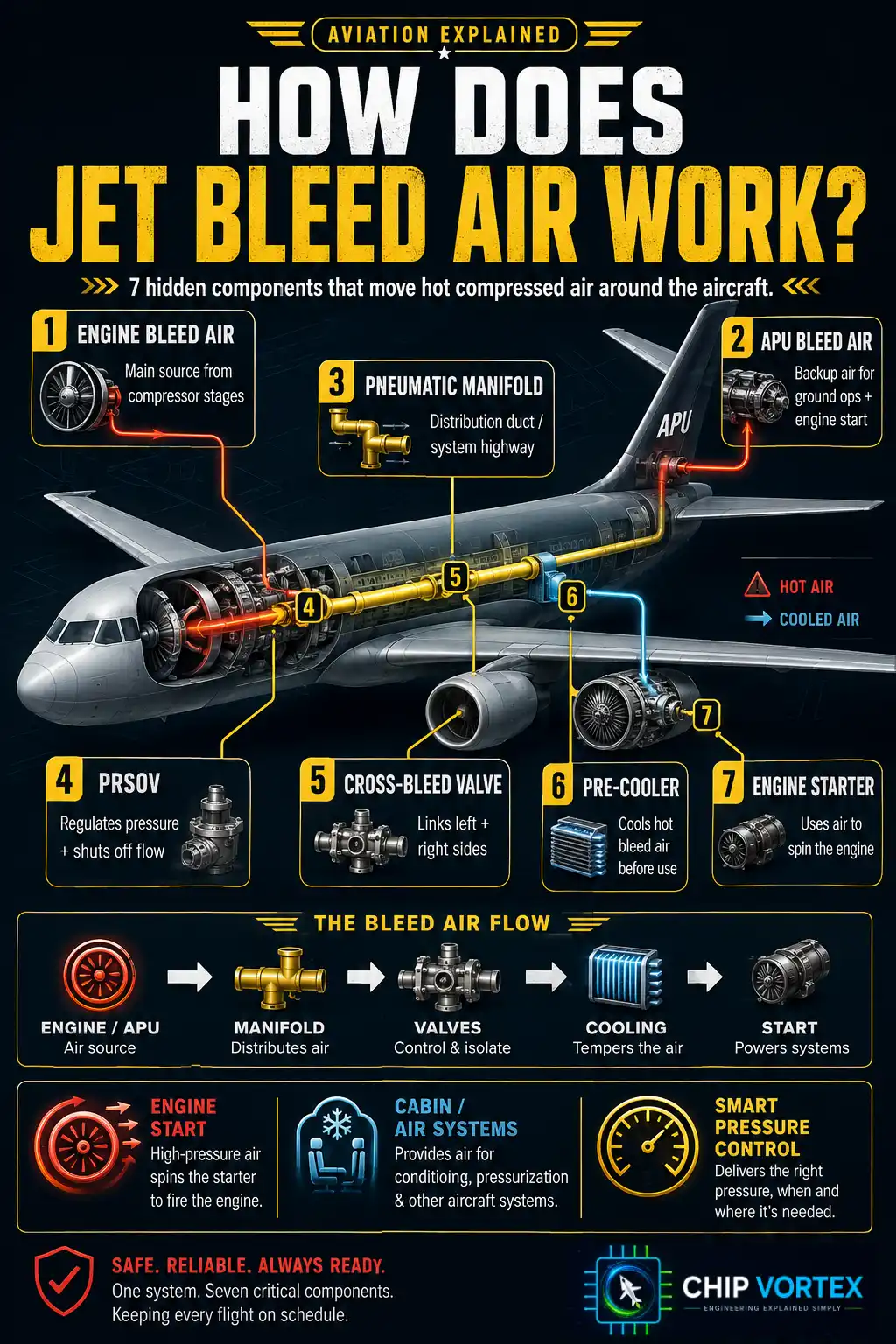
1. Engine Bleed Air System
The source. Ports at different compressor stages extract the air, and the system automatically selects the stage that provides adequate pressure with the least waste — a lower stage when the engine is working hard, a higher stage when it’s at low power and the early stages aren’t compressing enough. Smart plumbing before the air has traveled a meter.
2. APU Bleed Air System
The auxiliary power unit — the small turbine engine in the tail — supplies bleed air when the main engines are off. This is what makes an airliner self-sufficient at the gate: air conditioning for the cabin and, crucially, the compressed air blast that starts the main engines, all without a single ground cart. On many types the APU can also back up the system in flight within its altitude limits.
3. Pneumatic Manifold
The distribution network: ducting that runs from each engine through the pylons and wings into the fuselage, tying the left and right systems together and delivering air to every user. It’s the highway; everything else on this list is either an on-ramp, a toll booth, or an exit.
4. PRSOV (Pressure Regulating & Shutoff Valve)
The gatekeeper, one per engine. The PRSOV throttles raw bleed air down to the target system pressure — and doubles as the shutoff, closing instantly on crew command or automatically when protection systems detect a fault. One valve, two jobs: regulate in normal life, isolate in bad moments.
5. Cross-Bleed Valve
The bridge between the left and right systems. Open it, and one source can feed both sides — the APU pressurizing the whole aircraft, or one running engine supplying air to start the other. That second trick has a name every pilot knows: the cross-bleed start.
6. Pre-Cooler
An air-to-air heat exchanger in the pylon that tempers the scorching bleed air using cool air from the engine’s fan stream, before the flow heads into the wing. Think of it as the bleed system’s intercooler — same physics, same purpose: the downstream ducting, and everything near it, needs air hot enough to be useful but cool enough to be safe.
7. Engine Starter
The most dramatic user. The air turbine starter is a small turbine bolted to the engine’s accessory gearbox: feed it high-pressure air — from the APU, the other engine, or a ground air cart — and it spins the engine’s core up to light-off speed, fuel and ignition join in, and the engine accelerates to idle as the starter drops out. Jet engines are started by air.
How It Works: 4 Steps
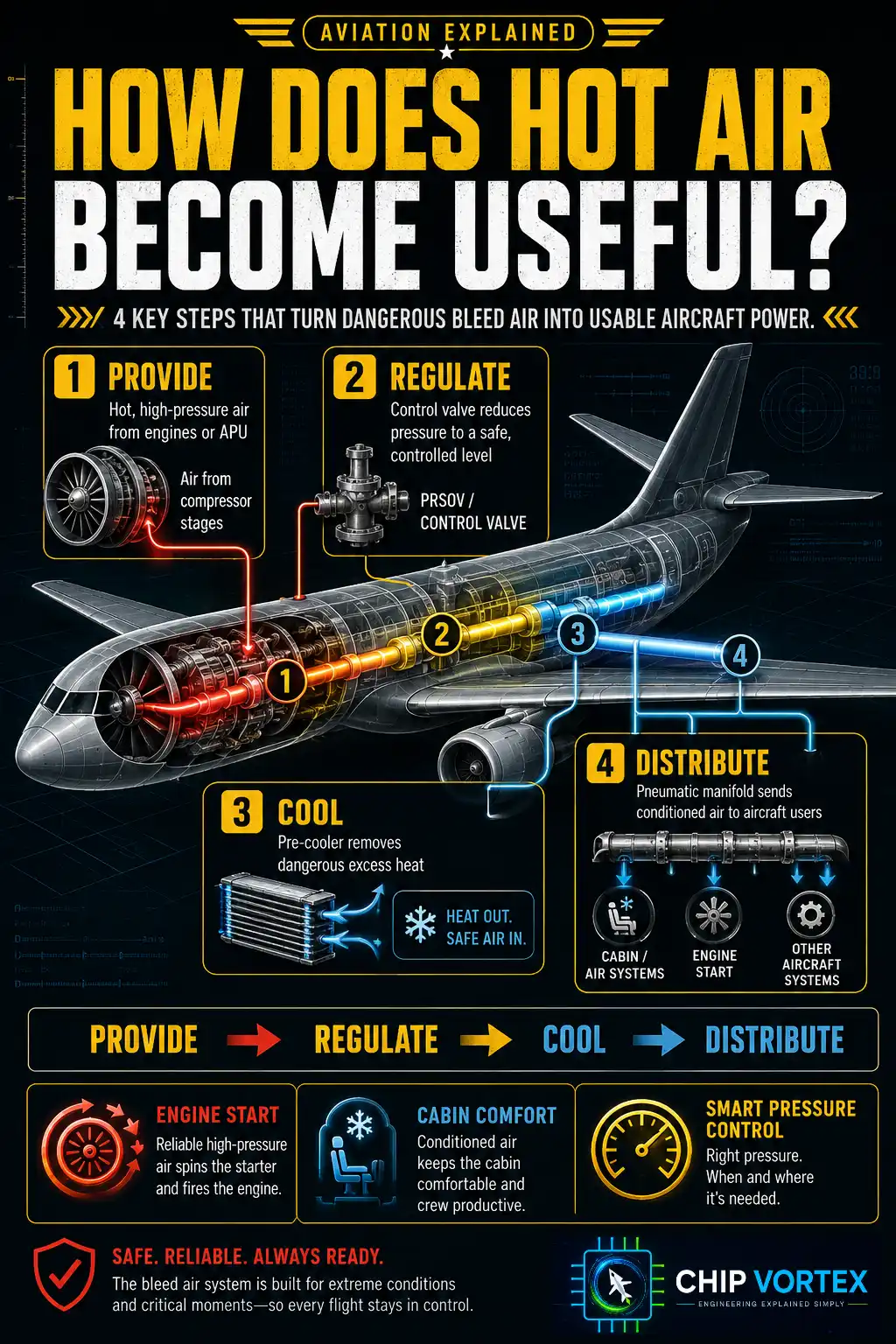
Step 1 — Provide. The engines or APU supply hot, high-pressure bleed air from their compressors.
Step 2 — Regulate. The PRSOV brings it down to the controlled system pressure.
Step 3 — Cool. The pre-cooler strips the dangerous excess heat.
Step 4 — Distribute. The manifold carries conditioned air to every user across the aircraft.
What Bleed Air Supplies
Six customers, in roughly descending order of glamour: engine starting (the air turbine starter), air conditioning (the packs that condition cabin air), cabin pressurization (the supply side of keeping you comfortable at 38,000 feet — a full story we’ll tell in its own series post), wing anti-ice (hot air ducted inside the leading edges — the same edges we toured in parts of an airplane wing, where ice is most dangerous), engine anti-ice (heating the engine inlet lips), and the other pneumatic users — the quiet ones, like pressurizing hydraulic reservoirs and pushing potable water to the taps.
Why It Matters
Without the pneumatic system, the jet doesn’t even start. With it, the aircraft starts its own engines anywhere in the world, keeps a warm, pressurized, breathable cabin at altitudes that would incapacitate a human in seconds, and shrugs off icing conditions that would ground lesser machines. It’s the least famous of the big three power systems — pneumatic, hydraulic, electrical — and the one passengers benefit from every single second of the flight.
Common Failures — and the Watchdogs That Catch Them
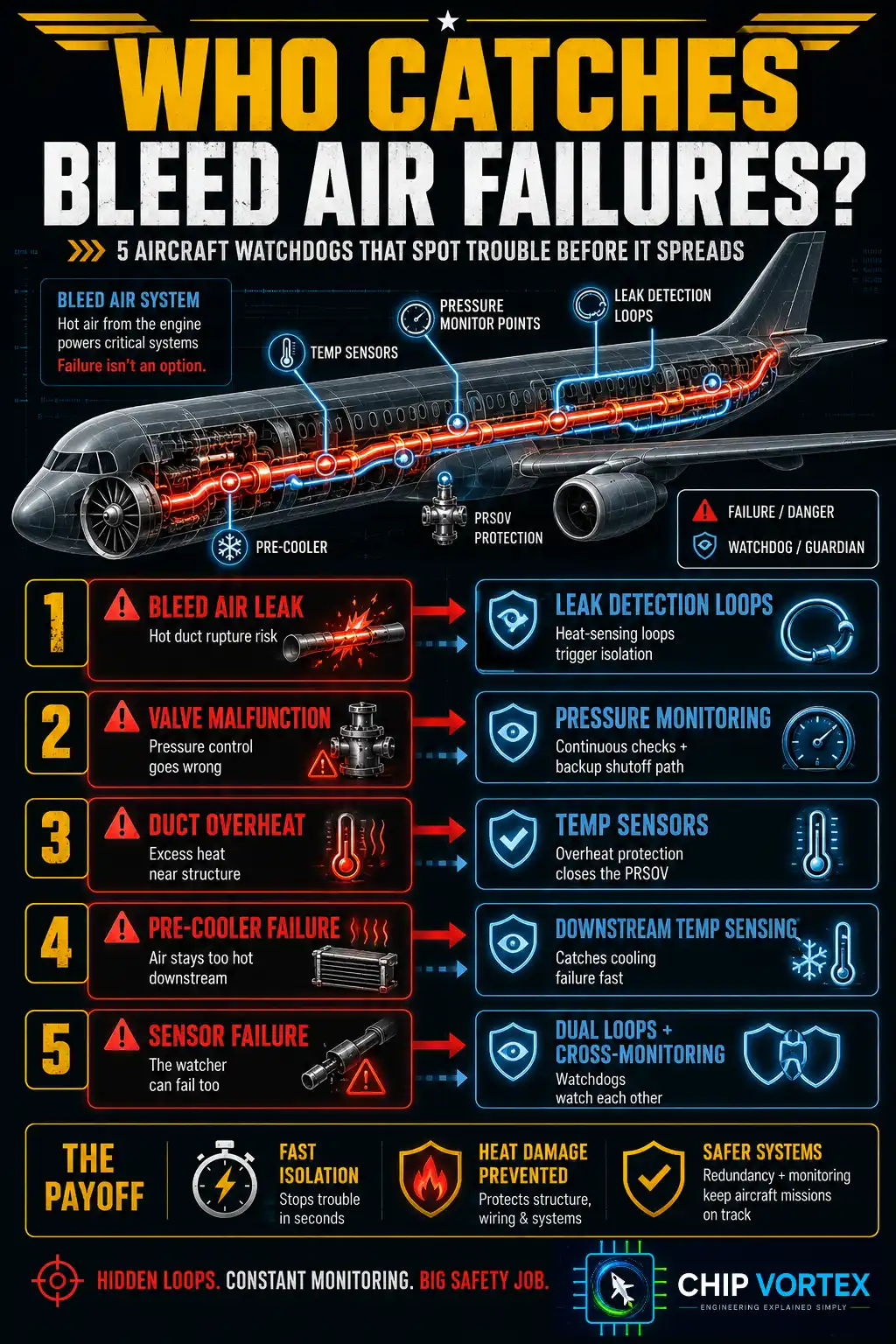
The pin’s two lists are really one list, because every failure mode has a guardian assigned to it.
Bleed air leaks are the headline risk — a ruptured duct sprays 200-plus-degree air near structure, wiring, and fuel systems. So the ducts are shadowed along their whole length by leak detection loops: sensing elements that react to the heat of escaping air and trigger automatic isolation of that side. Valve malfunctions are caught by continuous pressure monitoring and backed by redundant shutoff paths. Duct overheats trip dedicated temperature sensors and overheat protection, closing the PRSOV before heat becomes damage. Pre-cooler failures reveal themselves through downstream temperature sensing. Even sensor failures are covered — dual loops and cross-monitoring mean the watchdogs watch each other. For maintenance engineers, those unglamorous detection loops running along the ducting are some of the most safety-critical inches of the aircraft.
Did You Know?
Bleed air can leave the engine at up to 400°C (752°F) before cooling — hot enough that the pre-cooler isn’t a comfort feature, it’s a survival requirement for everything downstream.
And the modern twist: the Boeing 787 famously abandoned bleed air almost entirely. Instead of taxing the engines for compressed air, it uses electrical power — electric compressors pressurize the cabin, and electric heater mats de-ice the wings — keeping only engine inlet anti-ice on air. The payoff is efficiency: the engines keep the air they compress and turn it into thrust. One aircraft, and it reframed the whole pneumatic-versus-electrical debate.
FAQ: Aircraft Pneumatic System
What is bleed air?▾
Compressed air tapped from an engine’s (or APU’s) compressor stages, then regulated, cooled, and distributed to power aircraft systems — engine starting, air conditioning, pressurization, and anti-ice.
Why is bleed air so hot?▾
Because compressing air heats it — the same physics that makes a turbocharged engine need an intercooler. Squeezing air to many times atmospheric pressure leaves it at several hundred degrees.
How does compressed air start a jet engine?▾
It spins an air turbine starter geared to the engine’s core. Once the core reaches light-off speed, fuel and ignition take over, the engine accelerates to idle, and the starter disengages.
What is a cross-bleed start?▾
Starting one engine using bleed air from the other running engine, sent across through the cross-bleed valve — the standard method when the APU is unavailable after the first engine is running.
Why doesn’t the Boeing 787 use bleed air?▾
Efficiency. Extracting bleed air costs engine performance, so the 787 replaced most pneumatic functions with electrical systems — electric cabin compressors and electro-thermal wing anti-ice — letting its engines spend their compressed air on thrust.
So, the pin’s question stands: pneumatic, hydraulic, or electrical — which is most critical? Here’s the honest answer: they’re interdependent, and the 787 proves the balance can shift. Make your case in the comments. Save the chart, and keep touring the series: Inside the Cockpit, the Navigation System, and Air Data Systems.