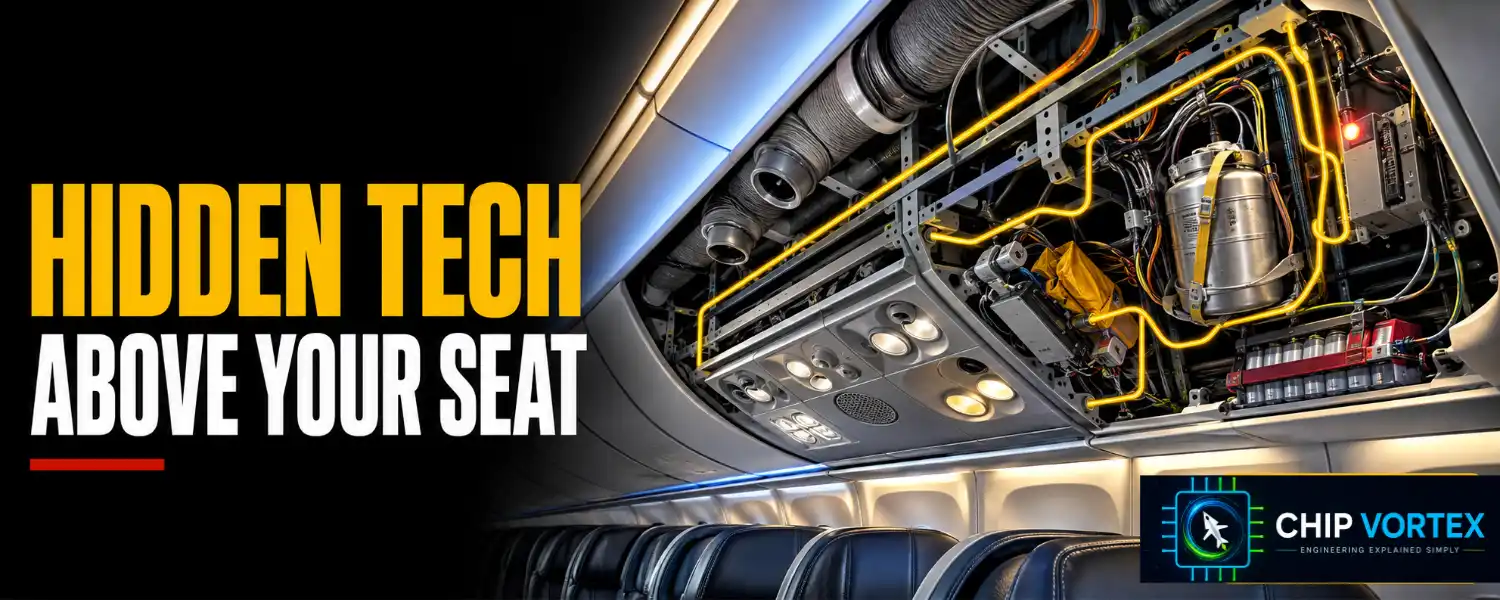
Board an airliner and you see seats, windows, and a ceiling. Look closer: every light has a schedule, every sign has a power supply, the little air vent has an official name, and the panel above you is hiding a small chemical factory. The cabin isn’t decorated — it’s engineered, by five systems whose entire job is keeping you comfortable, connected, and safe at 35,000 feet. Here’s what’s really working for you between takeoff and landing.
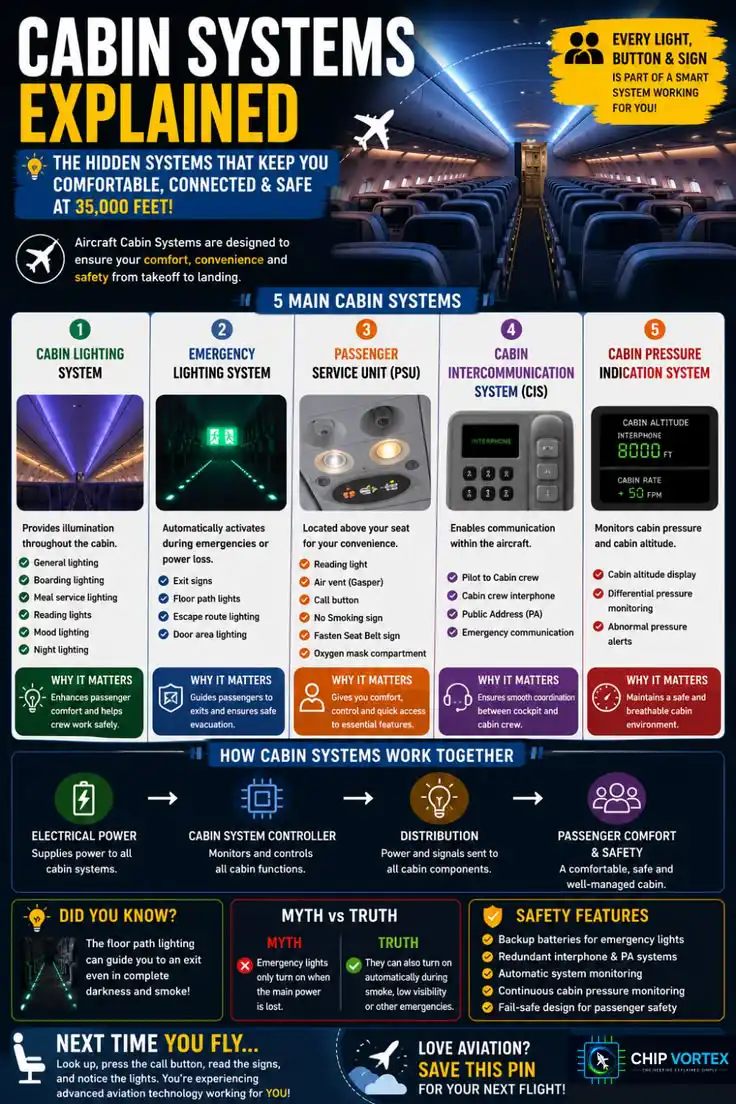
Save the guide for your next flight, then let’s tour the cabin the way an engineer sees it.
The Five Main Cabin Systems (Quick Answer)
An airliner’s cabin runs on five core systems: cabin lighting, emergency lighting, the passenger service units above each seat row, the cabin intercommunication system, and cabin pressure indication. Each one is monitored, backed up, and quietly coordinated by a central cabin controller — every light, button, and sign is part of that network.
1. Cabin Lighting: The Cabin Has Moods

Modern cabin lighting isn’t on/off — it’s scenes. Crews select boarding light, meal-service warmth, and deep night-mode from a touchscreen attendant panel, and on newer LED cabins (think A350, 787) the system paints sunrise and sunset gradients timed to help your body clock cross time zones. It’s not decoration: good lighting lets crews work safely, signals the flight’s rhythm to hundreds of people without a single announcement, and — on long-haul — is genuinely a jet-lag tool.
2. Emergency Lighting: The System That Waits
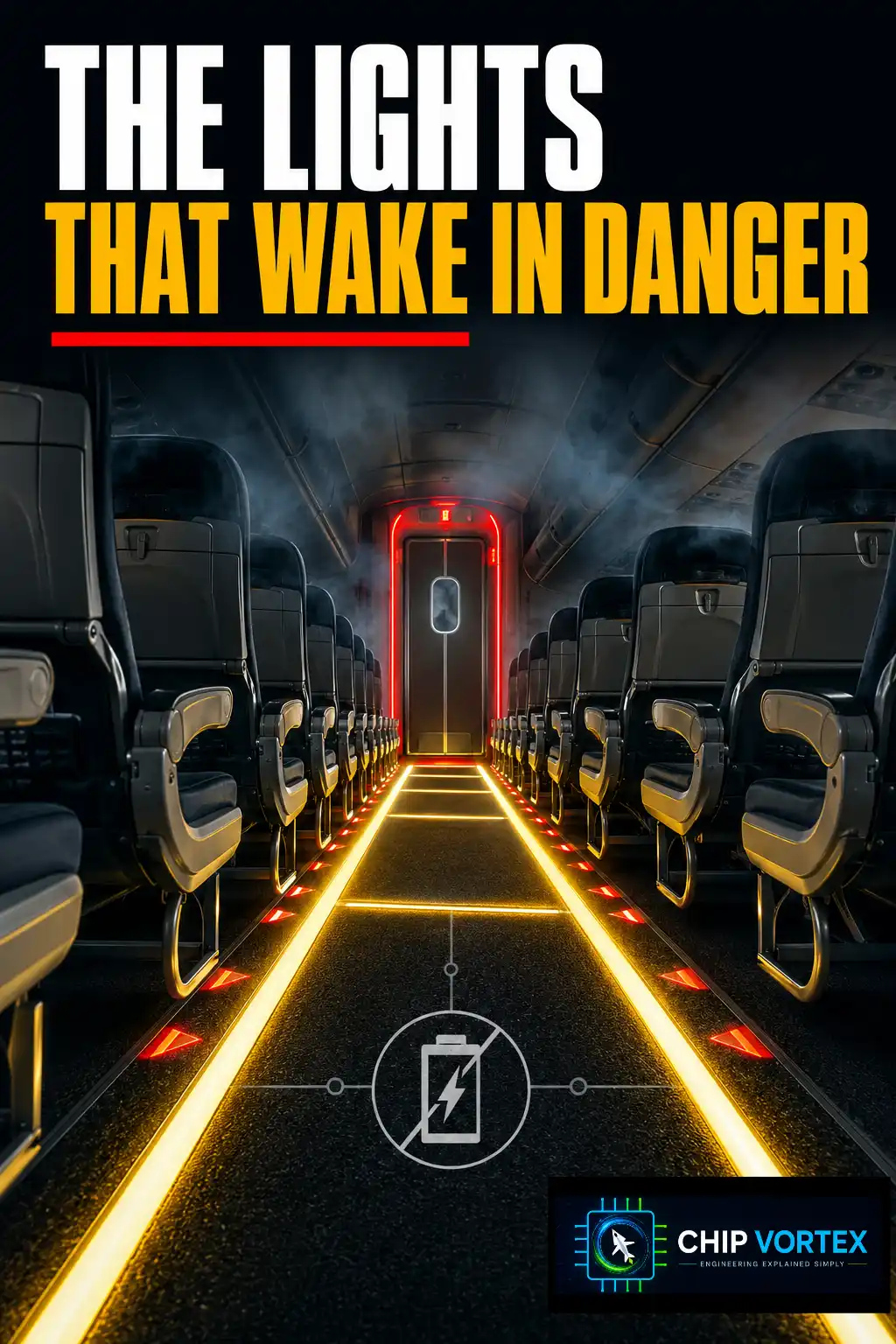
The emergency lights spend their whole life armed and hoping to stay off. If normal power fails, they switch on automatically, running from their own battery packs — and the crew can also command them on manually from the flight deck or attendant panel in any emergency. The famous part lives at your feet: floor path lighting, mandated in the 1980s after accident investigations showed that smoke fills a cabin from the top down — so the escape route is marked where the breathable air is. Exit signs, door-area lights, and path markers all carry independent power, because this is the one system that must work precisely when everything else doesn’t. It’s also half the answer to aviation’s most-asked question — why do they dim the lights for a night landing? — which we’ll settle in the FAQ.
3. The Passenger Service Unit: The Magic Panel
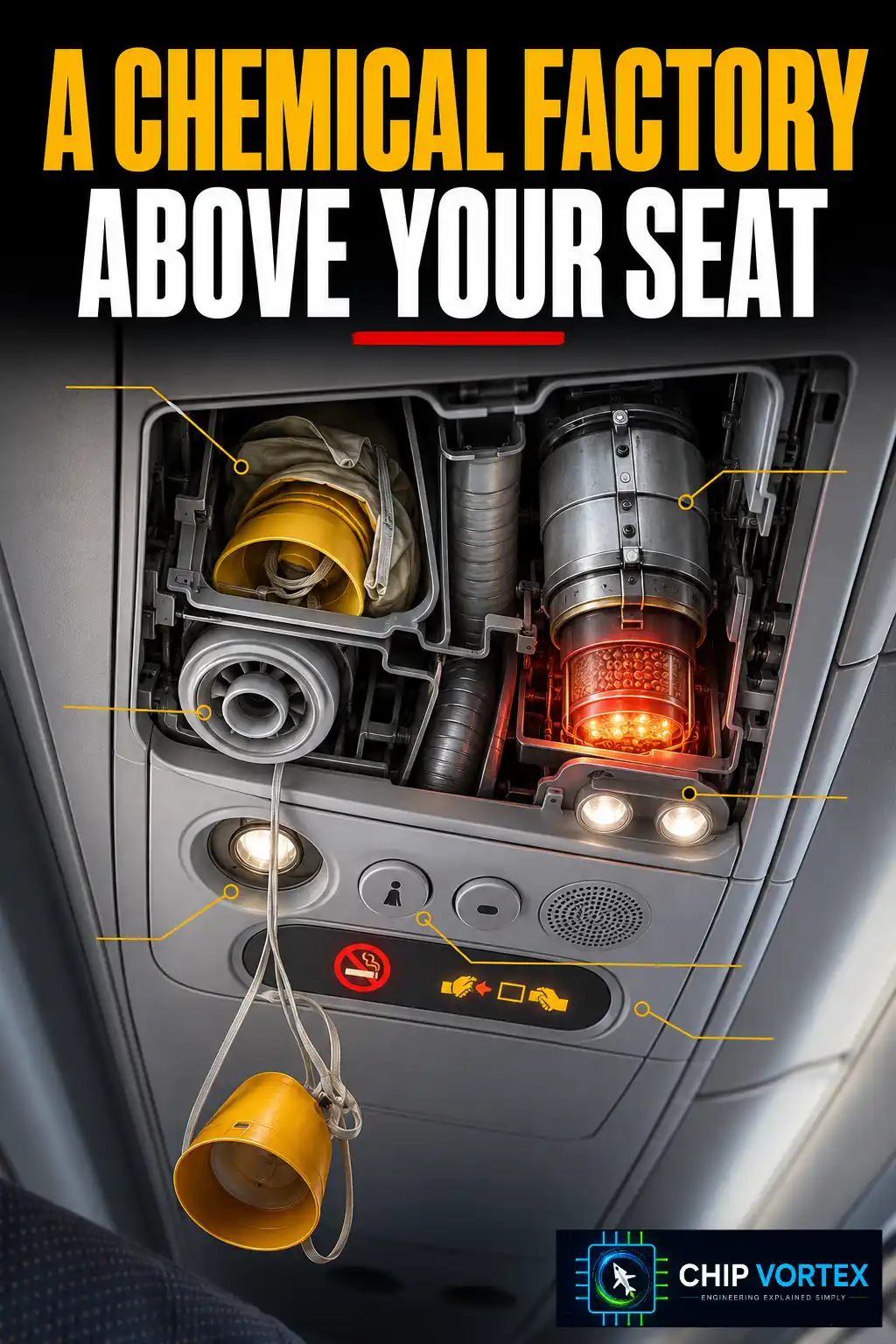
That panel above your seat row is the PSU — Passenger Service Unit — and it’s the cabin’s most densely packed real estate. The reading light. The call button (one chime in the galley, a light over your row — the crew’s quiet paging network). The illuminated signs. The air vent, whose official name is the gasper — fed by the aircraft’s air system so you get a personal breeze on demand. And behind the innocent-looking oxygen door: chemical oxygen generators. When masks drop, pulling one starts a chemical reaction that manufactures oxygen for roughly 12–15 minutes — the canister runs hot, a faint burning smell is normal, and the duration is deliberately matched to how long the crew needs to descend to breathable altitude. A small chemical factory, riding above your head for years, hoping never to be needed.
4. Cabin Intercommunication: The Aircraft’s Phone Network
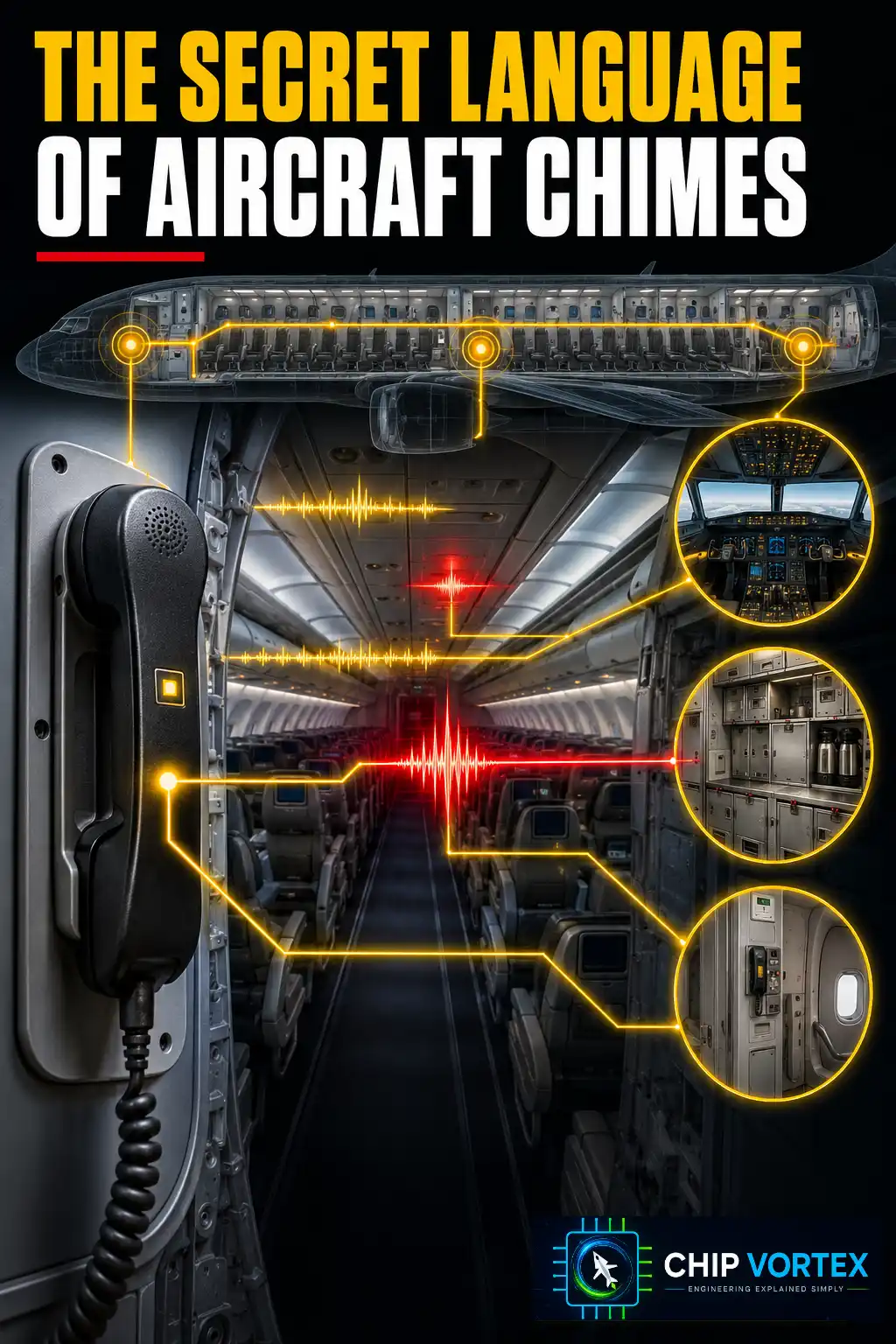
Every galley and door station has a handset, and together they form the cabin’s private telephone exchange — pilot-to-crew calls, crew-to-crew coordination, all-station “all call,” and the Public Address system, with strict priority: flight-deck announcements override everything else. Airbus formally calls the whole network CIDS (Cabin Intercommunication Data System), and its chime vocabulary — single tones, double tones, high-low patterns — is a language passengers hear all flight without knowing they’re listening to one. It’s the cabin-side sibling of the radios and datalinks up front: the flight deck talks to the world, the CIDS talks to the aircraft.
5. Cabin Pressure Indication: The Numbers Behind Your Ears
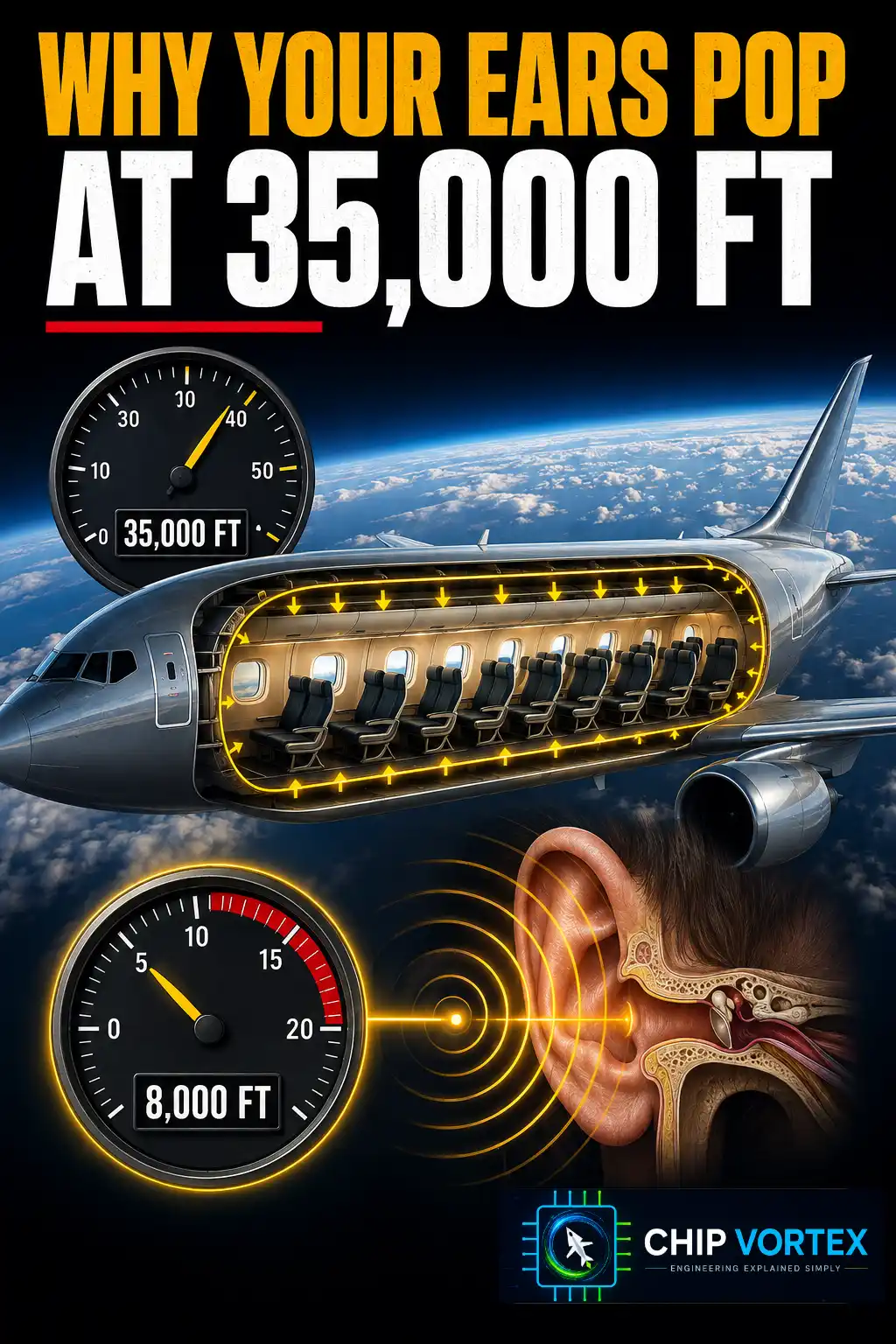
The display in the pin shows the two numbers crews watch: cabin altitude 8,000 ft and cabin rate ±50 fpm. While the aircraft cruises at 35,000+ feet, the pressurization system holds the cabin at a comfortable equivalent of about 8,000 ft — and the newest composite airliners (787, A350) hold a richer 6,000 ft, one reason you land less wrung-out. The rate is why your ears pop: they respond to pressure change, so the system climbs and descends the cabin gently even when the aircraft doesn’t. The indication system’s job is to monitor and warn — differential pressure, abnormal cabin altitude (a warning sounds if the cabin ever climbs past 10,000 ft, and masks deploy automatically higher still) — while the maintaining is done by the pressurization system’s outflow valves, breathing air supplied by the pneumatic system we’ve already toured.
How It All Works Together
The pin’s chain is real: electrical power feeds a cabin system controller (the CIDS “director” computers on Airbus), which distributes power, signals, and monitoring to every light, chime, sign, and display — with backup batteries under the emergency lights, redundant interphone and PA paths, and continuous self-monitoring. The crew’s window into all of it is the touchscreen Flight Attendant Panel by the forward door: lighting scenes, temperature, boarding music, and system status, one screen.
Next Time You Fly
Try the engineer’s boarding ritual: clock the lighting scene, find the floor path markers, name the gasper out loud (quietly), count the chimes, and — if you’re on a 787 or A350 — notice how your ears barely mention the descent. None of it is luck. All of it is systems.
FAQ: Aircraft Cabin Systems
Why do cabin lights dim for takeoff and landing at night?▾
So your eyes pre-adapt to darkness. Takeoff and landing are the phases where an evacuation is most likely, and eyes need several minutes to adjust to the dark — dimming the cabin means that if you ever step out into night, you can already see. The window shades go up for the same reason: crews and passengers can spot outside hazards instantly.
What is the air vent above my seat called?▾
The gasper. It taps the aircraft’s air supply to give each passenger a personal, adjustable stream of fresh air.
What happens when I press the call button?▾
A chime sounds at the crew station, a light illuminates over your seat row, and your row shows on the crew panel — a quiet, precise paging system that’s part of the cabin’s intercommunication network.
How long does the drop-down oxygen last?▾
The chemical generators supply roughly 12–15 minutes — intentionally sized to cover the descent to an altitude where you can breathe unaided. The masks’ oxygen is made, not stored, which is why the units run warm.
Why is the cabin kept at 8,000 feet instead of sea level?▾
Structural economics: the pressure difference between inside and out stresses the fuselage on every flight cycle. 8,000 ft is the sweet spot where humans stay comfortable and the airframe stays long-lived — and stronger composite fuselages are why newer jets can afford a richer 6,000 ft.
“Every light, button and sign is part of a smart system working for you” — and now you can name them all. What’s the cabin detail you’d never noticed before — the floor path, the chimes, or the vent with a name? Tell us in the comments, save the pin for your next flight, and keep exploring the machine around your seat: how the pneumatic system feeds your air, how the flight deck talks to the world, and what’s happening out on the wing beside your window.