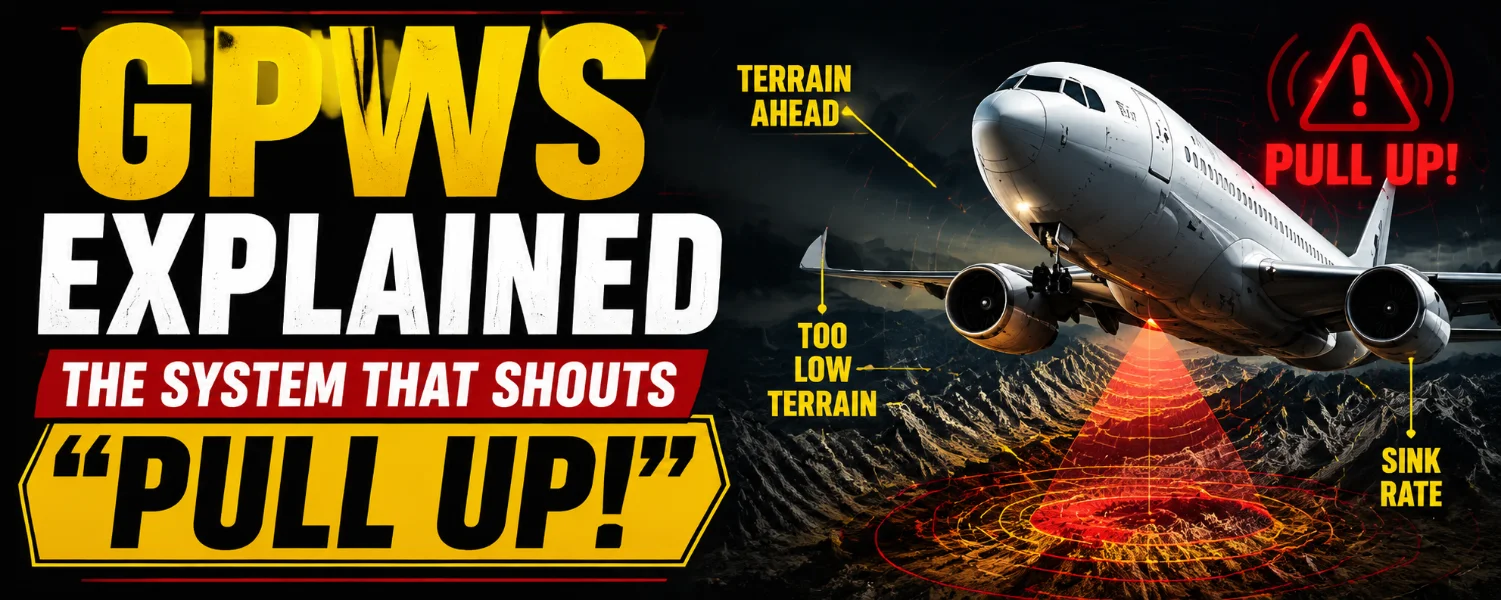
For decades, the deadliest category of aviation accident had a chilling name: Controlled Flight Into Terrain — CFIT. A perfectly functioning aircraft, a qualified crew, and yet the flight ends against a mountainside, usually at night or in cloud, with nobody aboard aware of the danger until the final seconds. GPWS — the Ground Proximity Warning System — is the box that was invented to end that, and it largely has. This is how your aircraft’s last line of defense works, what every callout means, and how its modern version sees mountains that are still minutes away.
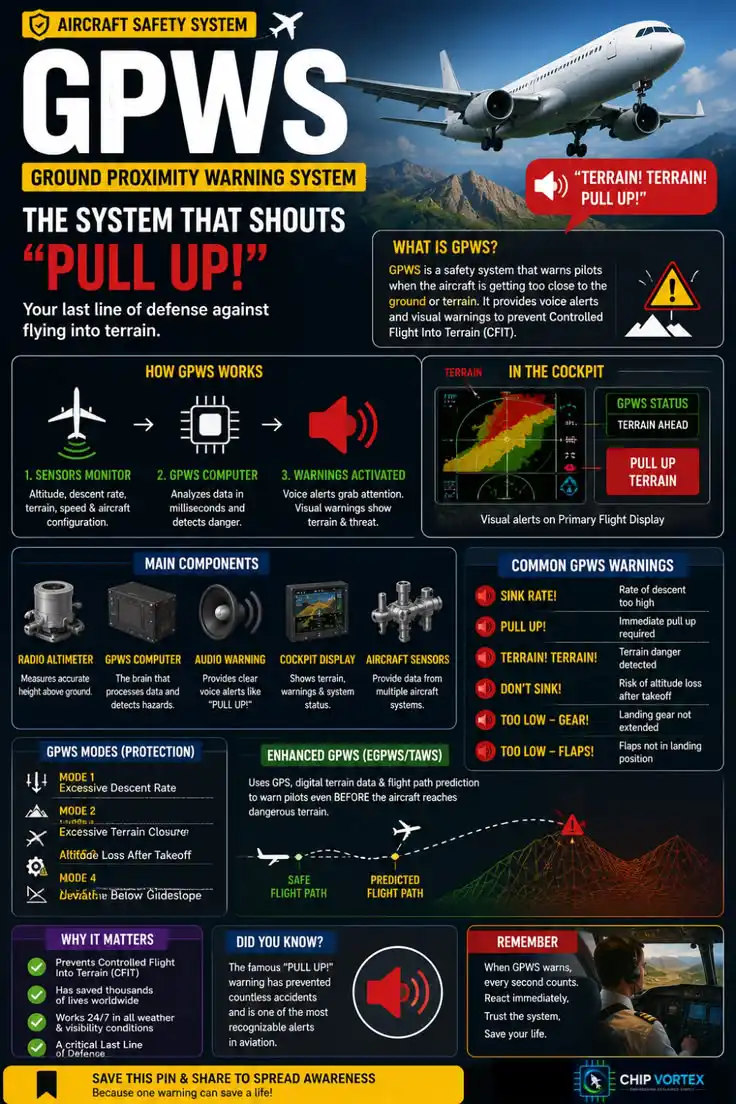
Save the guide, then let’s meet the voice every pilot obeys instantly.
What Is GPWS? (Quick Answer)
GPWS is a safety system that warns pilots — with urgent voice and visual alerts — when the aircraft is getting dangerously close to the ground or terrain. It exists to prevent CFIT: accidents where an airworthy aircraft under crew control is unintentionally flown into terrain, water, or an obstacle. When GPWS speaks, it is telling the crew something they don’t yet know: the ground is closer than you think.
How It Works: A Radio Beam Looking Down
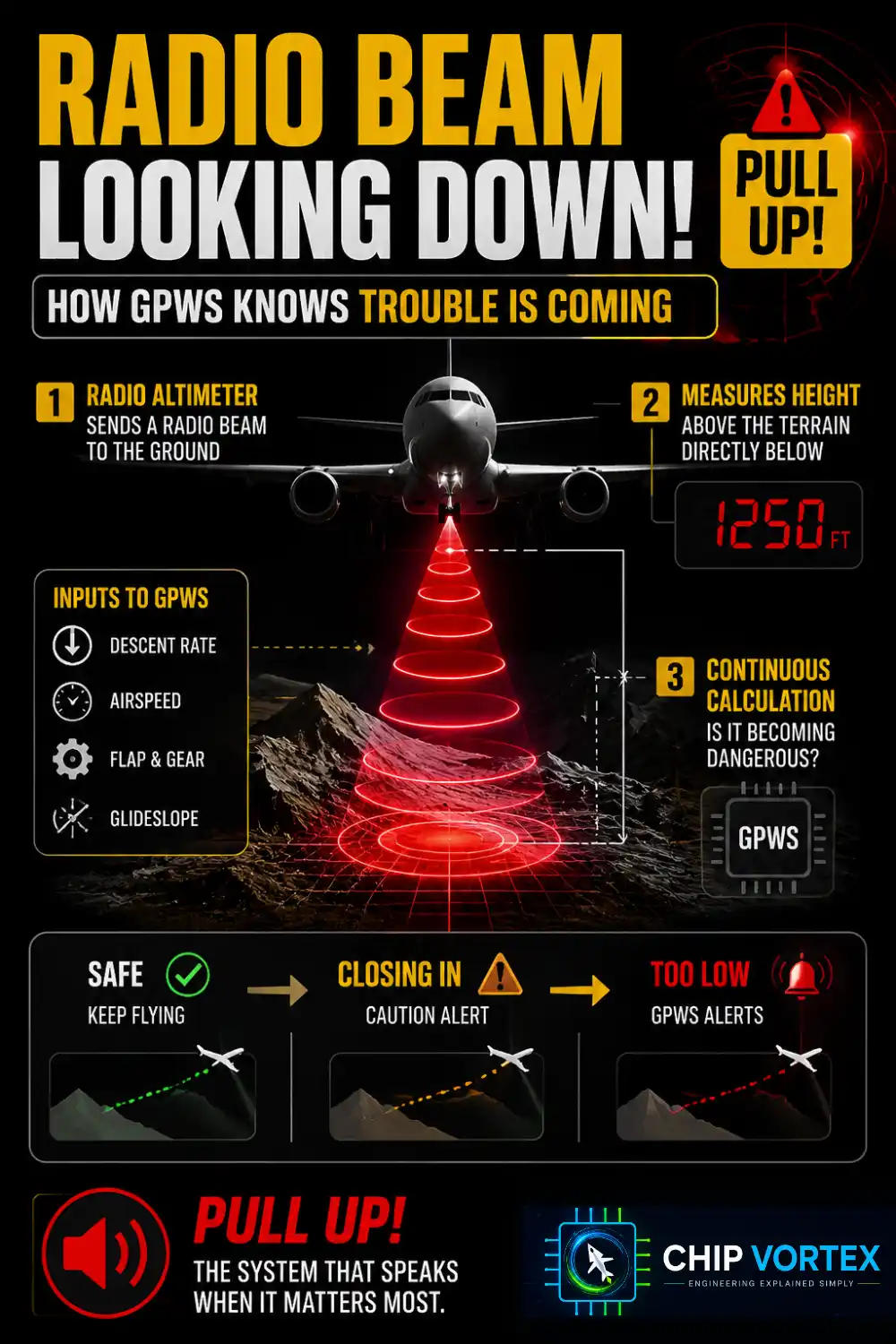
The heart of classic GPWS is the radio altimeter — and it’s worth pausing on, because it’s a different animal from the altimeter we covered in the air data systems guide. The barometric altimeter measures height above sea level from air pressure; the radio altimeter bounces a radio beam off the ground and measures height above the terrain directly below, to the foot. Feed that into the GPWS computer along with descent rate, airspeed, gear and flap position, and glideslope deviation, and the computer runs a continuous question in milliseconds: given how fast the ground is coming up and how the aircraft is configured, is this situation becoming dangerous? When the answer is yes, the flight deck gets loud.
The Callouts: What Each Warning Means
| Callout | What It Means |
|---|---|
| “SINK RATE!” | Descending too fast for this height — reduce the descent |
| “PULL UP!” | The hard warning: immediate maximum climb required, now |
| “TERRAIN! TERRAIN!” | Ground is rising toward the aircraft dangerously fast |
| “DON’T SINK!” | Losing altitude right after takeoff — climb |
| “TOO LOW — GEAR!” | Close to the ground with landing gear not extended |
| “TOO LOW — FLAPS!” | Close to the ground with flaps not set for landing |
| “GLIDESLOPE” | Drifting below the ILS glideslope on approach |
Notice the design language: short, unmistakable words, spoken in a voice engineered to cut through any cockpit workload. There is no “please review your descent profile.” There is “PULL UP!”
The Five Classic Modes
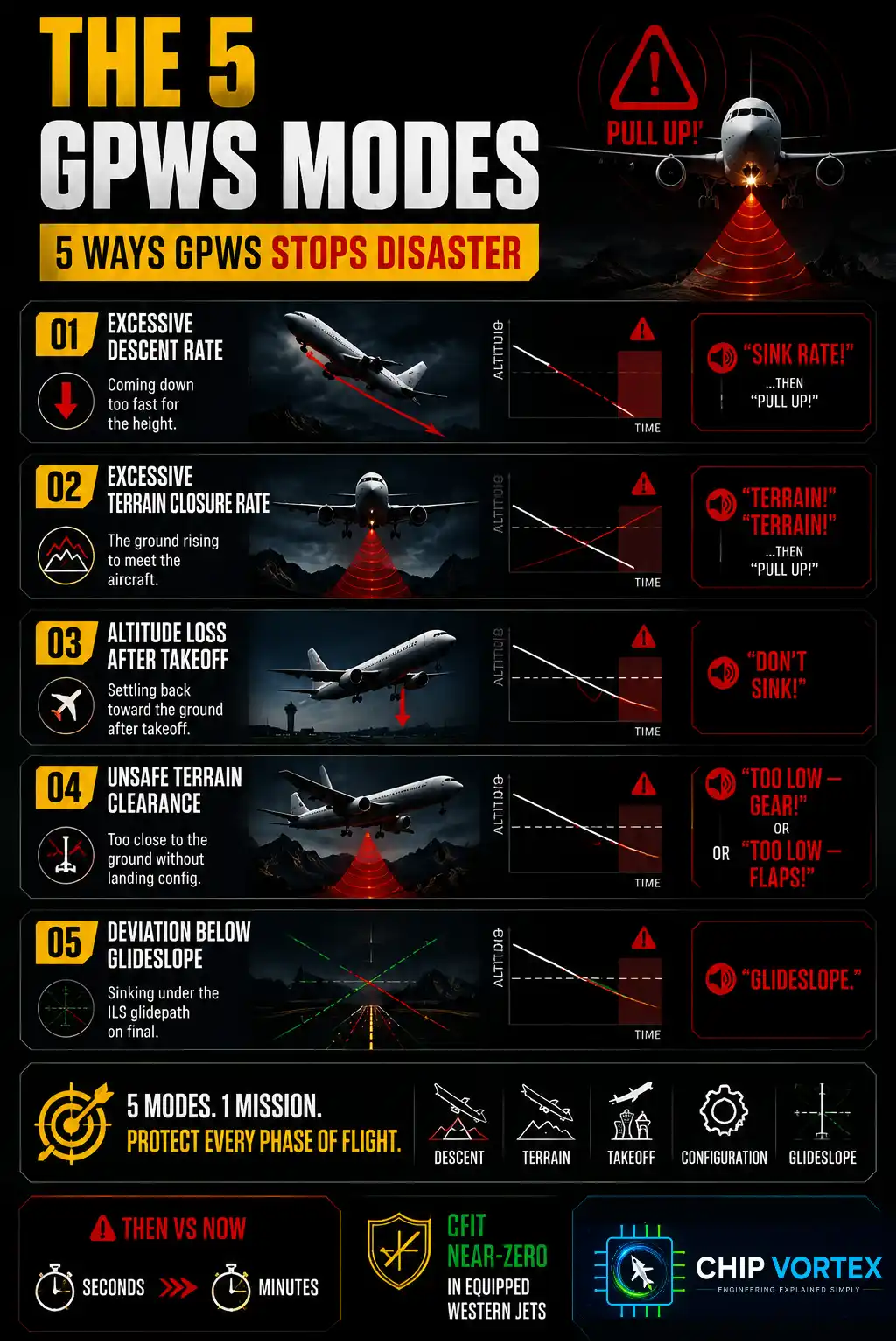
Behind those callouts sit five monitoring modes, each watching for a different way an aircraft can be flown toward the ground:
Mode 1 — Excessive Descent Rate. Coming down too fast for the current height: “SINK RATE!”, escalating to “PULL UP!”
Mode 2 — Excessive Terrain Closure Rate. The ground rising to meet the aircraft — the classic hidden-ridge scenario: “TERRAIN! TERRAIN!”, then “PULL UP!”
Mode 3 — Altitude Loss After Takeoff. Settling back toward the ground during initial climb: “DON’T SINK!”
Mode 4 — Unsafe Terrain Clearance. Too close to the ground without landing configuration: “TOO LOW — GEAR!” or “TOO LOW — FLAPS!”
Mode 5 — Deviation Below Glideslope. Sinking under the ILS glidepath on final: “GLIDESLOPE.”
Five modes, one philosophy: catch every geometry by which a good aircraft meets the ground by mistake.
The Fatal Flaw — and the Fix
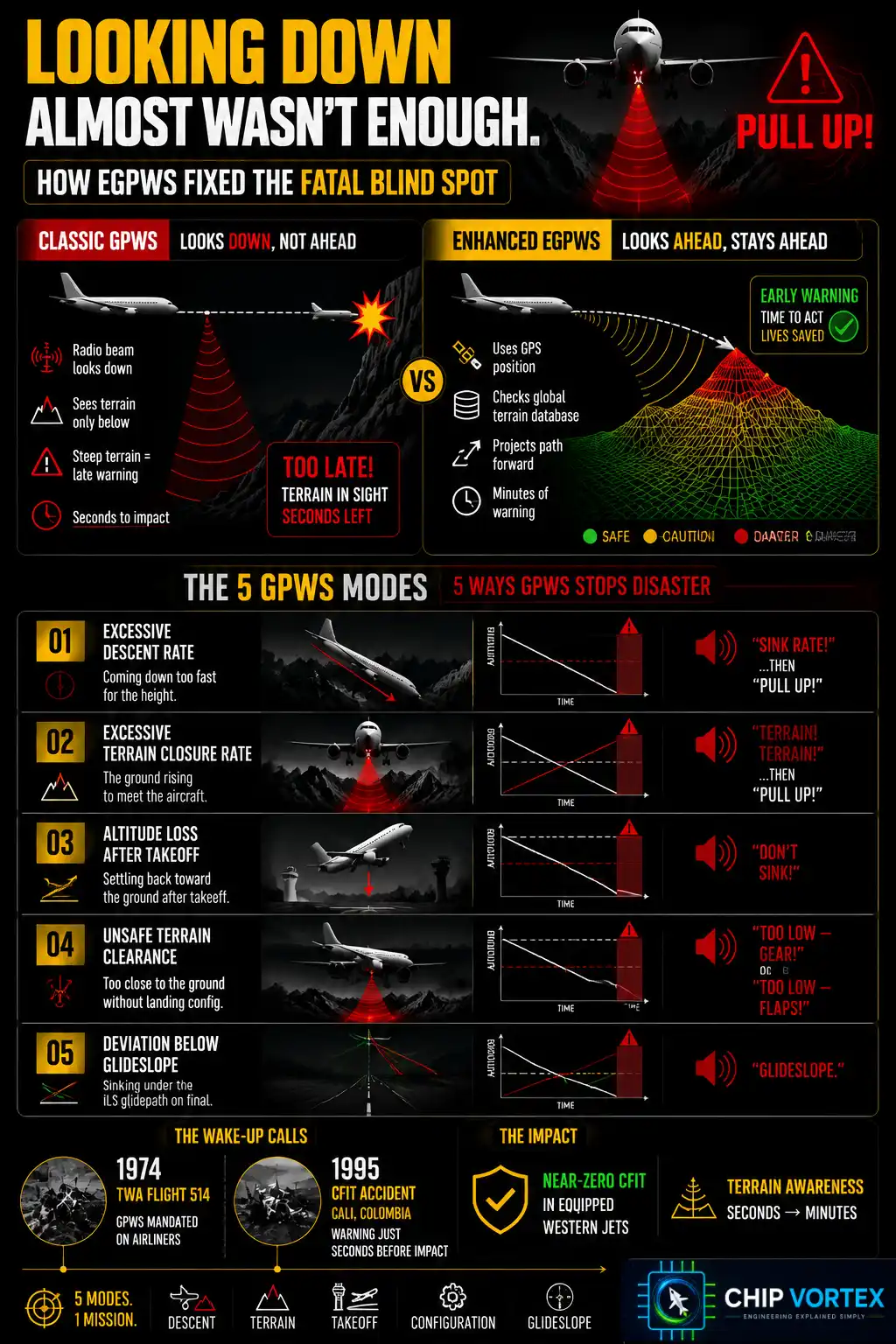
Classic GPWS had one built-in blindness: the radio altimeter looks down, not ahead. It measures the terrain you’re over — so if the ground rose gradually, the closure-rate math caught it in time. But a steep cliff or sheer ridge gave almost no warning: the beam saw flat valley floor right up until the wall. Crews sometimes got their “PULL UP!” with only seconds of terrain clearance left. The 1974 crash of TWA Flight 514 near Mount Weather had already driven regulators to mandate GPWS on airliners; two decades later, the 1995 CFIT accident at Cali, Colombia — where the warning came just seconds before impact — made the remaining gap impossible to ignore.
The fix was EGPWS (Enhanced GPWS, the pin’s TAWS box): take the aircraft’s GPS position from the navigation system, compare it against a digital terrain database of the entire planet, and project the flight path forward. Now the system doesn’t need to sense the mountain — the mountain has been in the database since before the aircraft ever flew toward it. Warning times stretched from seconds to minutes, terrain paints in green, yellow, and red on the navigation display, and CFIT — once aviation’s biggest killer — has been driven to near-zero among equipped Western jets.
Did You Know: The Engineer Behind the Voice
Both inventions trace to one man: Don Bateman, the Honeywell engineer who developed GPWS in the early 1970s and then, unsatisfied with his own creation’s blind spot, led the development of EGPWS in the 1990s. Aviation safety organizations have credited his work with saving more lives than perhaps any engineer in the industry’s history. When he died in 2023, pilots around the world paid tribute to a man most passengers have never heard of — whose voice, in a sense, rides on every airliner.
When It Shouts, You Don’t Think
The pin’s “Remember” box states real doctrine: a hard GPWS warning is a memory item — no discussion, no diagnosis. Maximum thrust, pitch up firmly, wings level, climb until the warning stops. Analysis comes later; the warning exists precisely for the moments when the crew’s mental picture is wrong, so the procedure assumes the box is right and the humans are not. And when multiple protection systems speak at once, aviation has even ranked the voices: windshear warnings outrank GPWS, and GPWS outranks TCAS — the ground you’re about to hit takes priority over the traffic a mile away.
FAQ: GPWS
What does “Terrain, terrain — pull up!” mean?▾
GPWS has detected ground rising toward the aircraft dangerously fast and is commanding an immediate maximum-performance climb. It’s the most urgent warning on the flight deck, and the response is instant and memorized.
What is CFIT?▾
Controlled Flight Into Terrain: an accident where an airworthy aircraft, under the crew’s control, is unintentionally flown into ground, water, or an obstacle — typically in darkness or cloud. Before GPWS, it was the leading cause of airline fatalities.
What’s the difference between GPWS and EGPWS?▾
Direction of sight. Classic GPWS senses the terrain below via radio altimeter — reactive, seconds of warning. EGPWS adds GPS position and a global terrain database to see ahead — predictive, minutes of warning, with terrain painted on the map display.
Does GPWS work at night and in bad weather?▾
Yes — that’s the point. The radio altimeter and terrain database don’t care about darkness or cloud; the system exists precisely for the conditions where pilots’ eyes fail.
Can pilots ignore a GPWS warning?▾
Hard warnings demand an immediate pull-up, full stop. The only recognized exception is clear daylight with the terrain unmistakably in sight — and even then, airline procedures overwhelmingly say: climb first, discuss on the ground.
“When GPWS warns, every second counts. React immediately. Trust the system.” That trust was engineered, one mode at a time, by people who refused to accept CFIT as normal. Which flight-deck guardian should we explain next — the autopilot that flies the aircraft, or the engine that powers it? Tell us in the comments, save this guide, and keep exploring the series: TCAS watches the traffic, ILS guides the landing, and the air data system feeds them all.