
Ask how airplanes fly and you will almost certainly get the same answer: the top of the wing is curved, so the air travelling over it has further to go, so it must speed up to meet the air underneath at the back, and faster air means lower pressure, which lifts the wing.
NASA has a page devoted to that explanation. The page is titled “Incorrect Lift Theory.”
NASA’s own framing is blunt: “many of the theories found in encyclopedias, on web sites, and even in some textbooks are incorrect, causing unnecessary confusion for students.” (That page title survives on NASA’s legacy K-12 pages; the current Beginner’s Guide has retitled them.)
Graham Wild’s 2023 review in Education Sciences traced 140 education articles on lift published from 1920 onward and found the median number of citations to other lift-education articles was zero — a fair explanation of how an error survives a century.
Why the Equal Transit Time Story Fails
The explanation is usually called “equal transit time.” It fails on both of its premises.
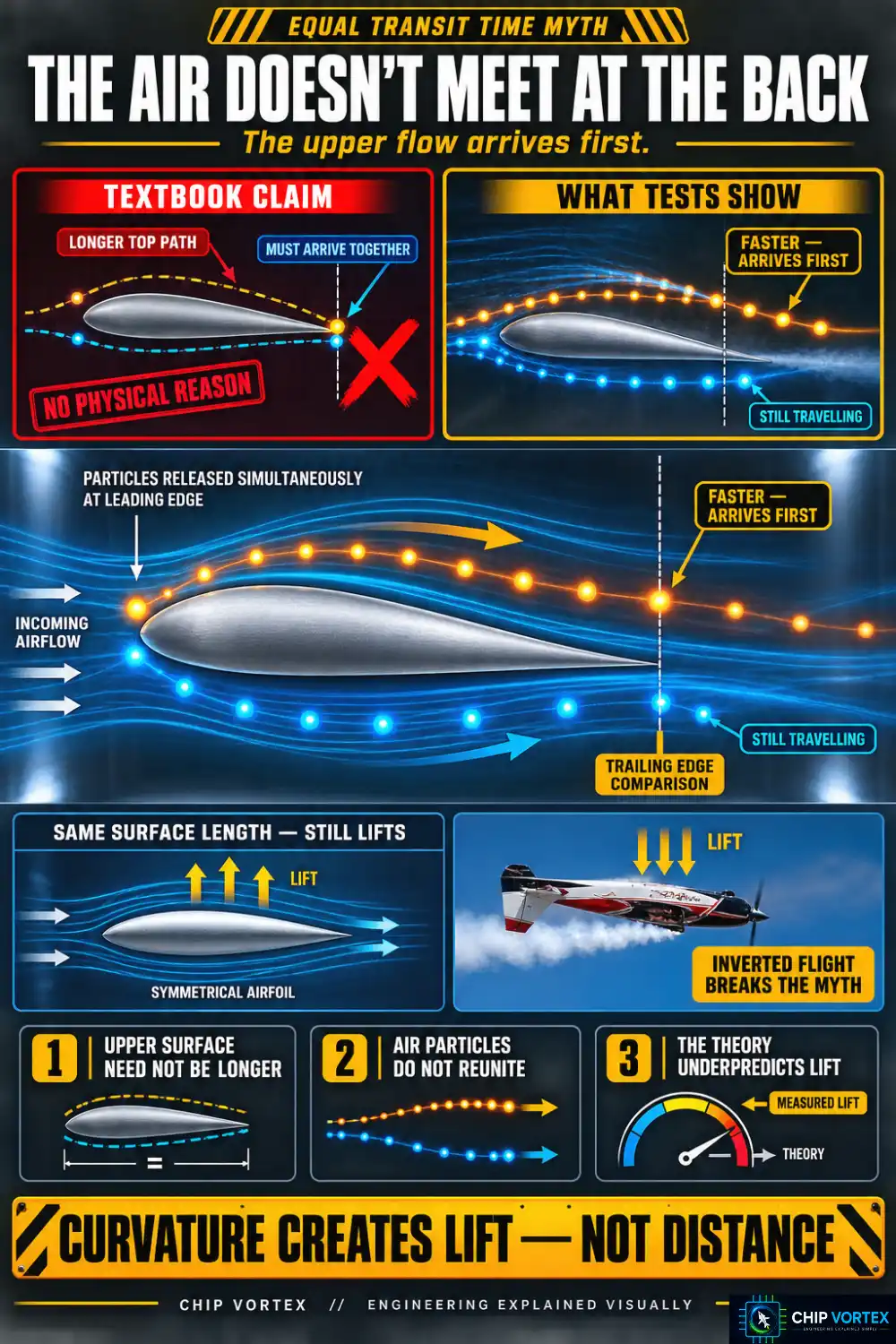
The first premise — that upper surfaces are longer — is not generally true. NASA is direct about it: “The symmetric airfoil in our experiment generates plenty of lift and its upper surface is the same length as the lower surface.” A paper aeroplane’s wing is a flat plate, identical top and bottom, and it flies. Some modern low-drag airfoils have a longer bottom surface. And aircraft fly inverted routinely at airshows, where the longer path would be underneath.
The second premise — that the two flows must meet at the trailing edge — is simply invented. There is no physical reason two neighbouring air particles must arrive together. And measurement shows they do not.
This is the part that surprises people. The air over the top does not merely travel fast enough to keep up. It travels much faster, and it reaches the trailing edge before the air from underneath. NASA states it plainly: “particles moving over the top arrive at the trailing edge before particles moving under the airfoil.” Holger Babinsky’s smoke-tunnel films at Cambridge show it directly: pause the video and the upper flow has already passed the trailing edge while the lower flow is still working its way along.
NASA also makes the quantitative point, which is more damning than the qualitative one: “The lift predicted by the ‘Equal Transit’ theory is much less than the observed lift, because the velocity is too low.” The theory does not merely rest on a bad assumption — it gives the wrong answer.
His conclusion is worth memorising: “it’s the curvature that creates lift, not the distance.”
But Bernoulli Is Not Wrong
Here is where a great many corrective articles overshoot, and get it wrong in the opposite direction.
You will read that “Bernoulli’s principle doesn’t explain lift” or that “Bernoulli is a myth.” That is not what NASA says. Read their assessment of the equal transit theory’s final step — faster flow means lower pressure, and the pressure difference produces lift:
“As we have seen in Experiment #1, this part of the theory is correct. In fact, this theory is very appealing because many parts of the theory are correct… The problem with the ‘Equal Transit’ theory is that it attempts to provide us with the velocity based on a non-physical assumption.”
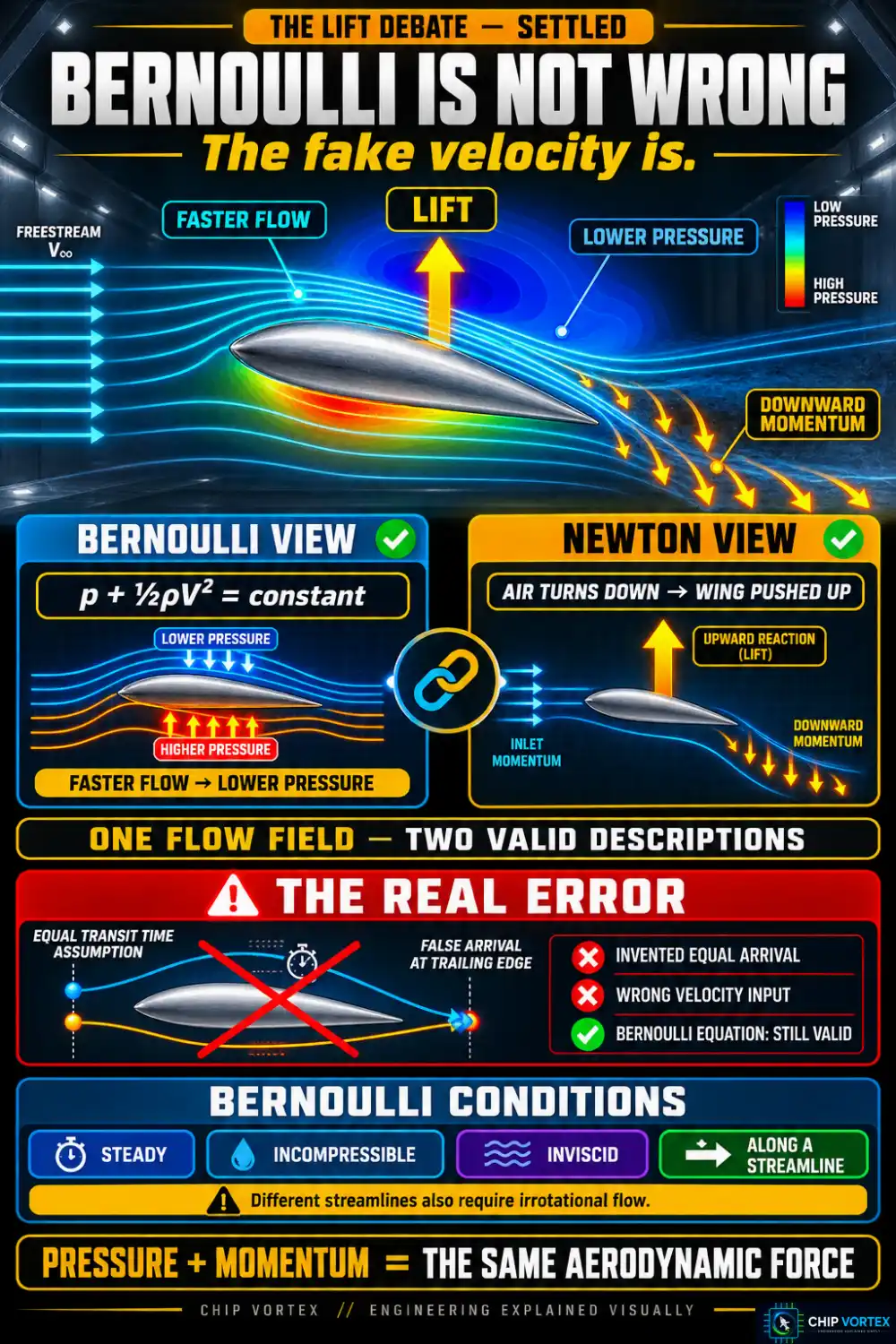
The error is not Bernoulli. The error is the fake velocity fed into Bernoulli.
NASA’s position on the wider argument is symmetric, and settles it:
“So both ‘Bernoulli’ and ‘Newton’ are correct. Integrating the effects of either the pressure or the velocity determines the aerodynamic force on an object.”
Pressure and momentum are not rival explanations. They are two ways of totalling up the same flow field.
One honest caveat, because the article’s critics will raise it: Bernoulli’s equation holds along a streamline, for flow that is inviscid, incompressible and steady. Comparing a speed above the wing with one below it means comparing different streamlines, which additionally requires the flow to be irrotational — true outside the boundary layer, but a condition worth stating rather than assuming.
What Actually Generates Lift
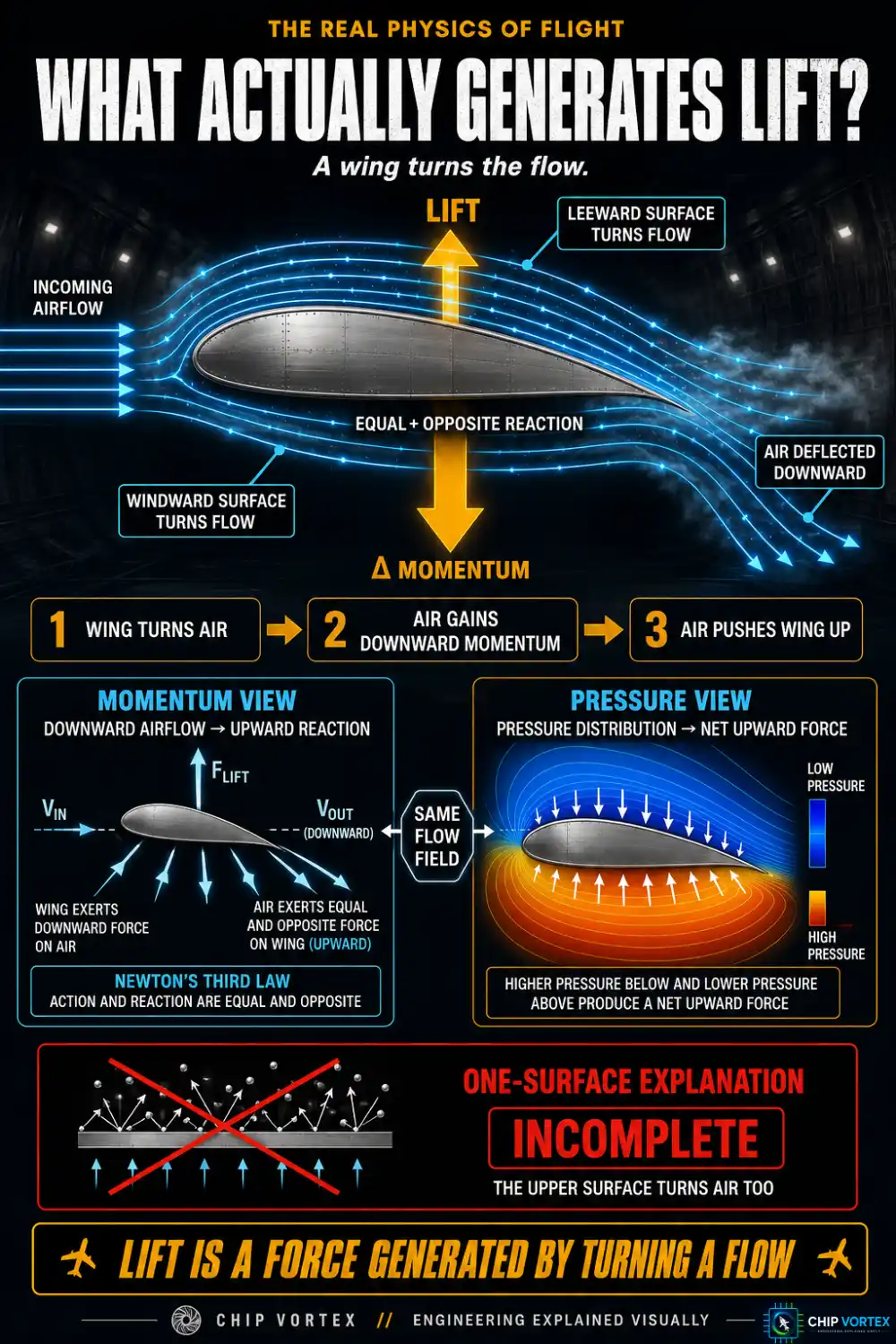
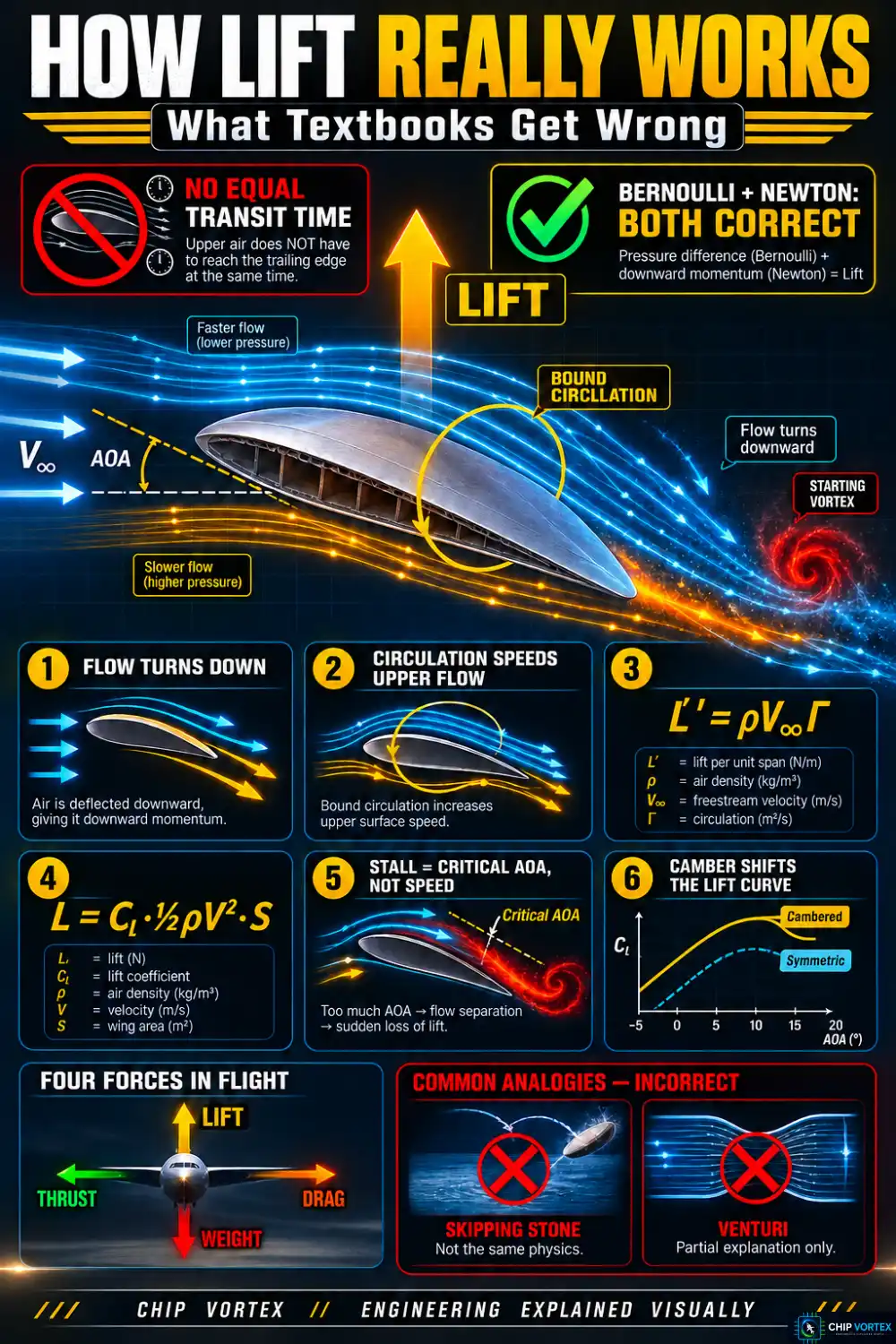
NASA’s positive statement is one sentence: “Lift is a force generated by turning a flow.”
A wing deflects air downward. By Newton’s third law the air pushes back, and that reaction is lift. The velocity changes around the wing because the flow is being turned, and pressure varies with velocity — so the pressure picture and the momentum picture arise together.
One line from NASA does more damage to bad explanations than any other: “Both windward and leeward parts can deflect a flow. Ignoring the leeward deflection leads to a popular incorrect theory of lift.” The upper surface turns air too. Any explanation that only looks at one surface is broken before it starts.
So Why Is the Air Faster Over the Top?
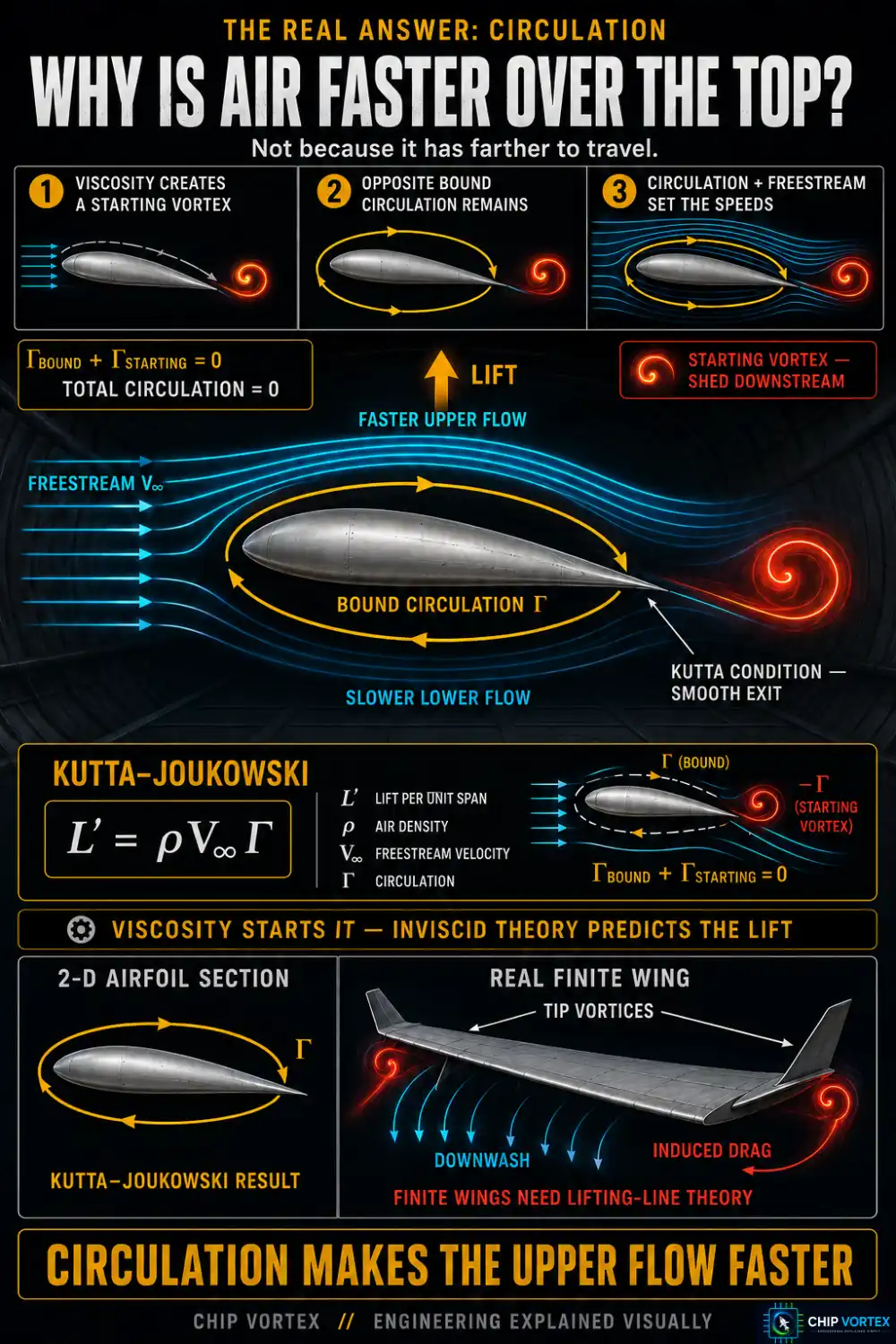
This is the question the equal-transit story was invented to dodge, and it has a real answer: circulation.
When a wing starts moving, viscosity prevents the flow from whipping around the sharp trailing edge. A starting vortex forms there and is shed downstream. Kelvin’s circulation theorem requires total circulation to be conserved, so an equal and opposite bound circulation is left around the wing. Superimpose that circulation on the oncoming flow and you get exactly what is observed: faster over the top, slower underneath.
The Kutta condition is the rule that fixes how much. Inviscid theory alone permits infinitely many solutions around an airfoil, one for each value of circulation. Nature selects the one that keeps the flow leaving the sharp trailing edge smoothly. The Kutta–Joukowski theorem then converts it to lift:
L′ = ρ V∞ Γ
Lift per unit span equals air density times freestream velocity times circulation. Note what this means: viscosity creates the circulation, and the circulation then makes the frictionless mathematics give the right answer.
Everything in this section is a two-dimensional result — a wing section, not a wing. Real finite wings shed trailing vorticity from the tips, which is where lifting-line theory, downwash and induced drag come in.
The Lift Equation
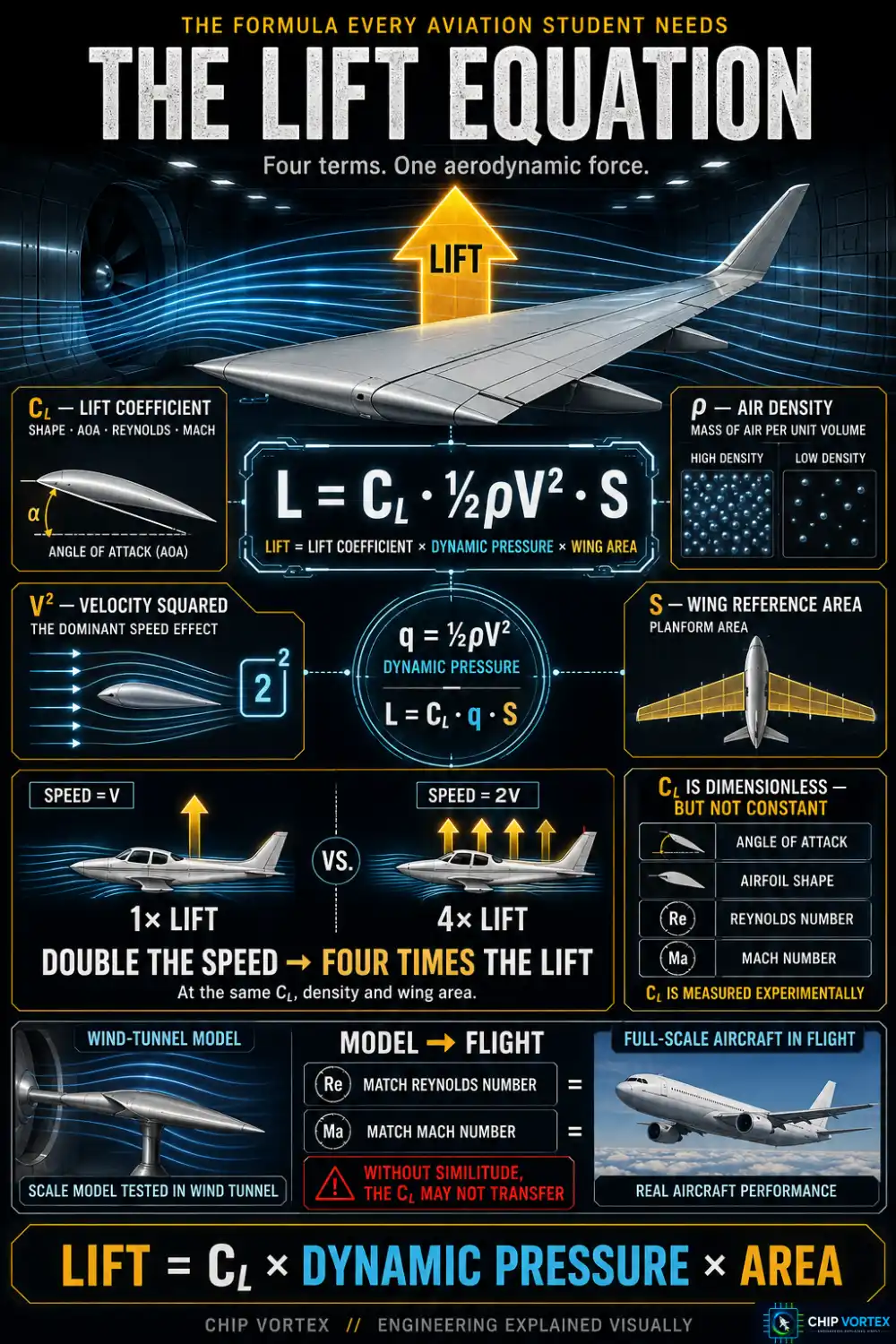
All of that physics reduces to one working formula, and it is the one every aviation student needs by heart:
L = CL · ½ρV² · S
- CL — coefficient of lift, a dimensionless number carrying the effects of shape, angle of attack, Reynolds number and Mach number
- ρ — air density
- V — velocity
- S — wing reference area
The term ½ρV² is dynamic pressure, so lift is simply CL × dynamic pressure × area. The practical consequence lives in that square: double the speed and you quadruple the lift available at a given angle of attack.
CL is determined experimentally in a wind tunnel by setting velocity, density and area and measuring the lift produced. Be careful how you state what it depends on. The explicit dependence on ρ, V² and S has been divided out — but CL still varies with Reynolds number and Mach number, and both of those contain density and speed. That is exactly why wind tunnel results only transfer to flight when Reynolds and Mach are matched.
Angle of Attack, and the Angle That Matters
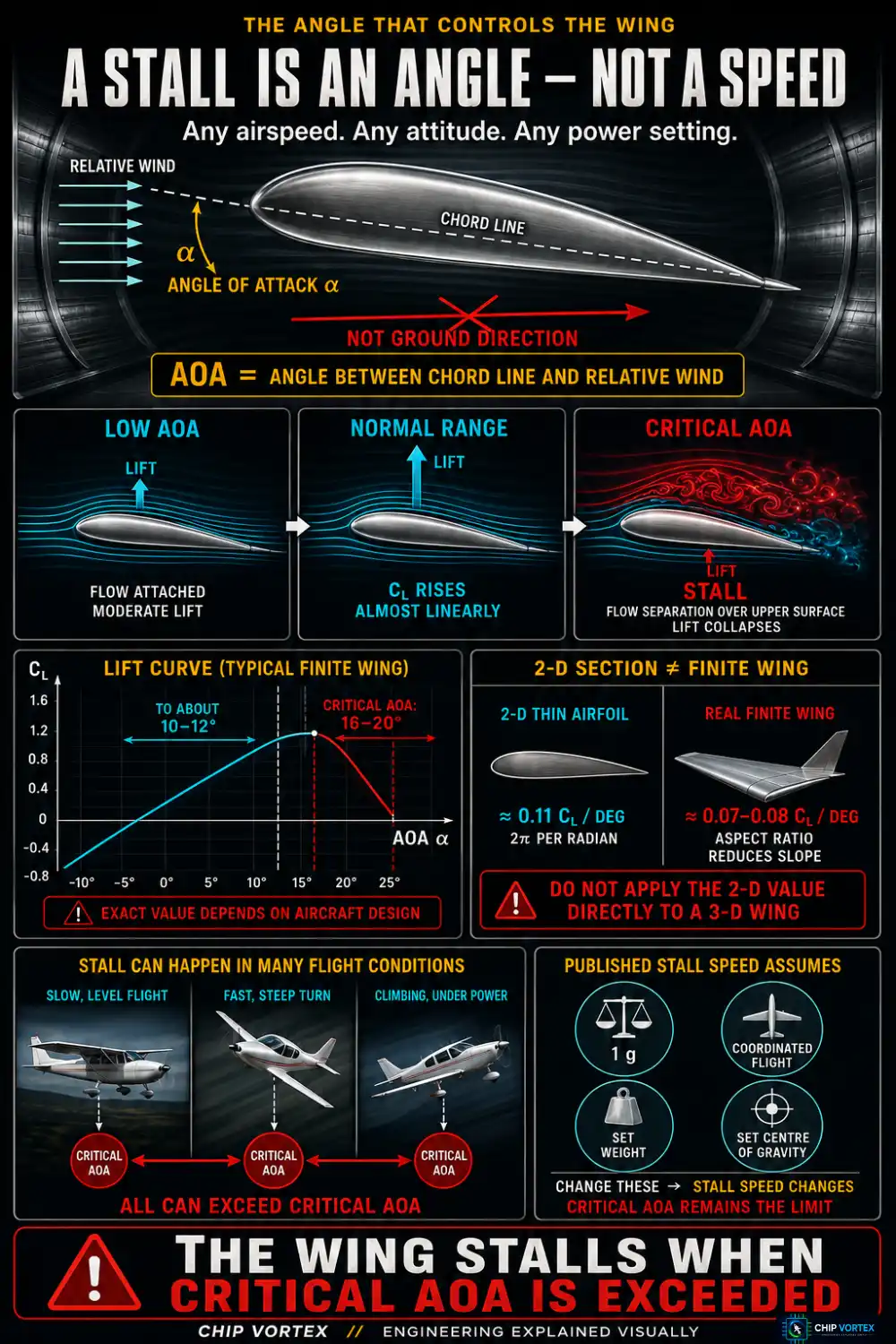
The FAA defines angle of attack as “the acute angle between the chord line of the airfoil and the direction of the relative wind.” Two words in that definition do work: chord line, not the wing generally; and relative wind, not the direction of flight over the ground.
Through the normal range, lift coefficient rises almost linearly with angle of attack. Thin-airfoil theory gives the slope of a two-dimensional section as about 2π per radian — roughly 0.11 per degree. A real finite wing is lower, because aspect ratio reduces the slope: nearer 0.07–0.08 per degree for a typical airliner or trainer wing. Do not carry the 2-D number onto a 3-D wing.
That linearity holds to around 10–12°, after which the flow separates and lift falls away sharply. The FAA gives critical angle of attack as ranging between 16 and 20 degrees depending on aircraft design; individual conventional airfoil sections commonly stall around 15–16°. You will see lower figures quoted, so know that the number is design-dependent — but the concept is not.
Which brings the single most important sentence in this article, from the FAA’s Airplane Flying Handbook:
“It is possible to exceed the critical AOA at any airspeed, at any attitude, and at any power setting.”
A stall is an angle, not a speed. The published stall speed is repeatable only under four conditions at once: unaccelerated 1 g flight, coordinated flight, one weight, and one centre of gravity. Change any of them and the speed moves. The angle is what is invariant — which is why an aircraft can stall in a steep turn at well above its book stall speed.
What Camber Actually Does
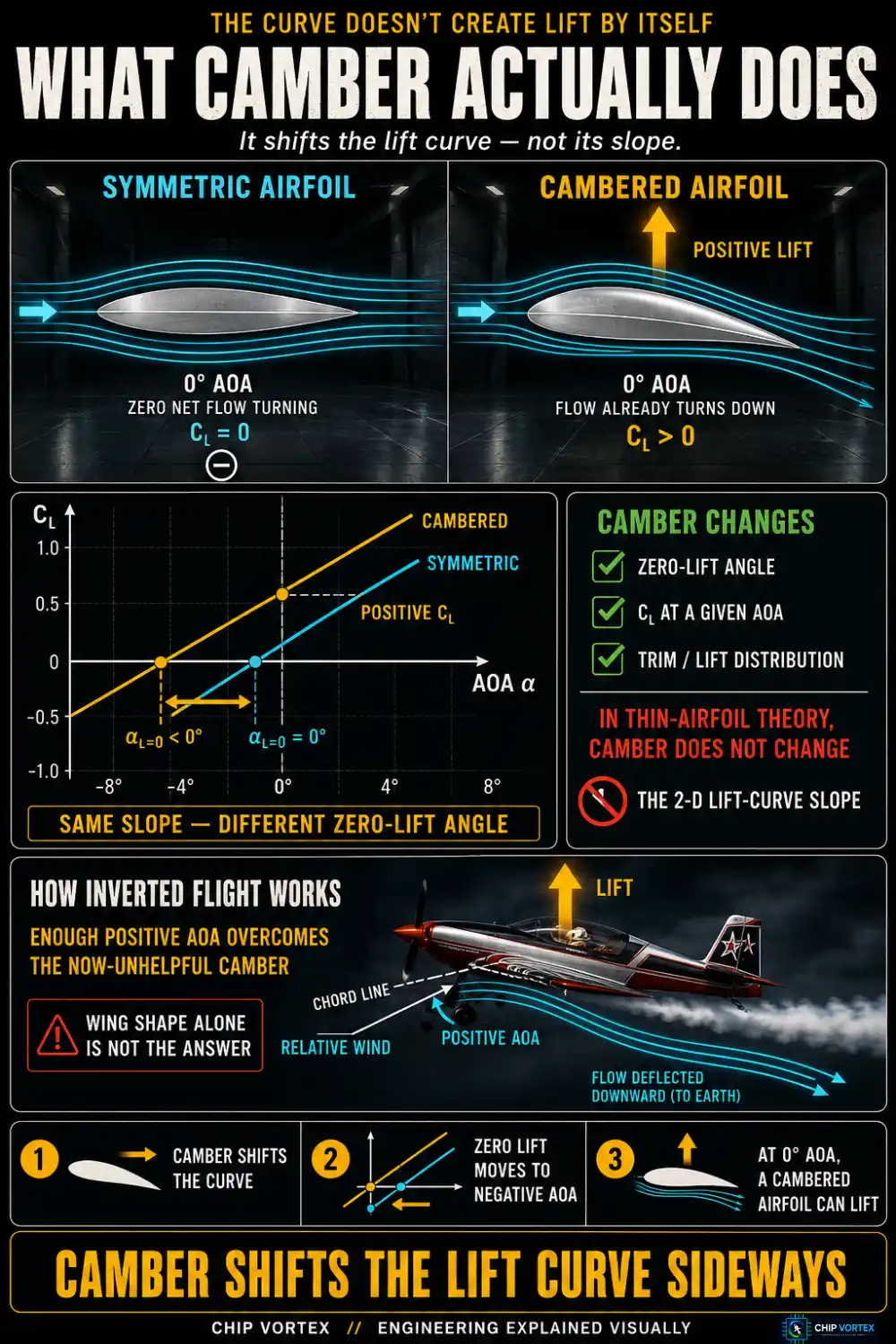
Camber is often described as “the curve that makes lift.” More precisely: in thin-airfoil theory camber does not change the slope of the lift curve at all. It shifts the curve sideways.
A symmetric airfoil has a zero-lift angle of attack of 0°: at zero incidence it turns the flow symmetrically, so there is no net turning and no lift. A positively cambered airfoil has a small negative zero-lift angle, so at 0° incidence it is already turning flow downward and already producing lift.
This also disposes of the inverted-flight puzzle. An aerobatic aircraft on its back simply flies at enough positive angle of attack to overcome its now-unhelpful camber.
The Four Forces — and a Common Error
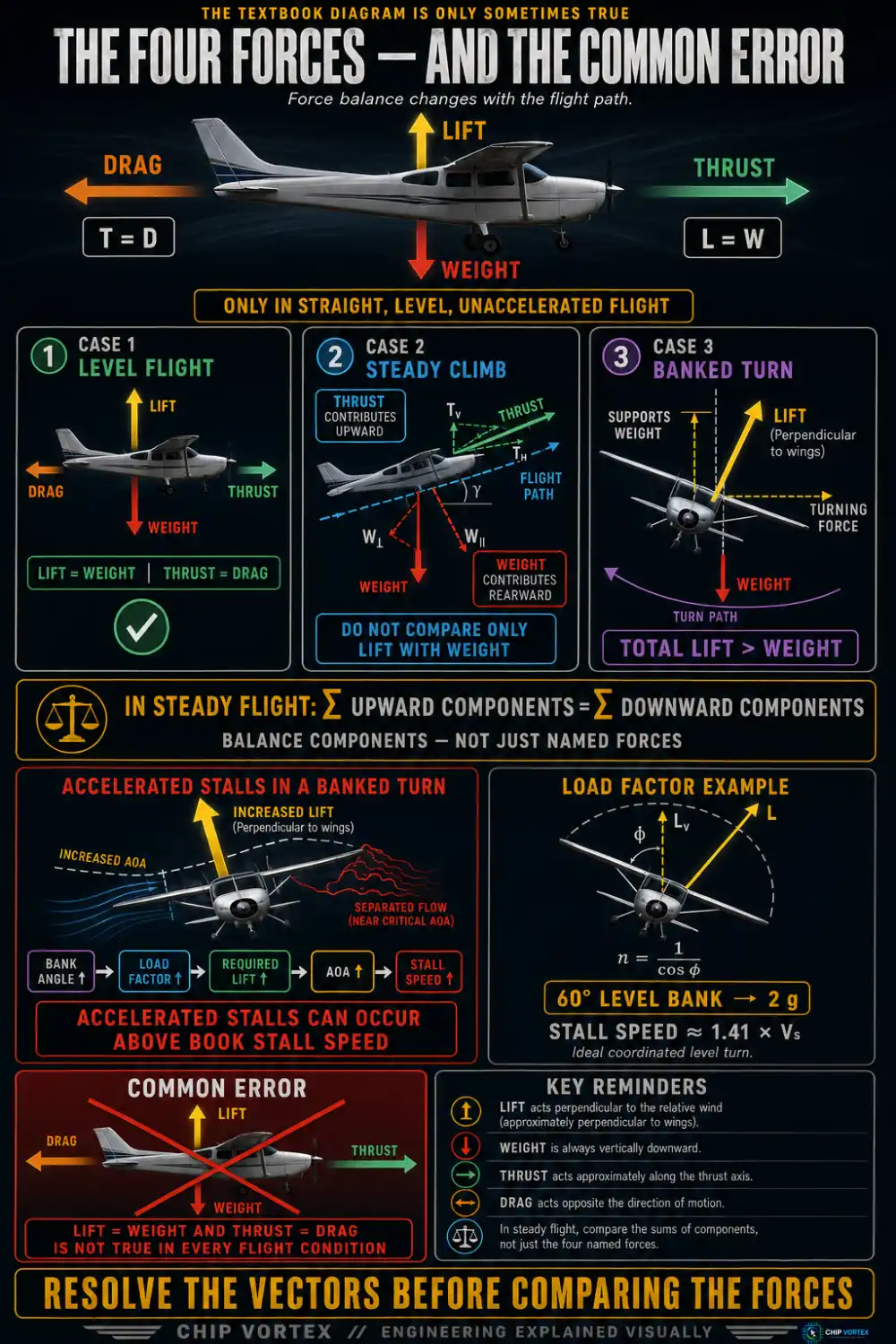
Lift, weight, thrust and drag. The textbook diagram shows lift equal to weight and thrust equal to drag, and in straight, level, unaccelerated flight that is true.
It is not true generally, and the FAA is careful about this. The accurate statement is that in steady flight the sum of all upward components of all forces equals the sum of all downward components — not merely lift versus weight. In a climb a portion of thrust acts upward like lift, and a portion of weight acts rearward like drag. In a turn, lift must exceed weight to supply the turning force as well, which demands a higher angle of attack — and is precisely why accelerated stalls happen above the published stall speed.
Two More Theories NASA Rejects
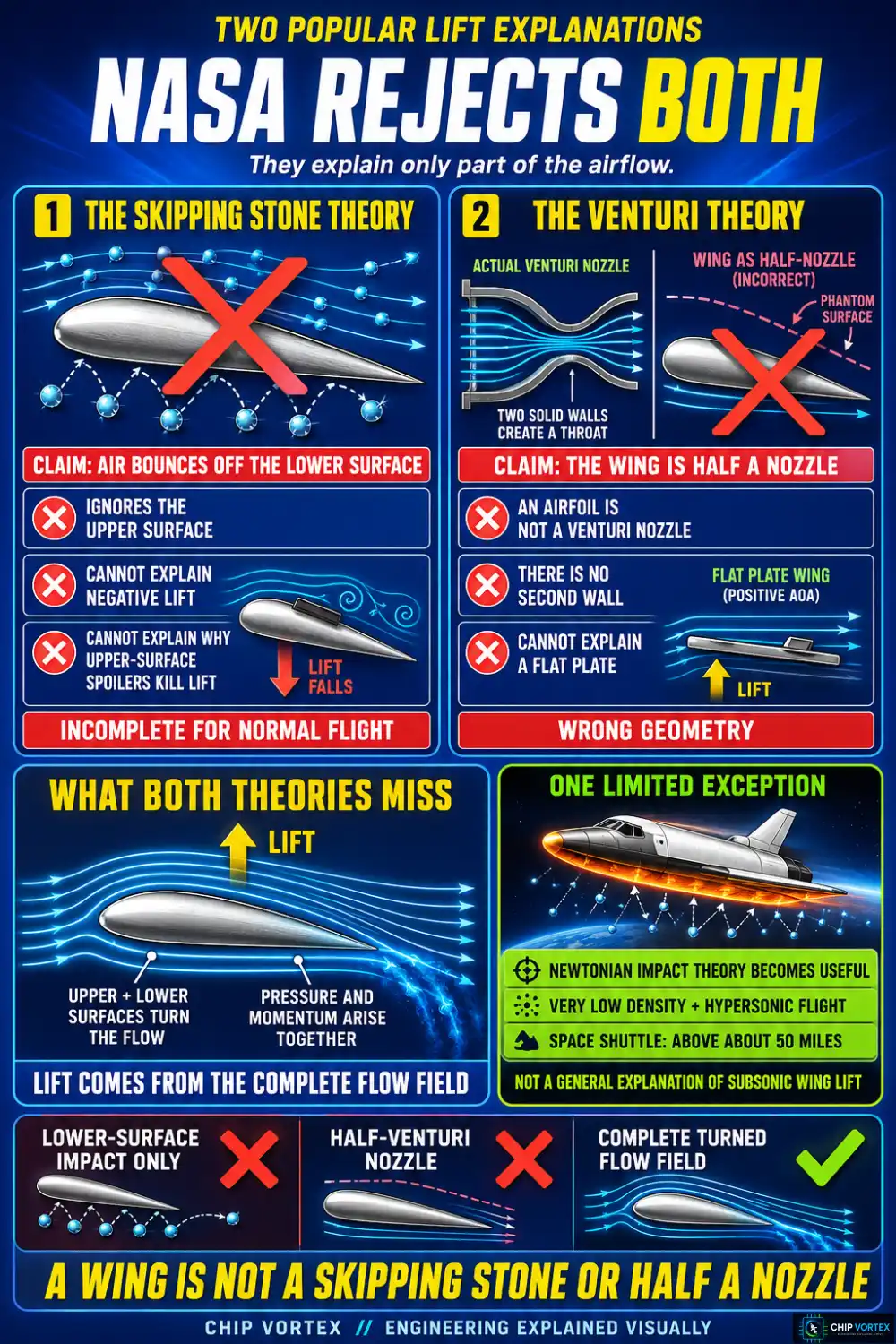
The “skipping stone” theory — lift as air molecules bouncing off the underside. It considers only the lower surface, predicts nothing about negative lift at negative angles of attack, and cannot explain why spoilers on the upper surface destroy lift. NASA notes one honest exception: in hypersonic, very-low-density flight this Newtonian model does become accurate, which is why it works for the Space Shuttle above about 50 miles.
The Venturi theory — the wing as half a nozzle. NASA’s objection is elegant: “But an airfoil is not a Venturi nozzle. There is no phantom surface to produce the other half of the nozzle.” It also cannot explain a flat plate, whose leading edge constricts nothing.
Frequently Asked Questions
Is Bernoulli’s principle wrong?▾
No. Bernoulli’s equation is valid physics and NASA explicitly calls the Bernoulli step of the popular theory correct. What is wrong is the equal-transit-time assumption used to produce the velocity that goes into it.
How can a plane fly upside down?▾
By flying at a positive angle of attack large enough to overcome the inverted camber. Angle of attack, not wing shape, is doing the work.
At what speed does a wing stall?▾
Wrong question. A wing stalls at a critical angle of attack — the FAA gives 16 to 20 degrees depending on design — and it can reach that angle at any airspeed, attitude or power setting.
Related reading: the inertial navigation system that tracks the aircraft’s motion, and the aircraft autopilot system that manages it.