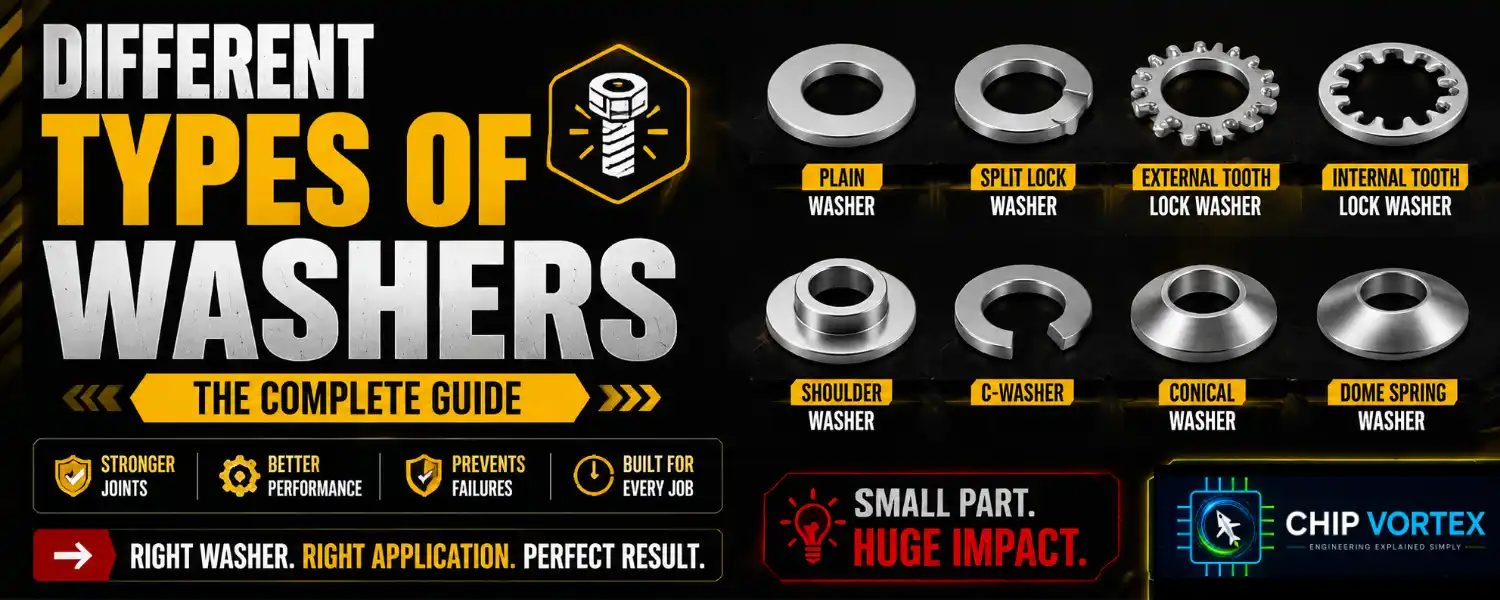
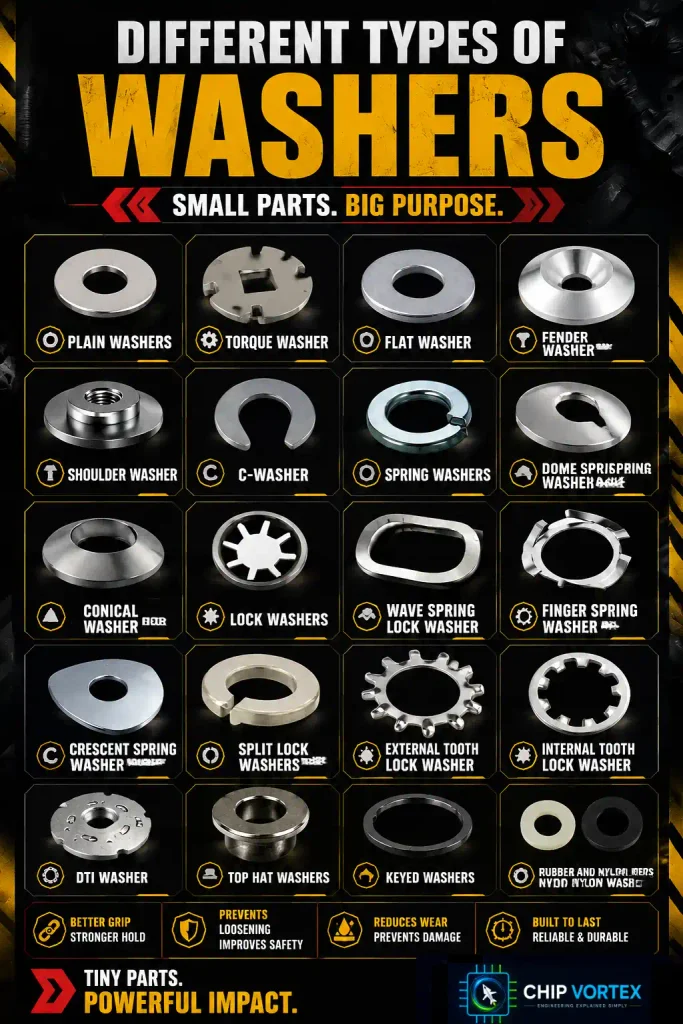
A washer looks like a small, forgettable disc of metal — but the wrong one can mean a loose bolt, a failed joint, or worse. Washers exist in dozens of shapes because every joint has a different job: some need to spread load, some need to lock a nut in place, some need to protect a soft surface, and some need to indicate exact torque tension. This guide breaks down the 20 most common washer types, what each one actually does, and where you’ll see them used in real assemblies — from everyday hardware to aircraft structures.
Why Washers Matter More Than You Think
A washer’s job goes far beyond “filling the gap” under a bolt head. The right washer:
- Gives better grip and a stronger, more even hold
- Prevents loosening from vibration, improving overall safety
- Reduces wear and protects the surface underneath the fastener
- Makes the whole joint more reliable and durable over time
Pick the wrong washer, and you lose one or more of these benefits — even if the bolt and nut are perfectly correct for the job.
Standard Washers: Load Distribution
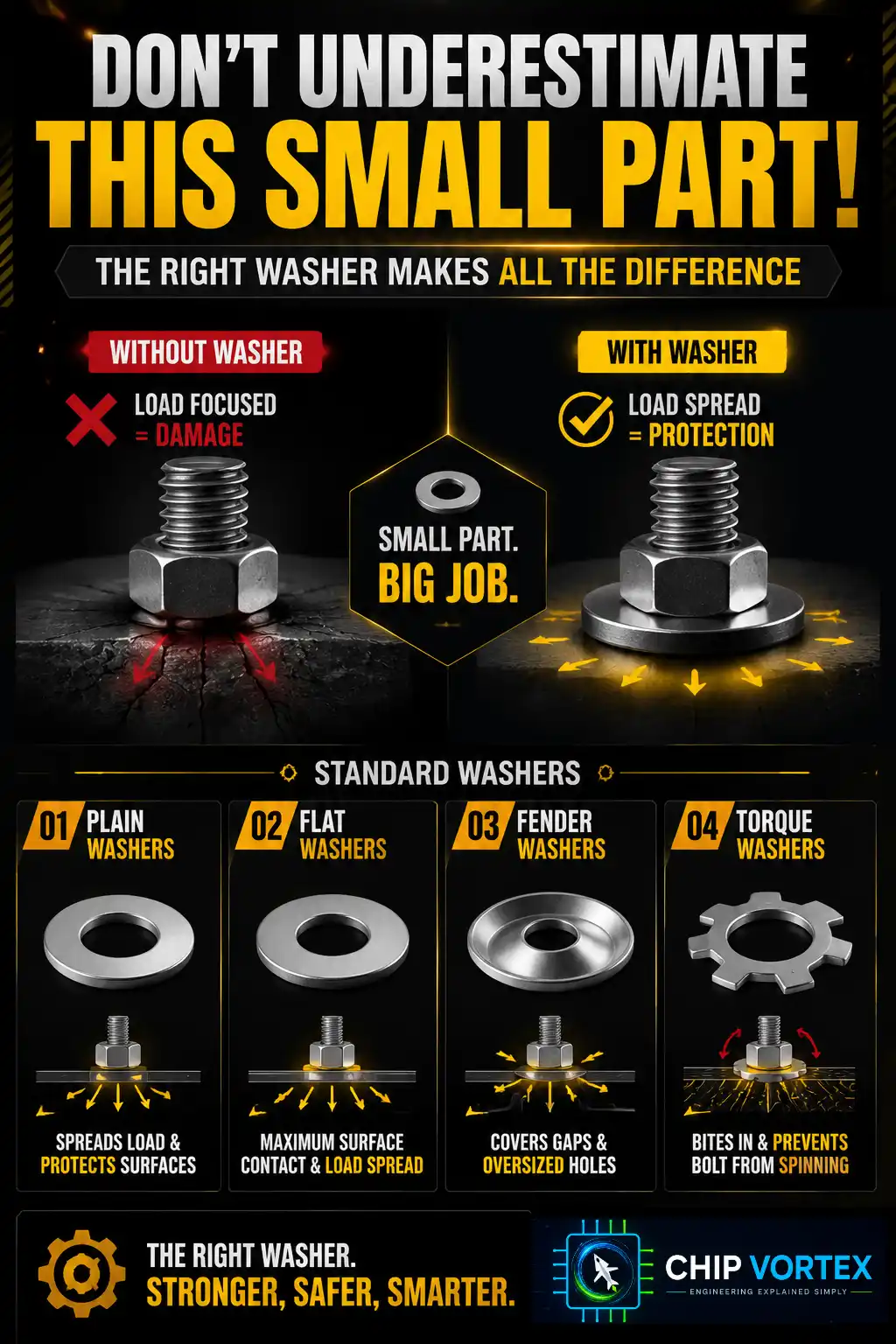
These are the baseline washers most people picture first. Their main role is spreading the clamping load of a bolt or screw over a wider surface so it doesn’t dig into or crack the material underneath — the washer is only half the story, though; pair it with the right nut and the joint holds far better than either part on its own.
Plain Washers
The simplest and most common type — a flat metal ring with a smooth surface. Used under a bolt head or nut to spread load evenly and prevent surface damage.
Flat Washers
Very similar to plain washers but typically wider and thinner. They’re the go-to choice when you need maximum surface contact and load spread, especially on softer materials like wood or plastic.
Fender Washers
Recognizable by their large outer diameter relative to a small inner hole. Fender washers are built to cover big gaps or oversized holes, and are common in automotive bodywork and sheet metal applications.
Torque Washers
A square or shaped washer designed to bite into surrounding material and stop a bolt from spinning while it’s tightened — useful when there’s no way to hold the fastener from the other side.
Lock Washers: Preventing Loosening
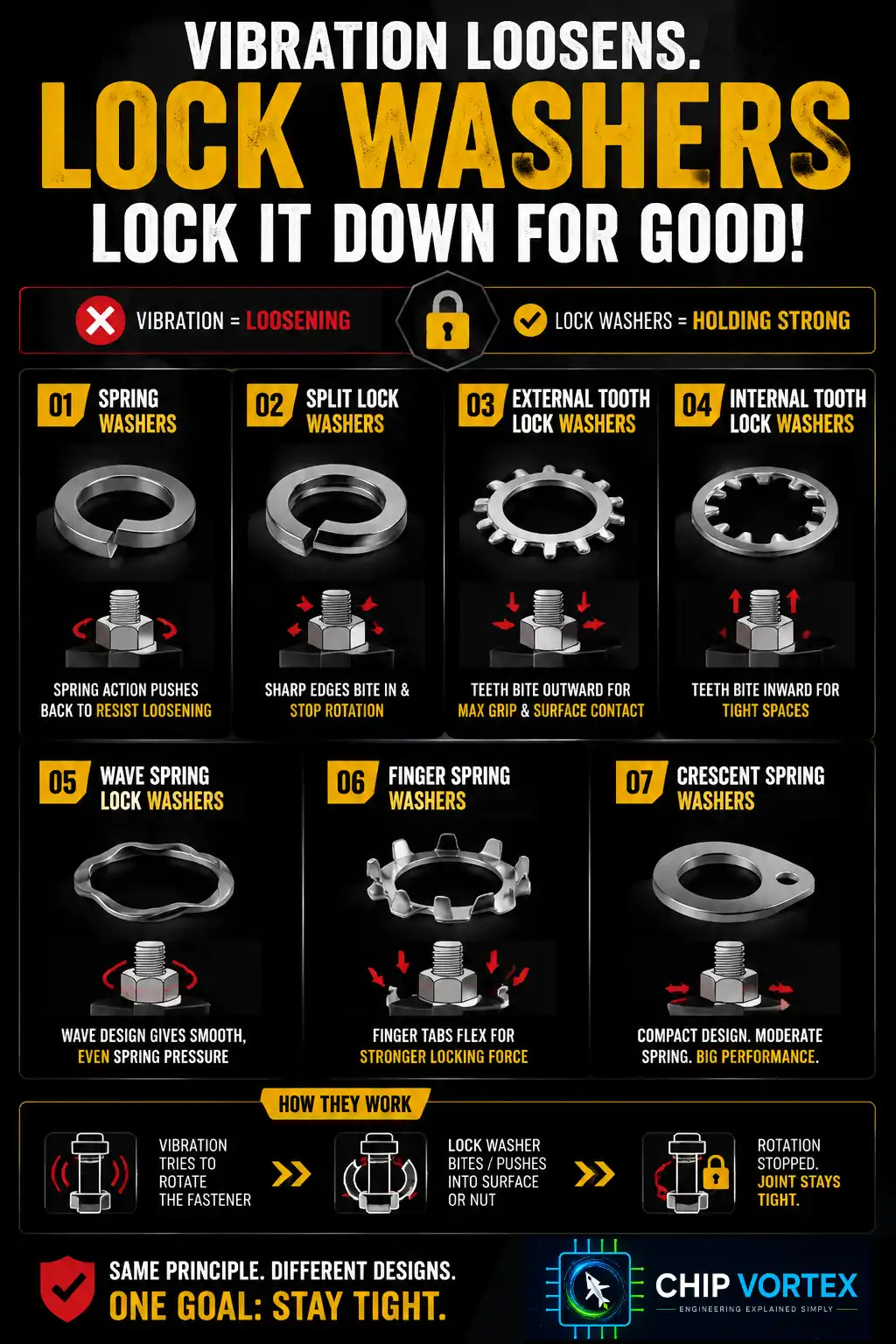
Vibration is one of the biggest causes of fastener failure. Lock washers use spring tension or teeth to bite into the surfaces and resist rotation, keeping the joint tight over time — they work on the same anti-loosening principle as retaining rings, just applied to a threaded joint instead of a shaft or bore.
Spring Washers
A single split ring with a curved profile. As the fastener is tightened, the washer flattens and stores spring tension, which pushes back against the nut to resist loosening.
Split Lock Washers
A heavier-duty spring washer with sharp, angled ends. The split edges dig slightly into both the bolt head and the mating surface, adding extra resistance to rotation.
External Tooth Lock Washers
Teeth point outward around the rim, biting into the surface beneath the bolt head. Ideal when you need maximum surface contact and a wide bearing area.
Internal Tooth Lock Washers
The reverse design — teeth point inward toward the bolt shaft. These work well in tighter spaces where there isn’t much surface area to grip.
Wave Spring Lock Washers
Shaped in a gentle wave pattern rather than teeth or a split ring. They provide light, even spring pressure and are often used where a smoother clamping force is needed.
Finger Spring Washers
Have multiple raised “fingers” around the circumference that flex under load, offering a stronger and more distributed locking force than a basic spring washer.
Crescent Spring Washers
A curved, crescent-shaped washer that offers moderate spring tension in a compact footprint — useful where a full circular lock washer won’t fit.
Specialty and Application-Specific Washers
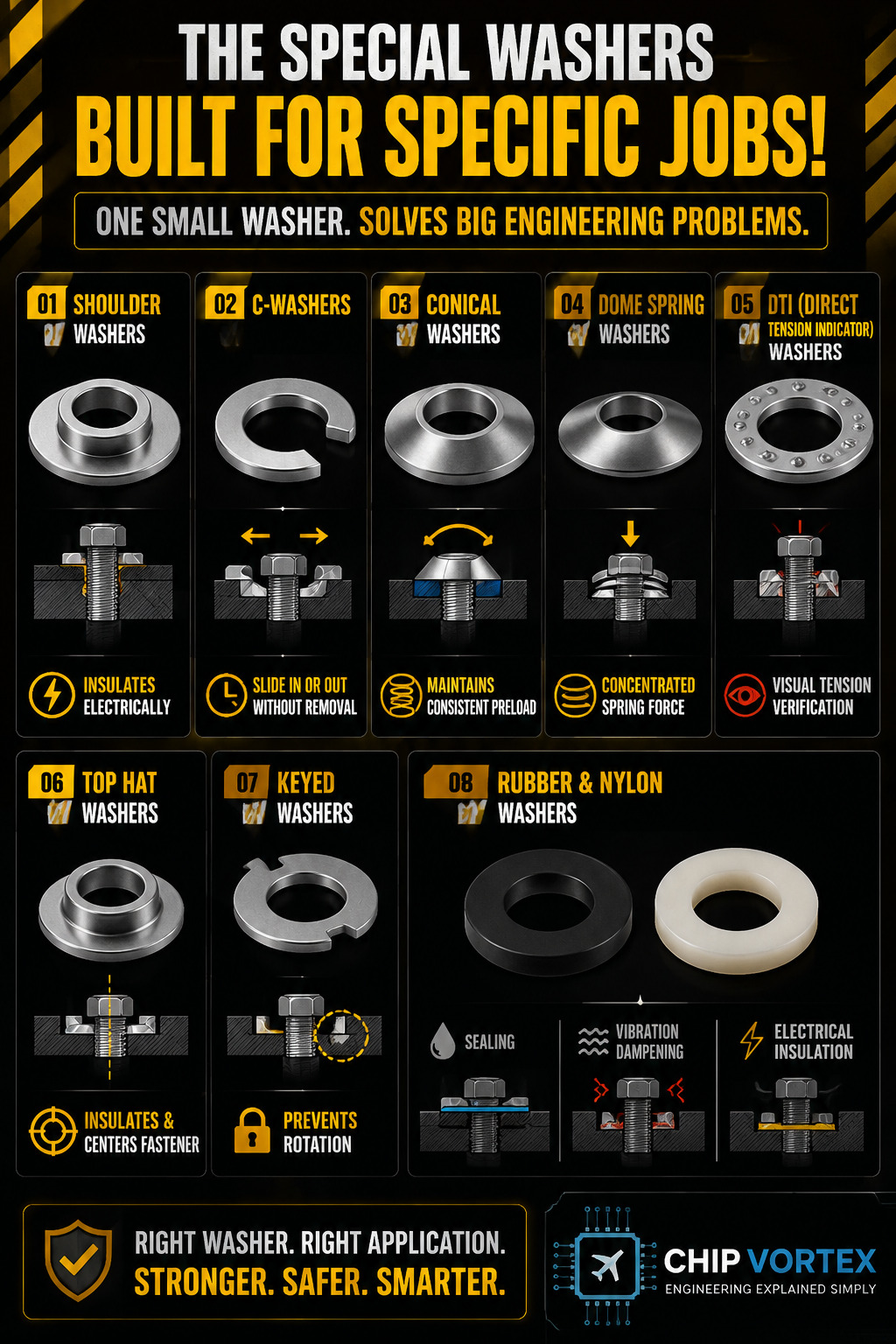
Beyond load-spreading and locking, some washers solve very specific engineering problems — insulation, precise fit, torque verification, or protecting delicate materials.
Shoulder Washers
Feature a raised collar (shoulder) that lines the inside of a bolt hole, electrically insulating the fastener from the surrounding material — common in electronics and instrument panels.
C-Washers
Open on one side like the letter C, allowing them to be slid in or out sideways without removing the fastener completely — a time-saver during maintenance and adjustments.
Conical Washers
Cone-shaped washers that create a controlled spring effect similar to a Belleville washer, often used to maintain consistent preload in bolted joints subject to thermal expansion.
Dome Spring Washers
Dome-shaped for concentrated spring force in a very small space. They’re commonly stacked to fine-tune the exact preload needed in precision assemblies.
DTI (Direct Tension Indicator) Washers
Purpose-built for structural bolting. DTI washers have small raised bumps that flatten as the bolt is tightened, giving a visual, measurable indication that the correct tension has been reached — critical in structural and aviation-grade joints.
Top Hat Washers
Shaped like a small hat with a raised collar, used to both insulate and center a fastener within a larger hole, similar in purpose to shoulder washers but with a different profile.
Keyed Washers
Include a tab or notch that fits into a matching slot, preventing the washer (and the fastener) from rotating at all — used where even slight movement isn’t acceptable.
Rubber and Nylon Washers
Non-metallic washers used for sealing, vibration dampening, and electrical insulation. Rubber washers help create a watertight seal, while nylon washers are prized for being lightweight, non-conductive, and corrosion-resistant.
How to Choose the Right Washer for the Job
Before picking a washer, ask these three questions:
- Is the joint exposed to vibration? → Choose a lock washer (spring, tooth, or wave type)
- Is the surface soft, oversized, or easily damaged? → Choose a flat or fender washer
- Does the joint need insulation, sealing, or precise tension control? → Choose a specialty washer (shoulder, DTI, rubber/nylon, or conical)
Matching the washer to the actual failure risk — not just the bolt size — is what separates a joint that holds for years from one that works loose in months.